Project your savings with a lump sum, monthly deposits and compounding.
Interest is assumed to stay in the account and the rate stays the same for the whole period. Results are before any tax on interest.
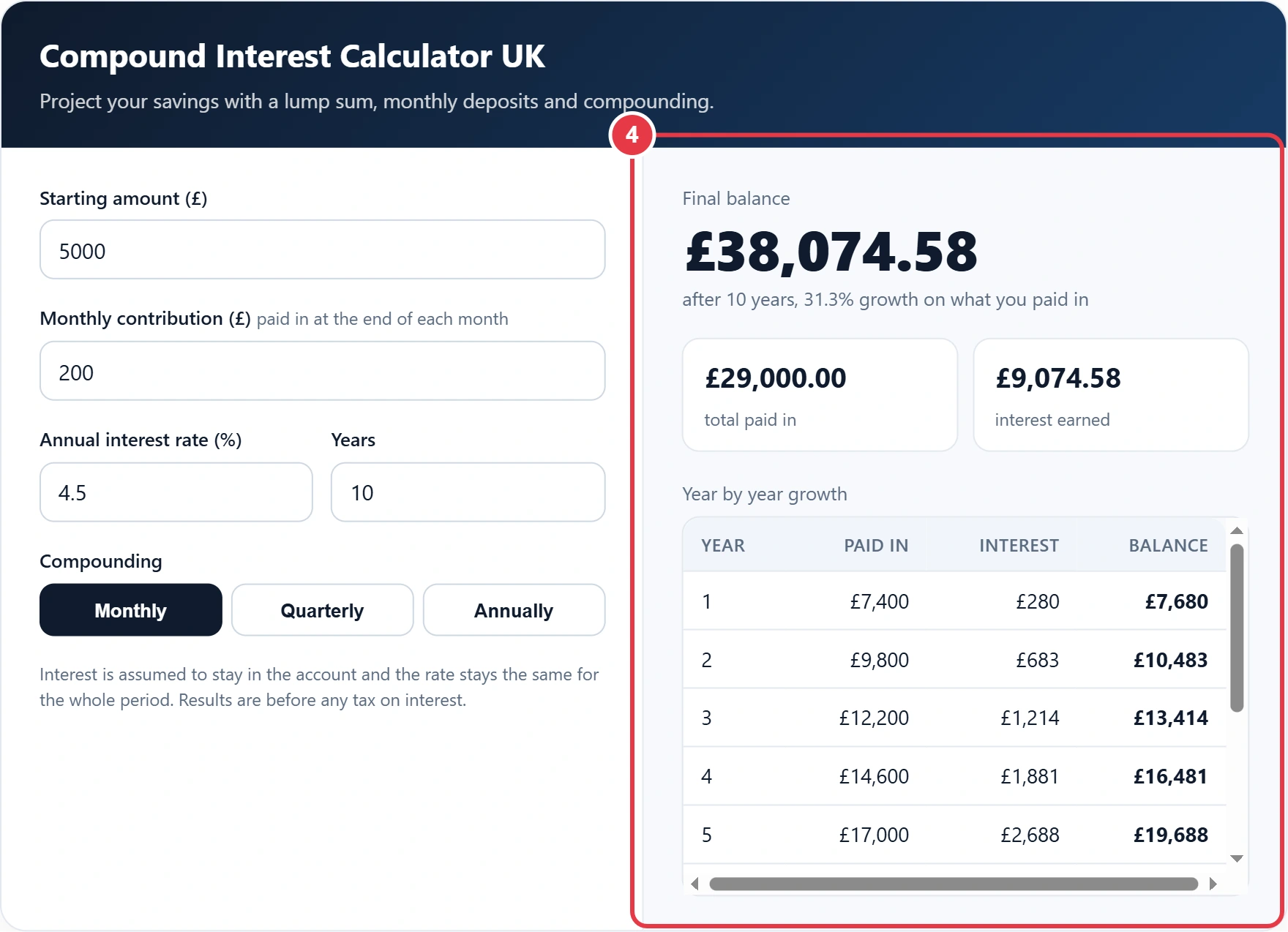
| Year | Paid in | Interest | Balance |
|---|
Want to know what your savings could be worth in five, ten or twenty years? This compound interest calculator UK savers can use takes a starting sum, a regular monthly deposit and an interest rate, then shows your final balance, the interest you earn and how the pot grows each year. Read it alongside the free savings guidance from MoneyHelper to understand the main account types, then compare offers before you open one.
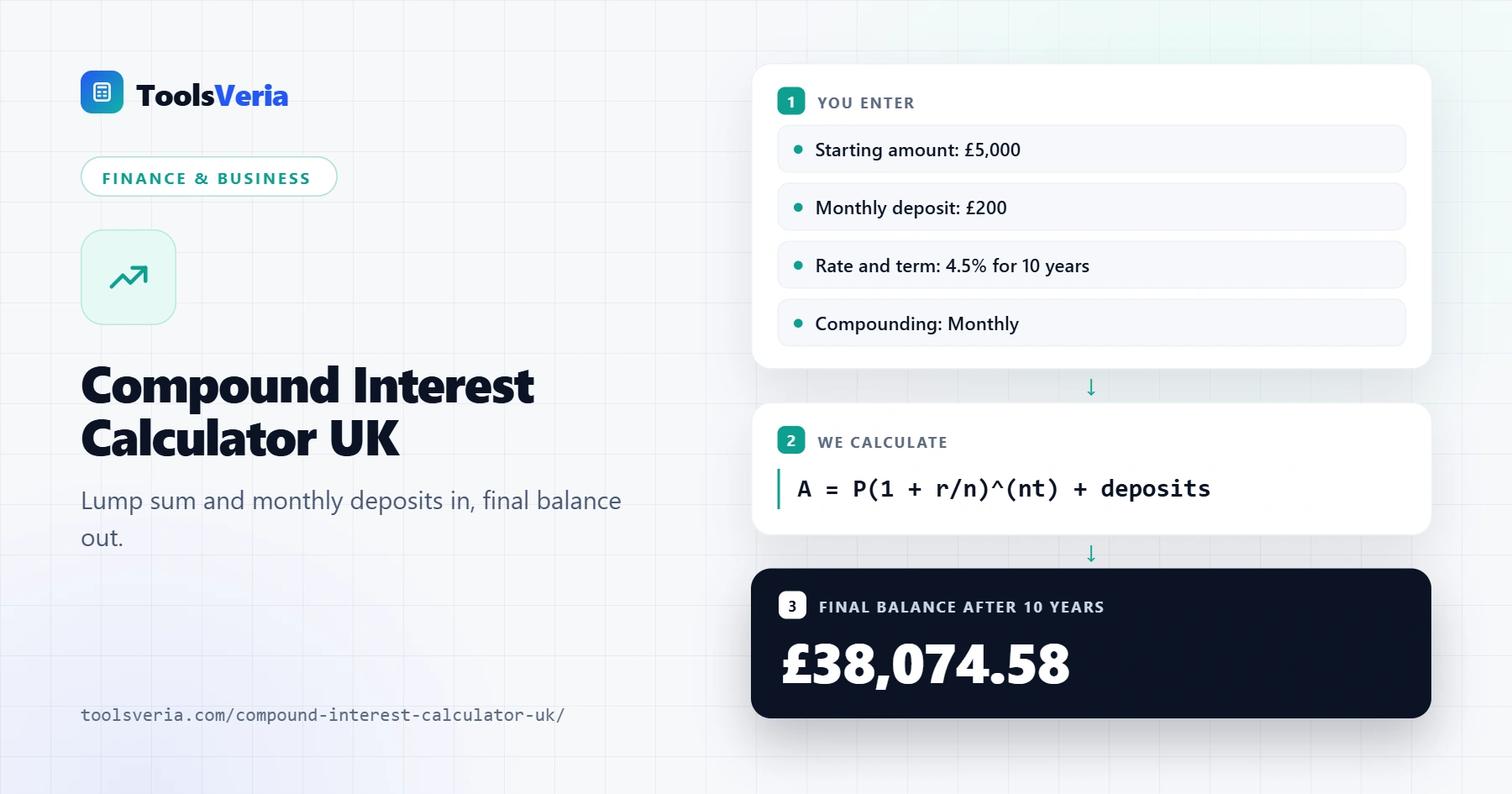
What Is Compound Interest?
Compound interest is interest paid on your interest. Each time interest is added to your account, the next payment is worked out on the bigger balance, so growth speeds up over time. The longer you leave the money alone, the stronger the effect.
For a lump sum the formula is A = P × (1 + r/n)^(n × t), where P is the starting amount, r the annual rate, n the number of times interest is added each year and t the number of years. With monthly contributions the calculator also adds each deposit at the end of the month, using PMT × ((1 + i)^m − 1) ÷ i, where i is the monthly rate and m the number of months. For example, £5,000 plus £200 a month at 4.5% compounded monthly grows to about £38,000 after 10 years.
How to Use the Compound Interest Calculator UK
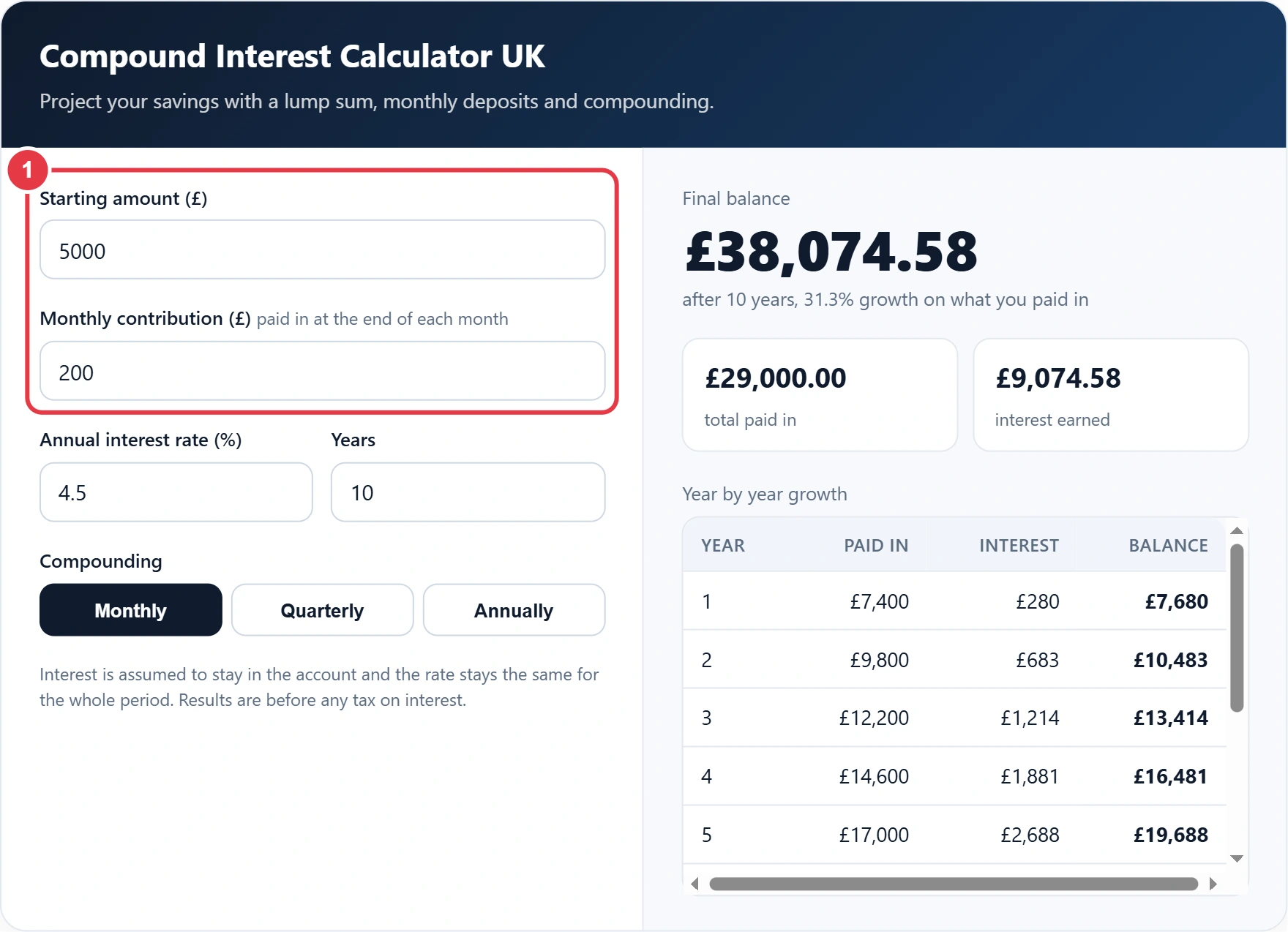
Step 1: Enter Your Starting Amount and Monthly Contribution
Type the sum you already have saved, then the amount you plan to pay in each month. Set the monthly figure to zero if you only want to grow a lump sum.
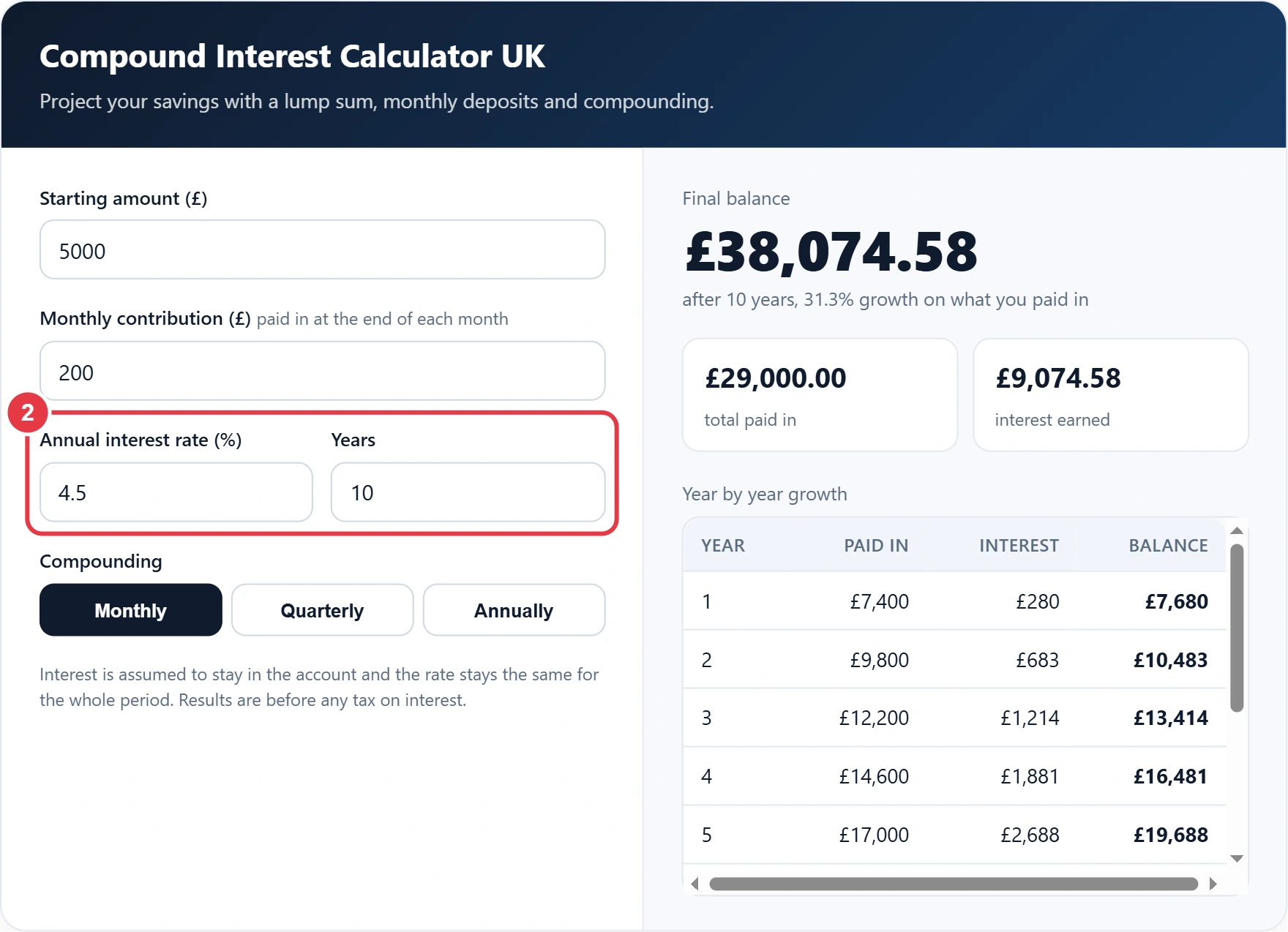
Step 2: Add the Interest Rate and Years
Enter the annual rate your account pays and how long you plan to save. Easy access accounts usually pay less than fixed rate bonds, so use the rate from the account you are actually comparing. If you want the figure after tax, the savings interest calculator applies your personal savings allowance and shows what you keep.
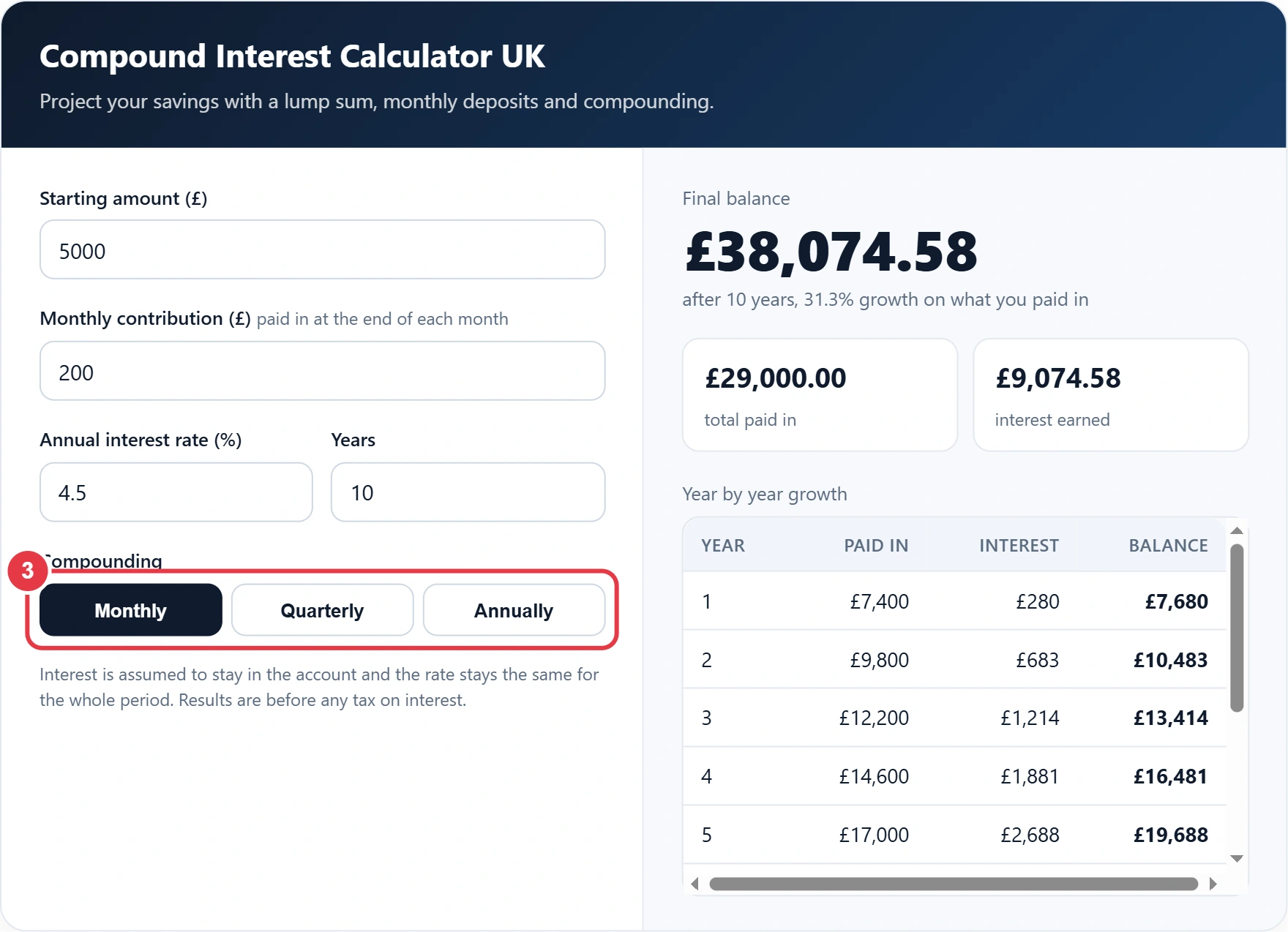
Step 3: Choose How Often Interest Compounds
Pick monthly, quarterly or annual compounding. Your bank's summary box tells you how often interest is paid. More frequent compounding gives a slightly higher return at the same headline rate.
Step 4: Read Your Results
You will see your final balance, the total you paid in and the interest earned. If you are weighing up saving against paying down your home loan, the mortgage overpayment calculator shows the interest an extra monthly payment would save. The year by year table shows how the interest share grows over time, which is the clearest picture of compounding at work.
Compound Interest Examples
| Starting amount | Monthly deposit | Rate and term | Final balance |
|---|---|---|---|
| £10,000 | £0 | 4% for 10 years | £14,908 |
| £5,000 | £200 | 4.5% for 10 years | £38,075 |
| £0 | £300 | 5% for 20 years | £123,310 |
| £1,000 | £100 | 3% for 5 years | £7,626 |
All examples use monthly compounding. Interest on ordinary savings can be taxable once it goes over your personal savings allowance, while money held in a cash ISA grows tax free. You can pay up to £20,000 a year into ISAs in total, as explained in the official ISA guidance on GOV.UK. Rates change over time, so treat the results as an estimate rather than a promise.
Frequently Asked Questions
How is compound interest calculated in the UK?
Interest is added to your balance at set intervals, usually monthly or annually, and the next payment is worked out on the new total. The formula is A = P × (1 + r/n)^(n × t) for a lump sum.
What is the difference between AER and the interest rate?
AER (annual equivalent rate) shows what you would earn in a year once compounding is included. It lets you compare accounts that pay interest at different intervals.
Does monthly compounding make much difference?
A little. At 4.5% a year, monthly compounding gives an effective rate of about 4.59%, so the gain over annual compounding is small but grows over long periods.
Is compound interest on savings taxed?
It can be. Interest above your personal savings allowance is taxed at your income tax rate, but interest earned inside a cash ISA is tax free.
How much will £200 a month grow to in 10 years?
At 4.5% compounded monthly, £200 a month grows to about £30,200, of which £24,000 is your own money and roughly £6,200 is interest.
What is the rule of 72?
Divide 72 by the annual interest rate to estimate how many years it takes to double your money. At 4% that is around 18 years.