Estimate your yearly and monthly gas and electricity bill from your usage, unit rates and standing charges.
Default rates are the Ofgem price cap for 1 October to 31 December 2026 paying by direct debit. Rates vary by region and payment method, so use the figures on your own bill for the most accurate result.
| Cost | Electricity | Gas |
|---|
Standing charges are based on 365 days. Monthly figure is the yearly total divided by 12. Your actual bill depends on when you use energy, as winter months cost more.
Want to know what your gas and electricity should cost over a year? This energy bill calculator estimates your annual and monthly bill from your usage, unit rates and daily standing charges, with a clear breakdown for each fuel. It is preloaded with the current Ofgem energy price cap rates, so you get a realistic result straight away.
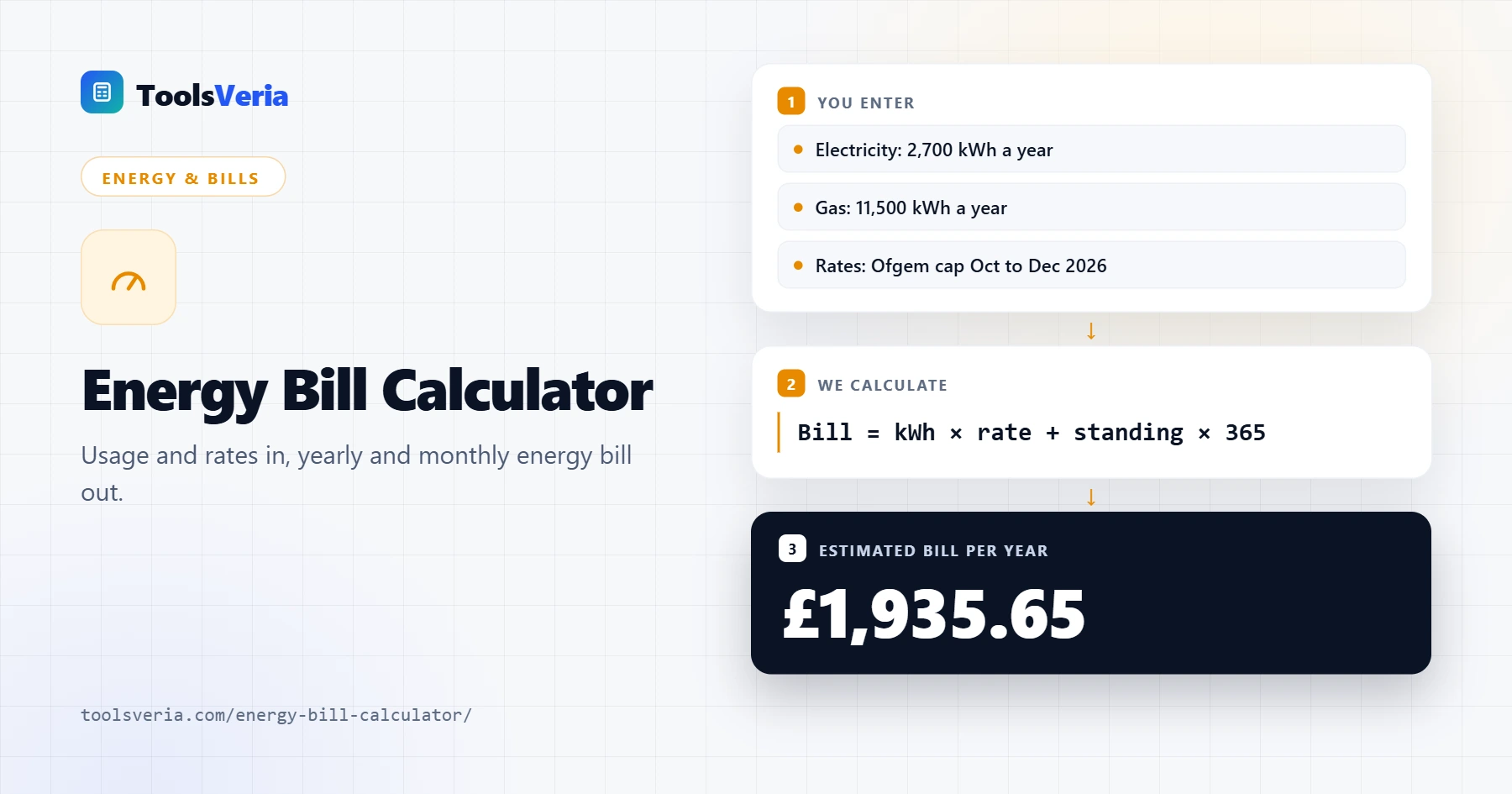
Quick answer: An energy bill calculator works out each fuel as (kWh used × unit rate) + (standing charge × 365), then adds gas and electricity together and divides by 12 for a monthly average. A typical medium UK home uses about 2,700 kWh of electricity and 11,500 kWh of gas a year, priced at Ofgem price cap rates.
In This Guide
What Is an Energy Bill Made Of?
A UK energy bill has two parts for each fuel. The unit rate is what you pay for every kilowatt hour (kWh) you use. The standing charge is a fixed daily amount that covers the cost of keeping your home connected to the network, and you pay it whether you use any energy or not.
The formula for each fuel is: (kWh used × unit rate) + (standing charge × 365). Add electricity and gas together for your yearly total, then divide by 12 for a monthly average. A typical medium home uses about 2,700 kWh of electricity and 11,500 kWh of gas a year.
How Do You Use the Energy Bill Calculator?
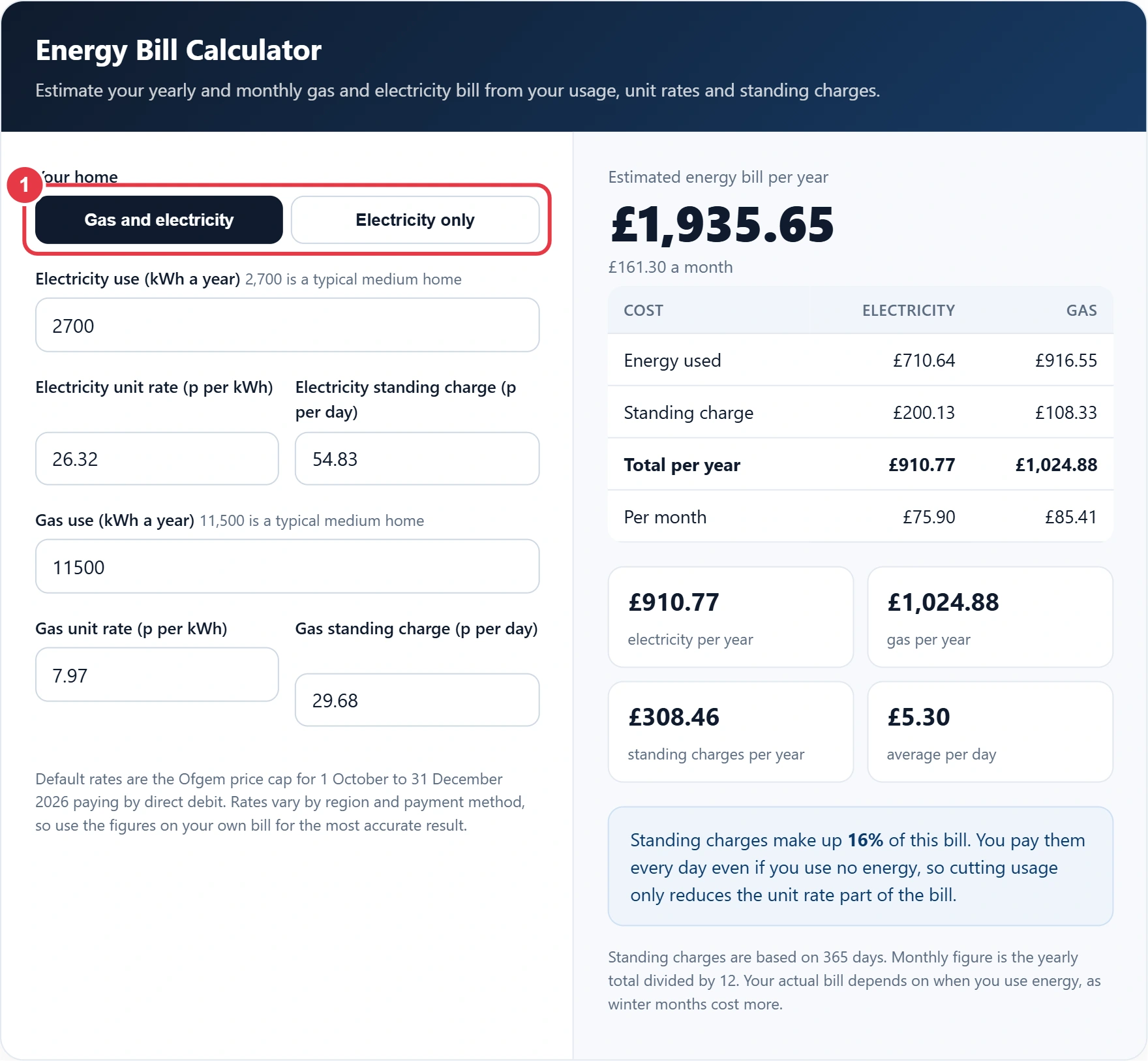
Step 1: Choose Your Fuel Type
Pick Gas and electricity for a dual fuel home or Electricity only if you have no gas supply, which hides the gas fields and removes the gas standing charge. Pick Gas and electricity for a dual fuel home, or Electricity only if you have no gas supply. Choosing electricity only hides the gas fields and removes the gas standing charge.
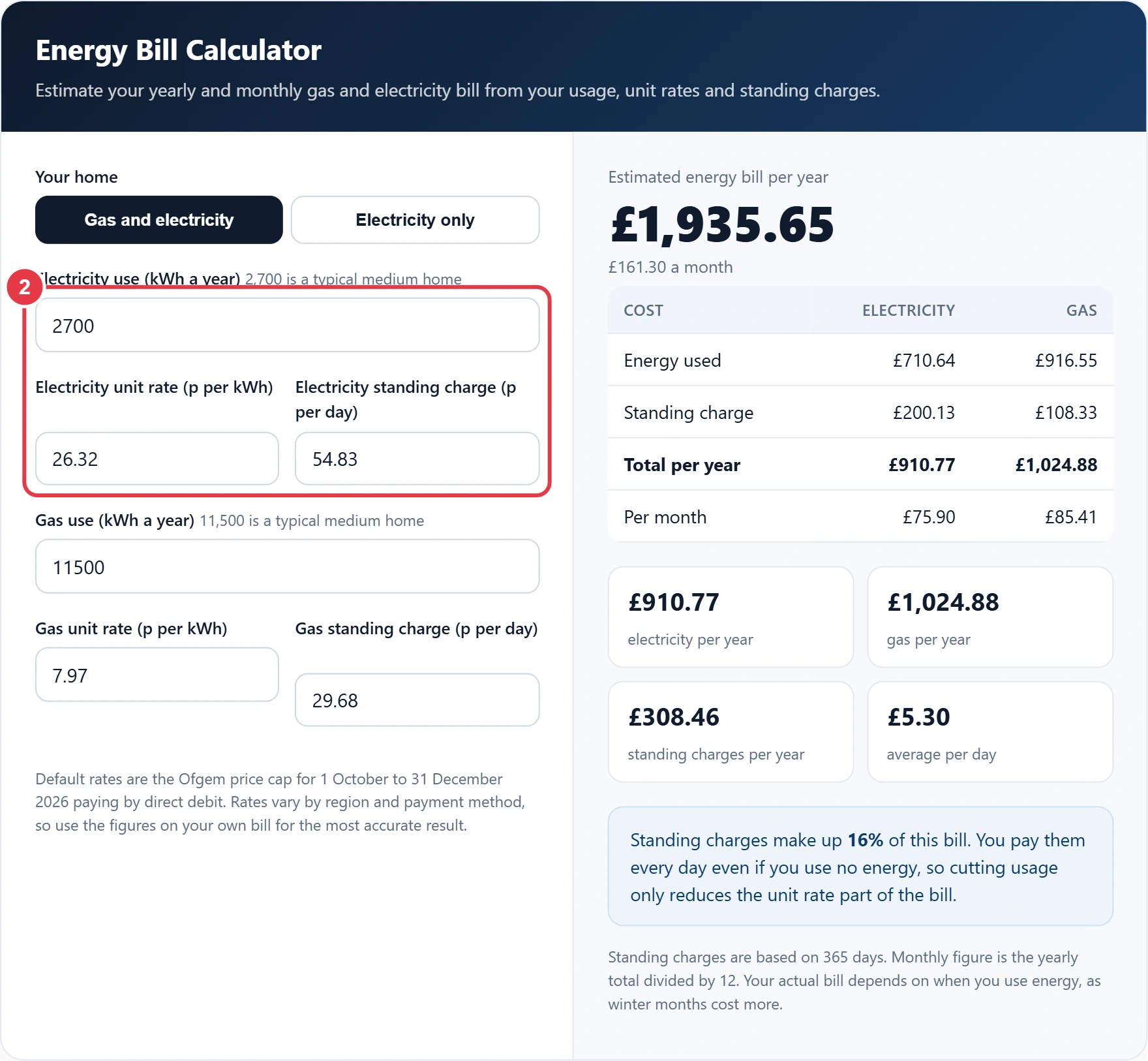
Step 2: Enter Your Electricity Details
Enter your yearly electricity use in kWh, plus your unit rate and standing charge. To see what a single appliance adds, the electricity cost calculator works out its running cost in pounds. Your annual statement or supplier app shows your usage over the last 12 months.
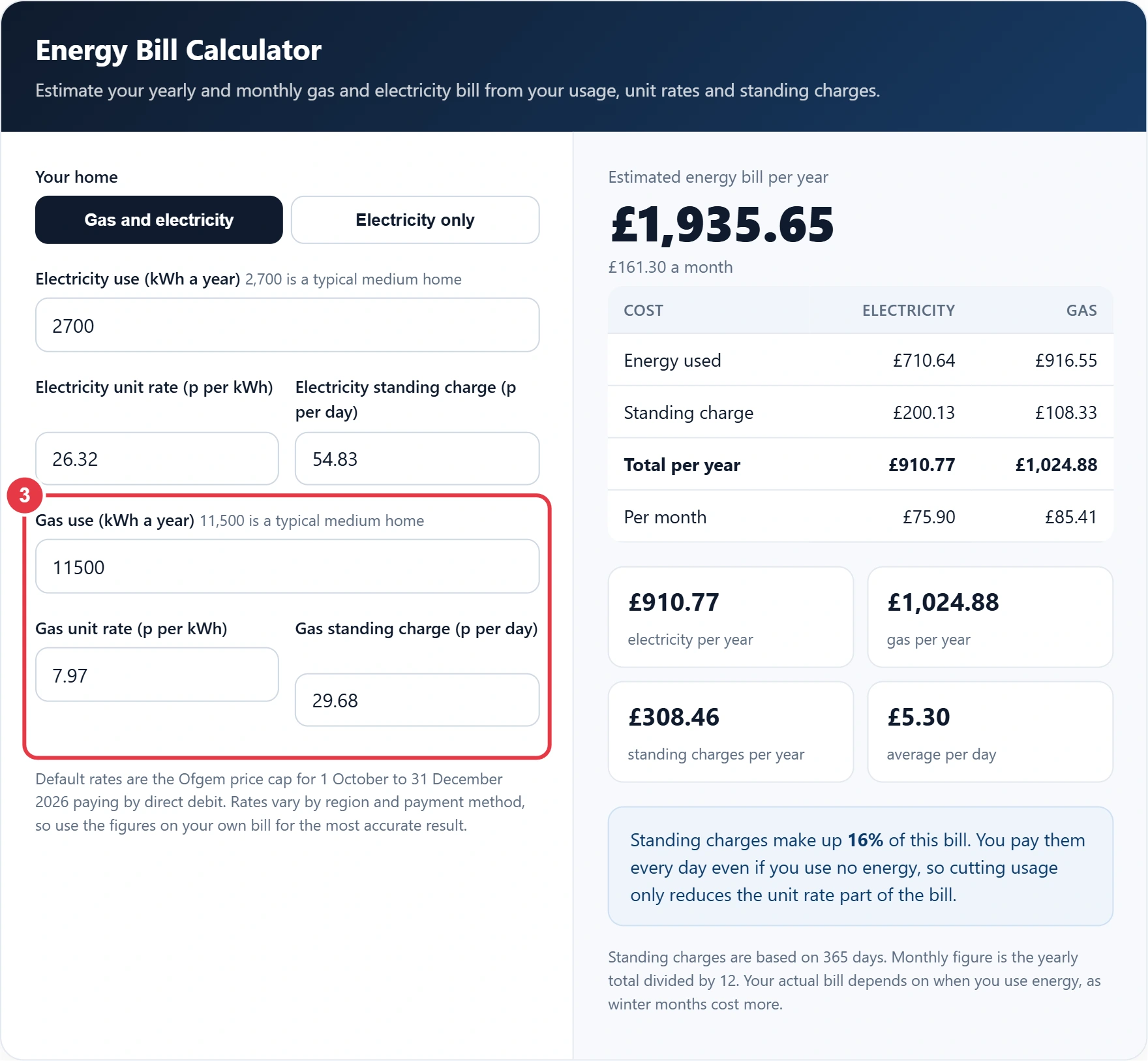
Step 3: Enter Your Gas Details
Do the same for gas. If your bill shows gas in cubic metres, use the kWh figure your supplier has already converted, which is usually printed next to it.
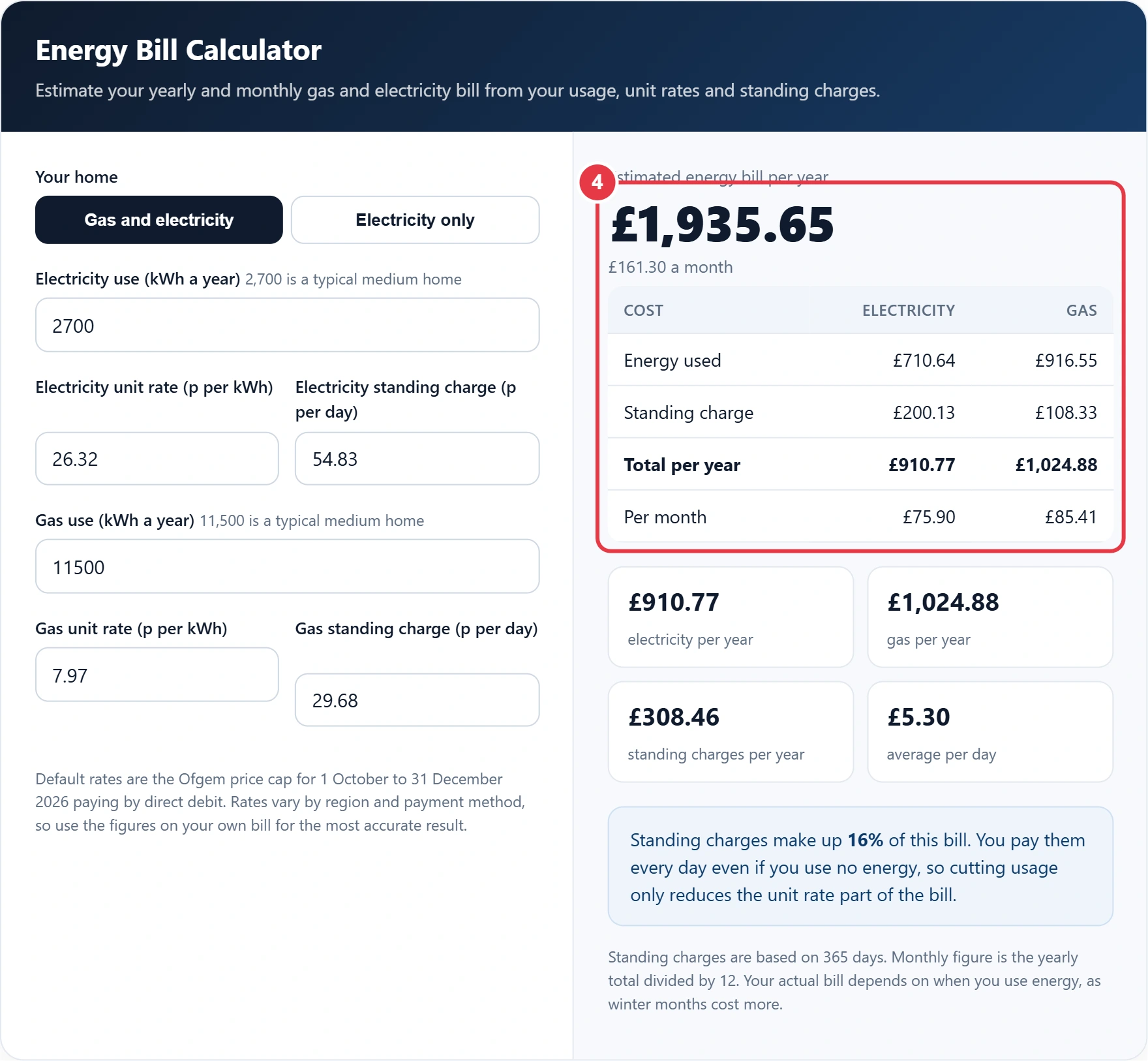
Step 4: Read Your Results
The calculator shows your total yearly bill, a monthly average, and a table splitting energy costs from standing charges for each fuel, plus how much of the bill is fixed. Thinking of replacing a gas boiler? The heat pump running cost calculator compares the two heating options, so you can see how your gas line might change.
What Are the Energy Price Cap Rates From October 2026?
| Fuel | Unit rate | Standing charge | Typical use | Yearly cost |
|---|---|---|---|---|
| Electricity | 26.32p per kWh | 54.83p per day | 2,700 kWh | £910.77 |
| Gas | 7.97p per kWh | 29.68p per day | 11,500 kWh | £1,024.88 |
| Total | £1,935.65 |
From 1 October to 31 December 2026, average direct debit rates are 26.32p per kWh for electricity and 7.97p per kWh for gas, with standing charges of 54.83p and 29.68p a day. These are average direct debit rates for 1 October to 31 December 2026. Your own rates depend on your region, meter type and how you pay, and you can check them in the Ofgem regional rates table. If you are on a fixed tariff, use the rates on your latest bill instead.
Key Energy Bill Calculator Terms Explained
These terms describe each figure the energy bill calculator uses, so you can match it to your own bill and see where your yearly cost comes from.
- Kilowatt hour (kWh)
- The unit of energy suppliers bill by, equal to one kilowatt of power drawn continuously for one hour. Annual gas and electricity use is quoted in kWh, and multiplying it by the unit rate gives the consumption part of a bill.
- Unit rate
- The price charged for each kilowatt hour of gas or electricity consumed, normally shown in pence. It scales with use, so halving consumption halves this part of the bill while leaving the fixed daily element untouched.
- Standing charge
- A fixed amount billed for every day a property is connected to the gas or electricity network, regardless of consumption. Over a year it is the daily rate multiplied by 365, and it applies separately to each fuel supplied.
- Energy price cap
- A limit set by Ofgem on the unit rates and standing charges suppliers may charge households on standard variable tariffs. It caps prices rather than total spending, so a home using more energy still pays more.
- Typical domestic consumption values
- Benchmark annual usage figures Ofgem publishes for low, medium and high users. The calculator preloads the medium values of 2,700 kWh of electricity and 11,500 kWh of gas as a starting point for households without their own readings.
- Dual fuel
- An arrangement where one home is supplied with both gas and electricity, often by the same supplier. The bill then carries two unit rates and two standing charges, while an electricity only home pays a single standing charge.
</>Embed this calculator on your website
Add the free Energy Bill Calculator to your own site or blog. Copy the code below and paste it into an HTML block. It resizes itself and works on phones.
How we checked this tool: the Tools Veria Editorial Team built this tool by hand, checked it against the official rules or published standards where they apply, and tested it against worked examples. Results are estimates for planning, not personal financial or tax advice. Read our editorial policy and disclaimer, or report an error.
Frequently Asked Questions
How much is the average UK energy bill?
At the price cap from 1 October to 31 December 2026, a typical dual fuel home using 2,700 kWh of electricity and 11,500 kWh of gas pays about £1,936 a year by direct debit.
What is a standing charge?
It is a fixed daily fee for being connected to the gas or electricity network. You pay it every day, even if you use no energy.
How do I find my energy usage in kWh?
Check your annual statement, your latest bill or your supplier's app. Most show your usage over the past 12 months in kWh.
Is the price cap a limit on my total bill?
No. The cap limits the unit rates and standing charges suppliers can charge on standard variable tariffs, so you still pay more if you use more.
How much is an electricity only bill?
Using 2,700 kWh a year at the October to December 2026 cap rates costs about £911 a year. All electric homes heating with electricity will use far more.
Why is my monthly direct debit higher in summer?
Suppliers spread your yearly cost evenly, so you build up credit in summer to cover higher winter use.