Compare Economy 7 with a single rate tariff and find your break even night share.
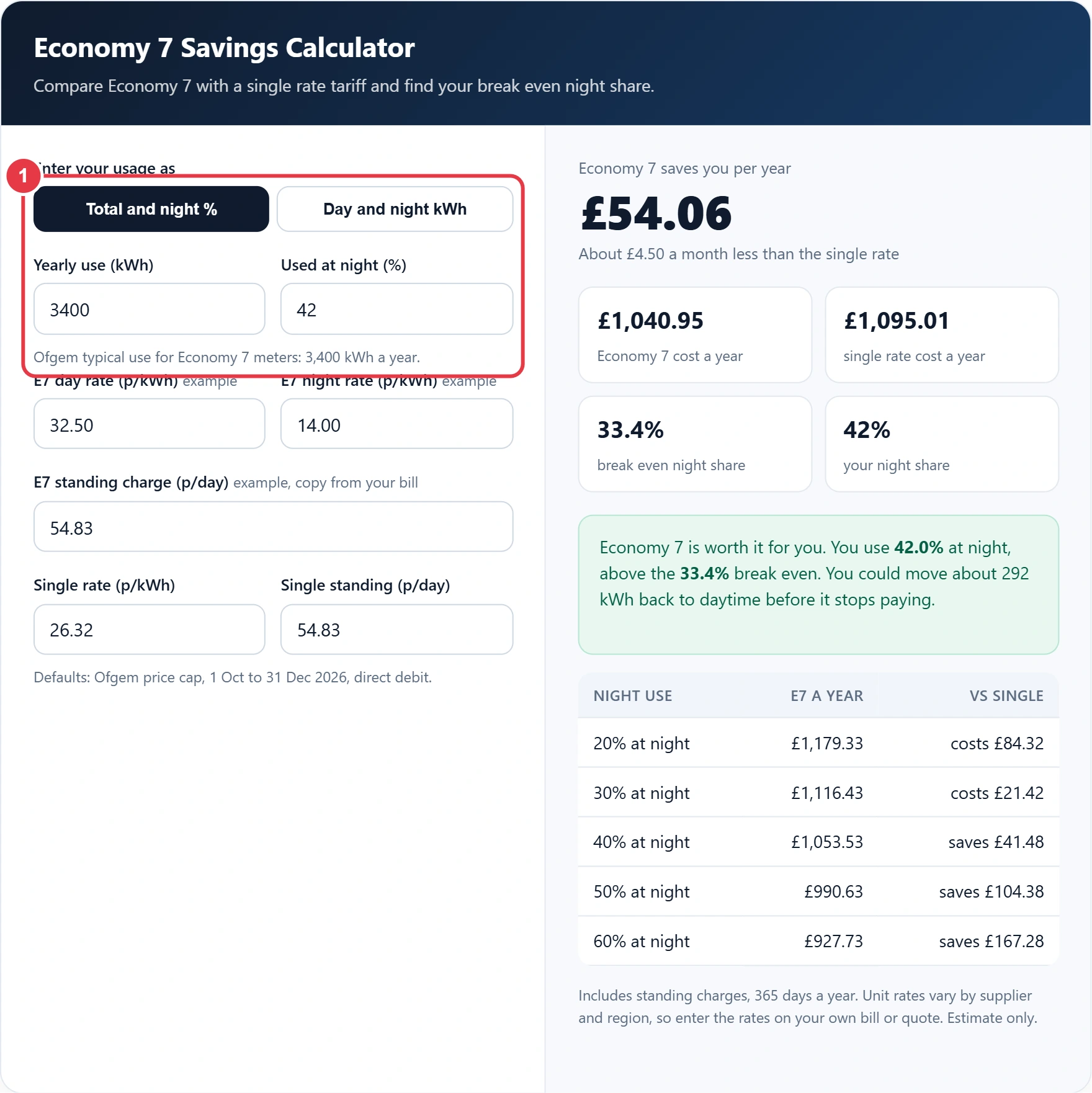
Ofgem typical use for Economy 7 meters: 3,400 kWh a year.
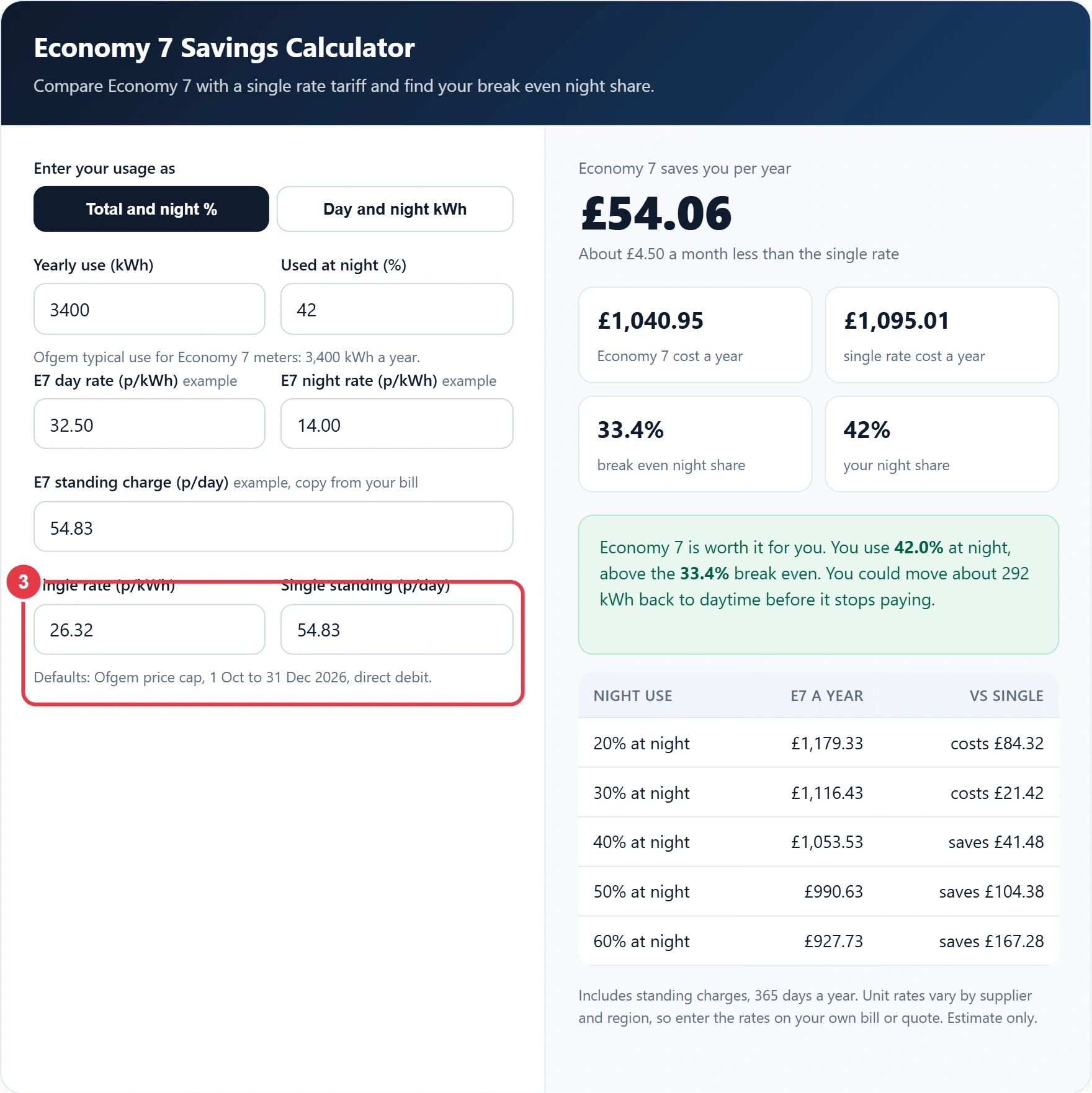
Defaults: Ofgem price cap, 1 Oct to 31 Dec 2026, direct debit.
| Night use | E7 a year | vs single |
|---|
Includes standing charges, 365 days a year. Unit rates vary by supplier and region, so enter the rates on your own bill or quote. Estimate only.
This Economy 7 savings calculator shows UK households whether an Economy 7 tariff is cheaper than a standard single rate tariff, using your own day rate, night rate, standing charges and share of night time use, with Ofgem's October to December 2026 price cap as the default comparison. It gives your yearly saving or extra cost, the exact Economy 7 break even point for your rates, and how many kWh you would need to move to the night hours to make it pay. Figures checked October 2026.
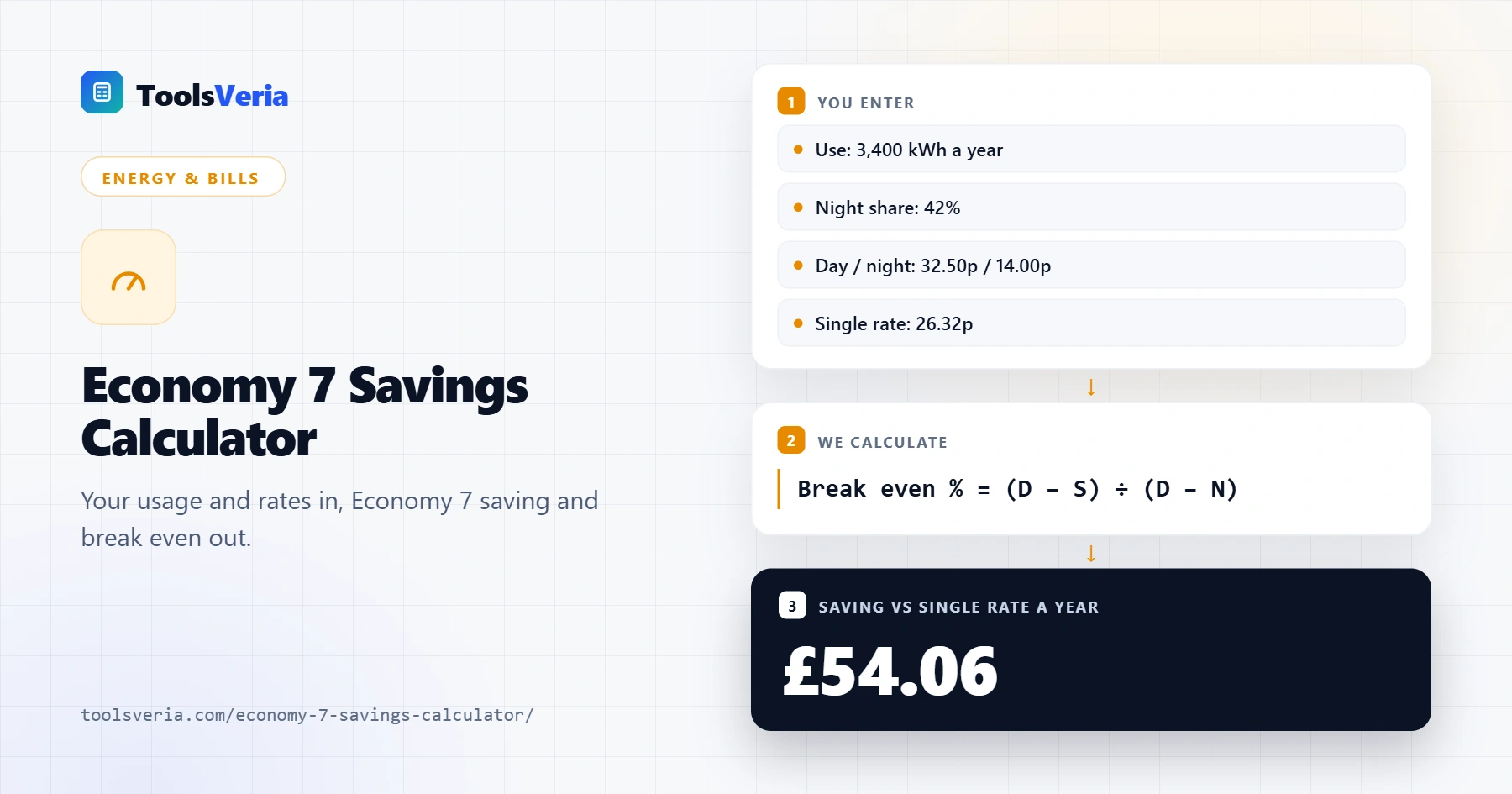
Quick answer: Economy 7 is worth it when your night share is above the break even point: (day rate minus single rate) divided by (day rate minus night rate). With a 32.50p day rate, 14.00p night rate and the 26.32p cap rate, that is 33.4%. The Economy 7 savings calculator works it out for your bill.
In This Guide
What Is an Economy 7 Savings Calculator?
An Economy 7 savings calculator is a tool that compares the yearly cost of a two rate Economy 7 electricity tariff with a single rate tariff for the same usage. Economy 7 charges a cheaper unit rate for seven off peak hours at night and a higher rate for the other seventeen hours, so it only saves money when enough of your electricity is used at night.
The formula in plain words: Economy 7 cost equals night kWh times the night rate, plus day kWh times the day rate, plus the daily standing charge times 365. The single rate cost is all kWh times the single rate, plus its standing charge times 365. The saving is the difference. The break even night share is the day rate minus the single rate, divided by the day rate minus the night rate, with any extra standing charge added to the top line as a cost per kWh.
How to Use the Economy 7 Savings Calculator
Step 1: Enter Your Usage
Choose how you know your usage. If you have an annual statement, switch to day and night kWh and type the two register totals. Otherwise enter total kWh a year and your best estimate of the share used at night. Ofgem's typical consumption figure for homes with multi register meters such as Economy 7 is 3,400 kWh a year, which is the default.
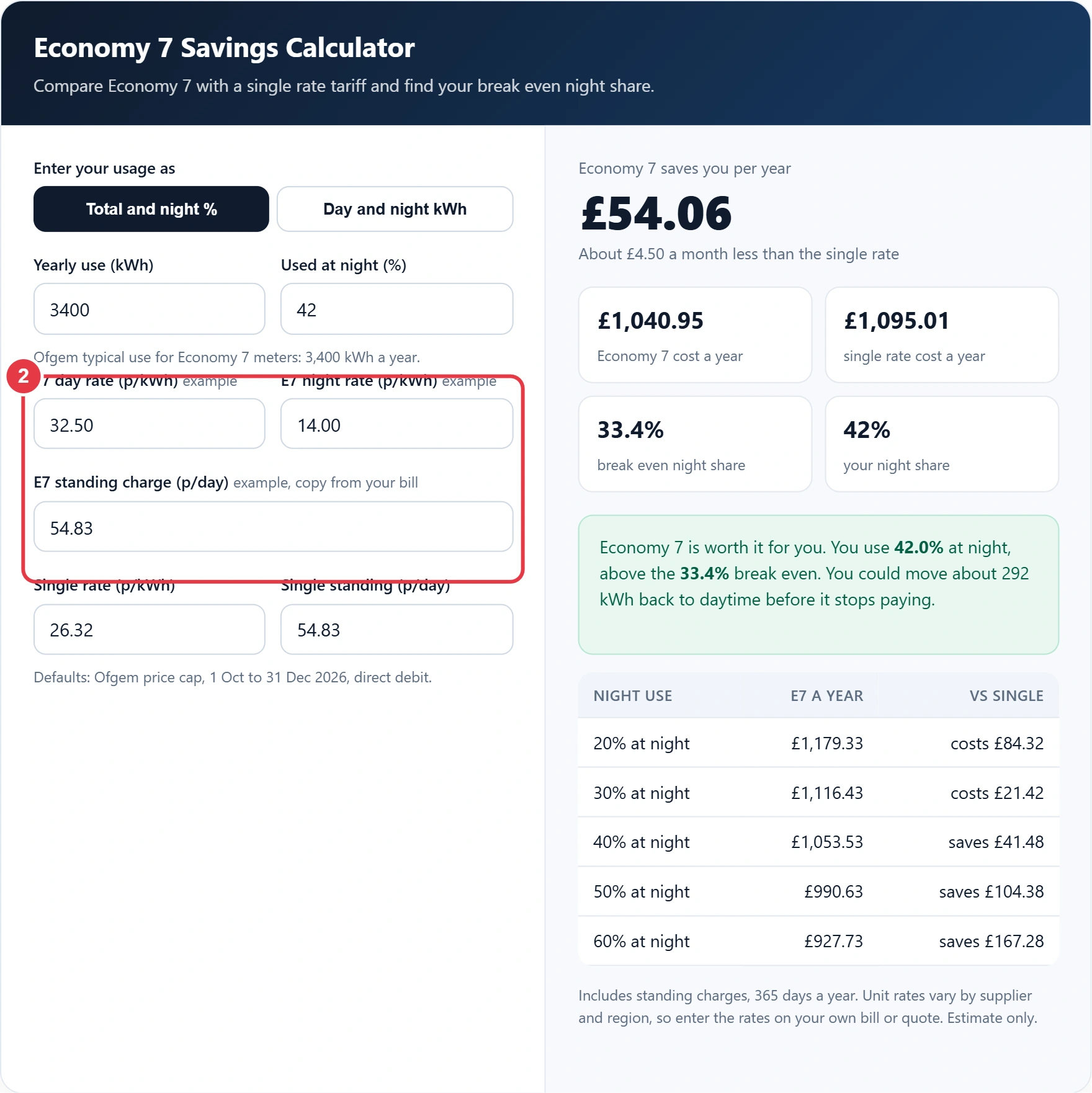
Step 2: Add Your Economy 7 Rates
Copy the day rate, night rate and standing charge from your bill or from the Economy 7 quote you are considering. The defaults are examples only, because Economy 7 rates differ by supplier and by region. Rates are in pence, so 32.50p is entered as 32.50.
Step 3: Add the Single Rate to Compare
The default single rate is the Ofgem price cap for direct debit customers from 1 October to 31 December 2026: 26.32p per kWh and 54.83p a day. If you only want the cost of one appliance at either rate, the kWh cost calculator handles single items in pence per kWh. For a full comparison, replace the default with a fixed tariff quote if you are weighing up a specific deal.
Step 4: Read Your Result
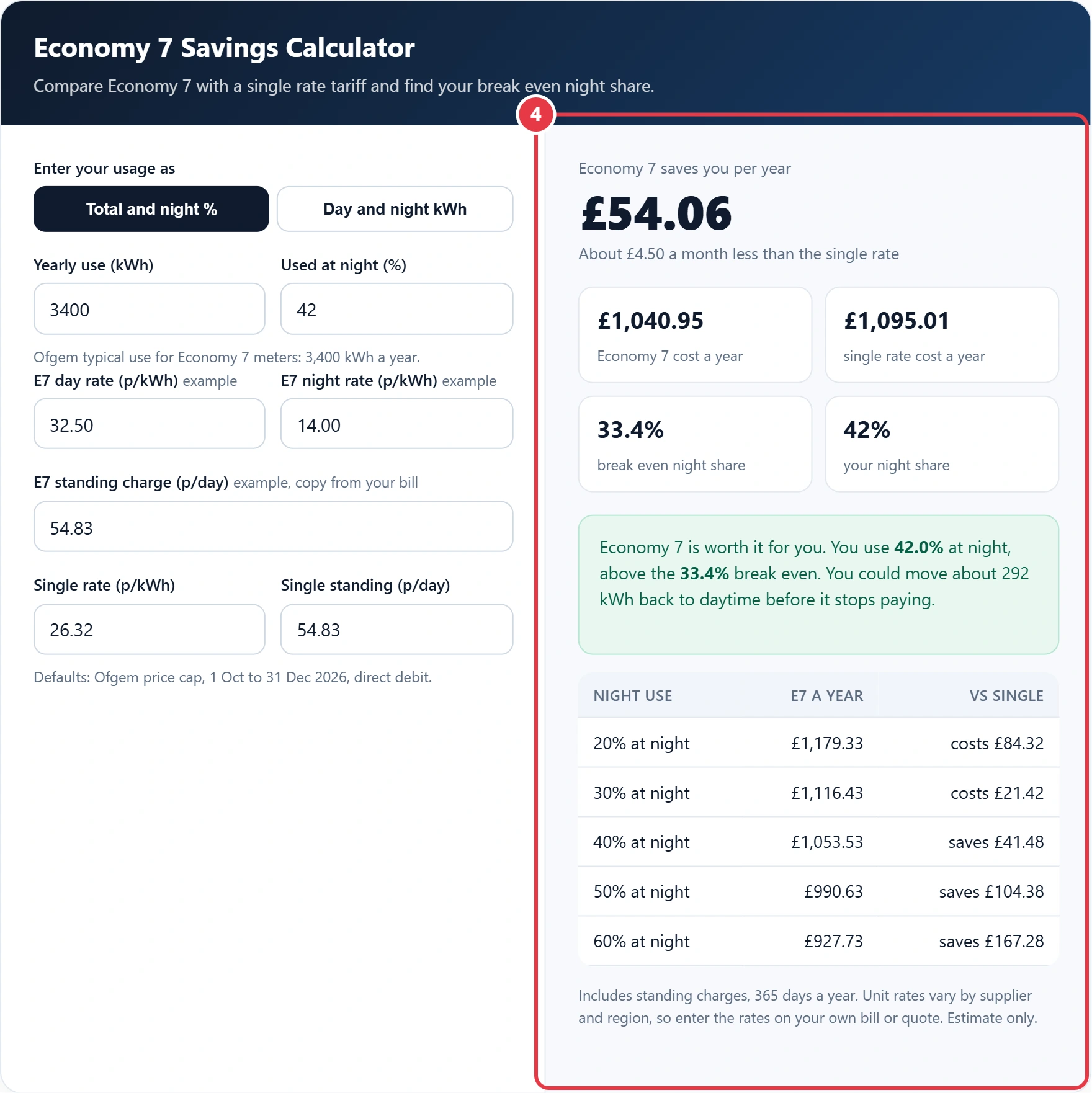
The headline shows how much Economy 7 saves or costs each year, with the monthly figure underneath. The box compares your night share with the break even share and tells you how many kWh you could shift either way. The table shows the yearly cost at 20% to 60% night use, which is useful if you are planning storage heaters or a timer on the immersion heater.
Is Economy 7 Worth It?
Economy 7 is worth it if you use more of your electricity at night than the break even share for your rates, which is usually somewhere between 30% and 40%. Below that point the higher day rate costs more than the cheap night rate saves, so a single rate tariff is cheaper.
Worked example: Gareth lives in a two bedroom flat in Swansea with night storage heaters and a hot water cylinder. He uses 3,400 kWh a year, 42% of it at night, on example rates of 32.50p by day and 14.00p by night with a 54.83p daily standing charge. His Economy 7 bill is £1,040.95 a year. The same use on the October 2026 cap single rate costs £1,095.01, so Economy 7 saves him £54.06 a year, about £4.50 a month. His break even is 33.4%, so he has room to spare. If he removed the storage heaters and his night share fell to 20%, Economy 7 would cost him £84.32 a year more than the single rate.
What Percentage of Electricity Should Be Used at Night on Economy 7?
You should aim to use at least the break even share at night, and the old rule of thumb is 40%, but the true figure depends on how far apart the three unit rates are. The wider the gap between the day and night rates, the lower the share you need. This table uses the same rates as the worked example, with 3,400 kWh a year.
| Share used at night | Economy 7 cost a year | Single rate cost a year | Difference |
|---|---|---|---|
| 20% | £1,179.33 | £1,095.01 | Costs £84.32 more |
| 30% | £1,116.43 | £1,095.01 | Costs £21.42 more |
| 33.4% (break even) | £1,095.01 | £1,095.01 | No difference |
| 40% | £1,053.53 | £1,095.01 | Saves £41.48 |
| 50% | £990.63 | £1,095.01 | Saves £104.38 |
| 60% | £927.73 | £1,095.01 | Saves £167.28 |
To see what your night share actually is, divide the night register reading for a year by the total of both registers and multiply by 100. A home with a gas boiler and no electric heating typically uses far less than 30% at night, which is why many people who inherit an Economy 7 meter in a rented flat end up paying more than they need to.
Who Should Use Economy 7?
Economy 7 suits homes that can move large loads into the night hours, such as electric car charging, an immersion heater on a timer and night storage heaters, plus washing machines and dishwashers set to run overnight. It rarely suits a small flat with gas heating, where most use happens in the evening peak. Night shift workers who sleep by day may also do well on it.
Off peak hours are set by your meter, not chosen by you, and are often around midnight to 7am but vary by region. Some older meters stay on GMT all year, so in summer the cheap hours run an hour later by the clock. Check the times on your meter or bill before you set any timers.
Does the Price Cap Apply to Economy 7?
Yes, but Ofgem caps the combined charge for a typical multi rate customer rather than each rate on its own, so a supplier can set a day rate above the single rate cap and still be within the rules. To estimate the rest of your energy bill, including gas, the energy bill calculator uses the same cap figures. Ofgem puts the cap level for a typical Economy 7 home at £1,046 a year for October to December 2026 by direct debit, which is why the day rate in this calculator is higher than the single rate default.
If you switch away from Economy 7, your supplier can usually bill a two register meter at a single rate, or a smart meter can be set to single rate remotely. If you are thinking of replacing storage heaters with a heat pump, the heat pump running cost calculator shows what that would cost to run on either tariff.
</>Embed this calculator on your website
Add the free Economy 7 Savings Calculator to your own site or blog. Copy the code below and paste it into an HTML block. It resizes itself and works on phones.
How we checked this tool: the Tools Veria Editorial Team built this tool by hand, checked it against the official rules or published standards where they apply, and tested it against worked examples. Results are estimates for planning, not personal financial or tax advice. Read our editorial policy and disclaimer, or report an error.
Frequently Asked Questions
Is Economy 7 worth it?
Economy 7 is worth it only if your night share of electricity is above your break even point, usually 30% to 40%. With a 32.50p day rate, 14.00p night rate and 26.32p single rate, you need at least 33.4% of your kWh at night to save money.
What times are Economy 7 off peak hours?
Economy 7 gives seven off peak hours each night, commonly about midnight to 7am, but the exact times depend on your region and meter. Some older meters stay on GMT, so in summer the cheap hours start and end an hour later by the clock.
How do I work out my Economy 7 night percentage?
Divide your night kWh for the year by your total kWh and multiply by 100. For example, 1,428 night kWh out of 3,400 kWh in total is 42%. Use the two register totals from a yearly statement or two meter readings a year apart.
Is Economy 7 cheaper than a single rate tariff?
Economy 7 is cheaper only when enough use falls in the night hours, because the day rate is higher than a single rate. At 3,400 kWh a year and 20% night use, the example rates cost £84.32 more than the October 2026 single rate cap.
How much electricity does an Economy 7 home use?
Ofgem's typical consumption figure for homes with multi register meters such as Economy 7 is 3,400 kWh a year, compared with 2,700 kWh for a typical single rate home. Homes with storage heaters can use several times more than this.
Can I switch from Economy 7 to a single rate?
Yes. You can ask your supplier to move you to a single rate tariff, and a smart meter can usually be switched remotely. Run your figures through the calculator first, because homes with storage heaters often pay more on a single rate.