Turn the kWh you have used into a cost in pounds, with or without the standing charge.
| Item | Calculation | Cost |
|---|---|---|
| Energy | ||
| Standing charge | ||
| Total |
The result uses the rates you enter. If your bill lists rates before VAT, add the VAT shown on your bill to the total.
Your bill and smart meter talk in kilowatt hours, but what you really want to know is the cost in pounds. This kWh cost calculator converts any number of kWh, or the gap between two meter readings, into money using your unit rate and daily standing charge. The defaults use the Ofgem energy price cap for October to December 2026: 26.32p per kWh and 54.83p a day.
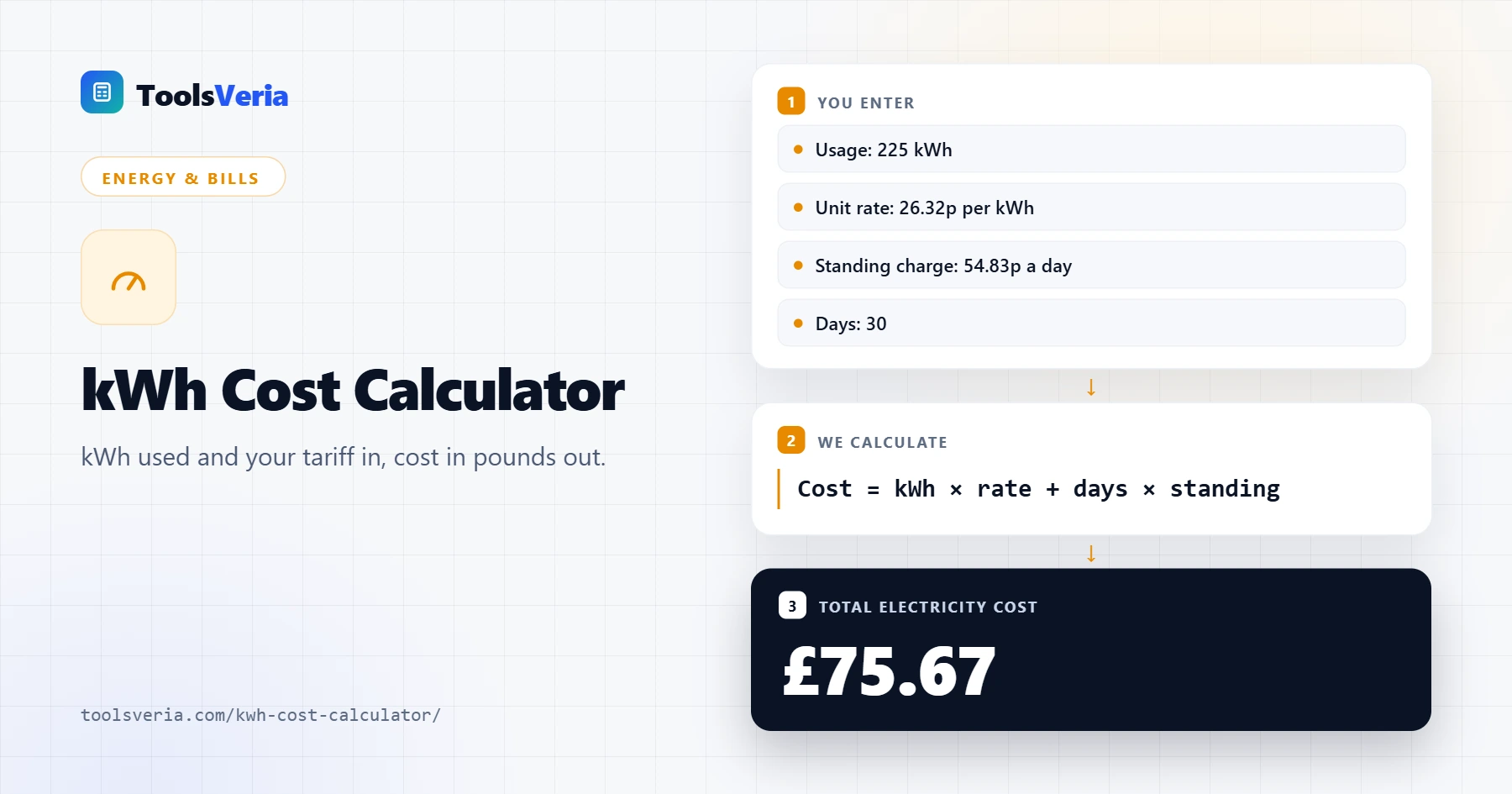
Quick answer: A kWh cost calculator uses (kWh × unit rate) + (days × standing charge) = total cost. At the October to December 2026 price cap of 26.32p per kWh and 54.83p a day, 225 kWh over 30 days costs £59.22 for energy plus £16.45 in standing charges, so £75.67 in total.
In This Guide
What Is a kWh Cost Calculator?
A kilowatt hour (kWh) is the unit suppliers use to measure electricity. It is the energy a 1,000W appliance uses in one hour. Your bill has two parts: the energy you use, charged per kWh, and a fixed standing charge for each day you are connected, whether you use any power or not.
The formula is: (kWh × unit rate) + (days × standing charge) = total cost. For 225 kWh over 30 days at the price cap, that is £59.22 for energy plus £16.45 in standing charges, so £75.67 in total.
How Do You Use the kWh Cost Calculator?
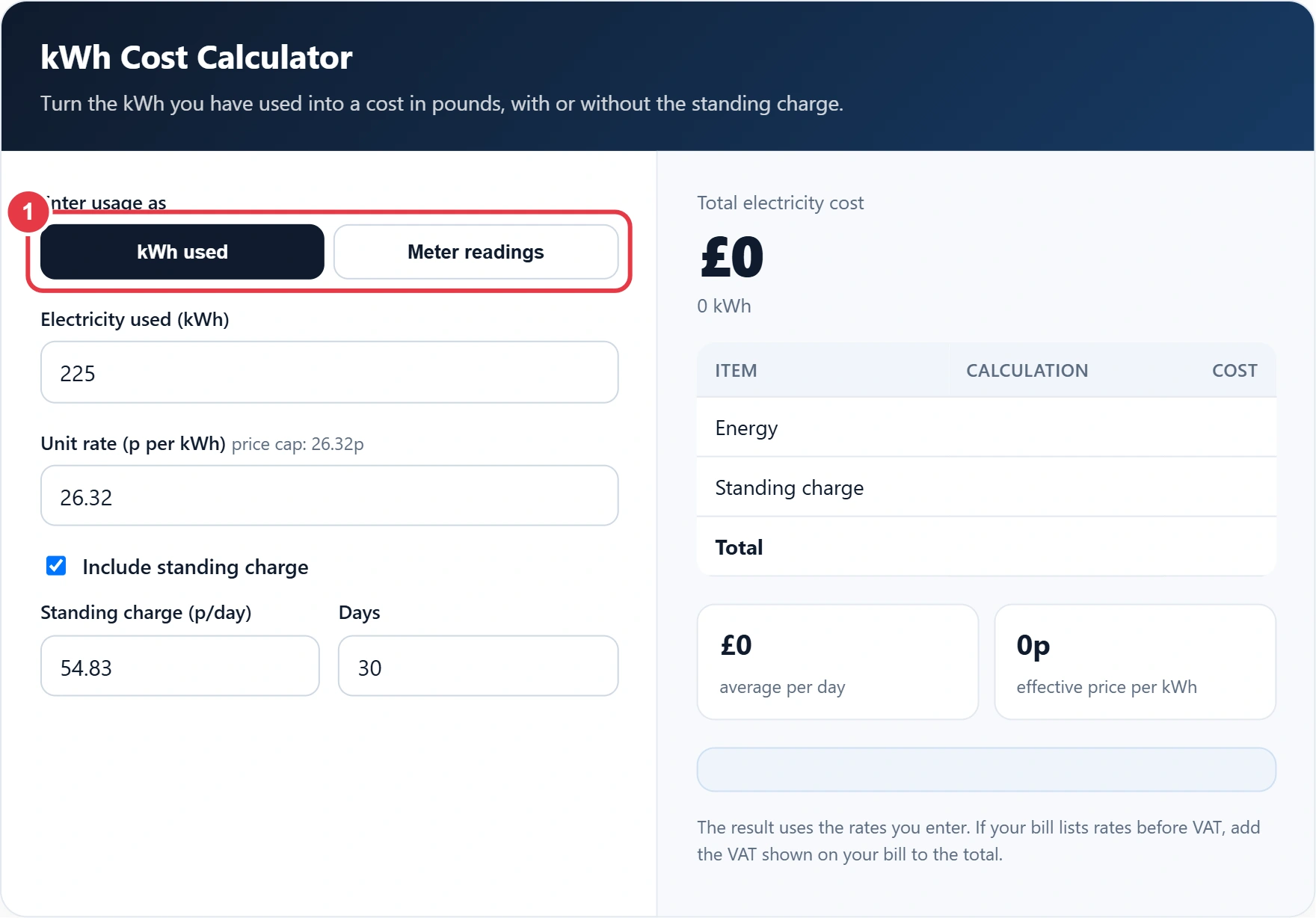
Step 1: Choose How to Enter Usage
You select kWh used if you know the figure from your bill, app or smart meter, or Meter readings to work it out from two readings. Select kWh used if you already know the figure from your bill, app or smart meter display. Select Meter readings if you want to work it out from two readings taken on different days.
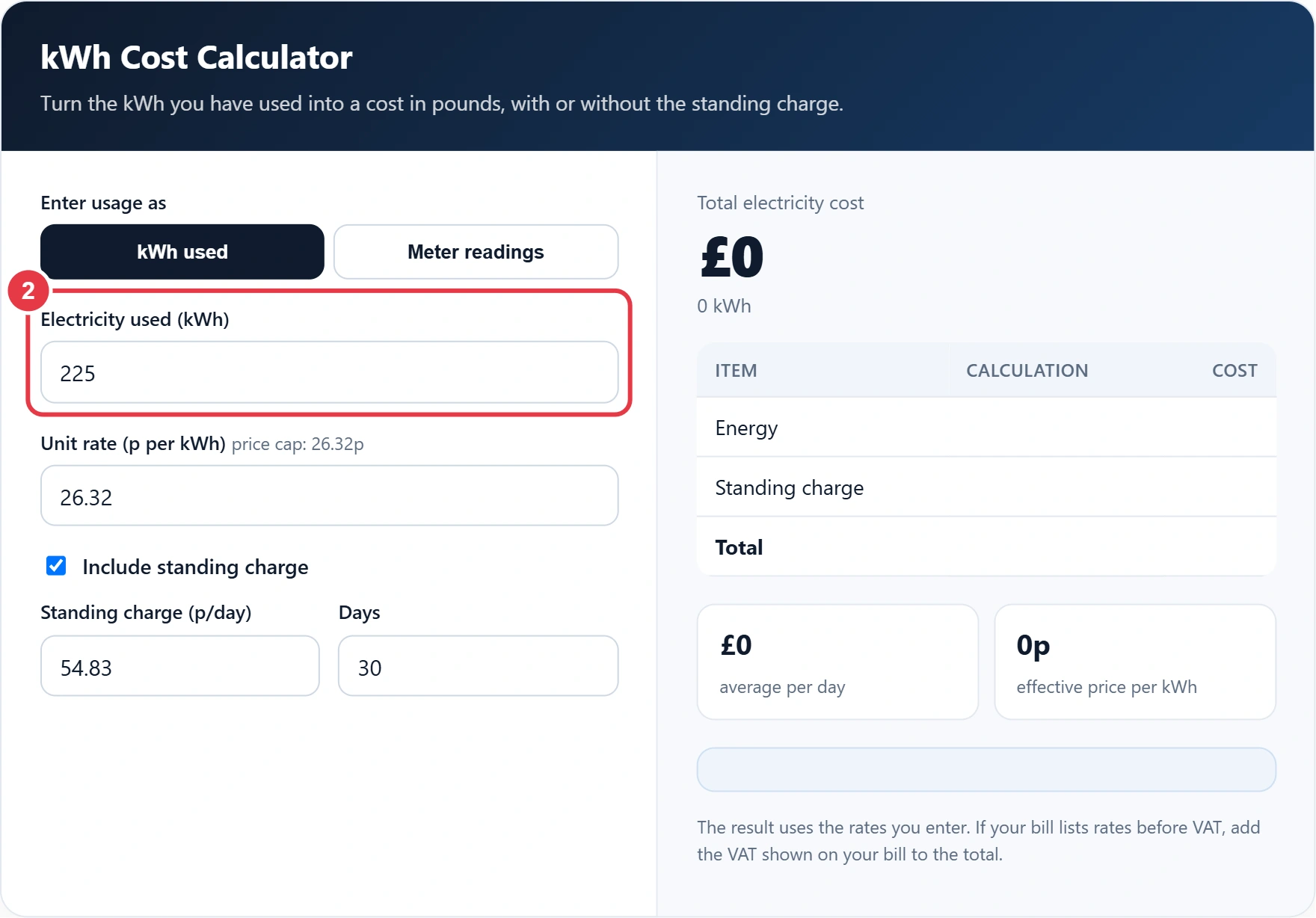
Step 2: Enter Your Usage
Type the kWh used, or enter the start and end readings. The calculator subtracts the start from the end to find the kWh. Ignore any red digits or figures after the decimal point on older meters.
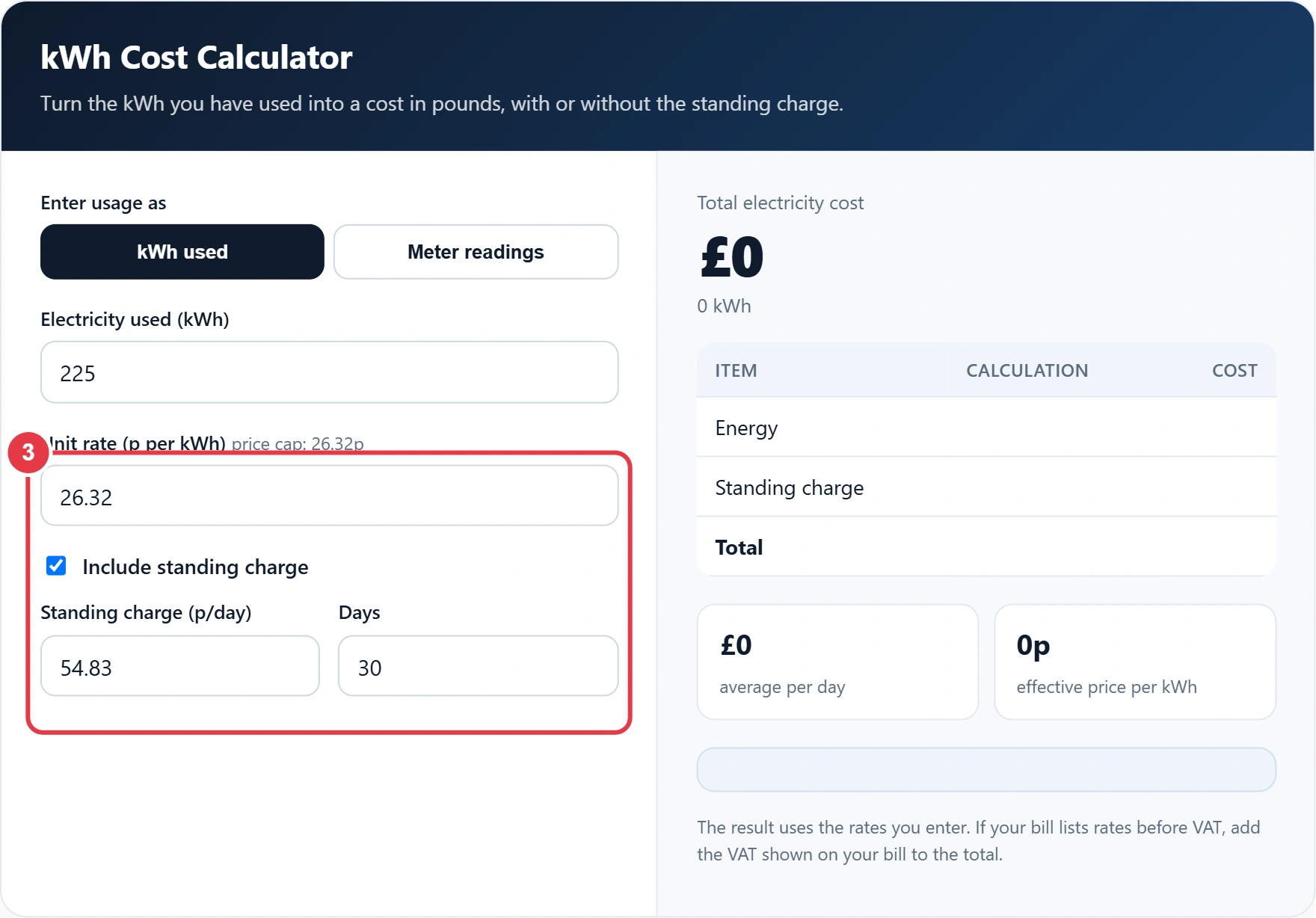
Step 3: Add the Unit Rate and Standing Charge
Enter the unit rate in pence from your tariff. Tick the standing charge box and enter the daily charge and the number of days to include it, or untick it to see the cost of the energy alone.
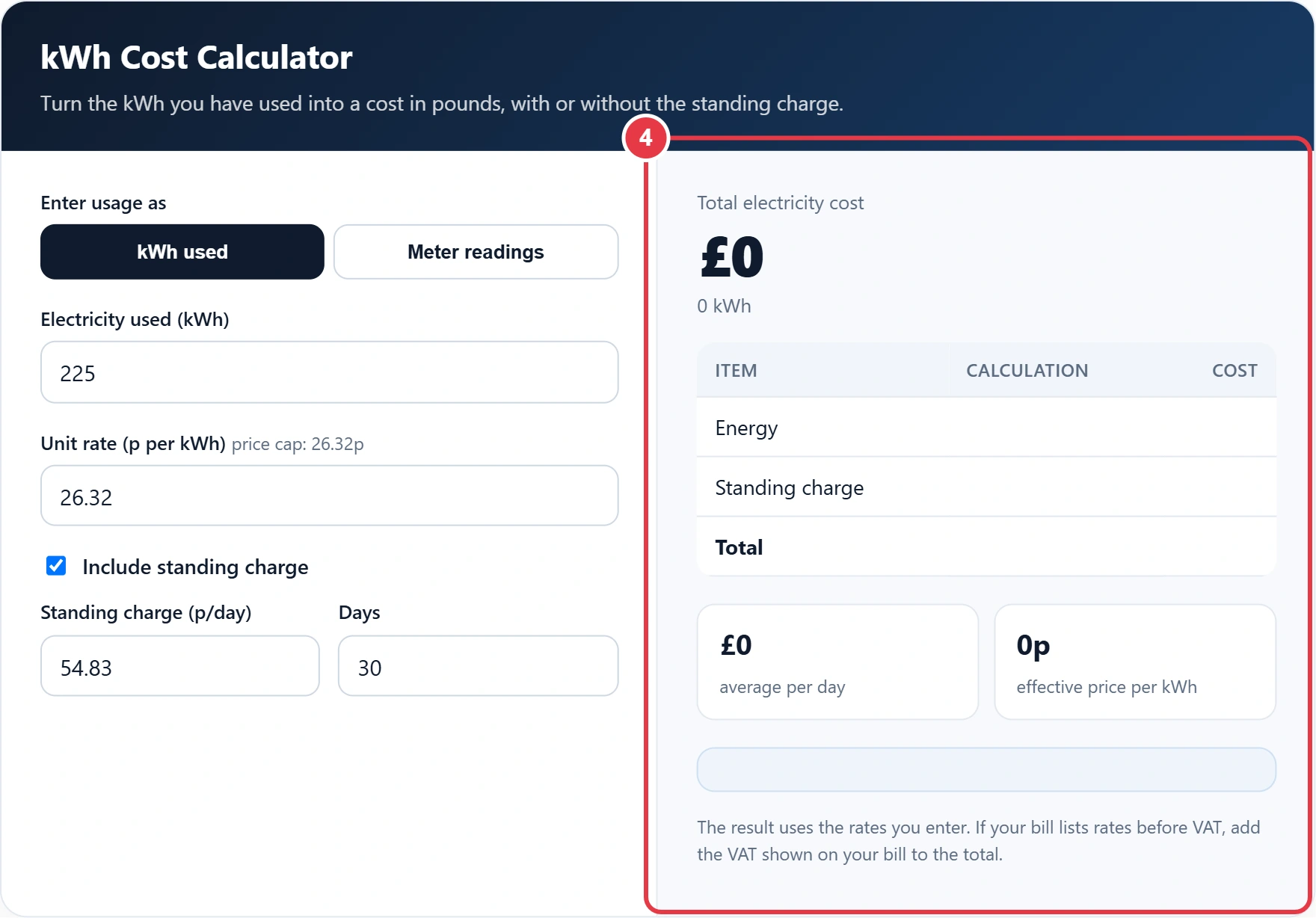
Step 4: Check the Breakdown
You get the total cost and a table splitting energy and standing charges. To estimate a full year of gas and electricity together, the energy bill calculator works from your annual usage instead. The panel also shows the average cost per day and your effective price per kWh once the standing charge is spread across your usage.
How Do You Turn Watts Into a kWh Cost?
Multiply the wattage by the hours used and divide by 1,000, so a 1,500W heater on for 2 hours uses 3 kWh, costing £0.79 at 26.32p per kWh. To go from watts to kWh, multiply the wattage by the hours used and divide by 1,000. A 1,500W heater on for 2 hours uses 3 kWh. Multiply that by the unit rate to get the cost in pounds, or use the electricity cost calculator to price any appliance by its wattage and hours of use. The table below shows common amounts at 26.32p per kWh, without the standing charge.
| kWh used | Example | Cost at 26.32p |
|---|---|---|
| 1 kWh | 1,000W for 1 hour | £0.26 |
| 3 kWh | 1,500W heater for 2 hours | £0.79 |
| 10 kWh | A day of light use | £2.63 |
| 225 kWh | A typical month | £59.22 |
| 2,700 kWh | Ofgem typical yearly use | £710.64 |
A full year of standing charges at 54.83p a day adds £200.13. Rates vary slightly by region, so check the Ofgem regional unit rates and standing charges if you are on a standard variable tariff.
Key Terms for Using the kWh Cost Calculator
These terms explain each input of the kWh cost calculator, so you can turn meter readings or appliance use into an accurate electricity cost in pounds.
- Kilowatt hour (kWh)
- The unit of energy used on electricity bills, equal to a power of 1,000 watts drawn for one hour. Multiplying the kilowatt hours used by the unit rate gives the energy part of a bill.
- Watt
- The unit of power that measures how fast an appliance uses energy, printed on its rating plate. Multiplying watts by hours of use and dividing by 1,000 converts a device's running time into kilowatt hours.
- Meter reading
- The cumulative figure shown on an electricity meter, recording all energy passed through it since installation. Subtracting an earlier reading from a later one gives the kilowatt hours used in between.
- Pence per kWh
- The price a tariff charges for each kilowatt hour of electricity, set by the supplier within the limits of the price cap for default tariffs. It is the main lever on cost for heavy users.
- Daily standing charge
- A fixed amount added for each day a property is connected to the grid, covering network and supply costs. It is charged even when no electricity is used, so it weighs more heavily on low users.
- Effective price per kWh
- The total cost of a bill, including standing charges, divided by the kilowatt hours used. It is higher than the unit rate and shows the true average cost of each unit consumed.
</>Embed this calculator on your website
Add the free kWh Cost Calculator to your own site or blog. Copy the code below and paste it into an HTML block. It resizes itself and works on phones.
How we checked this tool: the Tools Veria Editorial Team built this tool by hand, checked it against the official rules or published standards where they apply, and tested it against worked examples. Results are estimates for planning, not personal financial or tax advice. Read our editorial policy and disclaimer, or report an error.
Frequently Asked Questions
How do I convert kWh to pounds?
Multiply the kWh by your unit rate in pence, then divide by 100. For example, 100 kWh × 26.32p = 2,632p, which is £26.32.
How much is 1 kWh of electricity in the UK?
Under the Ofgem price cap from 1 October to 31 December 2026, the average is 26.32p per kWh for direct debit customers. Fixed tariffs can be higher or lower.
What is a standing charge?
It is a fixed daily fee that covers the cost of keeping your home connected to the grid. You pay it even if you use no electricity.
How do I work out kWh from meter readings?
Subtract the earlier reading from the later one. If your meter read 12,450 last month and 12,675 now, you used 225 kWh.
Does the calculator include VAT?
It uses the rates you enter. Check your bill: if your unit rate and standing charge are shown before VAT, add the VAT listed on your bill to the total.
How many kWh does a typical UK home use?
Ofgem uses 2,700 kWh of electricity a year as typical for a medium user, which is about 225 kWh a month.