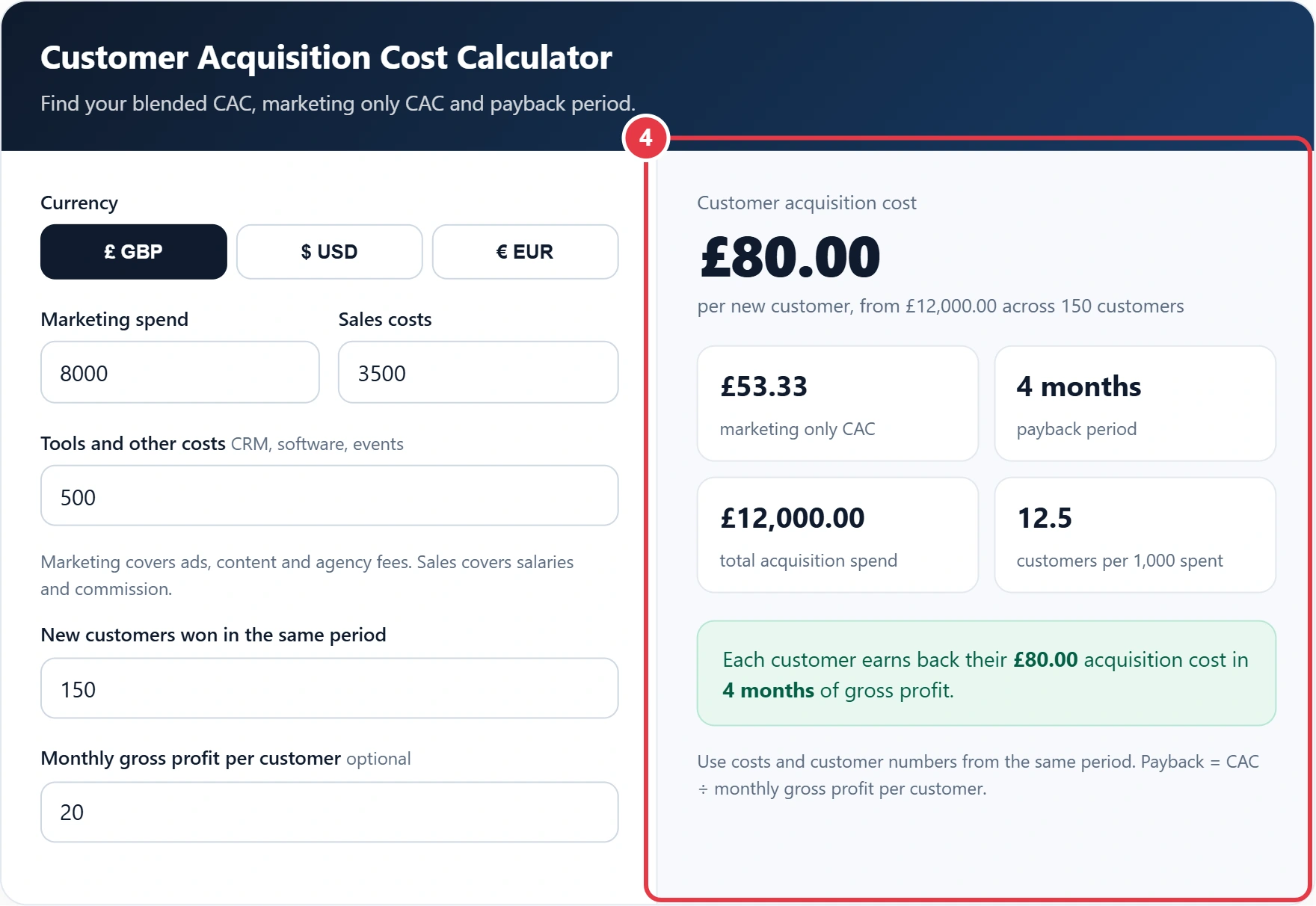
Find your blended CAC, marketing only CAC and payback period.
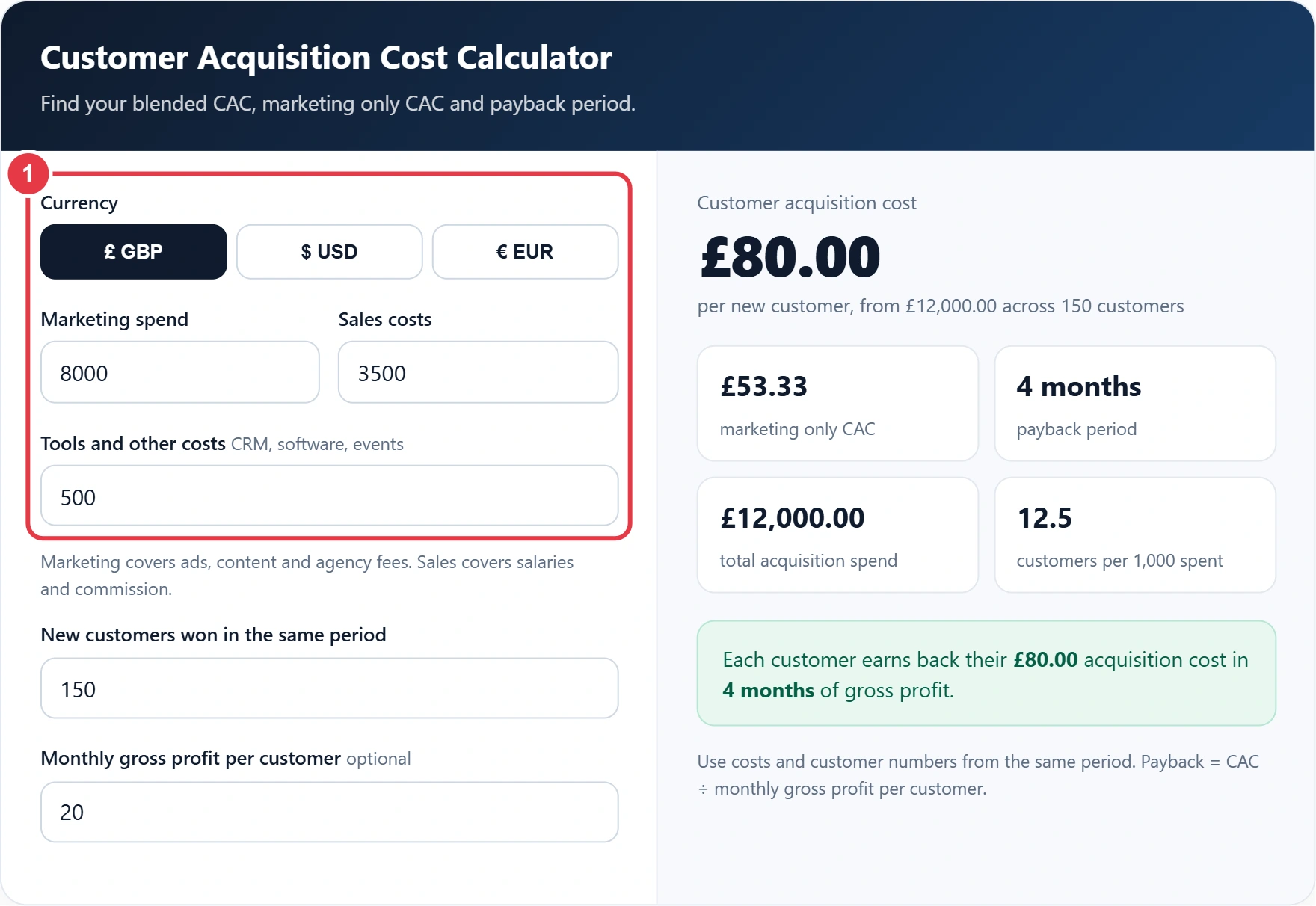
Marketing covers ads, content and agency fees. Sales covers salaries and commission.
Use costs and customer numbers from the same period. Payback = CAC ÷ monthly gross profit per customer.
Knowing how much it costs to win a customer tells you whether growth is building a business or just burning cash. This customer acquisition cost calculator adds up your marketing, sales and tool spend, divides it by the customers you actually won, and follows the standard definition of CAC that investors compare with lifetime value. It then shows how many months of profit it takes to earn that cost back, for subscription firms, online shops and service businesses alike.
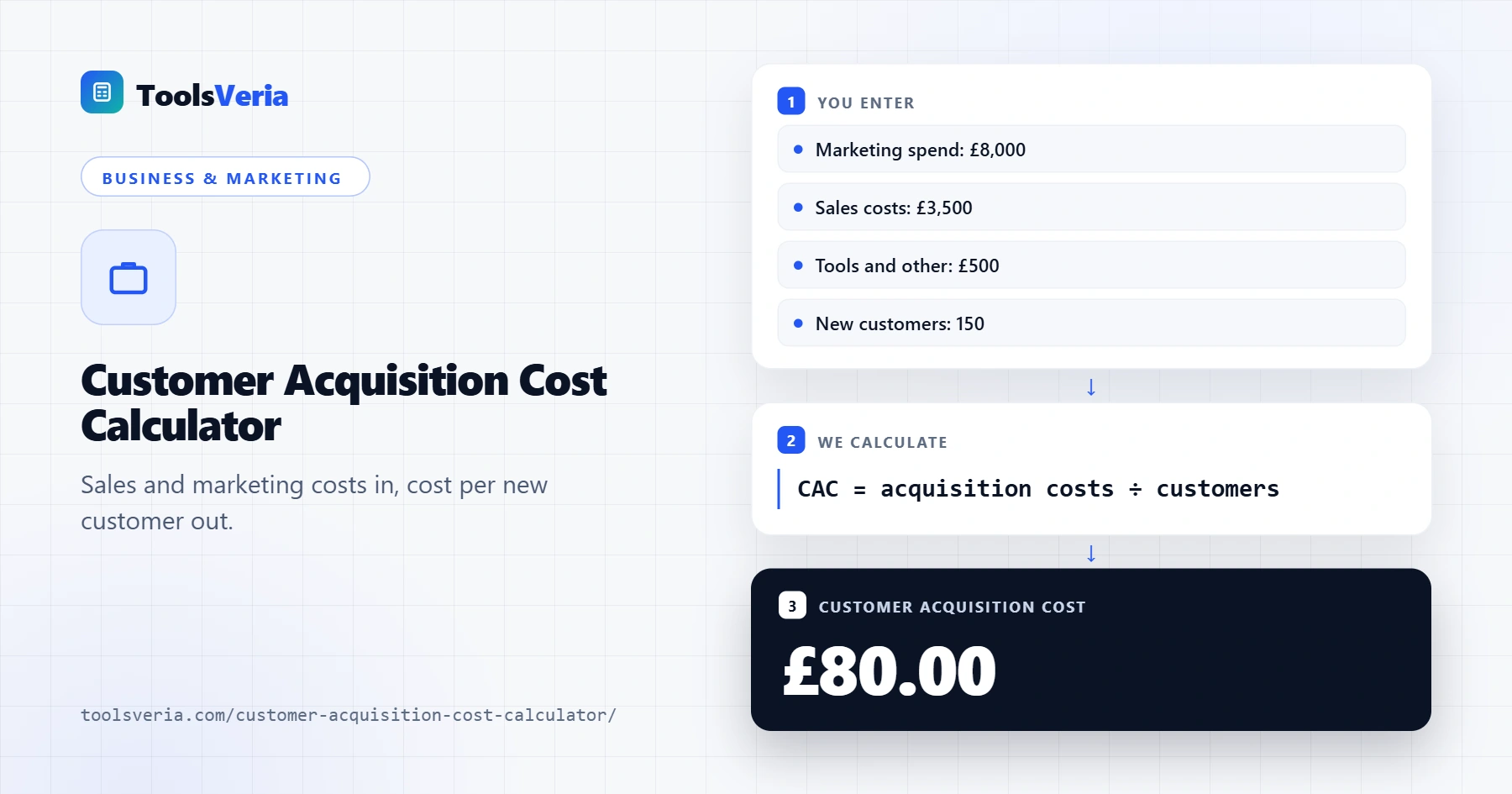
Quick answer: A customer acquisition cost calculator divides total sales and marketing costs by the new customers won in the same period. Spend £12,000 in a quarter, win 150 customers, and your CAC is £80. Blended CAC includes ad spend, salaries, commission and software, while marketing only CAC leaves out sales costs.
In This Guide
What Is Customer Acquisition Cost?
Customer acquisition cost, or CAC, is the average amount you spend to turn someone into a paying customer. The formula is total sales and marketing costs ÷ new customers won, with both figures taken from the same period. Spend £12,000 in a quarter, win 150 customers, and your CAC is £80.
A blended CAC includes everything: ad spend, agency fees, sales salaries, commission and the software your team uses. A marketing only CAC leaves out sales costs, which helps when you want to compare channels. Both are useful, but the blended figure is the honest one to set against what each customer is worth.
How to Use the Customer Acquisition Cost Calculator
Step 1: Enter Your Acquisition Costs
Pick a currency and enter marketing spend, sales costs and any tools or events used to win customers. Leave out costs that serve existing customers, such as account management.
Step 2: Enter New Customers
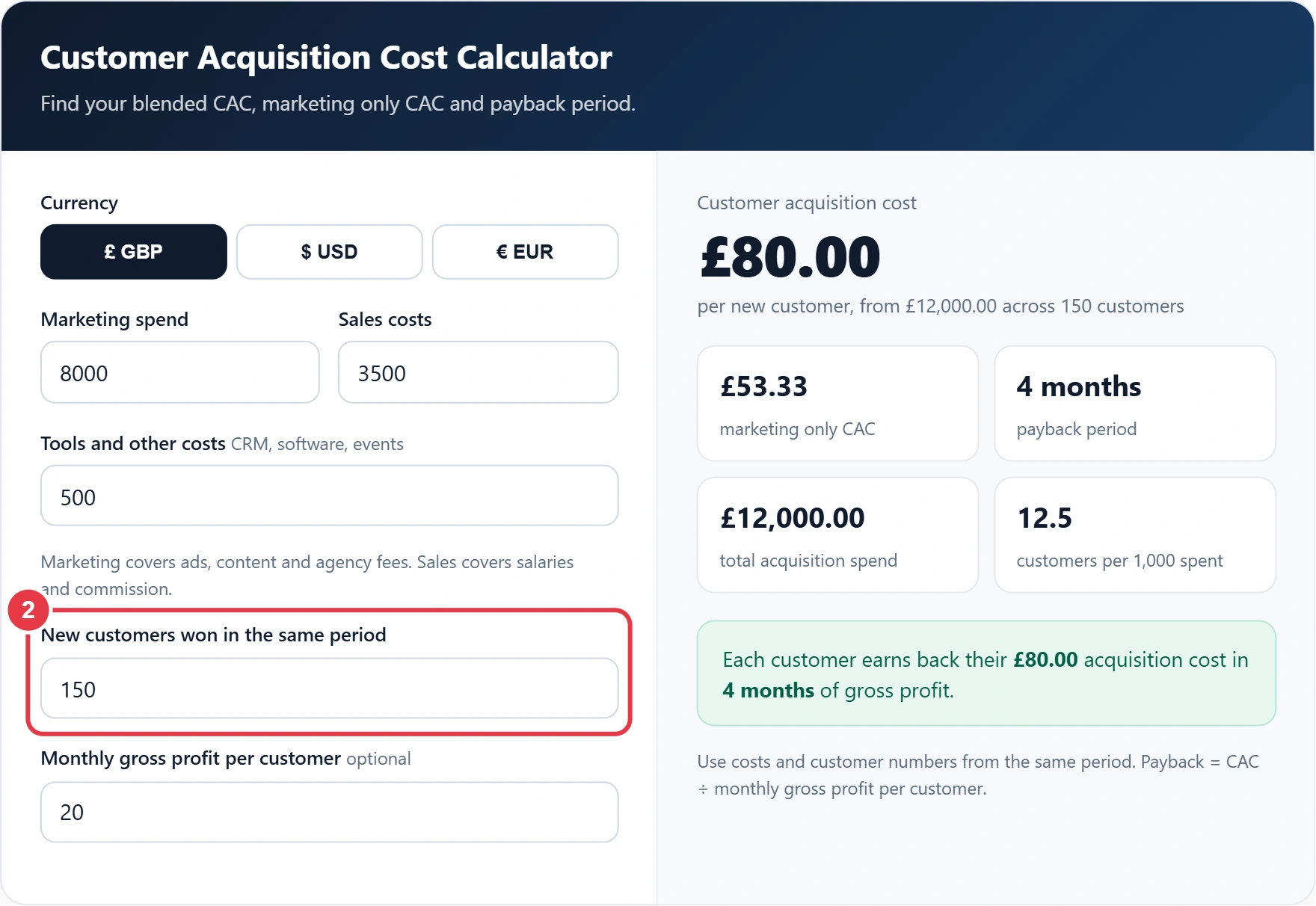
Type how many brand new paying customers you gained over the same dates. Do not count free trial sign ups or repeat buyers, or your CAC will look lower than it really is.
Step 3: Add Monthly Gross Profit
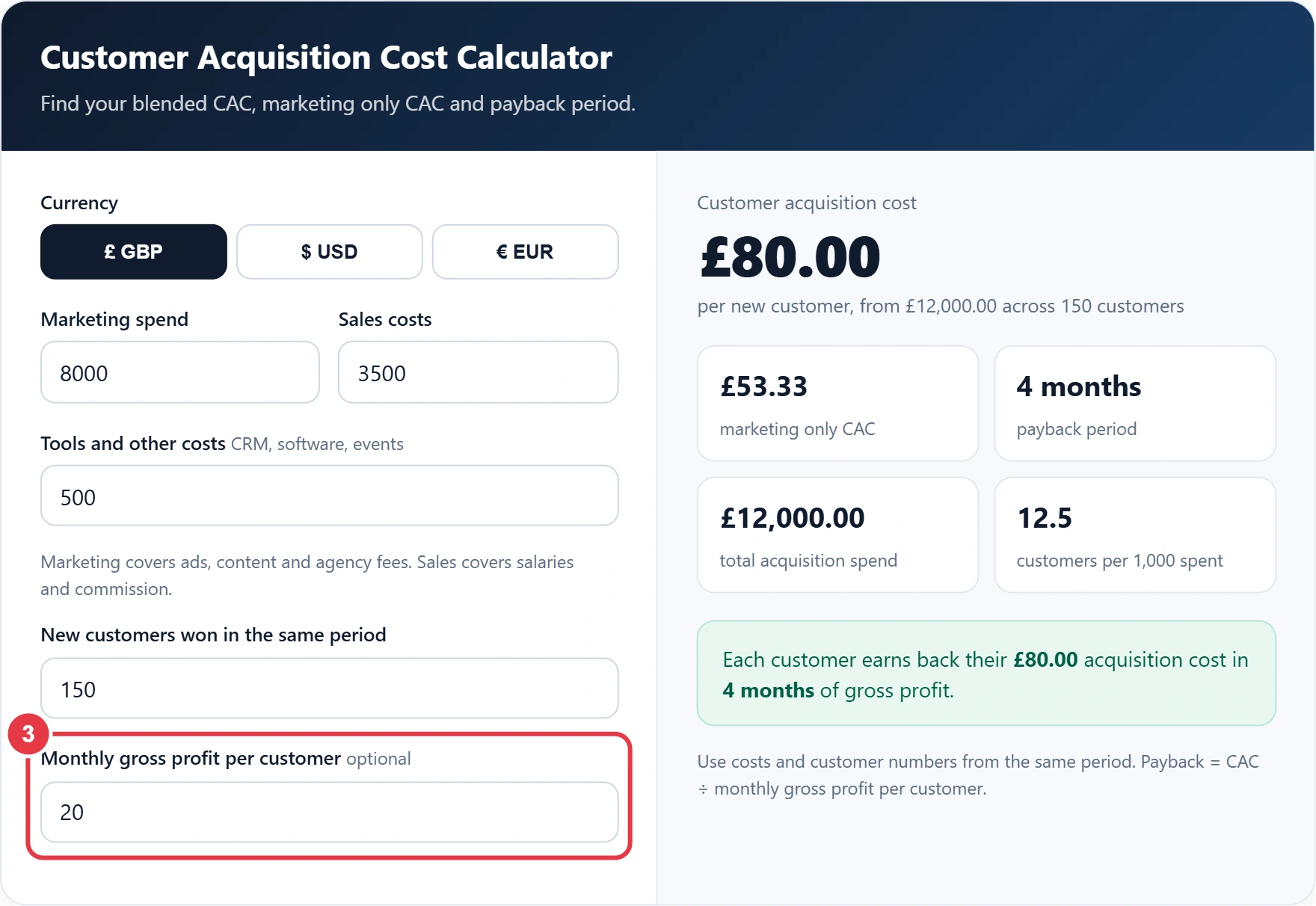
Enter the gross profit an average customer brings in each month. If you know the price and product cost, the profit margin calculator gives you the margin to apply to your monthly revenue per customer.
Step 4: Read Your CAC and Payback
The results show your blended CAC, marketing only CAC, total spend, customers won per 1,000 spent and the payback period in months. A green panel means you recover the cost within a year.
Comparing CAC by Channel
Owen runs a vegan meal kit service and spent £12,000 last quarter across four channels. His blended CAC is £80, but splitting it by channel tells a sharper story, and tracking each figure with the percentage increase calculator each quarter shows which channels are getting more expensive over time.
| Channel | Spend | New customers | CAC |
|---|---|---|---|
| Search ads | £4,000 | 60 | £66.67 |
| Social ads | £3,000 | 30 | £100.00 |
| Referral scheme | £1,000 | 40 | £25.00 |
| Food festivals | £4,000 | 20 | £200.00 |
Moving budget from festivals towards referrals would cut his CAC sharply. If you are planning growth, the GOV.UK guide to writing a business plan is a good place to set out these channel numbers for a lender or investor.
Key Customer Acquisition Cost Terms Explained
These definitions explain the metrics produced by the customer acquisition cost calculator, helping you judge whether each new customer is worth what you spend to win them.
- Blended CAC
- An acquisition cost figure that pools every sales and marketing expense, across all channels, and divides it by all new customers. It gives the most complete view of what growth really costs, though it hides differences between channels.
- Marketing only CAC
- An acquisition cost that counts only marketing spend such as advertising, content and agency fees, leaving out sales salaries and commission. It is useful for comparing channels but understates the full cost of winning a customer.
- CAC payback period
- The number of months a new customer must stay before the gross profit they generate covers the cost of acquiring them. Shorter paybacks free cash for reinvestment sooner and reduce the risk from customers who leave early.
- Gross profit per customer
- The revenue a customer brings in minus the direct cost of serving them, such as product, delivery and payment fees. Using it instead of revenue gives a realistic measure of how quickly acquisition spend is recovered.
- Marketing attribution
- The method of assigning credit for a new customer to the channels and touchpoints that influenced them. The model chosen, such as first click or last click, can change which channel appears to have the lowest acquisition cost.
- Organic acquisition
- Customers who arrive without direct paid promotion, for example through search results, referrals or word of mouth. Including them lowers blended CAC, so tracking them separately prevents overestimating how efficient paid channels are.
</>Embed this calculator on your website
Add the free Customer Acquisition Cost Calculator to your own site or blog. Copy the code below and paste it into an HTML block. It resizes itself and works on phones.
How we checked this tool: the Tools Veria Editorial Team built this tool by hand, checked it against the official rules or published standards where they apply, and tested it against worked examples. Results are estimates for planning, not personal financial or tax advice. Read our editorial policy and disclaimer, or report an error.
Frequently Asked Questions
What costs should go into CAC?
Include every cost spent winning new customers: advertising, agency fees, content, sales salaries and commission, and sales or marketing software. Leave out costs of serving customers you already have.
What is a good CAC payback period?
Many subscription businesses aim to recover CAC within 12 months. Shorter is safer, because you need less cash to fund growth.
Should I use a monthly or quarterly CAC?
Quarterly figures smooth out lumpy spend and long sales cycles. Monthly figures react faster, so many teams track both.
How is CAC different from cost per acquisition?
Cost per acquisition in ad platforms often counts any conversion, such as a sign up or lead. CAC counts only new paying customers and usually includes sales costs too.
What if a customer came from more than one channel?
Blended CAC avoids the problem by using total spend and total customers. For channel CAC, pick one attribution rule, such as first or last touch, and apply it consistently.
How does CAC relate to customer lifetime value?
Lifetime value is what a customer brings in over the whole relationship. Comparing it with CAC tells you whether each customer is worth what you pay to win them.