Add what you own and what you owe to see where you stand today.
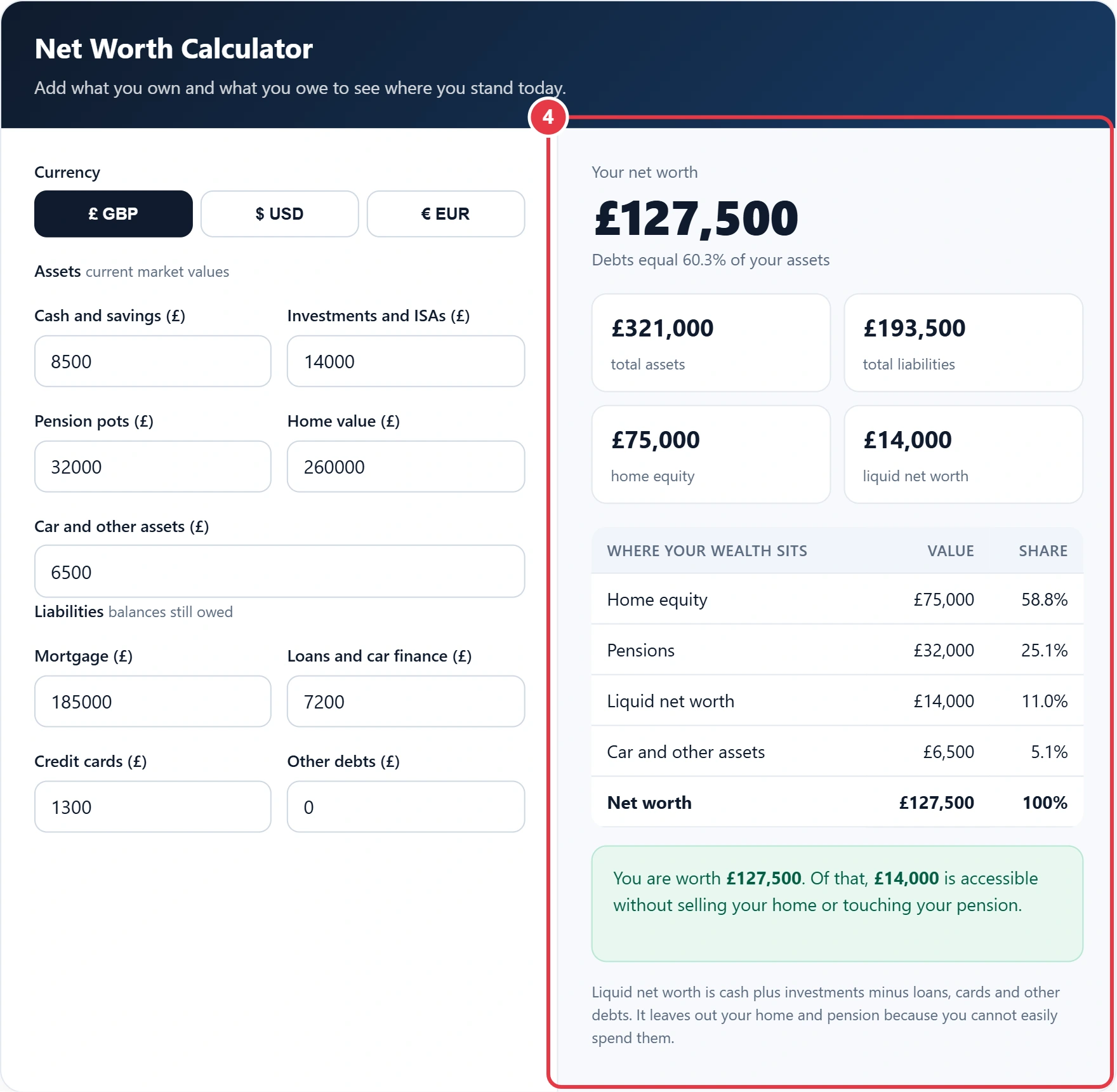
| Where your wealth sits | Value | Share |
|---|
Liquid net worth is cash plus investments minus loans, cards and other debts. It leaves out your home and pension because you cannot easily spend them.
Your bank balance tells you very little about how well off you are. This net worth calculator pulls everything into one number, using the same idea of assets minus liabilities that lenders and financial planners use, and then splits it into home equity, pensions and money you could actually spend. Run it once a year and you have a simple scorecard for your finances.
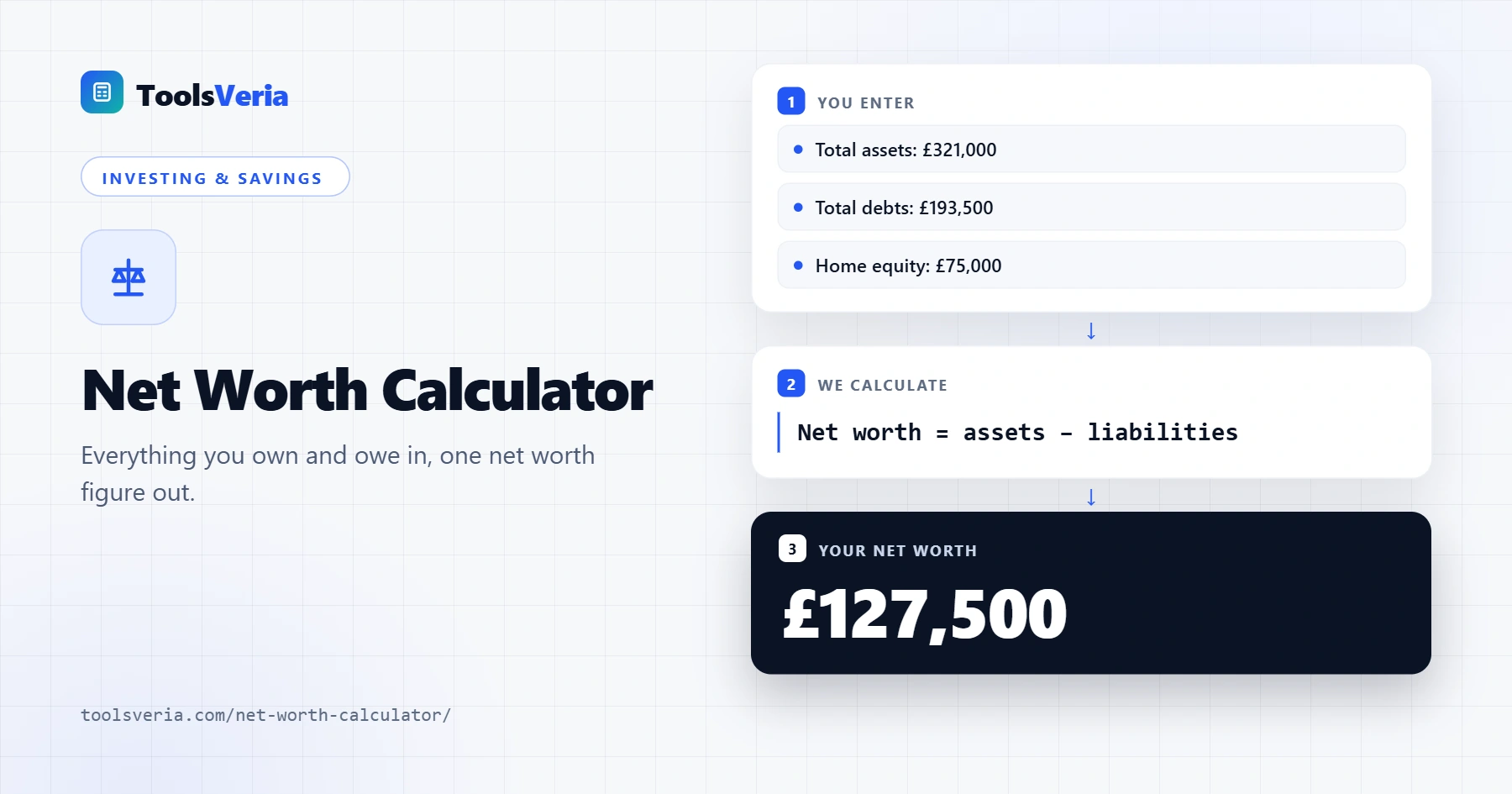
Quick answer: A net worth calculator uses total assets minus total liabilities. A Bristol couple with assets of £321,000, including a £260,000 home, and debts of £193,500, mostly a £185,000 mortgage, have a net worth of £127,500, though only £14,000 of that is liquid enough to spend if an income stops.
In This Guide
What Is Net Worth?
Net worth is what would be left if you sold everything you own at today's prices and cleared every debt. The formula is net worth = total assets − total liabilities. A big salary does not guarantee a big figure here: someone earning £80,000 who rents, leases a car and carries card debt can easily be worth less than a teacher who has slowly paid off a modest flat.
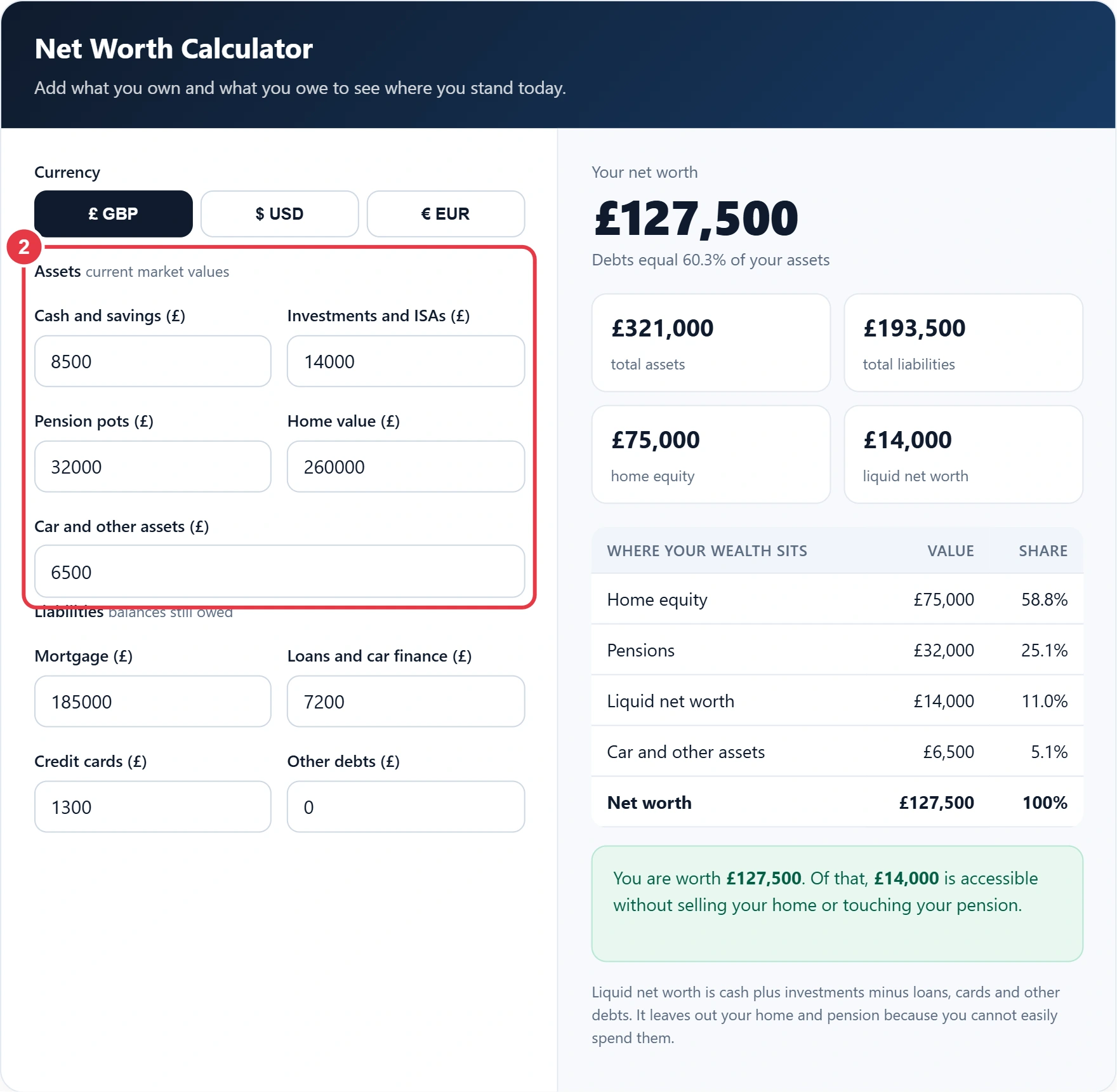
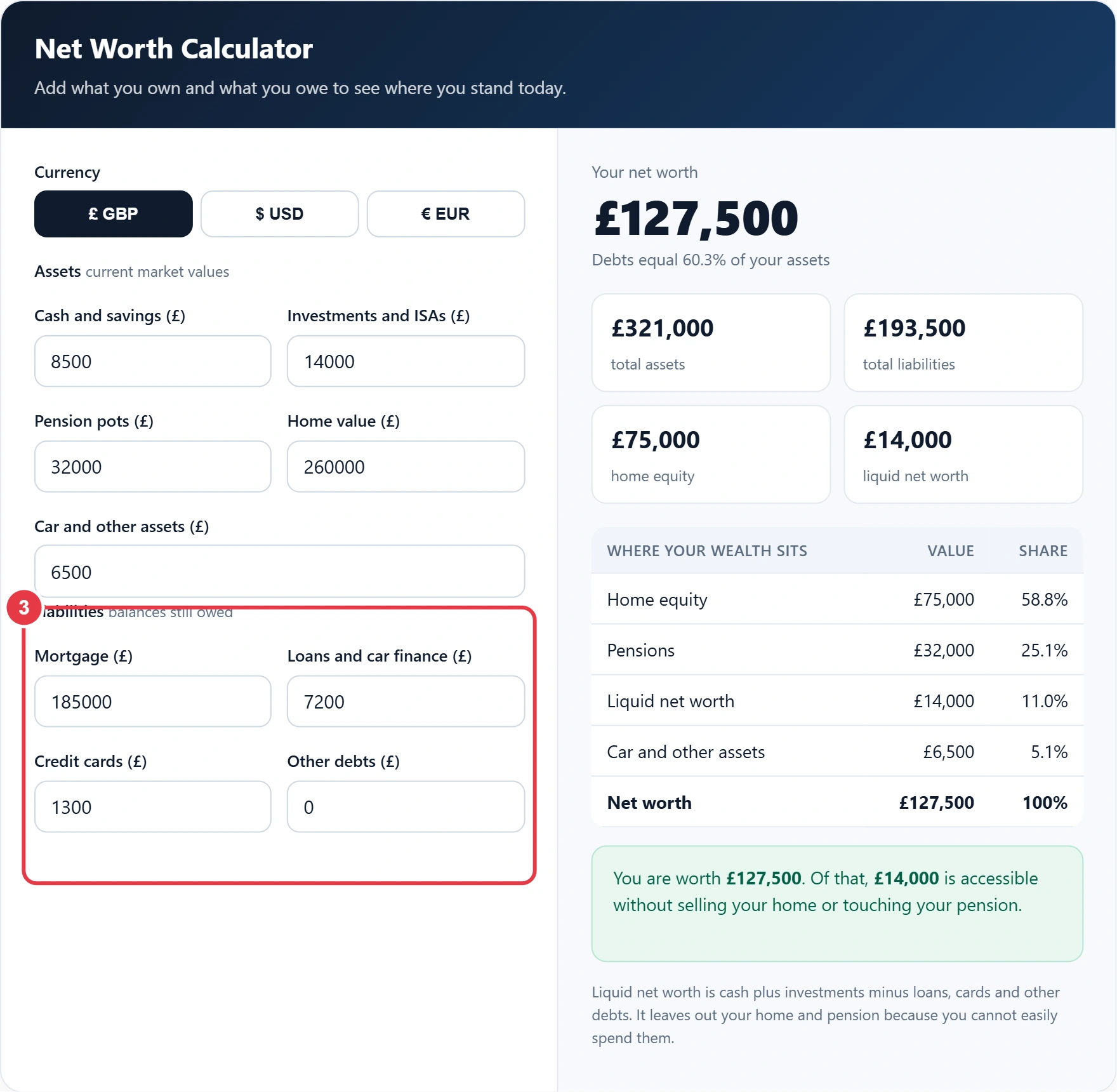
Take Daniel and Aisha in Bristol. They own a home worth £260,000 with £185,000 left on the mortgage, have £32,000 across their pensions, £14,000 in ISAs, £8,500 in savings and a car worth £6,500. Against that they owe £7,200 on car finance and £1,300 on cards. Their assets total £321,000, their debts £193,500, so their net worth is £127,500. Only £14,000 of it is liquid, which is the figure that matters if they lose an income.
How to Use the Net Worth Calculator
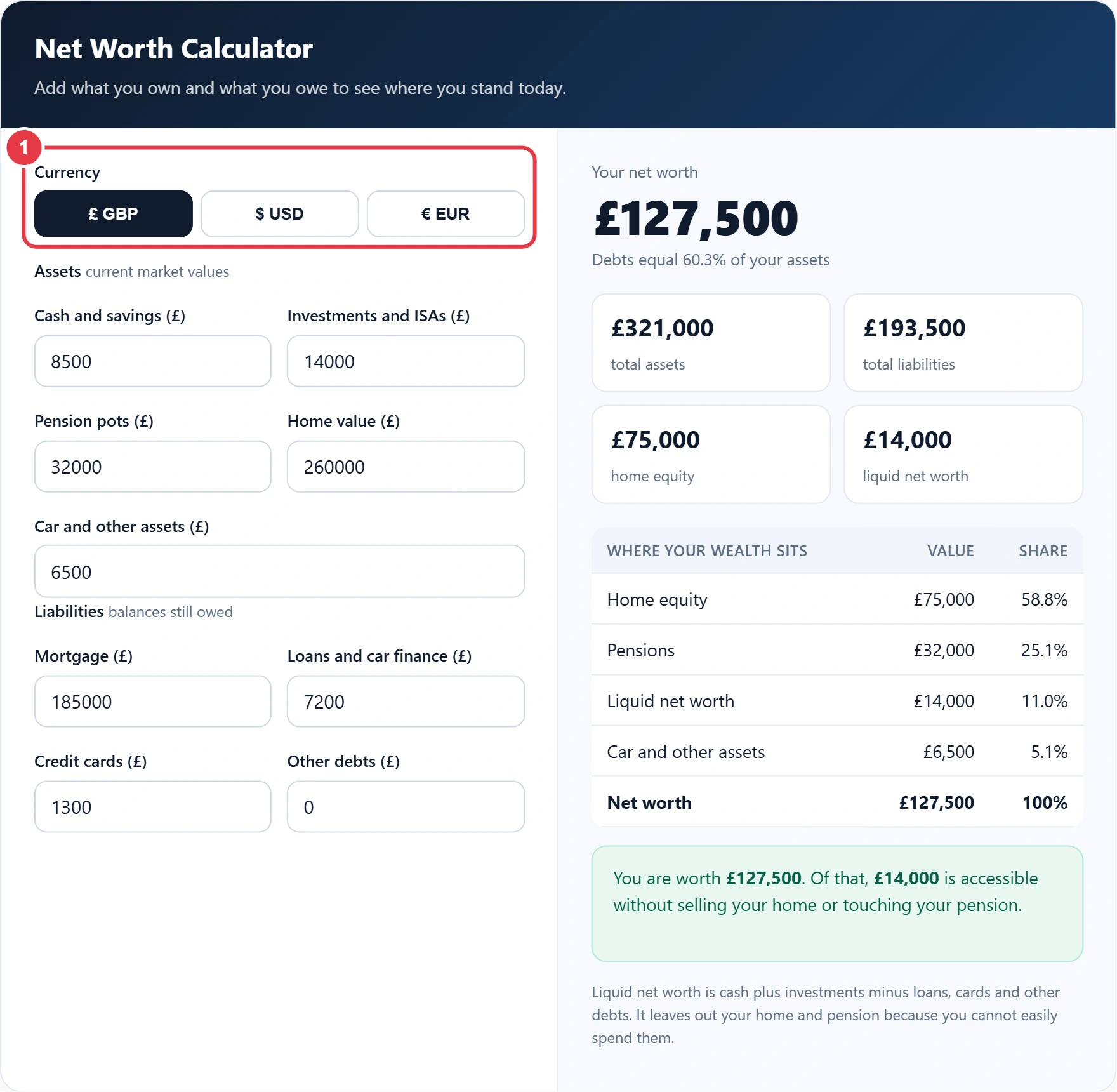
Step 1: Pick Your Currency
Choose pounds, dollars or euros. The maths is the same in any currency, so use whichever your accounts are held in.
Step 2: Add Your Assets
Use current values, not what you paid. Check pension statements online, take a cautious home value from recent local sales, and value a car at what a dealer would offer rather than the forecourt price. Leave out everyday belongings like furniture and phones.
Step 3: Add Your Liabilities
Enter the outstanding balance on each debt, which you will find on your latest statement or by asking the lender for a settlement figure. If you are weighing up clearing a loan early, the loan calculator shows how much interest is still to come on what you owe.
Step 4: Read Your Results
You get your net worth, total assets and liabilities, home equity and liquid net worth, plus a table showing where your wealth sits. The message under the table flags when short term debts outweigh your accessible money.
Ways to Grow Your Net Worth
- Clear high interest debt first, since every pound repaid lifts net worth straight away.
- Increase pension contributions, especially where an employer matches them.
- Overpay the mortgage when your fixed deal allows it, which builds equity faster.
- Track the figure on the same date each year so seasonal swings do not mislead you.
For a sense of how household wealth is spread across Britain, the ONS income and wealth statistics break it down by age and region, which is a fairer comparison than celebrity rankings. If overpaying is your plan, the mortgage overpayment calculator shows how quickly extra payments turn debt into equity.
Key Net Worth Calculator Terms Explained
These personal finance terms explain each figure the net worth calculator produces, helping you value assets fairly and track real progress from one year to the next.
- Asset
- Anything you own that has a cash value and could be sold or drawn on, such as savings, investments, pensions, property and vehicles. For a net worth figure, each should be recorded at its current realistic value, not the original cost.
- Liability
- Any amount you are legally obliged to repay, including mortgages, personal loans, car finance and credit card balances. Using the full outstanding balance, rather than the monthly payment, gives an accurate picture of what is owed.
- Home equity
- The part of a property's value that you own outright, equal to its current market value minus the mortgage secured on it. It grows as the loan is repaid and as house prices rise, and shrinks if prices fall.
- Liquid net worth
- The portion of your wealth you could reach quickly without selling your home or waiting for pension access. It shows how long you could cope with a loss of income, which a headline net worth figure can hide.
- Individual Savings Account
- A UK savings or investment wrapper in which interest, dividends and gains are free of UK tax. Money held in one counts as an accessible asset, although stocks and shares versions can fall in value.
- Settlement figure
- The exact sum a lender would accept to close a loan or finance agreement on a given date, including any interest or charges due. It can differ from the balance on a statement, so it gives the most precise liability value.
</>Embed this calculator on your website
Add the free Net Worth Calculator to your own site or blog. Copy the code below and paste it into an HTML block. It resizes itself and works on phones.
How we checked this tool: the Tools Veria Editorial Team built this tool by hand, checked it against the official rules or published standards where they apply, and tested it against worked examples. Results are estimates for planning, not personal financial or tax advice. Read our editorial policy and disclaimer, or report an error.
Frequently Asked Questions
Should I include my pension in my net worth?
Yes, because it is money you own. Many people also track a second figure without it, since you usually cannot touch a pension until your late fifties.
Is my house an asset if I still have a mortgage?
Yes. Enter the full home value as an asset and the mortgage balance as a liability. The difference is your home equity.
Should I count my car in net worth?
Include it at its realistic resale value. Cars lose value every year, so update the figure each time you recalculate.
Do I include a student loan as a debt?
You can, using the balance on your statement. Some people leave it out because repayments depend on income and the balance may be written off.
Can my net worth be negative?
Yes. It is common for graduates and first time buyers. The calculator flags it and shows how far below zero you are.
How often should I work out my net worth?
Once or twice a year is enough. Checking monthly tends to show market noise rather than real progress.