See what any appliance costs to run per hour, day, week, month and year.
Default unit price is the Ofgem price cap rate for 1 October to 31 December 2026 (direct debit). Preset wattages are typical figures, so check your appliance label for the exact rating.
Year is 52 weeks of your usage pattern and month is the yearly figure divided by 12. Standing charges are not included.
Want to know what your kettle, heater or tumble dryer really costs to run? This electricity cost calculator works out the running cost of any appliance per hour, day, week, month and year from its wattage and how long you use it. It starts with the current Ofgem energy price cap unit rate of 26.32p per kWh, and you can change it to match your own tariff in pounds, euros or dollars.
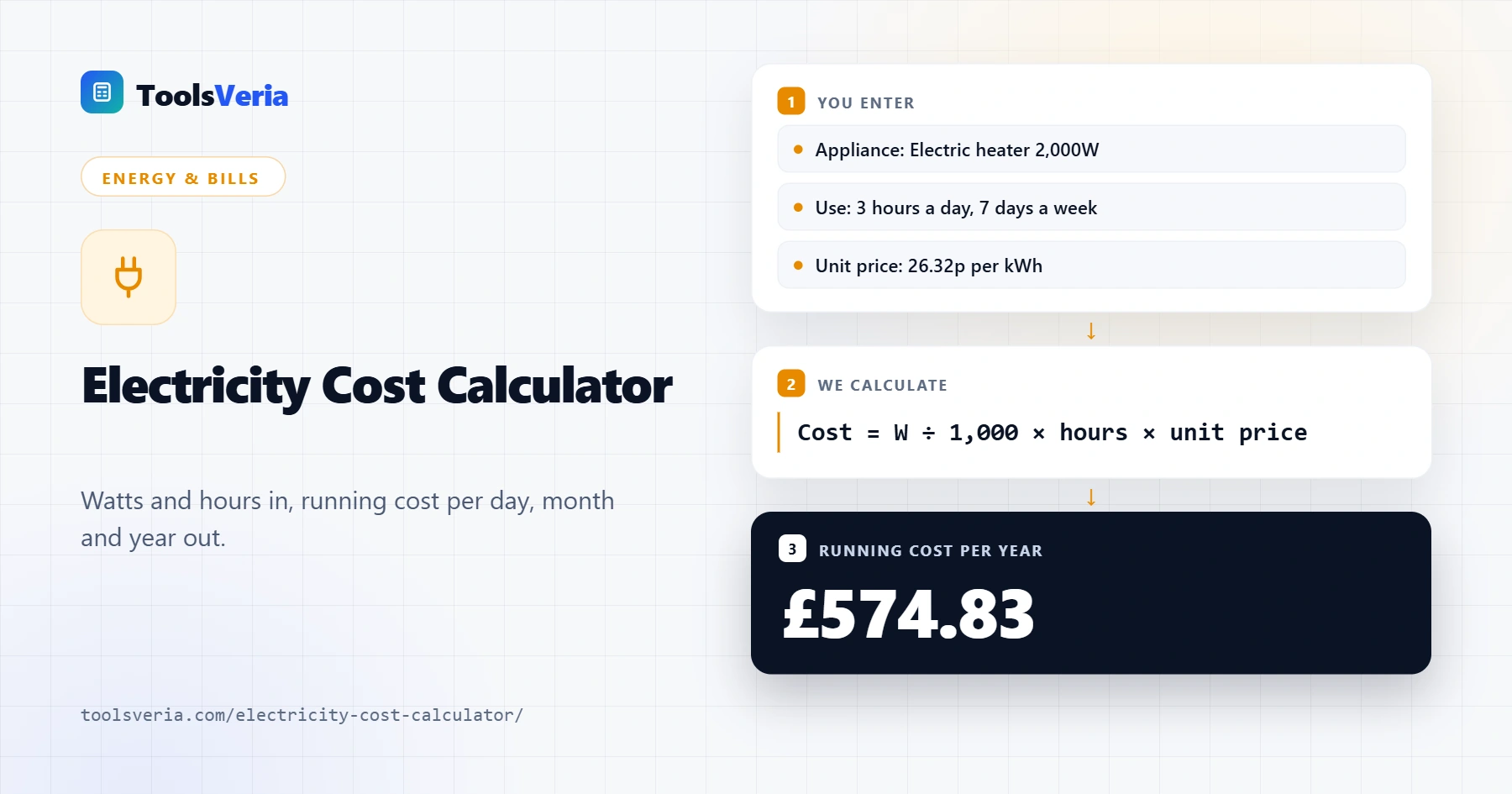
Quick answer: An electricity cost calculator uses the formula watts ÷ 1,000 × hours used × unit price = cost. At the UK price cap unit rate of 26.32p per kWh for October to December 2026, a 2,000W heater running for 3 hours uses 6 kWh, costing £1.58 a day or about £575 a year if used every day.
In This Guide
What Is an Electricity Cost Calculator?
An electricity cost calculator, sometimes called an appliance running cost calculator, turns the power rating of a device into money. Every appliance lists its power in watts on the rating plate or in the manual. Suppliers bill you in kilowatt hours (kWh), and one kWh is 1,000 watts used for one hour.
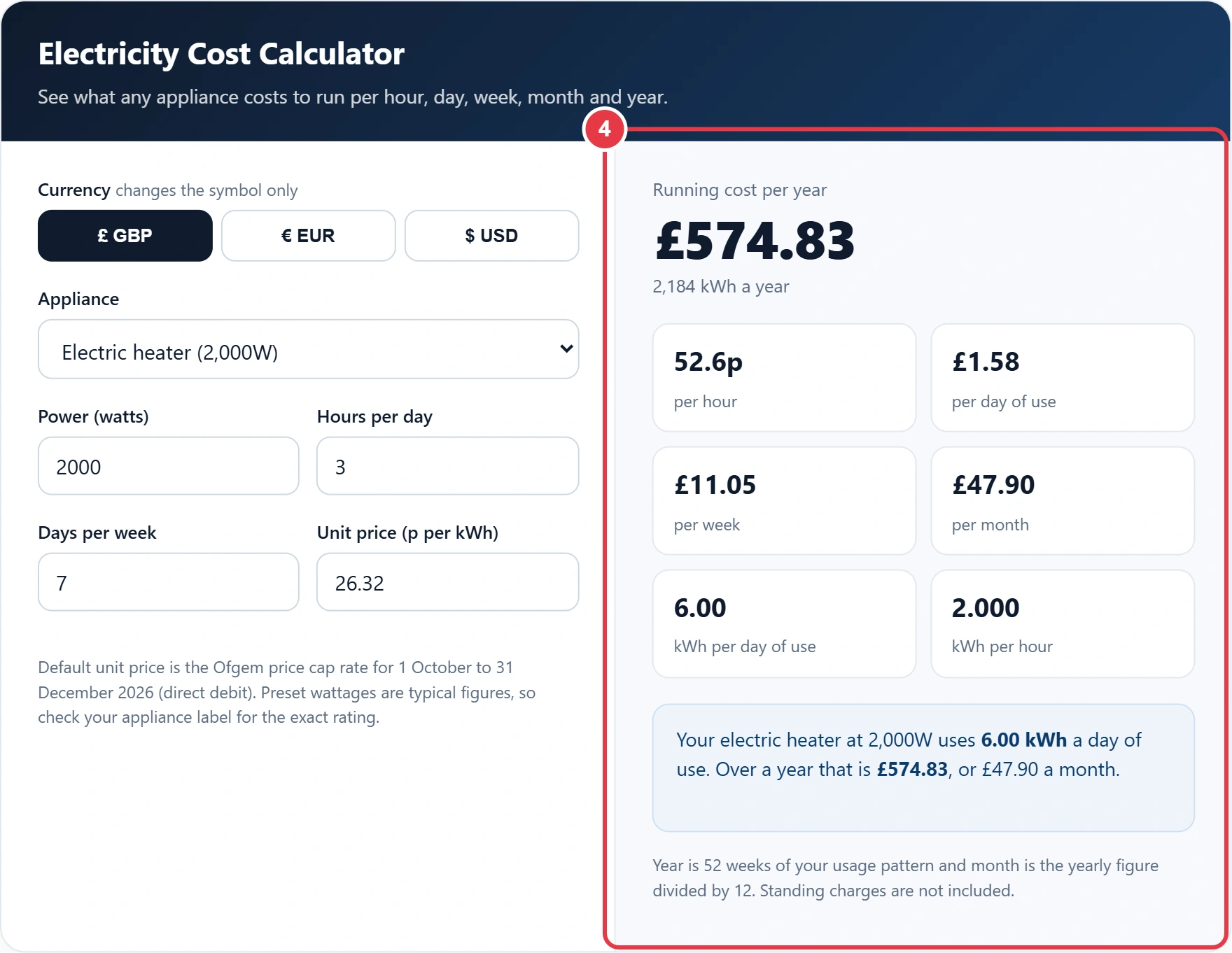
The formula is: watts ÷ 1,000 × hours used × unit price = cost. A 2,000W heater running for 3 hours uses 6 kWh. At 26.32p per kWh that costs £1.58 a day, or about £575 a year if you use it every day.
How Do You Use the Electricity Cost Calculator?
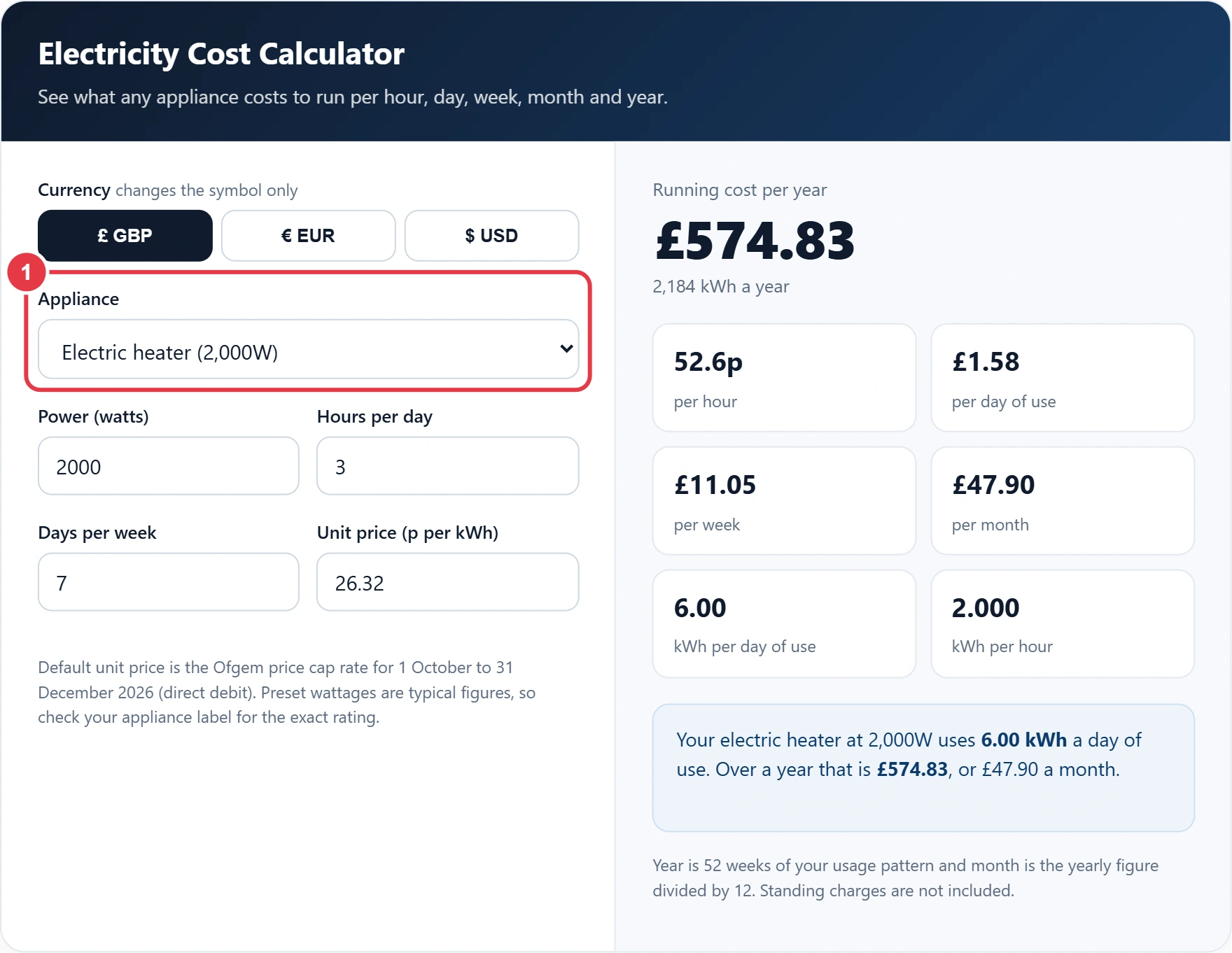
Step 1: Choose an Appliance
Pick an appliance from the list to load a typical wattage and usage pattern, then choose Custom or type over the watts if you know the exact rating. Pick an appliance from the list to load a typical wattage and usage pattern. The presets are averages, so choose Custom or type over the watts if you know the exact rating of your device.
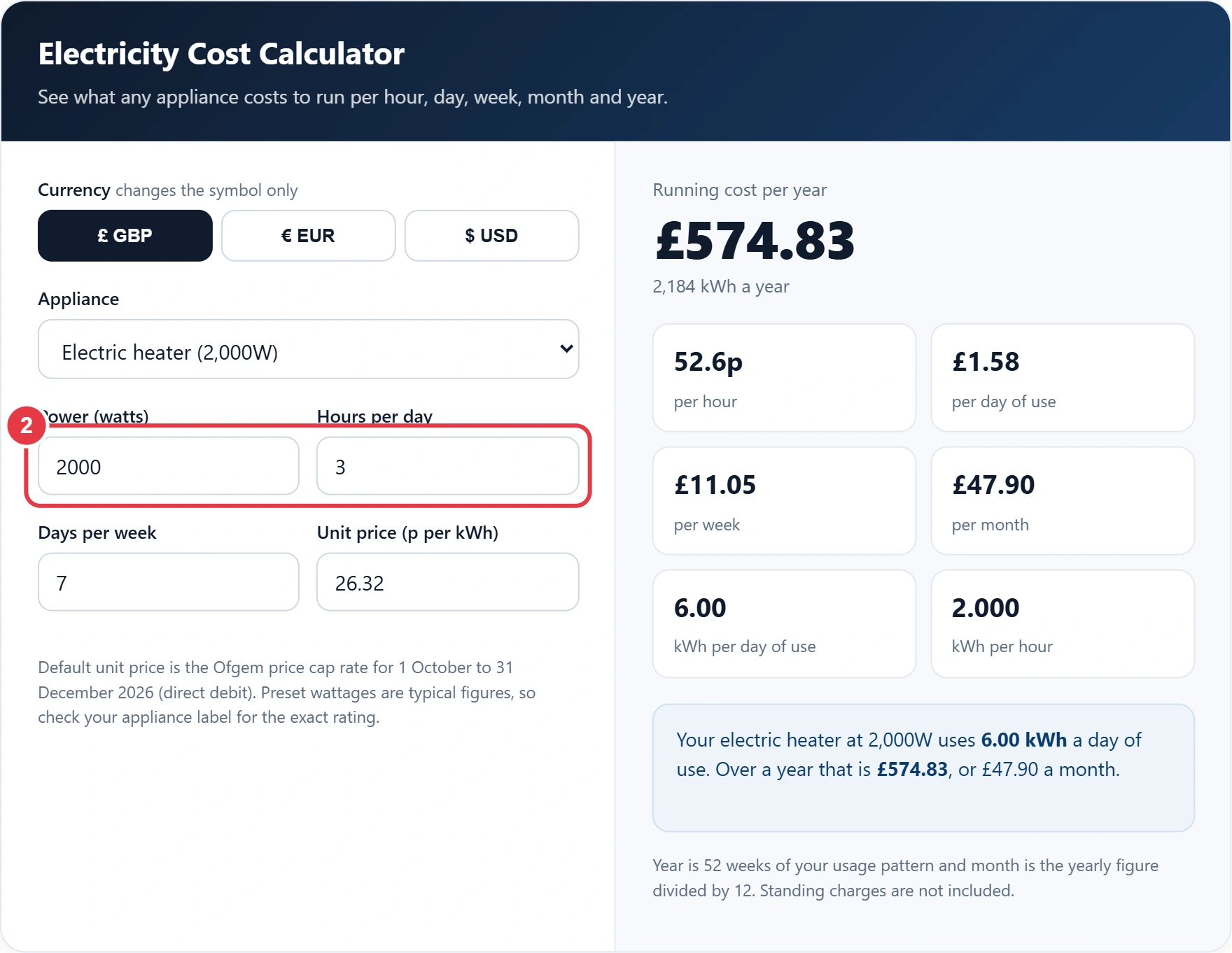
Step 2: Enter the Watts and Hours
Check the label on the back or base of the appliance for its power in watts (W) or kilowatts (kW). One kW is 1,000W. Then enter how many hours a day it runs. Use decimals for short bursts: 0.25 is 15 minutes and 0.5 is half an hour.
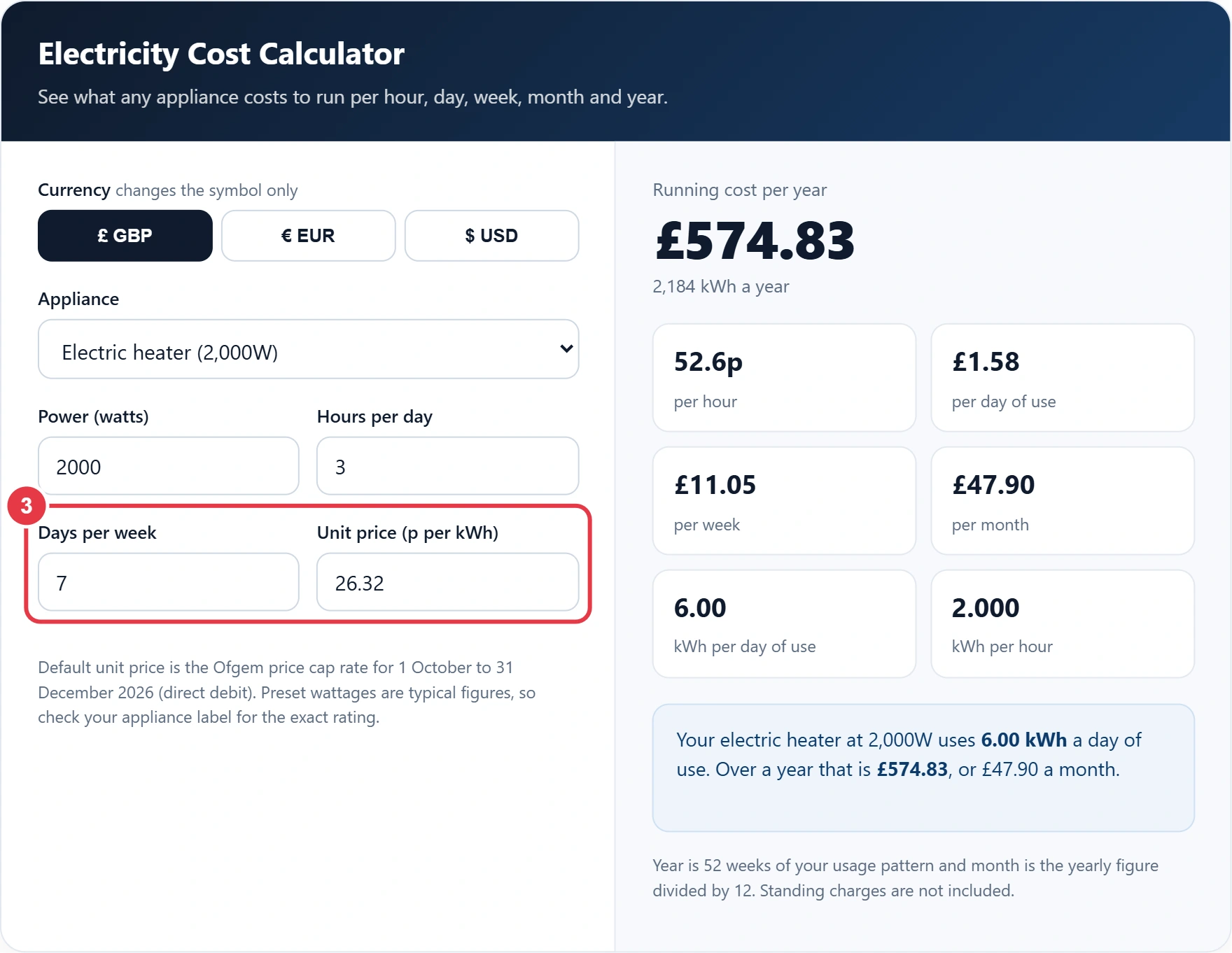
Step 3: Set the Days and Unit Price
Enter how many days a week you use the appliance and the unit rate from your bill. The default is the UK price cap rate for October to December 2026, and if you already know the kWh figure from a smart meter, the kWh cost calculator turns it straight into pounds. Choose £, € or $ to show the symbol you use; the maths stays the same.
Step 4: Read the Running Costs
Results update as you type, showing the cost per hour, per day of use, per week, per month and per year, plus the energy used in kWh. To add standing charges and see a whole household bill, use the energy bill calculator alongside these appliance figures. The yearly figure is 52 weeks of your pattern, and the monthly figure is that total divided by 12.
How Much Do Common Appliances Cost to Run?
At 26.32p per kWh, a 2,000W electric heater costs 52.6p an hour and £574.83 a year at 3 hours a day, while a kettle costs £57.48 a year. These examples use a unit rate of 26.32p per kWh and the same usage patterns as the calculator presets.
| Appliance | Power | Typical use | Cost per hour | Cost per year |
|---|---|---|---|---|
| Kettle | 3,000W | 12 minutes a day | 79.0p | £57.48 |
| Electric heater | 2,000W | 3 hours a day | 52.6p | £574.83 |
| Tumble dryer | 2,500W | 1 hour, 3 days a week | 65.8p | £102.65 |
| Gaming PC | 400W | 3 hours a day | 10.5p | £114.97 |
| Fridge freezer | 40W average | 24 hours a day | 1.1p | £91.97 |
| TV | 100W | 4 hours a day | 2.6p | £38.32 |
Appliances that make heat, such as heaters, dryers and ovens, cost the most because they draw a lot of power. Low wattage devices that run all day, like a fridge freezer, also add up over a year. The Energy Saving Trust has practical advice on cutting these costs, such as only boiling the water you need and drying clothes outdoors when you can.
Key Electricity Cost Calculator Terms
These terms explain the energy units and pricing used by the electricity cost calculator, so you can estimate and compare what each appliance costs to run.
- Watt
- The SI unit of power, equal to one joule of energy used each second. An appliance's wattage shows how fast it draws energy when running, so higher wattage devices cost more for every hour of use.
- Kilowatt-hour
- The unit of energy on electricity bills, equal to 1,000 watts used for one hour, or 3.6 megajoules. Multiplying kilowatt-hours by the unit price gives the cost of running any appliance.
- Power rating
- The wattage printed on an appliance's rating plate or in its manual, describing the maximum power it draws. Devices that cycle on and off, such as fridges or washing machines, use less than this rating on average.
- Unit rate
- The price charged for each kilowatt-hour of electricity, shown in pence on a bill. It varies by tariff, payment method and region, so using the figure from your own bill gives the most accurate running costs.
- Energy price cap
- The limit Ofgem sets on the unit rates and standing charges suppliers can charge households on standard variable tariffs in Great Britain. It is reviewed periodically, so running costs change whenever the cap is updated.
- Standby power
- The electricity an appliance draws while switched off but still plugged in, for example to power a clock or remote sensor. Each device uses little, but many left on standby add a noticeable amount over a year.
</>Embed this calculator on your website
Add the free Electricity Cost Calculator to your own site or blog. Copy the code below and paste it into an HTML block. It resizes itself and works on phones.
How we checked this tool: the Tools Veria Editorial Team built this tool by hand, checked it against the official rules or published standards where they apply, and tested it against worked examples. Results are estimates for planning, not personal financial or tax advice. Read our editorial policy and disclaimer, or report an error.
Frequently Asked Questions
How do I calculate the cost of running an appliance?
Divide the wattage by 1,000 to get kW, multiply by the hours used to get kWh, then multiply by your unit price. A 3,000W kettle used for 12 minutes uses 0.6 kWh, which costs about 15.8p at 26.32p per kWh.
How much does 1 kWh of electricity cost in the UK?
Under the Ofgem price cap from 1 October to 31 December 2026, electricity costs 26.32p per kWh on direct debit, plus a standing charge of 54.83p a day. Your own tariff may differ.
Where do I find the wattage of an appliance?
Look for the rating plate or sticker on the back, base or inside the door, or check the manual. It shows the power in watts (W) or kilowatts (kW).
Does the calculator include the standing charge?
No. The standing charge is a fixed daily fee you pay whatever you use, so it is left out of appliance running costs.
Why does my fridge freezer use less than its rated wattage?
The compressor switches on and off to keep the temperature steady, so the average draw over a day is much lower than its peak rating.
Can I use this calculator outside the UK?
Yes. Choose € or $ to change the symbol and enter your local unit price per kWh in cents. The formula works the same in any currency.