Capital Gains Tax on selling all or part of a business, with the £1 million lifetime limit.
Estimate using GOV.UK rules: relief rate 18% from 6 April 2026 (14% from 6 April 2025), £1 million lifetime limit, normal CGT rates 18% and 24%, £3,000 annual exempt amount used first against non qualifying gains, relief gains use the basic rate band first. England, Wales and Northern Ireland income bands. You must meet the qualifying conditions for 2 years. Check with HMRC or a tax adviser.
This business asset disposal relief calculator is for UK sole traders, partners and company shareholders selling or closing a business in 2026/27, or checking a 2025/26 sale. It works out the gain, applies the GOV.UK Business Asset Disposal Relief rates and the £1 million lifetime limit, uses your basic rate band in the right order and shows the tax saved. Figures checked October 2026.
Quick answer: Business Asset Disposal Relief taxes qualifying gains at 18% for disposals from 6 April 2026, and 14% from 6 April 2025 to 5 April 2026, on up to £1 million of lifetime gains. A business asset disposal relief calculator shows a higher rate taxpayer saves 6% against the normal 24% rate.
In This Guide
What Is Business Asset Disposal Relief?
Business Asset Disposal Relief (BADR), formerly Entrepreneurs' Relief, is a lower rate of Capital Gains Tax on gains from selling all or part of a trading business, or shares in your personal trading company. You claim it, and it covers up to £1 million of qualifying gains across your lifetime.
The formula in plain words: gain equals sale proceeds minus original cost and costs of sale. Take off any annual exempt amount not used on other gains, then multiply by 18%, or 14% for a 2025/26 disposal. Any gain beyond your remaining £1 million limit is taxed at the normal rates instead: 18% inside your unused basic rate band and 24% above it. Relief gains use up the basic rate band first, which matters if you also sell shares or property in the same year.
How to Use the Business Asset Disposal Relief Calculator
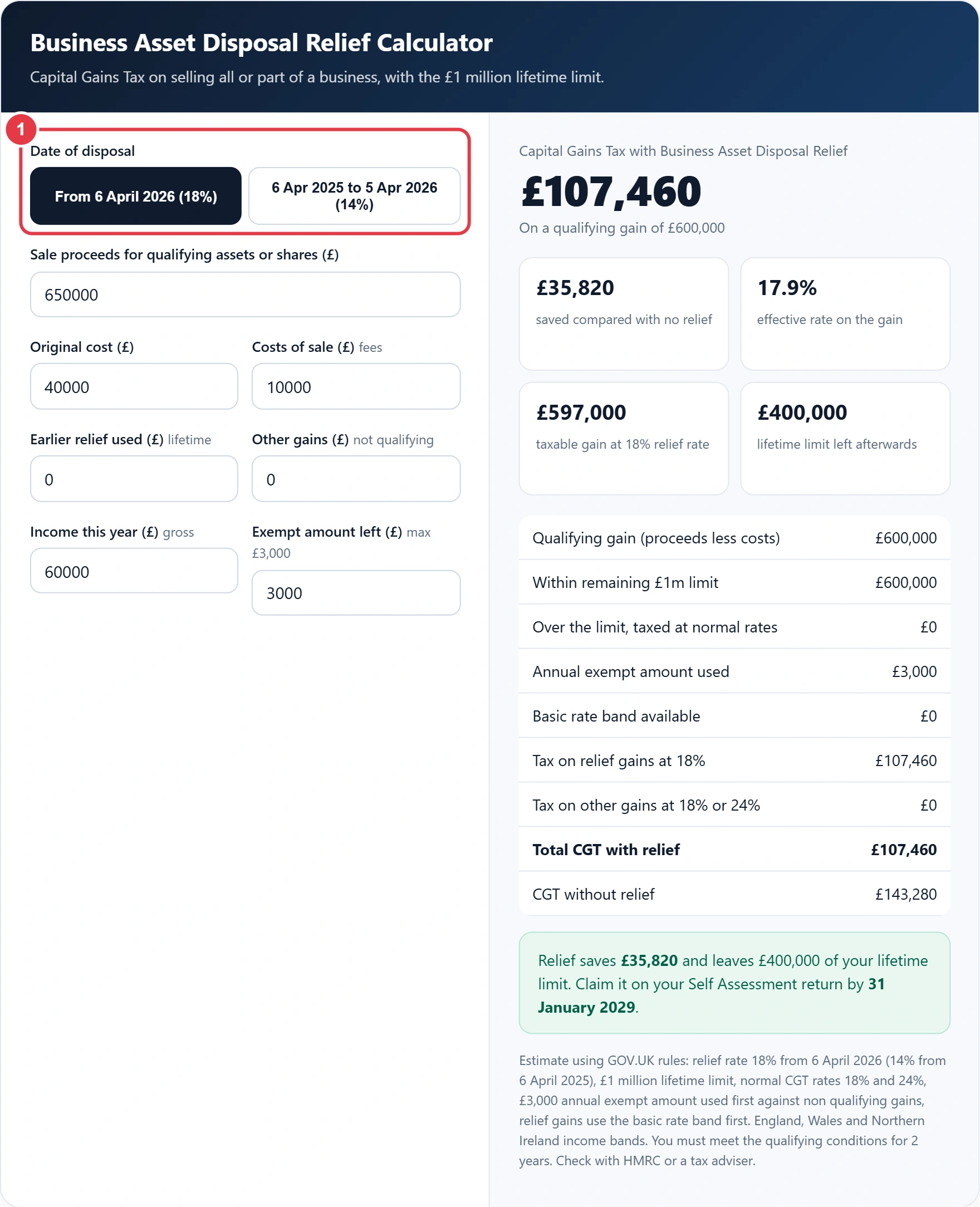
Step 1: Choose the Disposal Date
Pick the period your sale falls in. The date of disposal for CGT is usually when the contract becomes unconditional, not when the money arrives. Special anti-forestalling rules can apply where a contract signed before a rate change completes after it, so take advice if your sale straddles 6 April 2026.
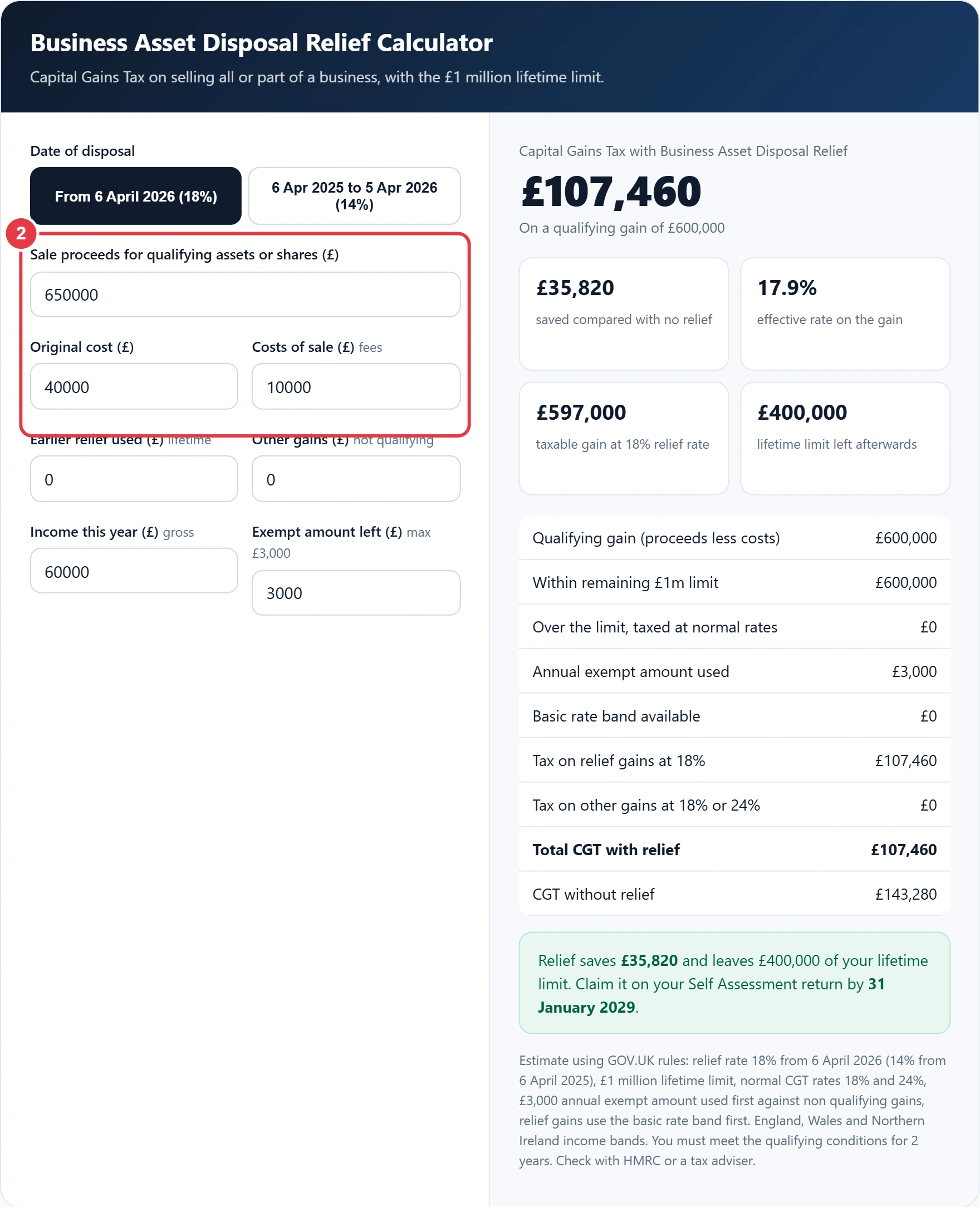
Step 2: Enter the Sale and Costs
Enter the proceeds for the qualifying assets or shares, what you originally paid for them and the costs of the sale, such as legal fees and broker commission. For a sole trader business, include goodwill and the other chargeable business assets sold, but not stock or debtors, which are taxed as trading income.
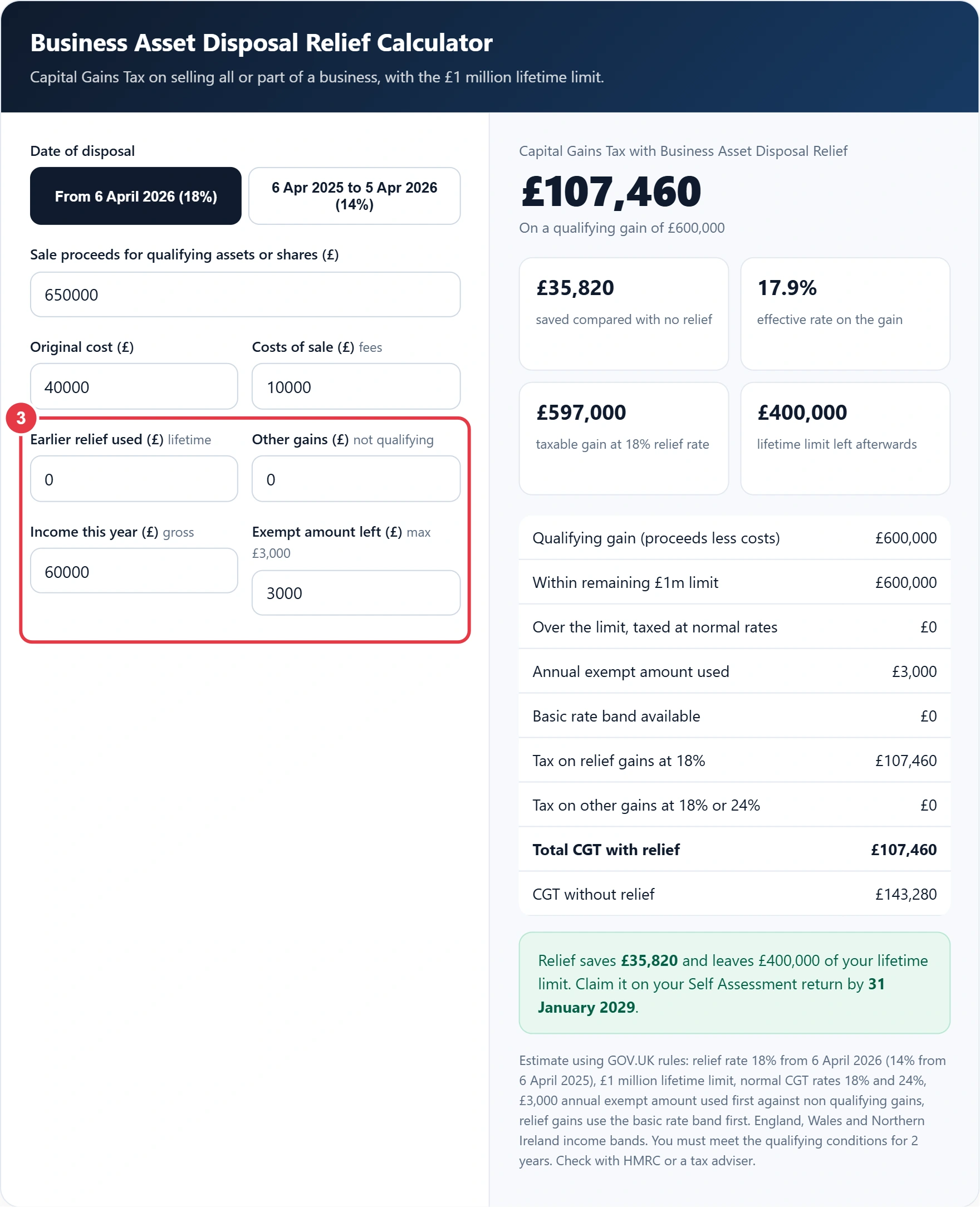
Step 3: Add Earlier Relief, Other Gains and Income
Enter relief claimed on any earlier disposals, because the £1 million limit is for life. Add other gains this year that do not qualify, and your total taxable income before the personal allowance, so the tool knows how much basic rate band is left. Reduce the £3,000 exempt amount if you have already used some.
Step 4: Read the Tax and the Saving
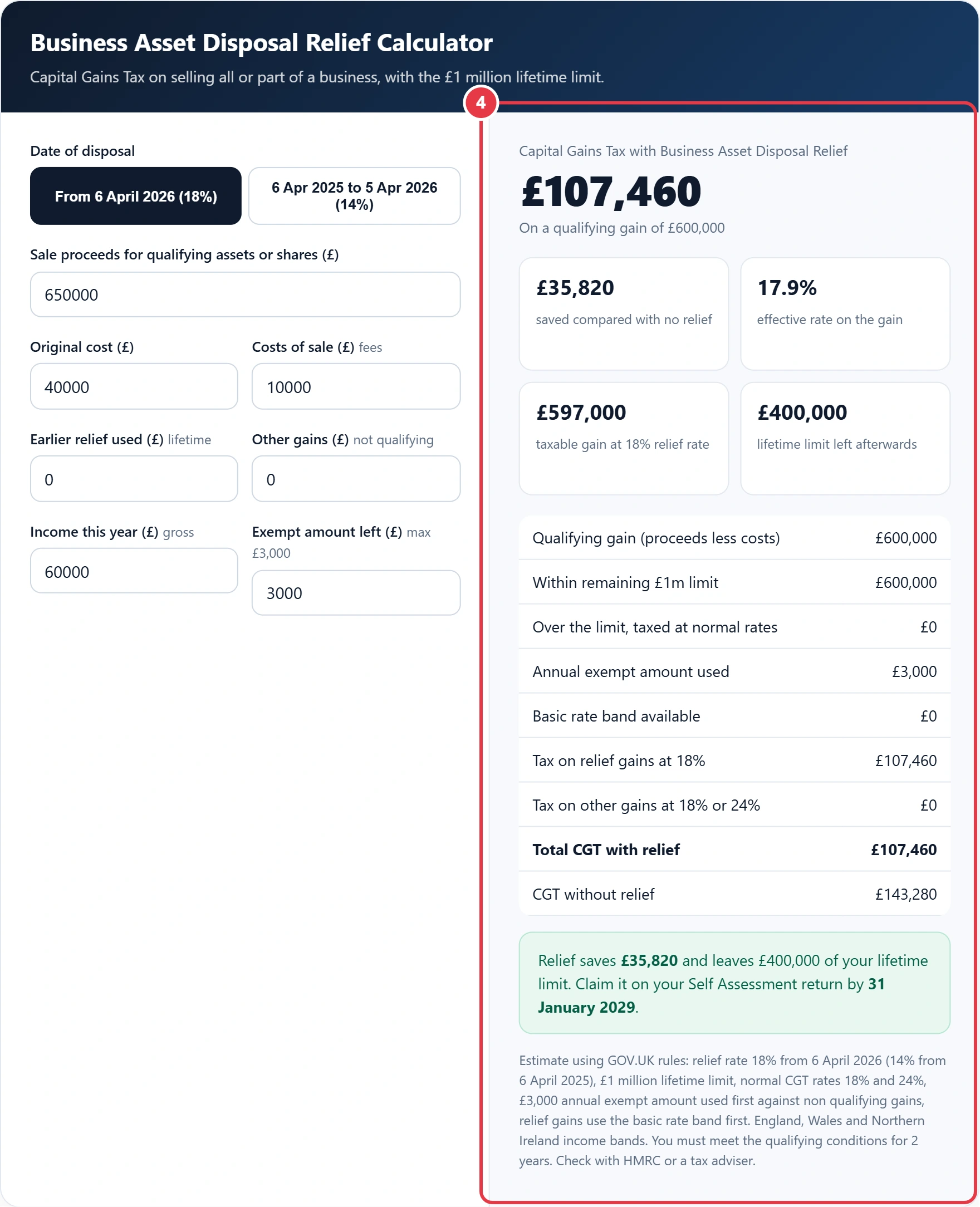
The headline is your total Capital Gains Tax for the year with the relief. The stats show the saving against no relief, the effective rate on the business gain, the gain charged at the relief rate and how much lifetime limit remains. The table shows each step, and the message gives your claim deadline.
How Much Tax Will I Pay When I Sell My Business?
With the relief, a higher rate taxpayer pays 18% on qualifying gains above the £3,000 exempt amount for a sale from 6 April 2026. The table shows the tax for a higher rate taxpayer with no other gains, set against the 24% normal rate.
| Qualifying gain | CGT with relief (18%) | CGT without relief (24%) | Saving |
|---|---|---|---|
| £100,000 | £17,460 | £23,280 | £5,820 |
| £250,000 | £44,460 | £59,280 | £14,820 |
| £500,000 | £89,460 | £119,280 | £29,820 |
| £1,000,000 | £179,460 | £239,280 | £59,820 |
| £1,500,000 | £299,280 | £359,280 | £60,000 |
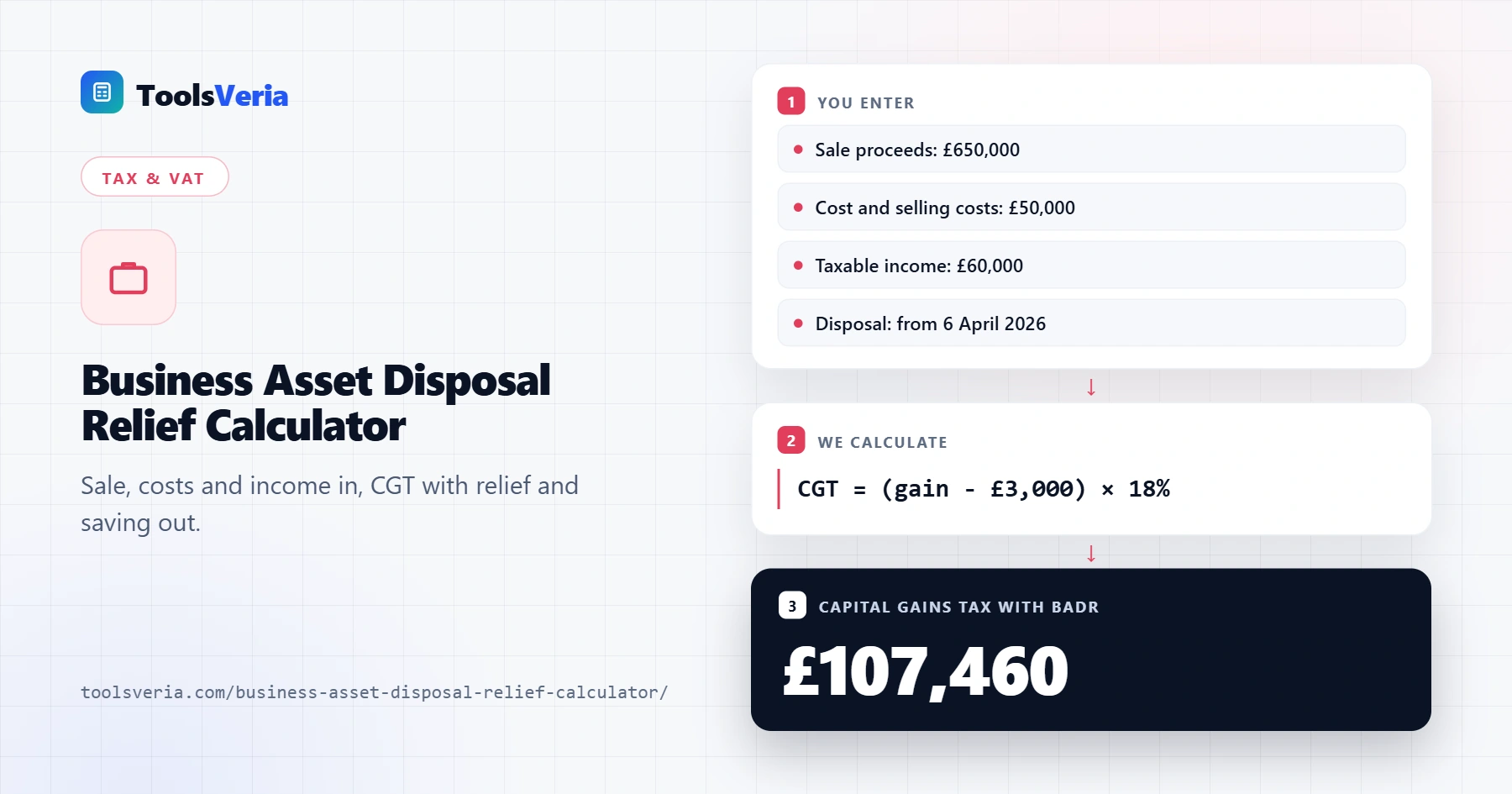
Worked example: Sanjay sells his joinery business in November 2026 for £650,000. The assets cost £40,000 and the sale costs £10,000, so his gain is £600,000. He has £60,000 of income, so no basic rate band is left. After the £3,000 exempt amount, £597,000 at 18% is £107,460 of CGT, against £143,280 at 24% without relief. He saves £35,820 and keeps £400,000 of his lifetime limit.
How Have Business Asset Disposal Relief Rates Changed?
The rate has risen in two steps, from 10% to 14% in April 2025 and to 18% in April 2026, while the normal CGT rates have stayed at 18% and 24% since 30 October 2024. The lifetime limit is £1 million, and GOV.UK notes that people who sold before 11 March 2020 may have been able to claim more.
| Disposal date | Relief rate | Normal higher rate CGT | Claim deadline |
|---|---|---|---|
| On or before 5 April 2025 | 10% | 20% or 24% | 31 January 2027 for 2024/25 |
| 6 April 2025 to 5 April 2026 | 14% | 24% | 31 January 2028 |
| From 6 April 2026 | 18% | 24% | 31 January 2029 for 2026/27 |
The 18% rate and the £1 million test are written into section 169N of the Taxation of Chargeable Gains Act 1992, and section 169M sets the deadline: the first anniversary of 31 January after the tax year of the sale.
Is Business Asset Disposal Relief Worth Claiming for Basic Rate Taxpayers?
It only saves tax on the part of the gain above your unused basic rate band, because from 6 April 2026 both the relief rate and the normal basic rate are 18%. The saving is 6% of the gain that would otherwise be charged at 24%.
Worked example: Laura has £30,000 of income, leaving £20,270 of basic rate band, and makes a £50,000 qualifying gain. With relief, £47,000 at 18% is £8,460. Without it, £20,270 at 18% plus £26,730 at 24% is £10,064. She saves about £1,604 but uses £50,000 of her lifetime limit, which is worth weighing if a larger sale may follow.
Company owners planning an exit often review how they draw profits in the final years as well. The salary vs dividend calculator compares the options, so you can set income at a level that leaves more basic rate band for the sale year.
Who Qualifies for Business Asset Disposal Relief?
- Sole traders and partners: you owned the business for at least 2 years up to the sale or closure. After closing, assets must be sold within 3 years.
- Shareholders: for 2 years you were an employee or officer, the company traded, and you held at least 5% of shares and voting rights plus 5% of profits and assets or sale proceeds.
- EMI shares: options granted at least 2 years before the sale and shares acquired after 5 April 2013, with no 5% test.
- Assets you lent the business: they can qualify alongside a sale of at least 5% of your partnership share or company shares.
Profits you earned while trading are taxed separately, so the self employed tax calculator covers the final year's trading income if you run the business as a sole trader.
</>Embed this calculator on your website
Add the free Business Asset Disposal Relief Calculator to your own site or blog. Copy the code below and paste it into an HTML block. It resizes itself and works on phones.
How we checked this tool: the Tools Veria Editorial Team built this tool by hand, checked it against the official rules or published standards where they apply, and tested it against worked examples. Results are estimates for planning, not personal financial or tax advice. Read our editorial policy and disclaimer, or report an error.
Frequently Asked Questions
What is the Business Asset Disposal Relief rate for 2026/27?
The rate is 18% for qualifying disposals made on or after 6 April 2026. It was 14% for disposals from 6 April 2025 to 5 April 2026 and 10% before that, on up to £1 million of lifetime gains.
What is the lifetime limit for Business Asset Disposal Relief?
The lifetime limit is £1 million of qualifying gains, across all your claims. Gains above the limit are taxed at normal CGT rates of 18% or 24%, so the most the relief can save in 2026/27 is £60,000.
How do I claim Business Asset Disposal Relief?
Claim it on your Self Assessment return or with Section A of the Business Asset Disposal Relief helpsheet. The deadline is the first anniversary of 31 January after the tax year, so 31 January 2029 for a 2026/27 sale.
Is Business Asset Disposal Relief the same as Entrepreneurs' Relief?
Yes. Business Asset Disposal Relief is the current name for Entrepreneurs' Relief, with the same core conditions. The lifetime limit is now £1 million, though GOV.UK says people who sold assets before 11 March 2020 may have claimed more.
Does the annual exempt amount apply with Business Asset Disposal Relief?
Yes. You still get the £3,000 annual exempt amount, and GOV.UK says to use it first against gains charged at 24%. Any amount left over then reduces your gains that qualify for the relief.
Do I need 5% of the shares to get Business Asset Disposal Relief?
Usually yes. For 2 years before the sale you need at least 5% of the shares and voting rights, plus 5% of profits and assets or sale proceeds, and you must be an employee or officer. EMI shares are exempt from the 5% test.