Pension lump sums and ex gratia termination payments, at 2026 Revenue rules.
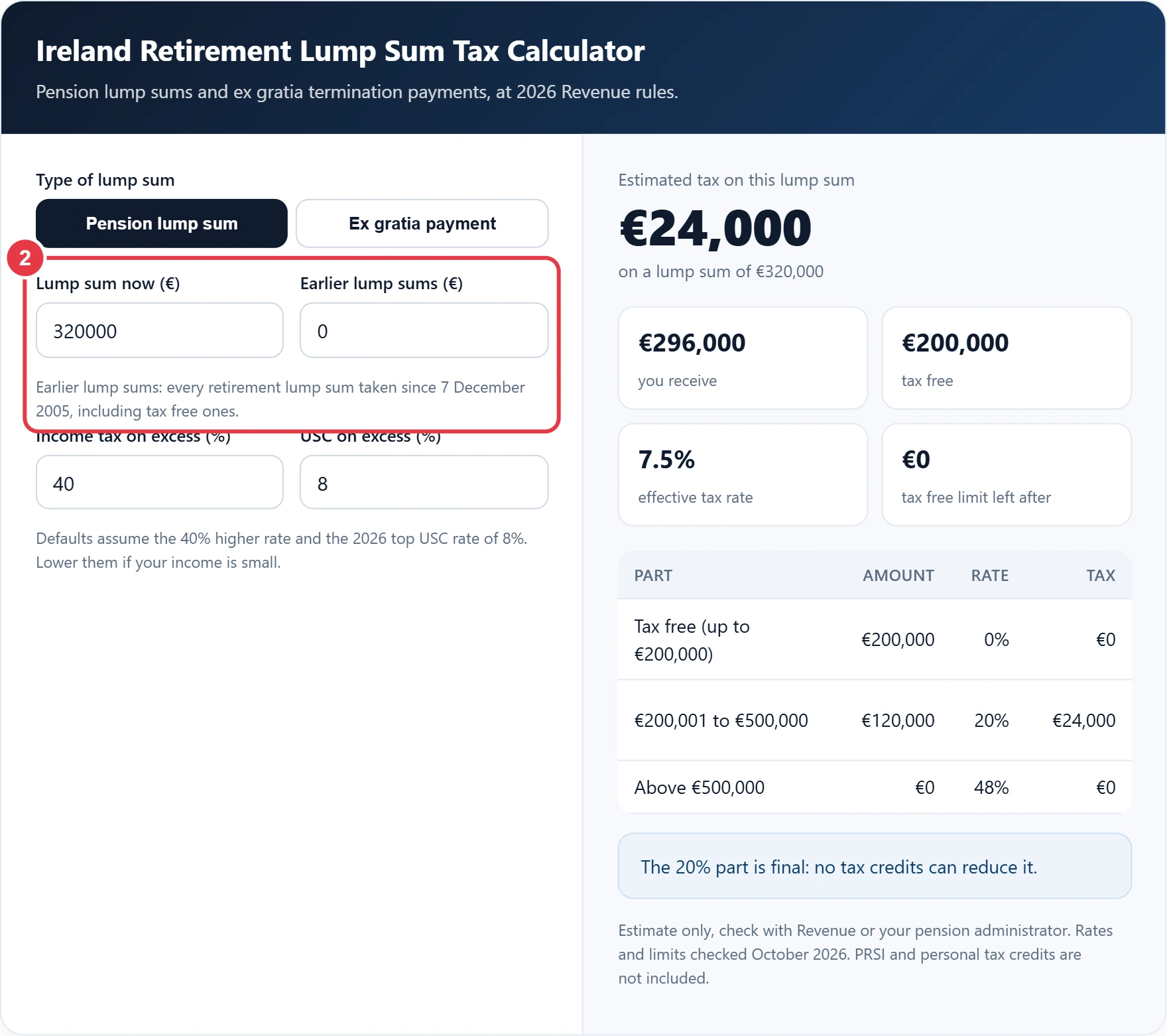
Earlier lump sums: every retirement lump sum taken since 7 December 2005, including tax free ones.
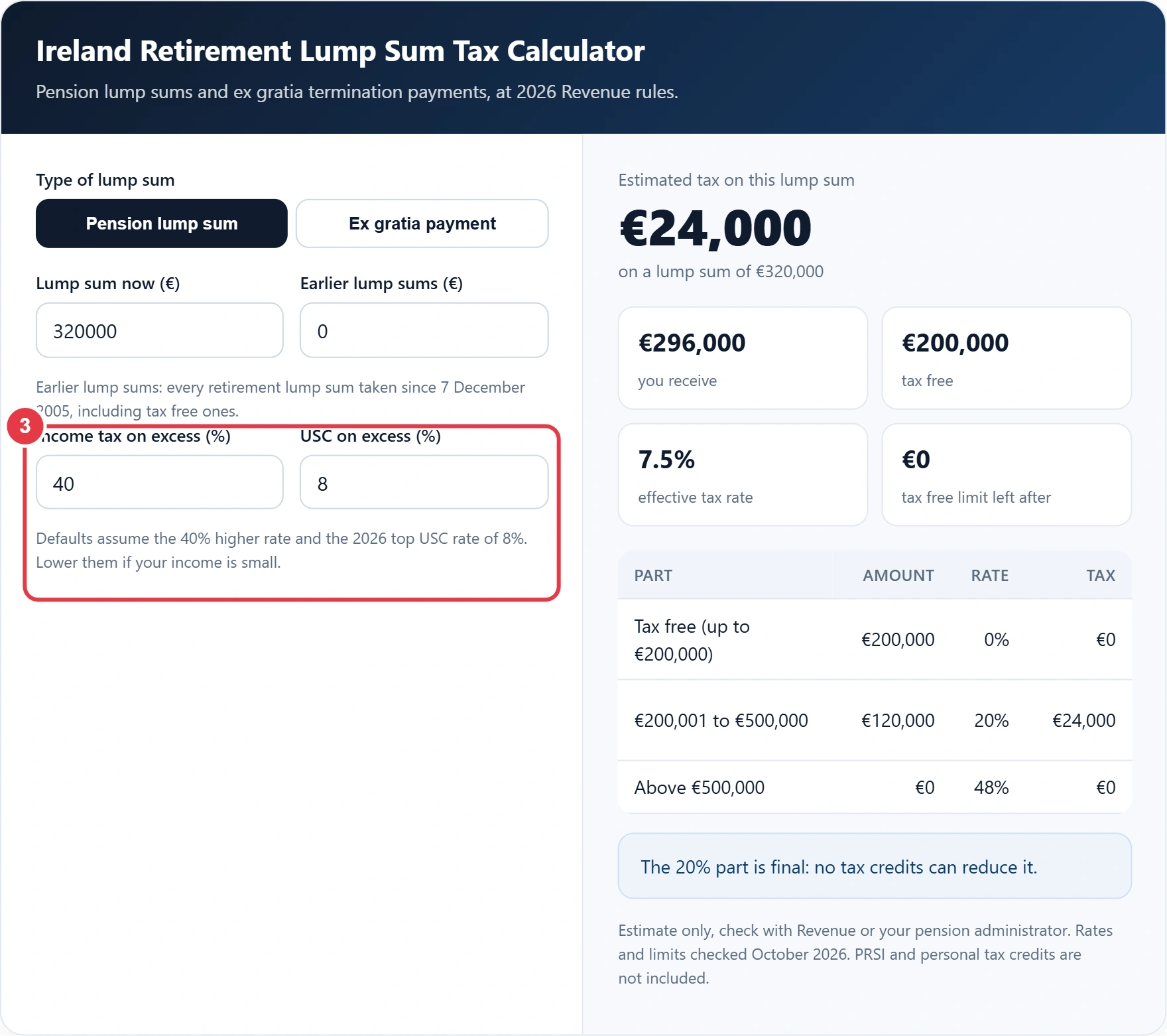
Defaults assume the 40% higher rate and the 2026 top USC rate of 8%. Lower them if your income is small.
| Part | Amount | Rate | Tax |
|---|
Estimate only, check with Revenue or your pension administrator. Rates and limits checked October 2026. PRSI and personal tax credits are not included.
This Ireland retirement lump sum tax calculator shows people retiring in Ireland in 2026 how much tax Revenue takes from a pension lump sum, and how much of an ex gratia termination payment is tax free. It applies the lifetime limits set by the Revenue Commissioners, counts the lump sums you took before, and shows the net amount in euro. Figures checked October 2026.
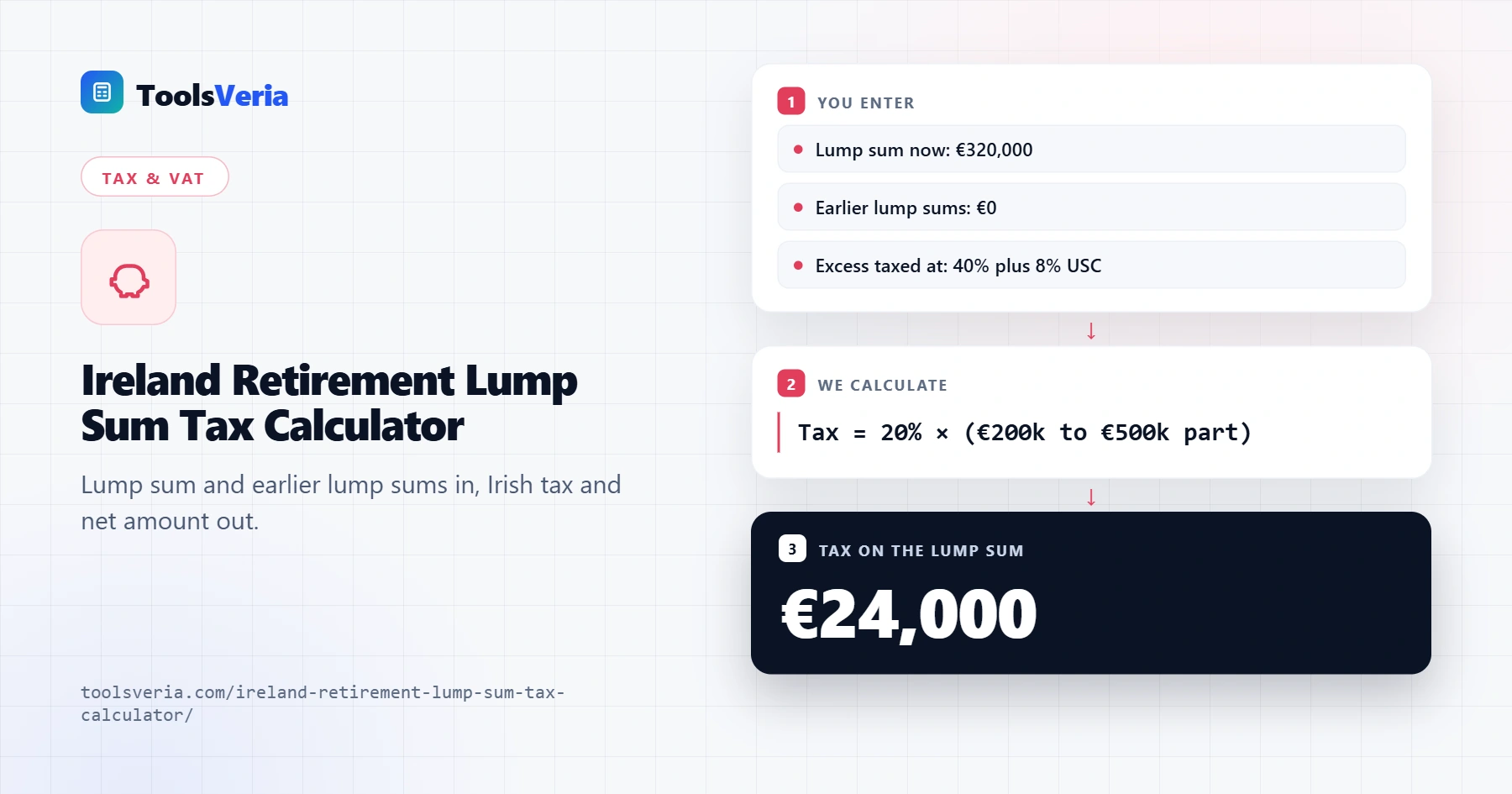
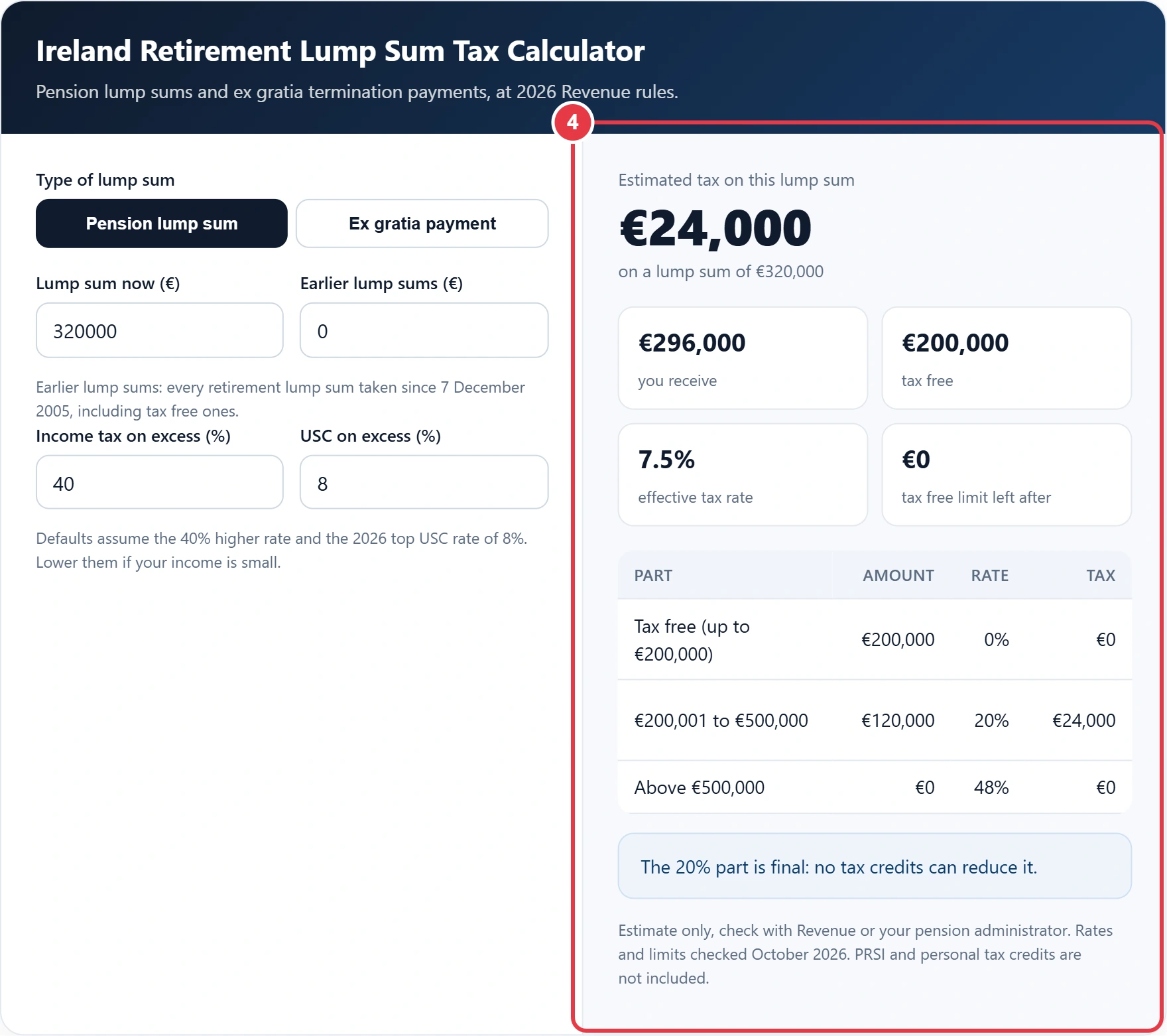
Quick answer: The first €200,000 of retirement lump sums in your lifetime is tax free, the next €300,000 is taxed at 20% and anything over €500,000 is taxed at your marginal rate plus USC. The Ireland retirement lump sum tax calculator shows that a €320,000 lump sum costs €24,000 in tax.
In This Guide
What Is Retirement Lump Sum Tax in Ireland?
Retirement lump sum tax is the income tax Revenue charges when the total of all retirement lump sums you have taken since 7 December 2005 goes above €200,000. It applies to lump sums from occupational schemes, PRSAs, personal pensions and foreign pension arrangements alike.
In plain words: add the new lump sum to your earlier lump sums, then tax the slice between €200,000 and €500,000 at 20% and the slice above €500,000 at your marginal rate. The 20% slice is ring fenced, which means it is a final charge that no tax credit or relief can reduce. The slice above €500,000 goes through PAYE as ordinary income, so USC is due on it too.
How Much Tax Do You Pay on a Retirement Lump Sum in Ireland?
You pay nothing on the first €200,000, 20% on the next €300,000 and around 48% above €500,000 if you are a higher rate taxpayer paying 40% income tax and 8% USC. The table shows a first lump sum with no earlier lump sums.
| Lump sum | Tax free | Taxed at 20% | Taxed at 40% plus 8% USC | Total tax |
|---|---|---|---|---|
| €150,000 | €150,000 | €0 | €0 | €0 |
| €250,000 | €200,000 | €50,000 | €0 | €10,000 |
| €400,000 | €200,000 | €200,000 | €0 | €40,000 |
| €600,000 | €200,000 | €300,000 | €100,000 | €108,000 |
Take Niamh, who took €150,000 from a previous employer's scheme in 2019 and now takes €420,000 from her current scheme. Only €50,000 of her tax free amount is left. The next €300,000 is taxed at 20%, which is €60,000, and the final €70,000 is above €500,000 in total, so it costs €33,600 at 40% plus 8% USC. Her tax is €93,600 and she keeps €326,400.
How to Use the Ireland Retirement Lump Sum Tax Calculator
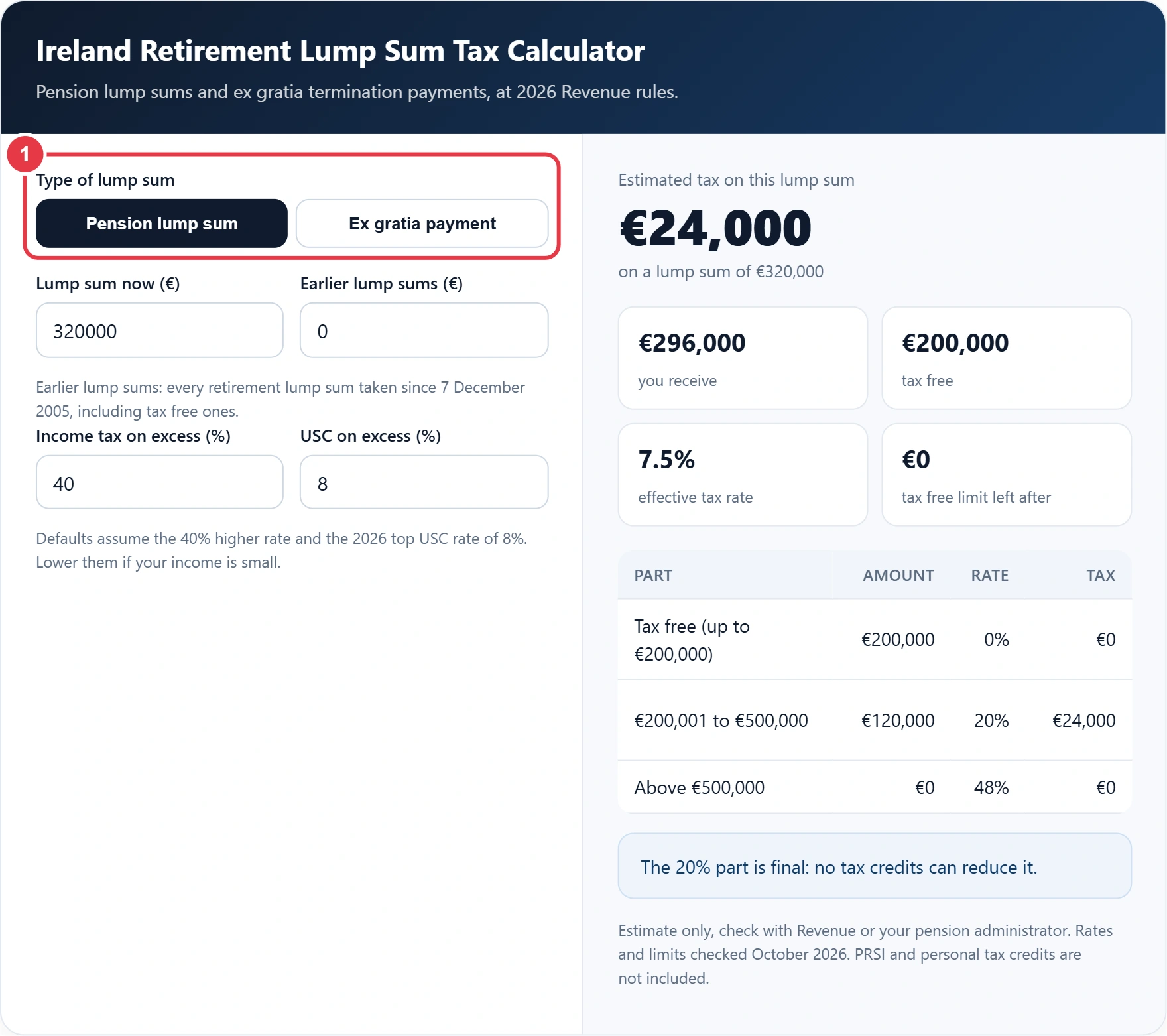
Step 1: Choose the Type of Lump Sum
Pick a pension retirement lump sum for money from a pension scheme or PRSA. Pick ex gratia termination payment for a payment from your employer when you leave a job, such as a severance package on top of statutory redundancy.
Step 2: Enter the Amounts
For a pension, enter the lump sum and the total of earlier retirement lump sums since 7 December 2005, including tax free ones. For an ex gratia payment, enter the payment, your full years of service, your average pay over the last 36 months and any tax free pension lump sum from the same job.
Step 3: Set the Rates on the Excess
Keep 40% and 8% if your other income already reaches the higher rate band and the top USC band, which starts at €70,044 for 2026. Lower them if your income is small, and see the overview of taxation in Ireland for how the bands fit together.
Step 4: Read the Result
The Ireland retirement lump sum tax calculator shows the tax, what you receive, the tax free part, your effective rate and how much of the €200,000 lifetime limit remains. The table breaks the lump sum into its bands, or lists each termination exemption so you can see which one wins.
How Is an Ex Gratia Termination Payment Taxed?
An ex gratia payment is tax free up to the highest of three exemptions, and the rest is taxed as pay through PAYE with USC. Statutory redundancy pay is exempt on its own and is not part of this sum.
- Basic exemption: €10,160 plus €765 for each full year of service.
- Increased exemption: up to €10,000 more, reduced by any tax free pension lump sum from the job, and only if you have not had more than the basic exemption in the last 10 years.
- SCSB: average yearly pay for the last 36 months × years of service ÷ 15, minus any tax free pension lump sum.
- All three are capped by a lifetime limit of €200,000 of tax free termination payments.
Ciarán leaves after 22 years with an €85,000 package and average pay of €52,000. His basic exemption is €26,990 and his increased exemption €36,990, but his SCSB is €76,267, so €76,267 is tax free. The remaining €8,733 costs about €4,192 at 40% plus 8% USC. If he plans to save the money, the savings interest calculator shows what it could earn on deposit, and the compound interest calculator works just as well with euro amounts. Keep part of the package aside if your pension does not start straight away.
</>Embed this calculator on your website
Add the free Ireland Retirement Lump Sum Tax Calculator to your own site or blog. Copy the code below and paste it into an HTML block. It resizes itself and works on phones.
How we checked this tool: the Tools Veria Editorial Team built this tool by hand, checked it against the official rules or published standards where they apply, and tested it against worked examples. Results are estimates for planning, not personal financial or tax advice. Read our editorial policy and disclaimer, or report an error.
Frequently Asked Questions
How much of my pension lump sum is tax free in Ireland?
Up to €200,000 over your whole lifetime, counting every retirement lump sum taken since 7 December 2005 from all sources. Anything above that, up to €500,000 in total, is taxed at 20%.
Is USC charged on a retirement lump sum?
USC applies to the part above €500,000, which is taxed as income through PAYE. Revenue charges the slice from €200,001 to €500,000 as a separate ring fenced 20% tax outside your total income, and the first €200,000 is tax free.
Can tax credits reduce the 20% tax on my lump sum?
No. The 20% charge on the slice between €200,000 and €500,000 is ring fenced, so personal tax credits and reliefs cannot be set against it. It is deducted before you are paid.
Do earlier lump sums count towards the €200,000 limit?
Yes. All retirement lump sums paid on or after 7 December 2005 are added together. If you took €120,000 before, only €80,000 of a new lump sum is tax free.
What is the SCSB in Ireland?
The Standard Capital Superannuation Benefit is a tax free amount for ex gratia termination payments: average pay for the last 36 months × full years of service ÷ 15, minus any tax free pension lump sum.
Is statutory redundancy pay taxed in Ireland?
No. Statutory redundancy under the Redundancy Payments Act 1967 is exempt from income tax and USC. Only an ex gratia payment above it is tested against the basic exemption, the increased exemption and the SCSB.