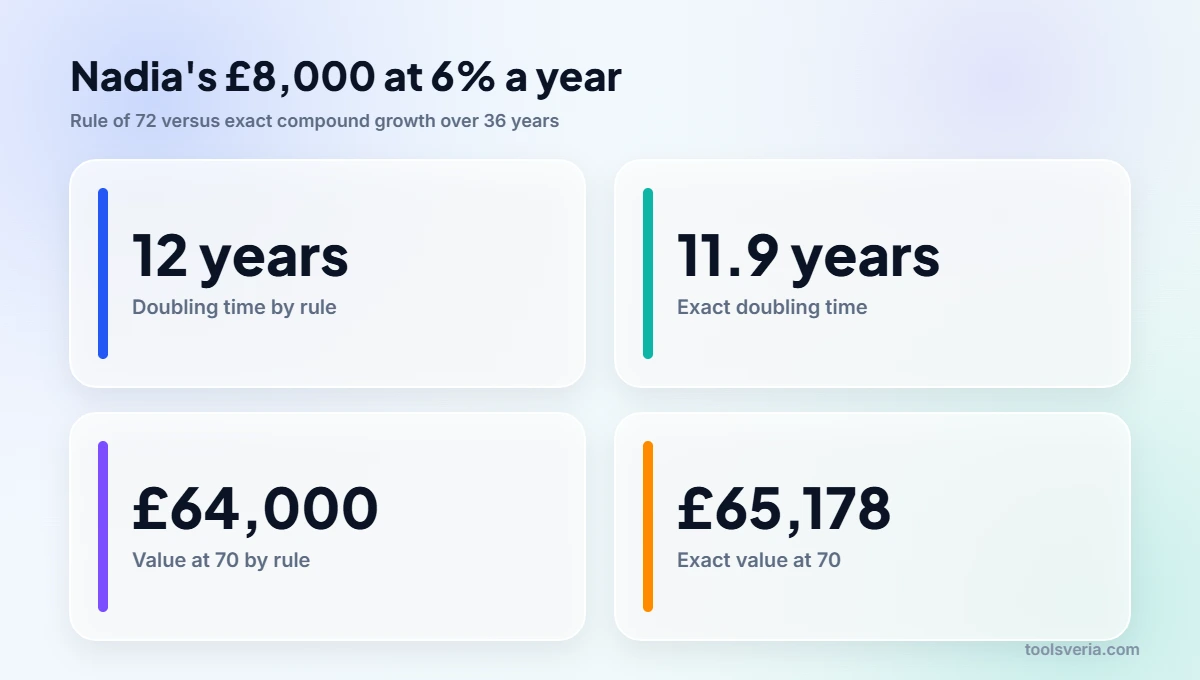
Nadia is 34 and has £8,000 sitting in a global tracker fund. Her question is simple: if she never adds another penny, roughly what will it be worth when she is 70? With the rule of 72 explained properly, she can answer that on the back of a receipt in under a minute, and the same trick tells her how fast rising prices are eating into her cash savings.
The shortcut is remarkably good at everyday rates, slightly off at high ones and silent about fees, tax and bad years. Each of those points is shown below, with the rule of 72 explained through real numbers, including UK inflation since 2000.
Quick answer: With the rule of 72 explained simply, money doubles in roughly 72 divided by the yearly percentage return, so 6% a year doubles a sum in about 12 years against an exact 11.9. It works for inflation too: at 3% a year, prices double and cash loses half its spending power in about 24 years.
In This Guide
Rule of 72 Explained: How Does It Work?
The rule of 72 works by dividing 72 by the annual growth rate in per cent, which gives an estimate of the years needed for a sum to double when returns compound each year. Dividing 72 by a target number of years does the reverse and gives the growth rate needed.
Nadia assumes 6% a year after charges. Her doubling time is 72 divided by 6, or 12 years. From 34 to 70 is 36 years, which is three doublings: £8,000 becomes £16,000, then £32,000, then £64,000. The precise compound figure is £65,178, so the mental version lands within 2% of the answer across nearly four decades.
Her sister Farah prefers cash. At 4% interest, 72 divided by 4 gives 18 years to double, so over the same 36 years her £8,000 doubles twice to £32,000, before any tax. If Farah wants her money to double within 10 years instead, she needs 72 divided by 10, which is 7.2% a year, a return no instant access account is likely to offer for that long.
How accurate is the rule of 72?
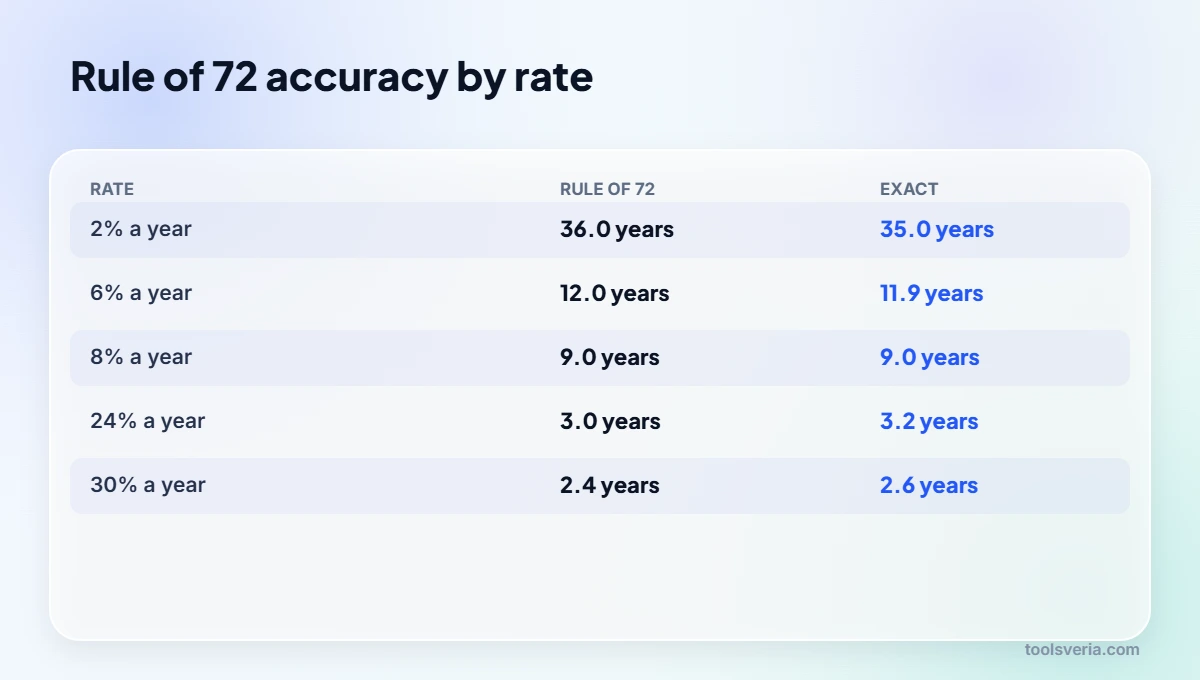
The rule of 72 is accurate to within a few months for annual returns between about 4% and 12%, and its error grows as rates move further from 8%, where it is almost perfect. The exact doubling time uses logarithms: the natural log of 2 divided by the natural log of one plus the rate.
| Yearly rate | Rule of 72 estimate | Exact doubling time | Gap |
|---|---|---|---|
| 2% | 36.0 years | 35.0 years | 1.0 year too long |
| 4% | 18.0 years | 17.7 years | 0.3 years too long |
| 6% | 12.0 years | 11.9 years | 0.1 years too long |
| 8% | 9.0 years | 9.0 years | Almost none |
| 12% | 6.0 years | 6.1 years | 0.1 years too short |
| 24% | 3.0 years | 3.2 years | 0.2 years too short |
| 30% | 2.4 years | 2.6 years | 0.2 years too short |
Why 72 and not 69 or 70? The truly exact constant for continuous growth is about 69.3, yet 72 splits cleanly by 2, 3, 4, 6, 8, 9 and 12, which makes it far easier to use in your head. The Wikipedia article on the rule of 72 sets out the derivation if you enjoy the algebra, and it shows why the number drifts upward at higher rates.
How fast does inflation halve the value of money?
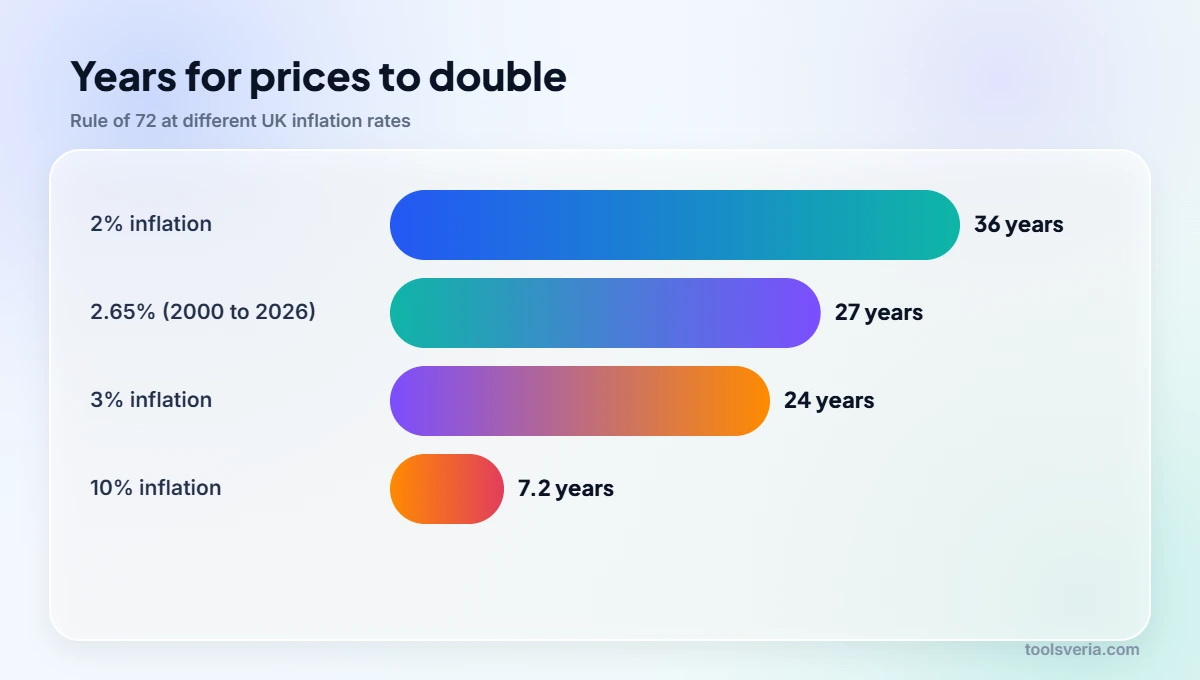
A pound loses half its buying power after about 72 divided by the annual inflation rate in years, which means around 36 years at 2% inflation and around 24 years at 3%. The same doubling that grows an investment also doubles prices, and when prices double, every pound buys half as much.
UK data lets you test this. The Office for National Statistics consumer prices index averaged 72.7 in 2000 and reached 143.6 in August 2026, according to ONS series D7BT for CPI, so prices have risen by a factor of 1.975 in roughly 26 years. That implies average inflation of about 2.65% a year, and 72 divided by 2.65 predicts a doubling in about 27 years. Reality and rule sit very close.
In pounds, £1,000 kept in a drawer since 2000 now buys what about £506 bought then. To see the effect between any two years, our UK inflation calculator applies the same ONS index, and it is a sobering check before leaving a large sum in a current account paying nothing.
Short bursts matter too. CPI moved from 111.6 in 2021 to 130.5 in 2023, a rise of about 16.9% in two years. Had prices kept rising at a steady 10% a year, the rule of 72 warns that they would have doubled in just over seven years.
Where does the rule of 72 break down?
The rule of 72 breaks down when returns are very high, when interest compounds daily, when fees and tax are ignored, and when returns jump around from year to year. In each case the simple division still gives an answer, but the answer describes a tidier world than the one your money lives in.
- Fees. If Nadia’s fund earns 6% but total charges are 1%, she should divide by 5, not 6. Her doubling time stretches from 12 years to 14.4 years, and her three doublings shrink to two and a half.
- Volatility. A gain of 20% followed by a fall of 10% averages 5% on paper, yet the pot only grows by 8% across both years, which is about 3.9% a year compounded. Dividing 72 by the average flatters the result.
- Daily compounding. A savings rate of 5% compounded daily doubles in about 13.9 years, which 69.3 divided by 5 matches better than 72 does.
- Regular deposits. The rule only follows one lump sum. Monthly payments need a proper projection, which our compound interest calculator handles year by year.
Debt is where the rule earns its keep as a warning. A credit card balance charging 24% a year with nothing repaid doubles in about three years by the rule, and in 3.2 years exactly. A £2,000 balance left alone becomes roughly £4,000 in that time, which is why clearing expensive debt usually beats saving at 4%.
Can the rule of 72 tell you when money triples?
Money roughly triples in 114 divided by the rate and quadruples in 144 divided by the rate, using the same logic as the rule of 72. At 6% that gives 19 years to triple, close to the exact 18.9, and 24 years to quadruple, close to the exact 23.8.
Farah uses these when comparing options. Her savings account at 4% would quadruple in 36 years, while Nadia’s fund at 6% does so in 24. A 2 point difference in yearly growth buys twelve years, which is the clearest argument for keeping long term money invested once an emergency fund is in place. Checking how big that gap is in percentage terms, our percentage difference calculator shows that 4% and 6% are 40% apart, which explains why the final pots diverge so sharply.
Key points
- The rule of 72 estimates doubling time as 72 divided by the yearly percentage return.
- At 6% a year money doubles in about 12 years, against an exact 11.9 years.
- UK CPI rose from 72.7 in 2000 to 143.6 in August 2026, nearly doubling prices as the rule predicts.
- A 1% yearly charge stretches a 6% doubling time from 12 years to 14.4 years.
- Above about 20% a year, the rule underestimates doubling time noticeably.
Rule of 72 Terms You Should Know
These definitions support the rule of 72 explained above, covering the growth, inflation and investment ideas you need to apply the shortcut sensibly to real money.
- Compound interest
- Interest earned on both the original sum and the interest already added, so growth speeds up over time. The rule of 72 is a shortcut for this process and does not describe simple interest, which grows by the same amount each year.
- Purchasing power
- The quantity of goods and services a sum of money can buy. When prices rise it falls, so cash earning less than the inflation rate loses real value even though the number in the account stays the same or grows.
- Consumer Prices Index
- The main official UK measure of inflation, published by the Office for National Statistics, which tracks price changes across a representative basket of goods and services. Its yearly rate can be plugged into the rule of 72 to estimate price doubling.
- Index tracker fund
- An investment fund that aims to match the performance of a market index rather than beat it, usually with low charges. Its returns vary from one year to the next, so any doubling estimate reflects an assumed average rather than a promise.
- Real return
- Investment growth after inflation has been subtracted, showing the change in actual spending power. Applying the rule of 72 to a real rather than nominal rate reveals how long it takes for what your money can buy to double.
Frequently Asked Questions
My pension fund grew 7% last year. Will it double in about ten years?
Only if it keeps averaging 7% after charges every year. The rule gives 72 divided by 7, about 10.3 years, but one strong year says little about the next decade, so test a cautious 4% or 5% alongside it.
Should I use the interest rate or the AER on my savings account?
Use the AER, because it already includes the effect of compounding within the year. A 4% AER divided into 72 gives 18 years to double before tax, and that figure is directly comparable between accounts.
Does the rule of 72 work for house prices?
It works as rough arithmetic on any steady growth rate, house prices included. If a home rose 4% a year, its value would double in about 18 years, though buying costs, mortgage interest and uneven price growth make the real picture messier.
My savings earn 4% and inflation is 3%. How long until my real money doubles?
Divide 72 by the real return of roughly 1%, which gives about 72 years. That is why savings that only just beat inflation preserve spending power but rarely grow it in any meaningful way.
Nadia wrote three numbers on her receipt: 12 years, three doublings and £64,000. She now knows that cutting her fund charges matters almost as much as the return she hopes for. Try your own rate in the calculator and compare the shortcut with the exact answer. Figures checked October 2026.