Owen moved £20,000 into a stocks and shares ISA and chose a fund his bank recommended. The factsheet listed an ongoing charge of 0.90%, the platform added 0.35%, and neither number looked worth worrying about. With fund fees OCF explained in pounds rather than percentages, the picture changes: over 25 years those two small figures could cost him close to £12,000 compared with a cheaper set up holding similar investments.
Below, Owen’s ISA and his sister Hayley’s personal pension are projected under low and high charges, using the same growth before fees, so the only thing that changes is the cost.
Quick answer: With fund fees OCF explained in pounds, a £20,000 ISA growing at 5% before fees reaches about £61,270 over 25 years at 0.40% in total charges, but only £49,453 at 1.25%. The OCF is a fund’s yearly running cost, and platform and adviser fees are charged on top of it.
In This Guide
Fund Fees OCF Explained: What Is the OCF on a Fund?
The OCF, or ongoing charges figure, is the yearly cost of running a fund shown as a percentage of the money you hold in it, and it is taken from the fund’s value rather than billed to you. A 0.90% OCF on £20,000 removes about £180 in the first year, quietly, through a slightly lower unit price.
The OCF is only one layer. Most investment platforms charge their own fee, often a percentage of your balance and sometimes a flat monthly amount, and a financial adviser may add a third layer. The MoneyHelper beginner’s guide to investing lists the OCF and adviser fees among the costs to check, which is why Owen adds them together before comparing anything.
For Owen, that total is 0.90% plus 0.35%, or 1.25% a year. The cheaper alternative he is weighing up is a global index tracker with a 0.15% OCF on a platform charging 0.25%, a total of 0.40%. In year one, the gap is just £170: £250 against £80 on his £20,000.
How much do fund fees cost over 25 years?
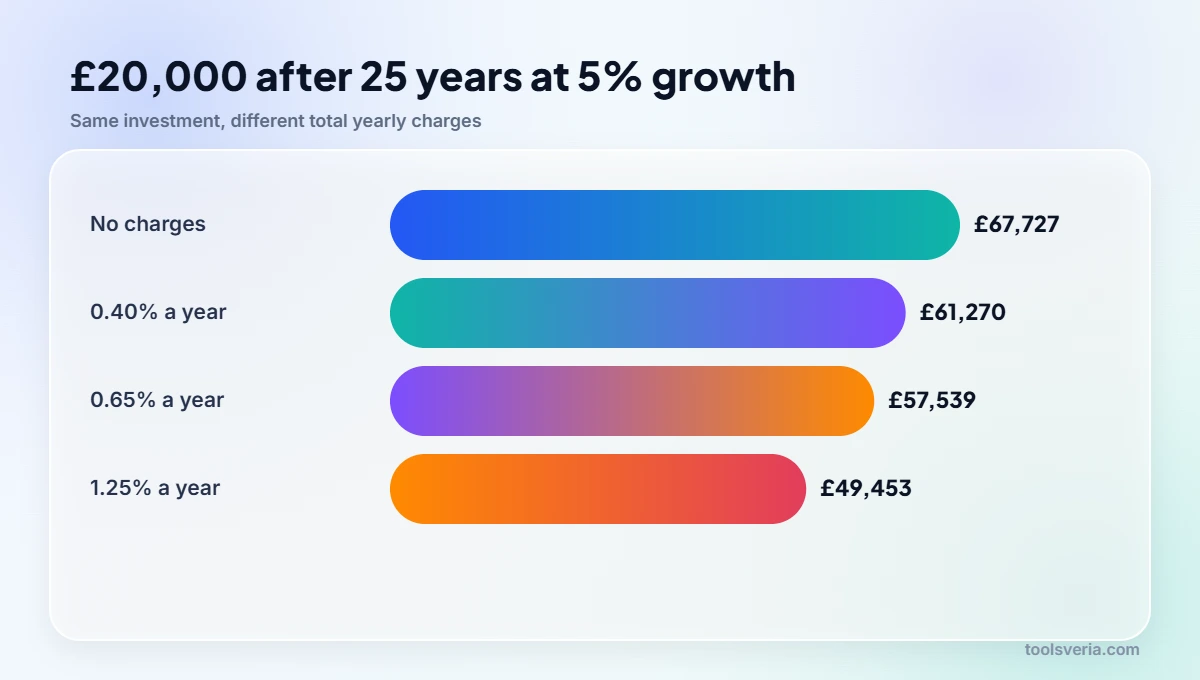
Over 25 years, a total charge of 1.25% a year on a £20,000 lump sum costs about £11,817 more than a charge of 0.40%, assuming 5% yearly growth before fees. That gap is around 69 times the £170 difference in the first year, because each £1 Owen pays in charges this year can never compound for him in any of the years that follow.
| Total yearly charge | Value after 25 years | Lost to charges versus no fees |
|---|---|---|
| 0% (theoretical) | £67,727 | £0 |
| 0.40% | £61,270 | £6,457 |
| 0.65% | £57,539 | £10,188 |
| 1.25% | £49,453 | £18,274 |
All rows use a single £20,000 lump sum and the same 5% growth before charges, applied once a year. Real returns will rise and fall, but the charges keep coming off in good years and bad, which is why their effect is so predictable. To see the uncharged version of the same growth, our compound interest calculator gives a fee free baseline that you can set beside each row of the table using your own sums.
One more way to read the table: at 1.25% a year, Owen hands over more than a third of the growth his money would otherwise have produced. At 0.40% he keeps about 86% of it.
What do charges do to a pension with monthly payments?
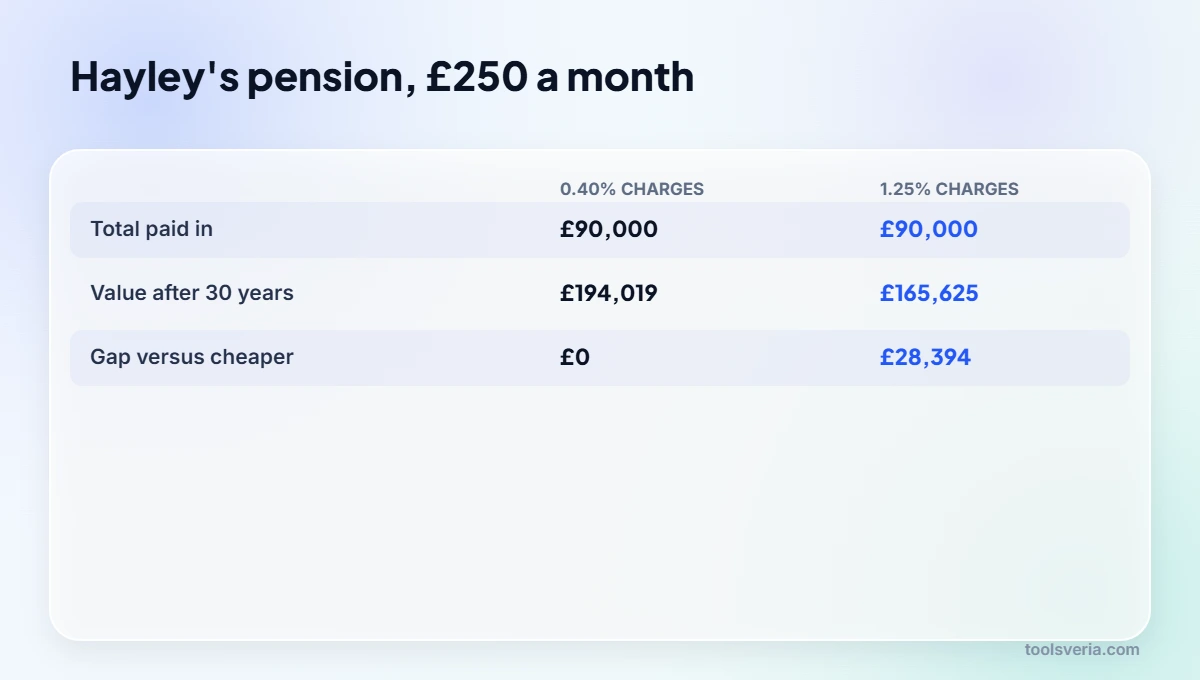
With regular contributions, charges cost even more in pounds because the pot is growing from two directions at once and the percentage fee is applied to all of it. Hayley pays £250 a month into a personal pension, £3,000 a year, for 30 years, and assumes 5% yearly growth before fees.
- With no charges at all, her £90,000 of contributions would grow to about £209,282.
- At 0.40% a year in total charges, the pot reaches about £194,019.
- At 1.25% a year, it reaches about £165,625.
The difference between the cheap and expensive options is £28,394, nearly a third of everything Hayley paid in. Measured with our percentage difference calculator, the two final pots sit about 16% apart, even though the yearly charges differ by less than one percentage point.
Is a flat platform fee cheaper than a percentage fee?
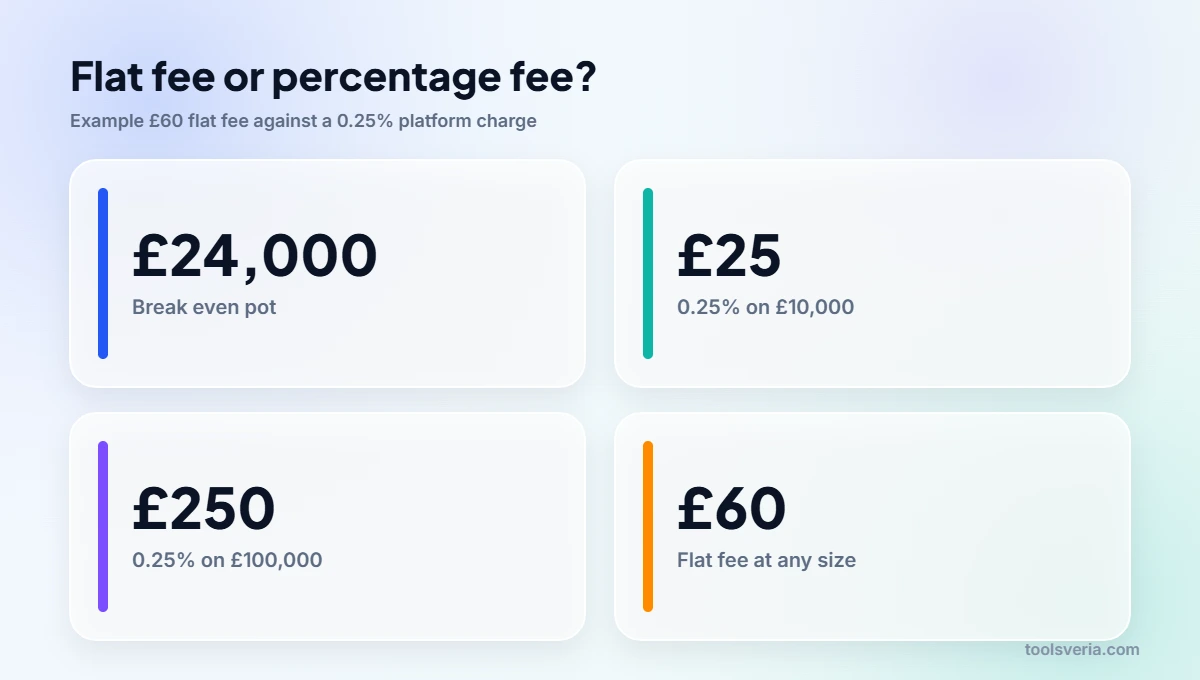
A flat platform fee beats a percentage fee only above a certain pot size, and you find that size by dividing the flat fee by the percentage rate. Smaller pots tend to pay less on a percentage platform, while larger ones save with a fixed charge.
Take an example flat fee of £60 a year against a 0.25% charge. Divide £60 by 0.0025 and the break even pot is £24,000. Below that, the percentage platform is cheaper: on £10,000 it costs £25. Above it, the flat fee wins: on £100,000 a 0.25% charge is £250, more than four times the £60 flat amount. Owen’s £20,000 sits just under the line today, but after a few years of growth and new contributions he will cross it, so he plans to review the platform every couple of years.
Watch for dealing charges on flat fee platforms, since a fee per trade can wipe out the saving for anyone buying small amounts every month. The cheapest structure depends on how much you hold and how often you trade, not on the headline rate alone.
How can you cut what you pay in fund charges?
You can cut fund charges by adding up every layer of cost, comparing like for like funds, and moving to a lower cost option when the gap is large and the investment is similar. Owen’s checklist took him one evening.
- Find the OCF on each fund’s factsheet or key information document, plus any listed transaction costs.
- Add the platform fee and any adviser fee to get one total yearly percentage.
- Compare against a fund with a similar mix of shares and bonds, not against something riskier.
- If you move, transfer the ISA rather than withdrawing it, so the tax wrapper is kept.
That last step matters. In the 2026/27 tax year you can pay in up to £20,000 across your ISAs, and a direct transfer between providers keeps earlier years’ money sheltered, a point covered in the GOV.UK guide to Individual Savings Accounts alongside the yearly limit. Cashing out and paying back in would usually count against this year’s allowance instead.
Key points
- The OCF is a fund’s yearly running cost as a percentage of your money, taken from the fund’s value.
- Platform and adviser fees are charged on top of the OCF and should be added to it.
- At 5% growth, £20,000 reaches about £61,270 after 25 years at 0.40% in charges but only £49,453 at 1.25%.
- On £250 a month for 30 years, the same two charge levels leave pots £28,394 apart.
- The ISA allowance for 2026/27 is £20,000, and transfers keep money inside the tax wrapper.
Fund Fees and OCF Terms Explained
With fund fees OCF explained term by term, you can see which charges apply to your ISA or pension and compare investment costs in pounds.
- Ongoing charges figure (OCF)
- A standardised measure of a fund’s annual running costs, including management and administration, shown as a percentage of assets. It is deducted inside the fund through the unit price, so investors never receive a separate bill for it.
- Platform fee
- The charge an investment platform makes for holding investments and providing the account, separate from any fund costs. It may be a percentage of the balance or a fixed amount, which affects which suits a larger or smaller pot.
- Index tracker fund
- A passively managed fund that aims to match the performance of a market index by holding its constituents, rather than paying managers to select investments. Its lower running costs typically give it a much smaller ongoing charge.
- Stocks and shares ISA
- A UK tax wrapper that lets investors hold funds and shares with no tax on growth or income. The wrapper removes tax drag but does nothing to reduce fund or platform charges, which still come out of the balance.
- Fee drag
- The cumulative reduction in an investment’s value caused by charges over time. Because each fee removes money that would otherwise have compounded, the gap between low and high cost portfolios widens faster than the yearly difference suggests.
- Transaction costs
- The expenses a fund incurs when buying and selling its underlying holdings, such as dealing commissions and bid offer spreads. They are reported separately from the ongoing charge and add a further hidden layer to the total cost.
Frequently Asked Questions
My fund’s OCF is 0.15% but the platform charges 0.45%. Which matters more?
Both count equally because they come off the same pot, so your true cost is 0.60% a year. On £20,000 that is £120 in the first year, and here the platform takes three times as much as the fund itself.
I never see a charge on my ISA statement. Am I still paying?
Almost certainly, because the OCF is deducted inside the fund and shows up only as a lower unit price. Platform fees are usually visible as a separate line, so check your annual costs and charges statement for both.
Is an expensive active fund ever worth 0.90%?
Only if it beats a similar cheaper fund by more than the extra cost, year after year. Owen’s active fund would need to outperform a 0.15% tracker by 0.75 points a year just to finish level over 25 years.
Will switching funds inside my pension cost me anything?
Many pension providers allow fund switches at no charge, but some apply dealing fees or exit charges on older plans. Ask your provider for the full cost first, then compare it with the yearly saving, such as £170 on £20,000.
Owen switched to the tracker and set a reminder to recheck his platform fee once his ISA passes £24,000. Put your own pot, monthly payments and both sets of charges into the calculator, and the decision usually becomes obvious in pounds. Figures checked October 2026.