Your take home pay after Income Tax, National Insurance, pension and student loan.
| Year | Month | Week |
|---|
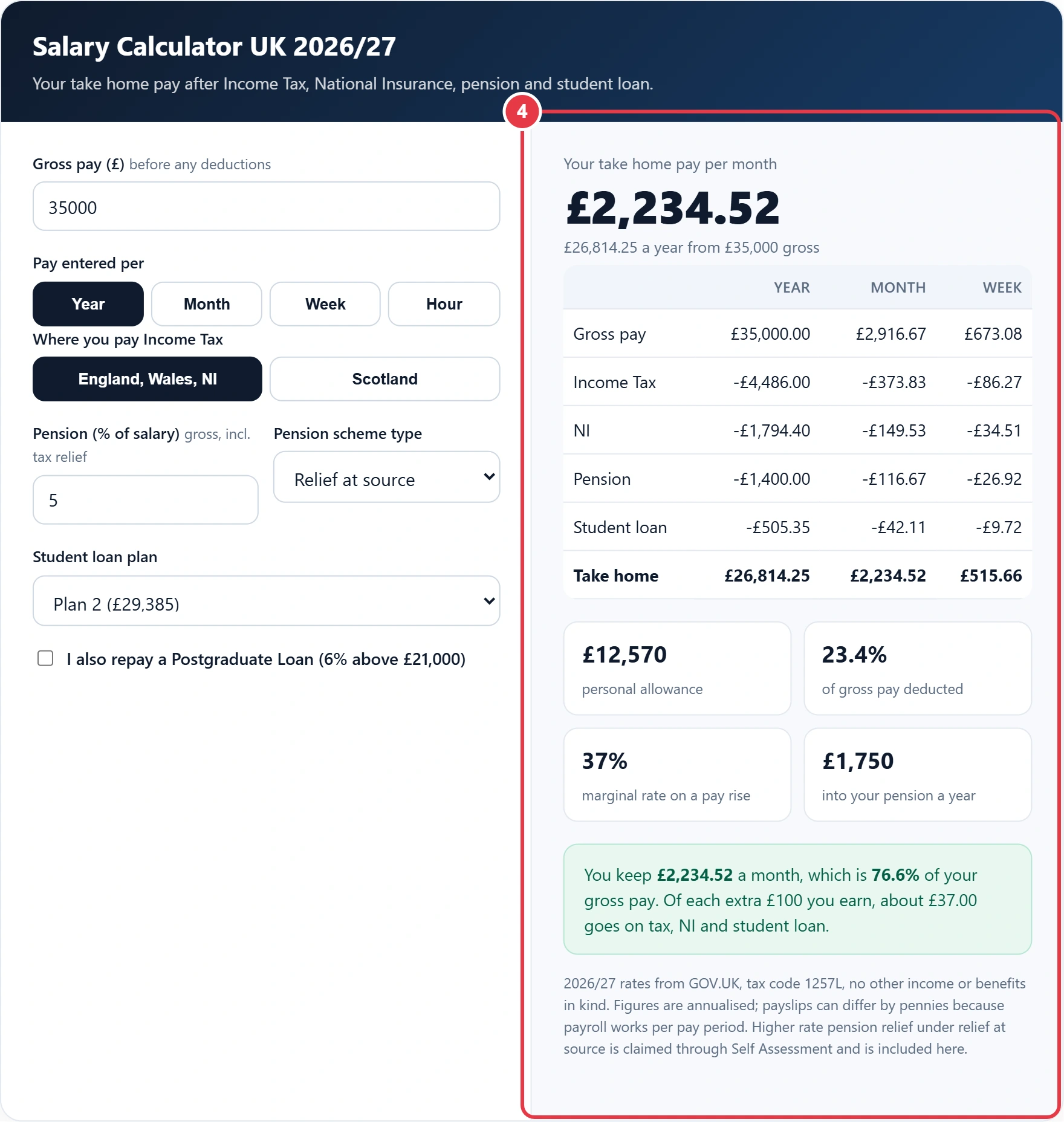
2026/27 rates from GOV.UK, tax code 1257L, no other income or benefits in kind. Figures are annualised; payslips can differ by pennies because payroll works per pay period. Higher rate pension relief under relief at source is claimed through Self Assessment and is included here.
This salary calculator UK shows employees in England, Wales, Northern Ireland and Scotland exactly how much of their pay they keep in the 2026/27 tax year. It uses the HMRC rates and thresholds for employers to take off Income Tax, National Insurance, pension and student loan, then shows the result per year, month and week.
Quick answer: A salary calculator UK for 2026/27 deducts Income Tax, National Insurance, pension and student loan from gross pay. The first £12,570 is tax free, the next £37,700 is taxed at 20% outside Scotland, and employee NI is 8% between £12,570 and £50,270. A £35,000 salary leaves £28,719.60 a year, or £2,393.30 a month.
In This Guide
What Is Take Home Pay?
Take home pay is the money that reaches your bank account after your employer deducts tax, National Insurance and other payroll items from your gross salary. In words: take home pay = gross pay minus Income Tax, minus employee National Insurance, minus student loan, minus your pension contribution.
For 2026/27 the first £12,570 is tax free. Outside Scotland, the next £37,700 of taxable pay is taxed at 20%, pay up to £125,140 at 40% and anything above at 45%. Employee National Insurance is 8% on earnings between £12,570 and £50,270 and 2% above that. Once income passes £100,000, the personal allowance falls by £1 for every £2, so it disappears completely at £125,140.
How to Use the Salary Calculator UK
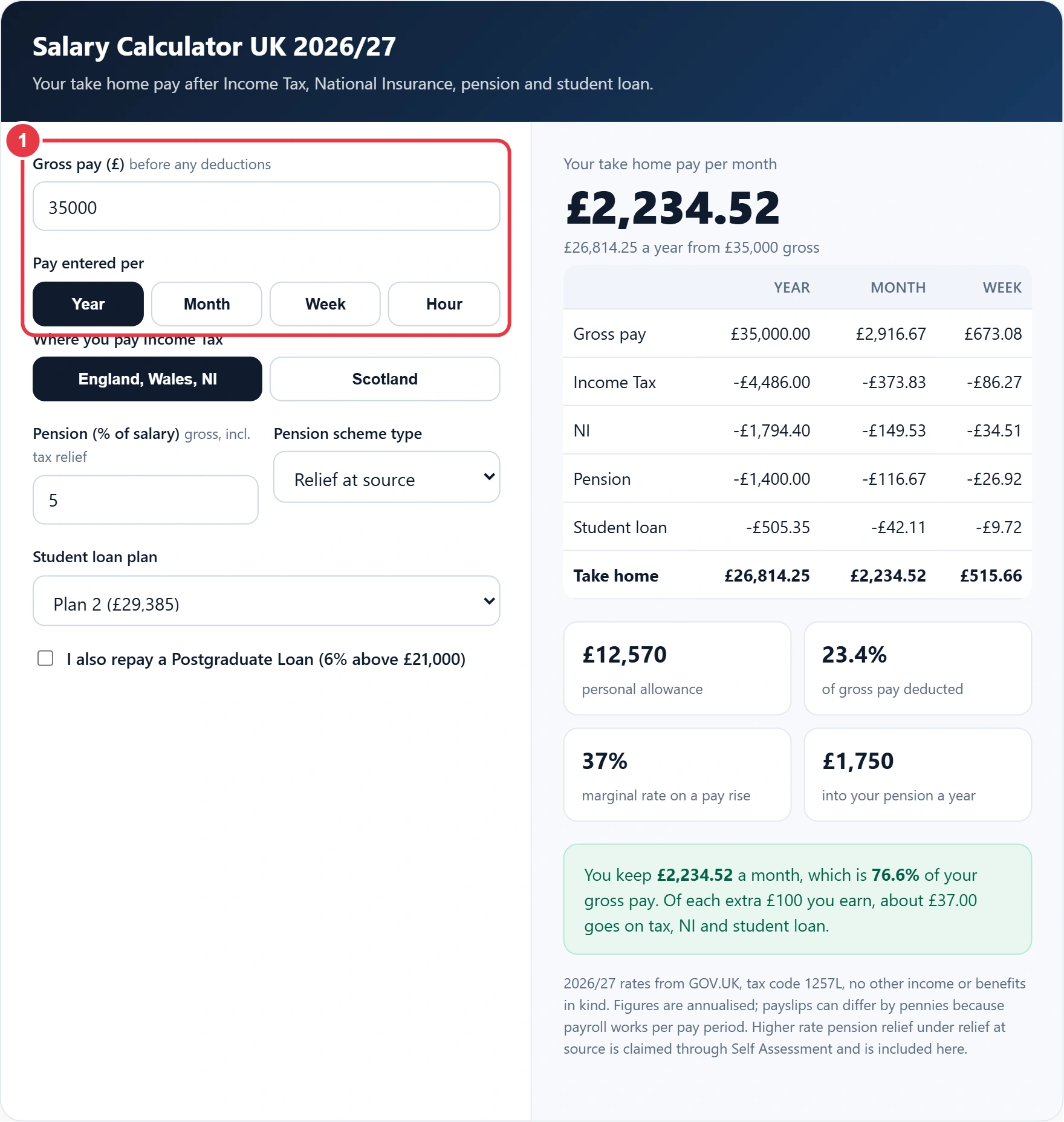
Step 1: Enter Your Gross Pay
Type your salary before deductions and say whether it is per year, month, week or hour. Hourly pay is annualised using your weekly hours over 52 weeks, so £18 an hour for 37.5 hours becomes £35,100.
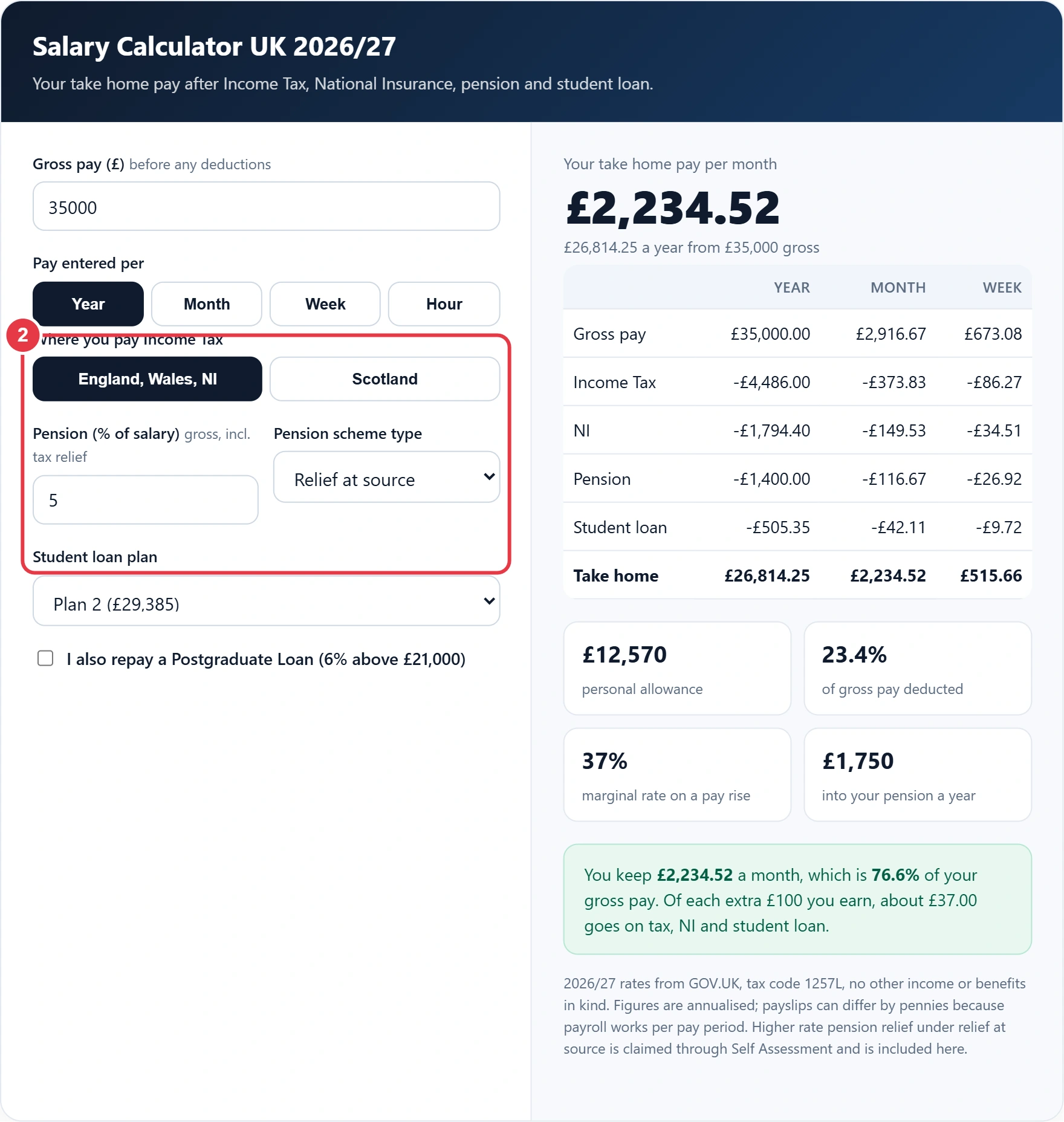
Step 2: Choose Your Tax Region and Pension
Pick Scotland if you live there, because Scottish taxpayers use six bands from 19% to 48%. Part time staff can find their real salary with the pro rata salary calculator before entering it here. Then enter your pension as a percentage of salary. Salary sacrifice lowers the pay that tax and NI are worked out on, while relief at source comes out of net pay with 20% added by the provider.
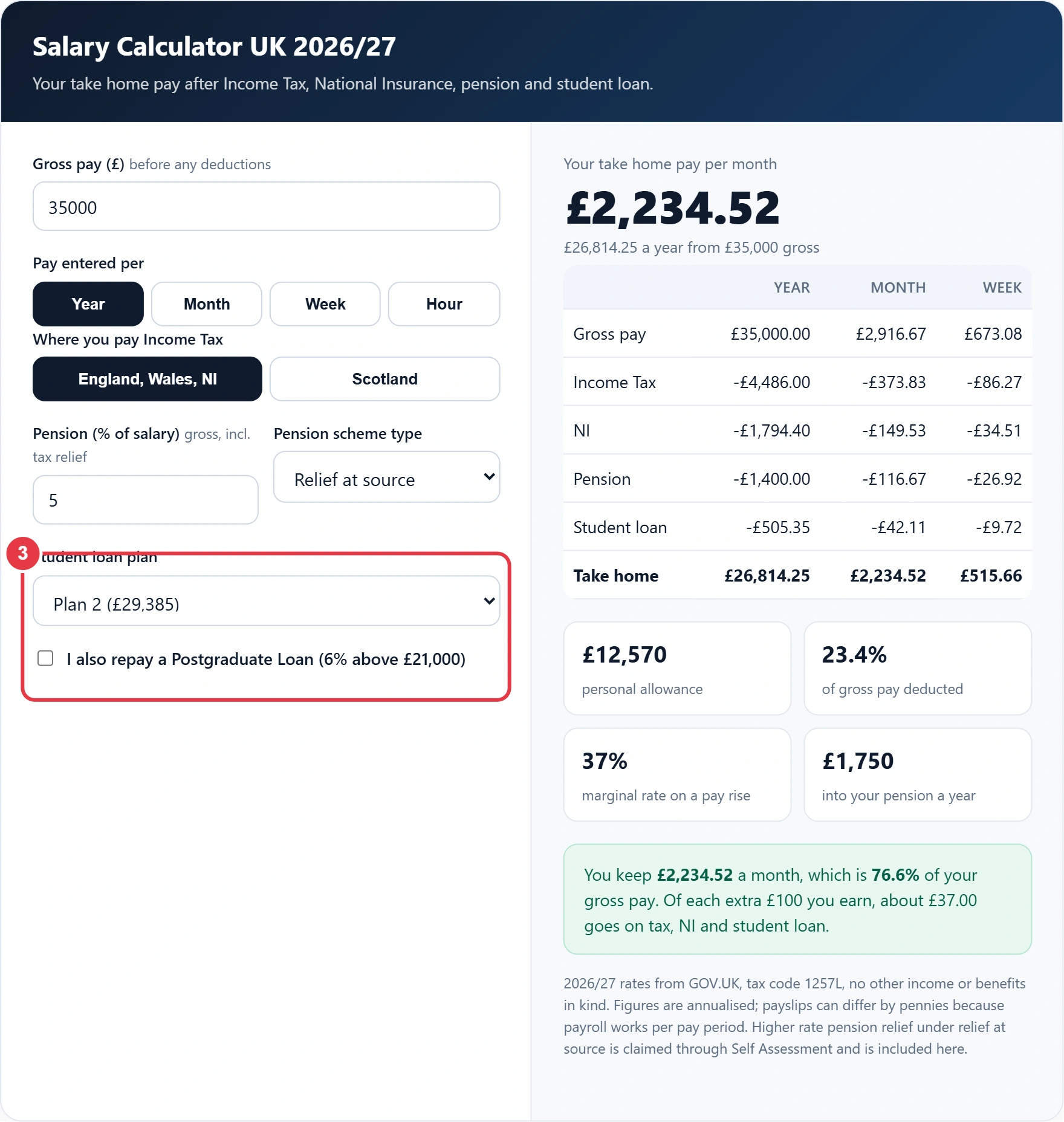
Step 3: Add Any Student Loan
Select your plan. Plans 1, 2, 4 and 5 take 9% of pay above their threshold, and a Postgraduate Loan takes another 6% above £21,000. Your payslip or the Student Loans Company account shows which plan you are on.
Step 4: Read Your Take Home Pay
The table splits every deduction by year, month and week. The marginal rate tells you how much of a pay rise you lose, which matters when you are weighing up extra shifts with the overtime calculator or comparing an hourly job offer.
How Much Is £35,000 a Year After Tax in 2026/27?
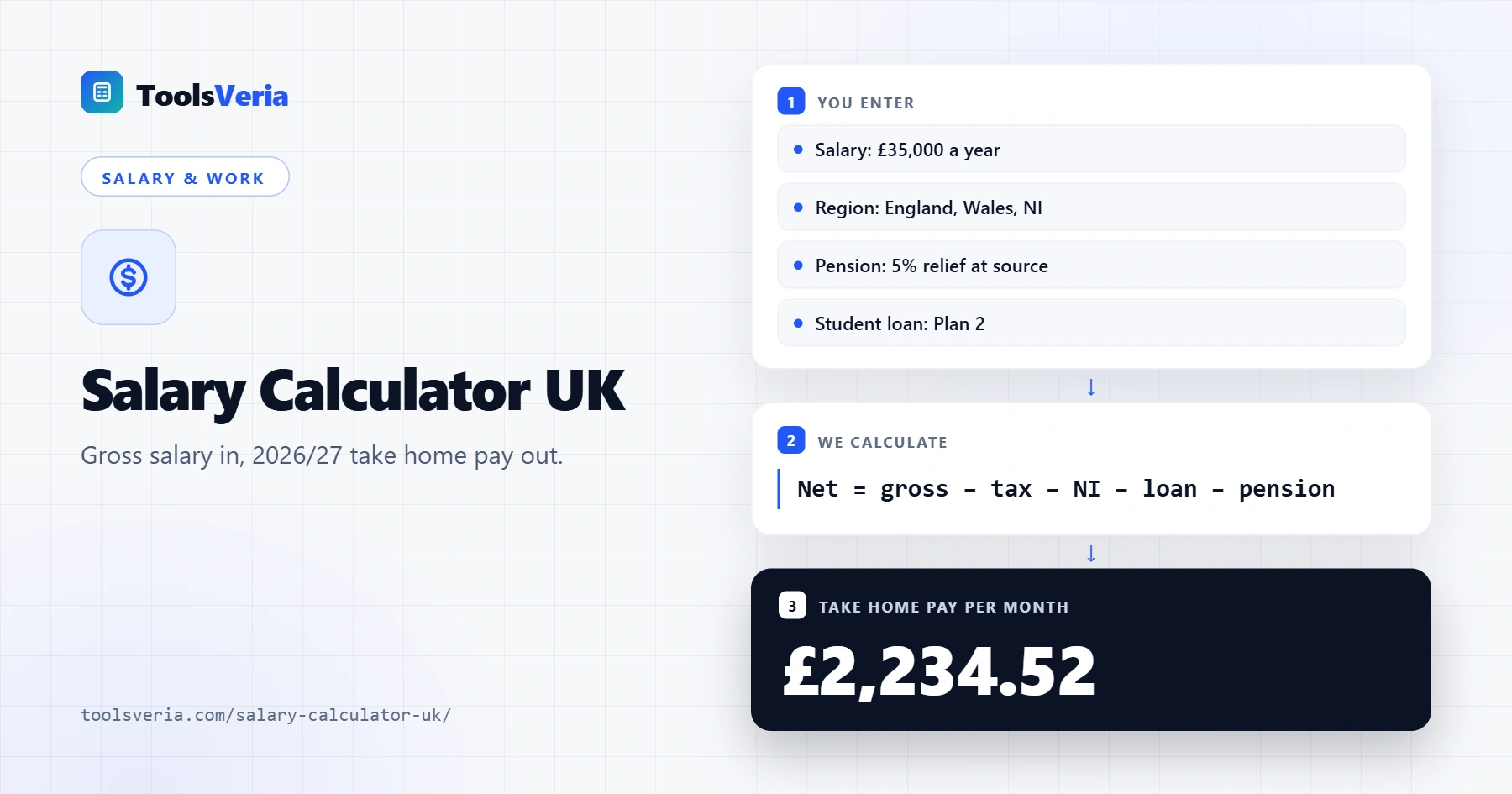
A £35,000 salary gives £28,719.60 a year, or £2,393.30 a month, in England, Wales or Northern Ireland with no pension or student loan. Amira, a project coordinator in Manchester, earns £35,000, pays 5% into a relief at source pension and is on Plan 2. Her Income Tax is £4,486, NI is £1,794.40, her student loan takes £505.35 and her pension costs her £1,400, leaving £26,814.25 a year or £2,234.52 a month.
| Gross salary | England, Wales, NI per month | Scotland per month |
|---|---|---|
| £25,000 | £1,793.30 | £1,796.61 |
| £35,000 | £2,393.30 | £2,392.04 |
| £50,000 | £3,293.30 | £3,168.63 |
| £75,000 | £4,504.78 | £4,333.95 |
| £100,000 | £5,713.12 | £5,438.11 |
These rows assume no pension or student loan. Scotland's 2026/27 bands come from the GOV.UK Scottish Income Tax page, and they explain why Scots earning £50,000 keep about £125 a month less. To turn an hourly rate into a salary first, the hourly to annual salary converter gives you the yearly figure to paste in here.
</>Embed this calculator on your website
Add the free Salary Calculator UK to your own site or blog. Copy the code below and paste it into an HTML block. It resizes itself and works on phones.
How we checked this tool: the Tools Veria Editorial Team built this tool by hand, checked it against the official rules or published standards where they apply, and tested it against worked examples. Results are estimates for planning, not personal financial or tax advice. Read our editorial policy and disclaimer, or report an error.
Frequently Asked Questions
How much tax do I pay on £30,000 in 2026/27?
On £30,000 in England, Wales or Northern Ireland you pay £3,486 Income Tax and £1,394.40 National Insurance. That leaves £25,119.60 a year, or £2,093.30 a month, before any pension or student loan.
What is the personal allowance for 2026/27?
The personal allowance is £12,570 for 2026/27 across the whole UK. It reduces by £1 for every £2 of adjusted net income above £100,000, so it reaches zero at £125,140.
Does the salary calculator include Scottish tax rates?
Yes. Choose Scotland and it uses the 2026/27 Scottish bands: 19% starter, 20% basic, 21% intermediate, 42% higher, 45% advanced and 48% top rate. National Insurance is the same everywhere in the UK.
Is salary sacrifice better than relief at source?
Salary sacrifice usually leaves you better off because it also saves 8% or 2% National Insurance. On a £60,000 salary, a 10% sacrifice gives £41,877.40 take home against £41,757.40 with relief at source.
How much National Insurance do employees pay in 2026/27?
Employees pay 8% Class 1 National Insurance on earnings between £12,570 and £50,270 a year, and 2% on everything above £50,270. Someone earning £40,000 pays £2,194.40 a year.
Why is my payslip slightly different from the calculator?
Payroll works out tax and NI per pay period, and your tax code, bonuses, benefits in kind or an emergency code can change the deductions. The calculator uses the standard 1257L code on an annual basis.