Work out your average weekly hours under the UK Working Time Regulations.
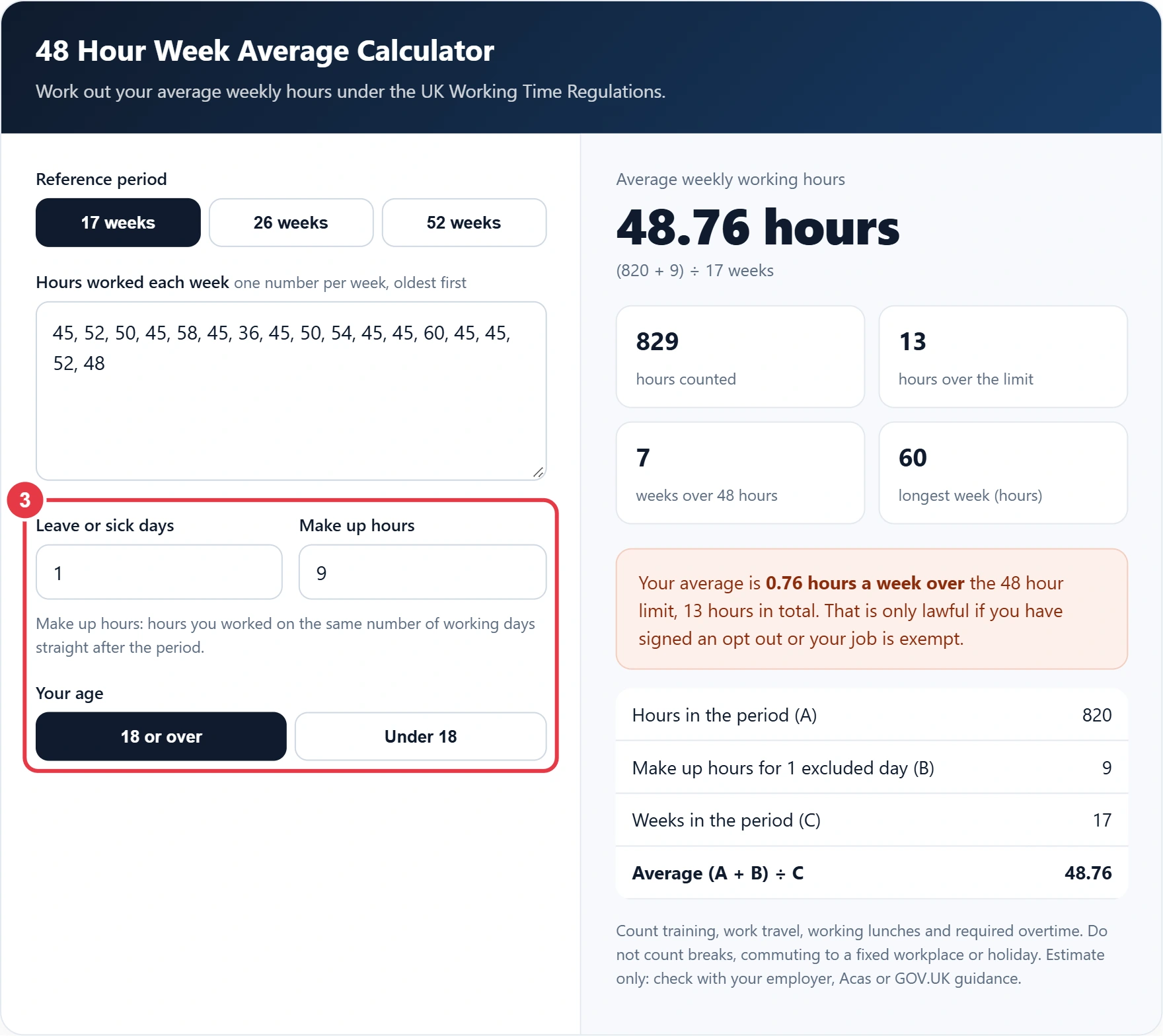
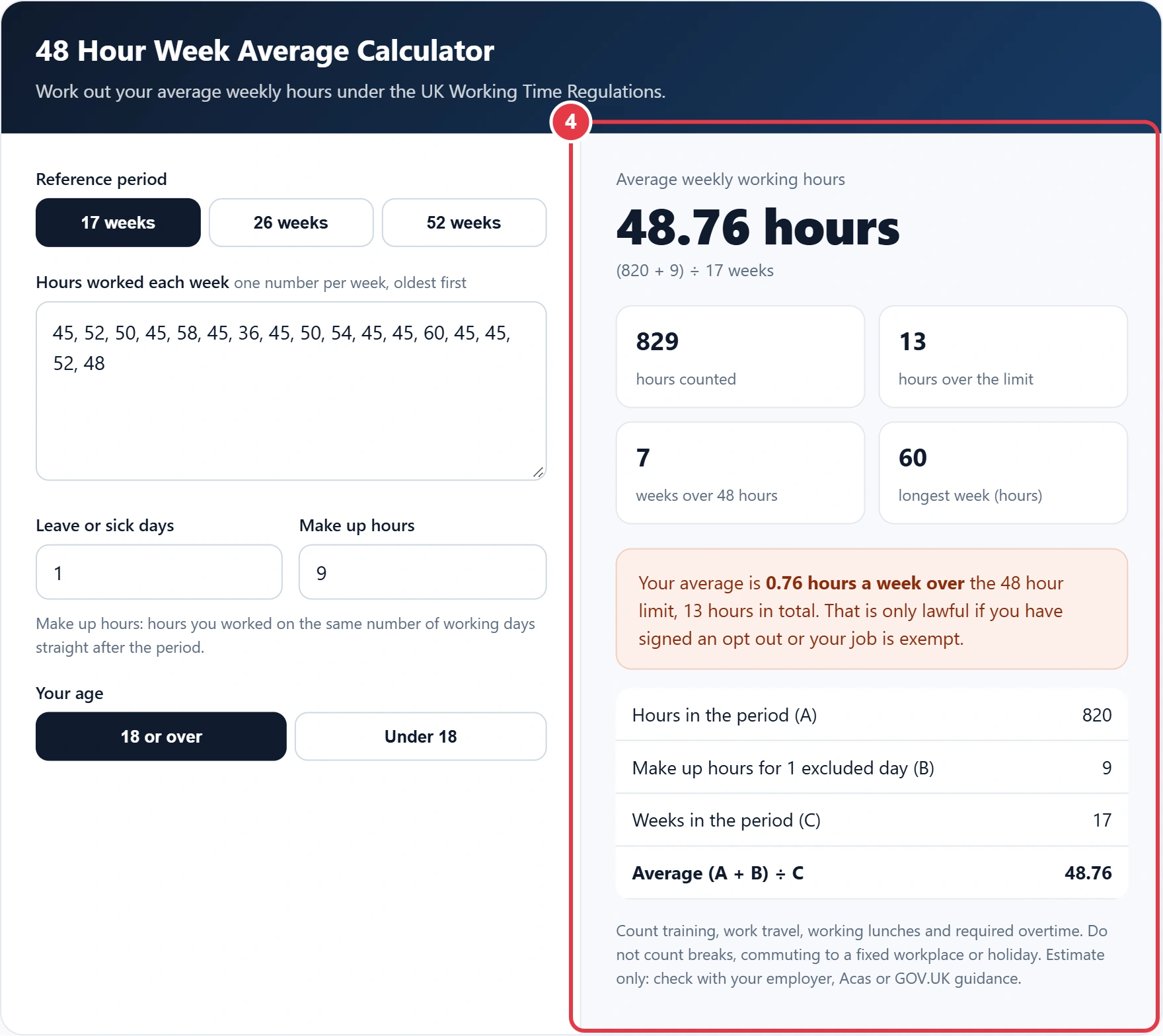
Make up hours: hours you worked on the same number of working days straight after the period.
Count training, work travel, working lunches and required overtime. Do not count breaks, commuting to a fixed workplace or holiday. Estimate only: check with your employer, Acas or GOV.UK guidance.
This 48 hour week average calculator works out the average weekly working hours of UK workers over the 17 week reference period used by the Working Time Regulations 1998, including the adjustment for holiday, sickness and family leave, so you can see straight away whether your hours are within the legal 48 hour limit. It follows the GOV.UK guidance on calculating working hours, handles 26 and 52 week periods, tells you how many hours you can still work in a period that has not finished, and switches to the stricter rules for workers under 18. Figures checked October 2026.
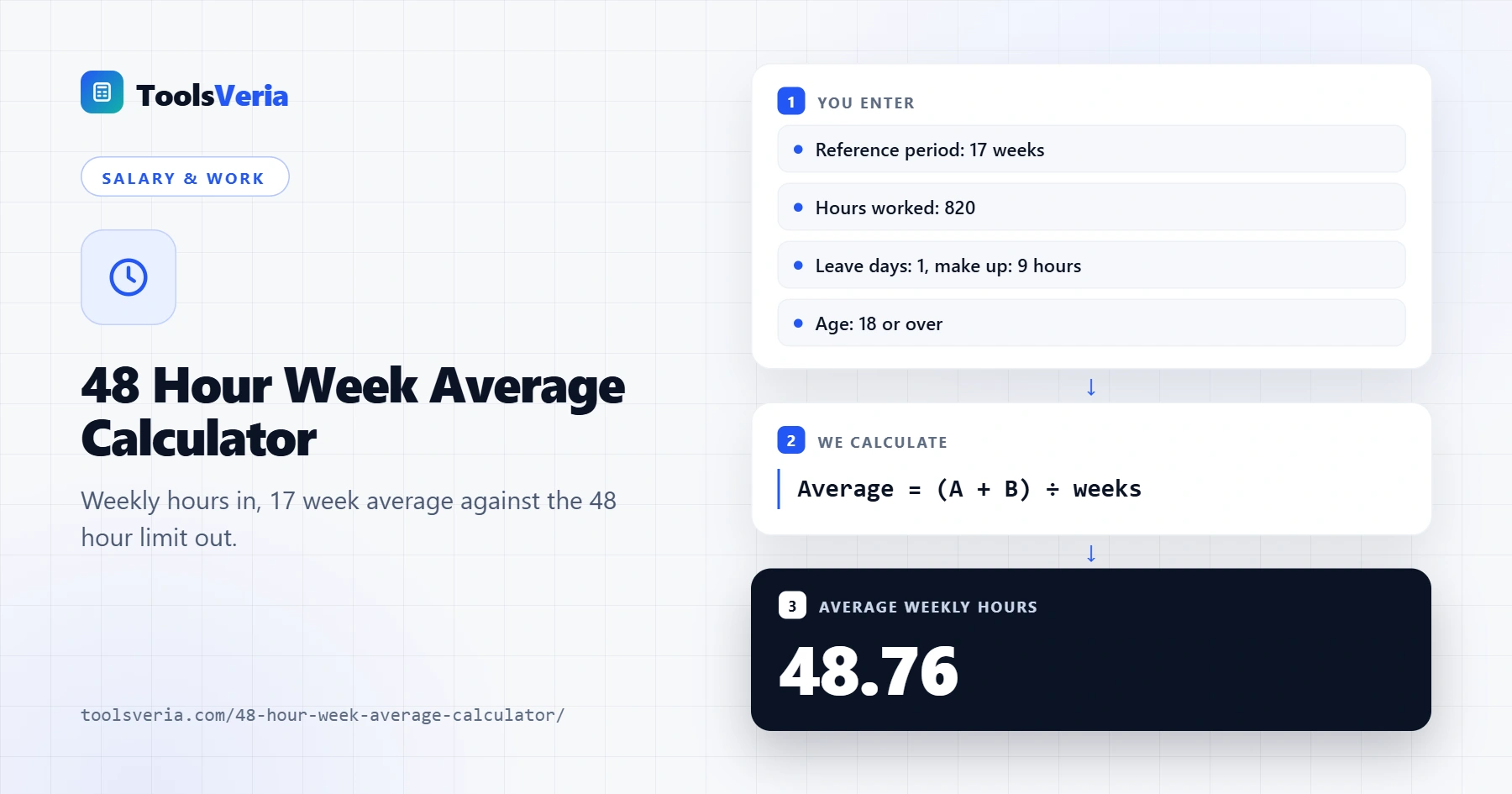
Quick answer: add up the hours you worked over 17 weeks, add the hours worked on the same number of days straight after the period for any leave or sick days, then divide by 17. The result must be 48 or less. The 48 hour week average calculator does this for 17, 26 or 52 weeks.
In This Guide
What Is the 48 Hour Week Average?
The 48 hour week average is the legal maximum for working time in Great Britain: an adult worker cannot be made to work more than 48 hours a week averaged over a reference period, normally 17 weeks, unless they have opted out in writing. A single week of 60 hours is lawful as long as the average across the period stays at 48 or below.
The formula in plain words comes from regulation 4 of the regulations: average weekly hours equal (A + B) divided by C. A is all the hours you worked in the reference period. B is the hours you worked in the days immediately after the period, counting forward until you have worked as many days as you had excluded days. C is the number of weeks in the period. Excluded days are days of annual leave, sick leave and maternity, paternity, adoption or parental leave, plus any days covered by an opt out.
How to Use the 48 Hour Week Average Calculator
Step 1: Choose the Reference Period
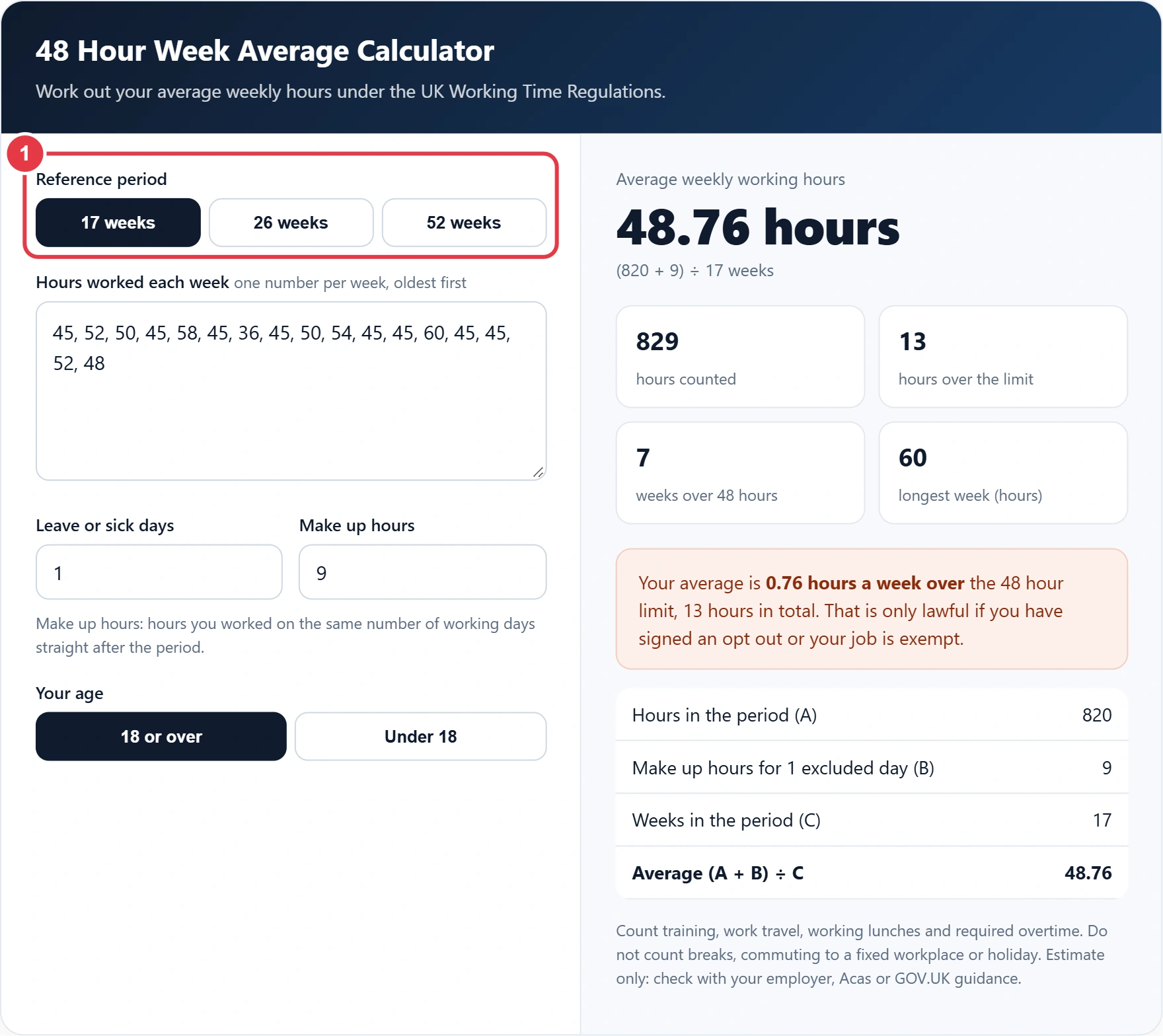
Most workers use 17 weeks. A collective or workforce agreement can extend it to 52 weeks, and some jobs, such as junior doctors, use 26 weeks, so pick the period in your contract or staff handbook if it says something different.
Step 2: Enter Your Weekly Hours
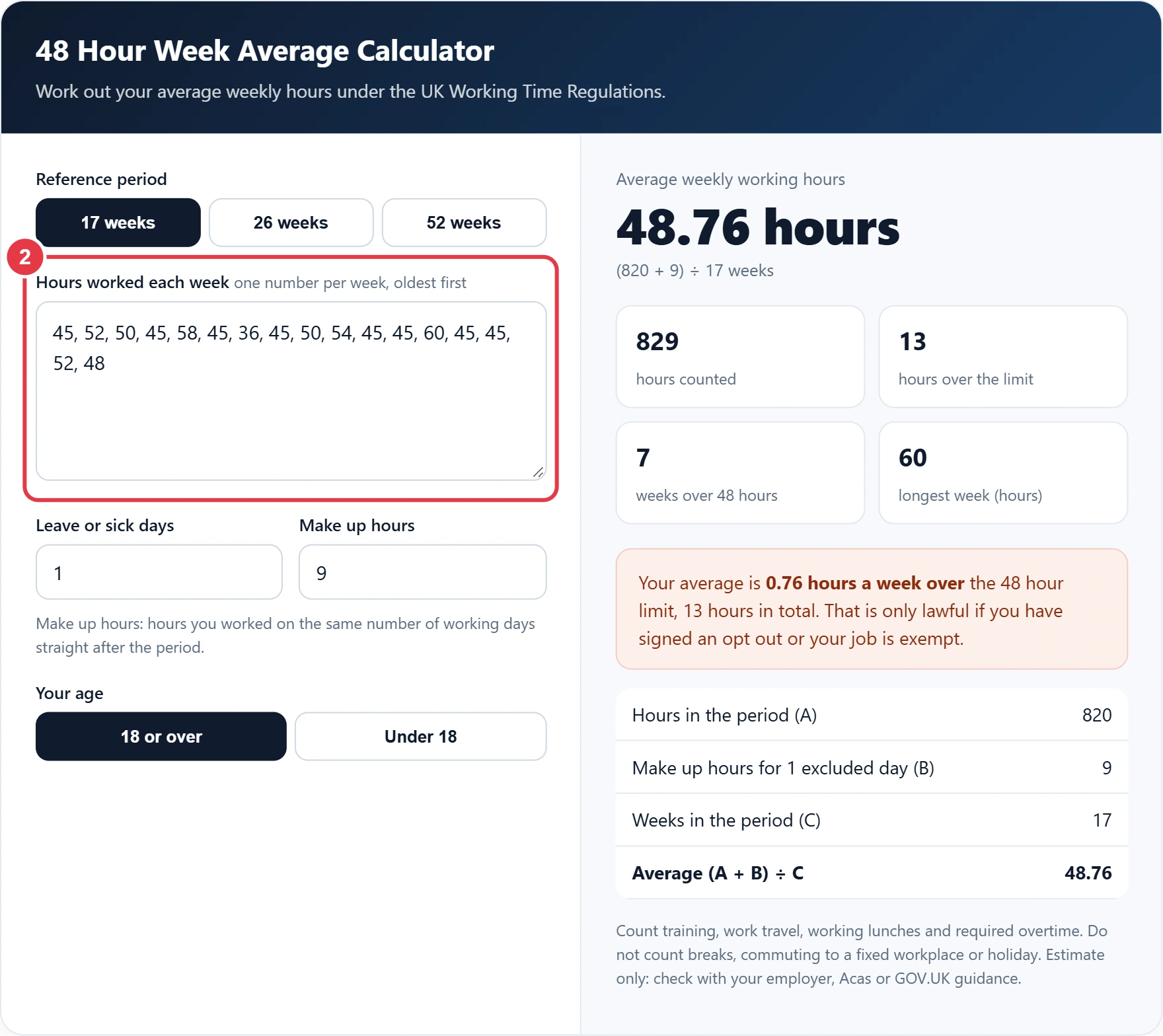
Type one total for each week, oldest first, separated by commas, spaces or new lines. Include overtime, job related training, travel between jobs and working lunches. If your rota is in start and finish times, the time card calculator adds up each week's shifts so you can paste the totals here. If you enter fewer weeks than the period, the calculator shows how many hours you have left.
Step 3: Add Leave Days and Your Age
Enter the number of working days you were off on holiday, sick or on family leave during the period. Then enter the hours you worked on that many working days straight after the period ends. Choose under 18 if it applies, because young workers cannot average their hours at all.
Step 4: Read Your Result
The headline is your average weekly hours. The stats show the total hours counted, how many hours of headroom you have, how many single weeks went over 48 and your longest week. The table lays out A, B and C so you can show your working to your manager or HR.
How Is the 48 Hour Week Calculated?
The 48 hour week is calculated by dividing the total hours worked in the reference period, plus any make up hours for leave days, by the number of weeks in the period. Holiday itself never counts as working time, which is why the make up rule exists: without it, taking leave would pull your average down artificially.
Worked example: Priya is a warehouse shift supervisor in Northampton on a 45 hour contract with regular overtime. Over 17 weeks she worked 820 hours, including one week of 36 hours when she took a day of annual leave. On her first working day after the period she worked 9 hours, so B is 9. Her average is (820 + 9) ÷ 17 = 48.76 hours a week. That is 0.76 hours a week, or 13 hours in total, over the limit. Seven of her weeks were above 48, peaking at 60. Unless she has signed an opt out, her employer needs to cut her hours.
| Reference period | Maximum total hours | Who it applies to |
|---|---|---|
| 17 weeks | 816 hours | Most workers |
| 26 weeks | 1,248 hours | Some jobs, for example junior doctors |
| 52 weeks | 2,496 hours | Where a collective or workforce agreement extends the period |
| No averaging | 40 hours in any week | Workers under 18, also limited to 8 hours a day |
What Counts Towards the 48 Hour Limit?
Working time includes job related training, travel that is part of the job, working lunches, overtime you are required to do and time on call at your workplace. If you have no fixed workplace, travel to your first job of the day counts too. Rest breaks when no work is done, normal commuting to a fixed workplace and paid or unpaid holiday do not count. If you have two jobs, the hours from both are added together, which surprises many people with a weekend job.
Overtime pay is a separate question from the limit, and the overtime calculator shows what extra hours are worth at time and a half or double time. Remember that hours above the average are still restricted by the daily and weekly rest rules.
Can I Opt Out of the 48 Hour Week?
Yes, adults can choose to opt out of the 48 hour limit by signing a written agreement, but your employer cannot sack you or treat you unfairly for refusing. You can cancel an opt out at any time by giving at least 7 days' notice, or up to 3 months if your agreement says so. Workers under 18 cannot opt out, and some jobs, such as the armed forces, emergency services and police, are outside the limit. Your employer must keep records showing that the limit is met for everyone who has not opted out.
What If My Employer Makes Me Work Over 48 Hours?
If your average is over 48 and you have not opted out, raise it with your manager first and show the A, B and C figures from the calculator, because the full rule in regulation 4 of the Working Time Regulations puts the duty on the employer to keep your average within the limit. If that does not work, you can raise a formal grievance in writing, and Acas gives free, confidential advice on the next steps, including when a claim to an employment tribunal is possible.
Keep your own record of start and finish times, because rotas often differ from the hours actually worked. If you are paid for the extra hours, check your holiday pay as well, since the holiday pay calculator shows how regular overtime can raise the pay you get for each day of leave. Average hours over a full reference period are the evidence that matters most.
</>Embed this calculator on your website
Add the free 48 Hour Week Average Calculator to your own site or blog. Copy the code below and paste it into an HTML block. It resizes itself and works on phones.
How we checked this tool: the Tools Veria Editorial Team built this tool by hand, checked it against the official rules or published standards where they apply, and tested it against worked examples. Results are estimates for planning, not personal financial or tax advice. Read our editorial policy and disclaimer, or report an error.
Frequently Asked Questions
How is the 48 hour week calculated?
Add up the hours you worked over the reference period, normally 17 weeks, then divide by the number of weeks. If you had leave or sick days, add the hours worked on the same number of days straight after the period before dividing.
Can I work more than 48 hours in one week?
Yes. The 48 hour limit is an average, normally over 17 weeks, so a single week of 60 hours is lawful if the 17 week average stays at 48 or below. That means no more than 816 hours over 17 weeks.
Does holiday count towards the 48 hour week?
No. Paid or unpaid holiday is not working time. Days of annual leave, sickness and family leave are excluded, and you replace them with the hours worked on the same number of days immediately after the reference period.
How long is the reference period for the 48 hour week?
The reference period is normally 17 weeks. It is 26 weeks for some jobs, such as junior doctors, and a collective or workforce agreement can extend it to 52 weeks. Workers under 18 have no reference period at all.
How many hours can under 18s work?
Workers under 18 can work no more than 8 hours a day and 40 hours a week, and their hours cannot be averaged. They also cannot opt out of these limits, so every single week must be 40 hours or less.
How much notice do I need to cancel a 48 hour opt out?
You must give your employer at least 7 days' notice to cancel an opt out agreement. Your agreement can require longer notice, but never more than 3 months, and your employer cannot force you to keep the opt out.