Trattamento di fine rapporto under art. 2120 of the Italian Civil Code, projected year by year.
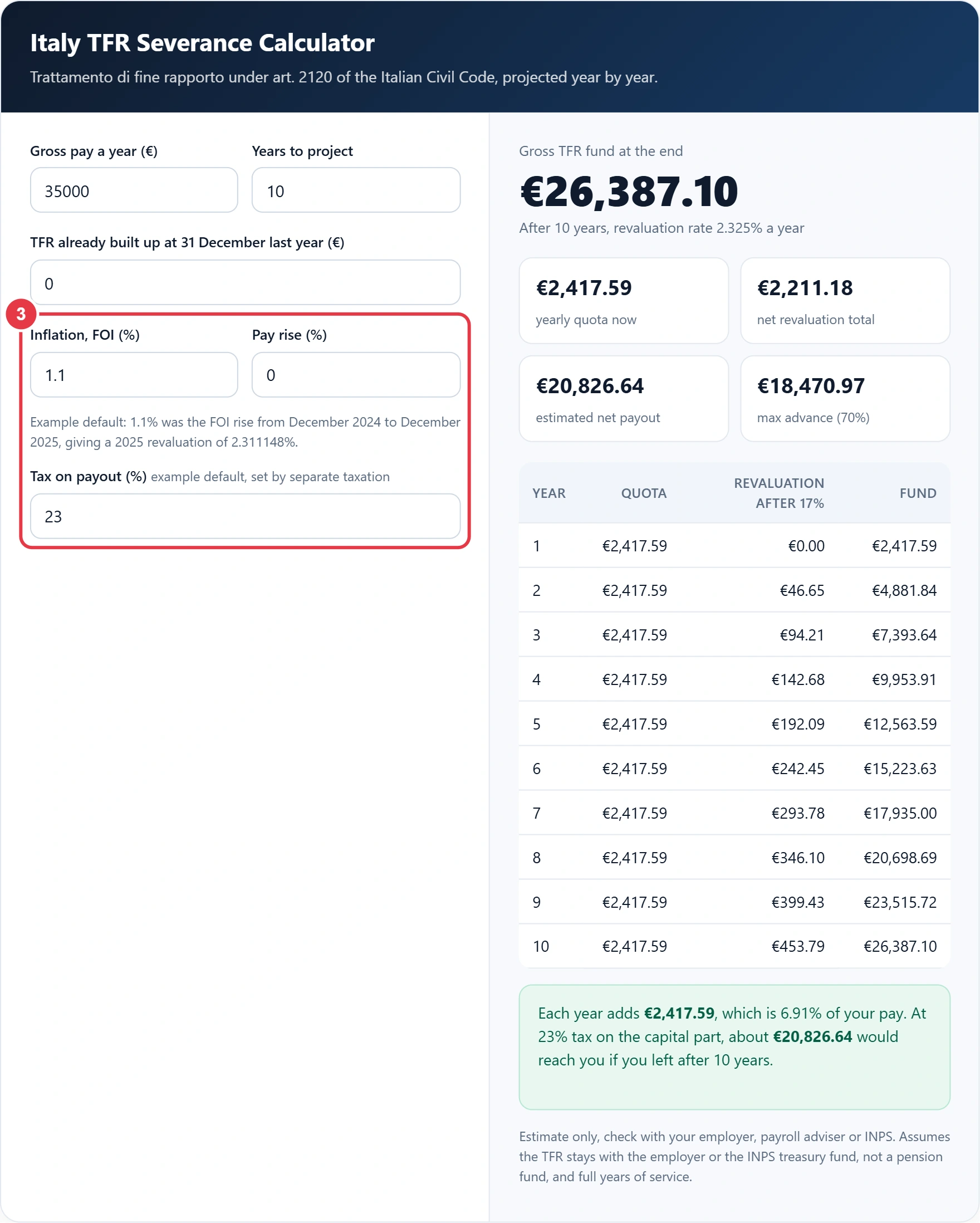
Example default: 1.1% was the FOI rise from December 2024 to December 2025, giving a 2025 revaluation of 2.311148%.
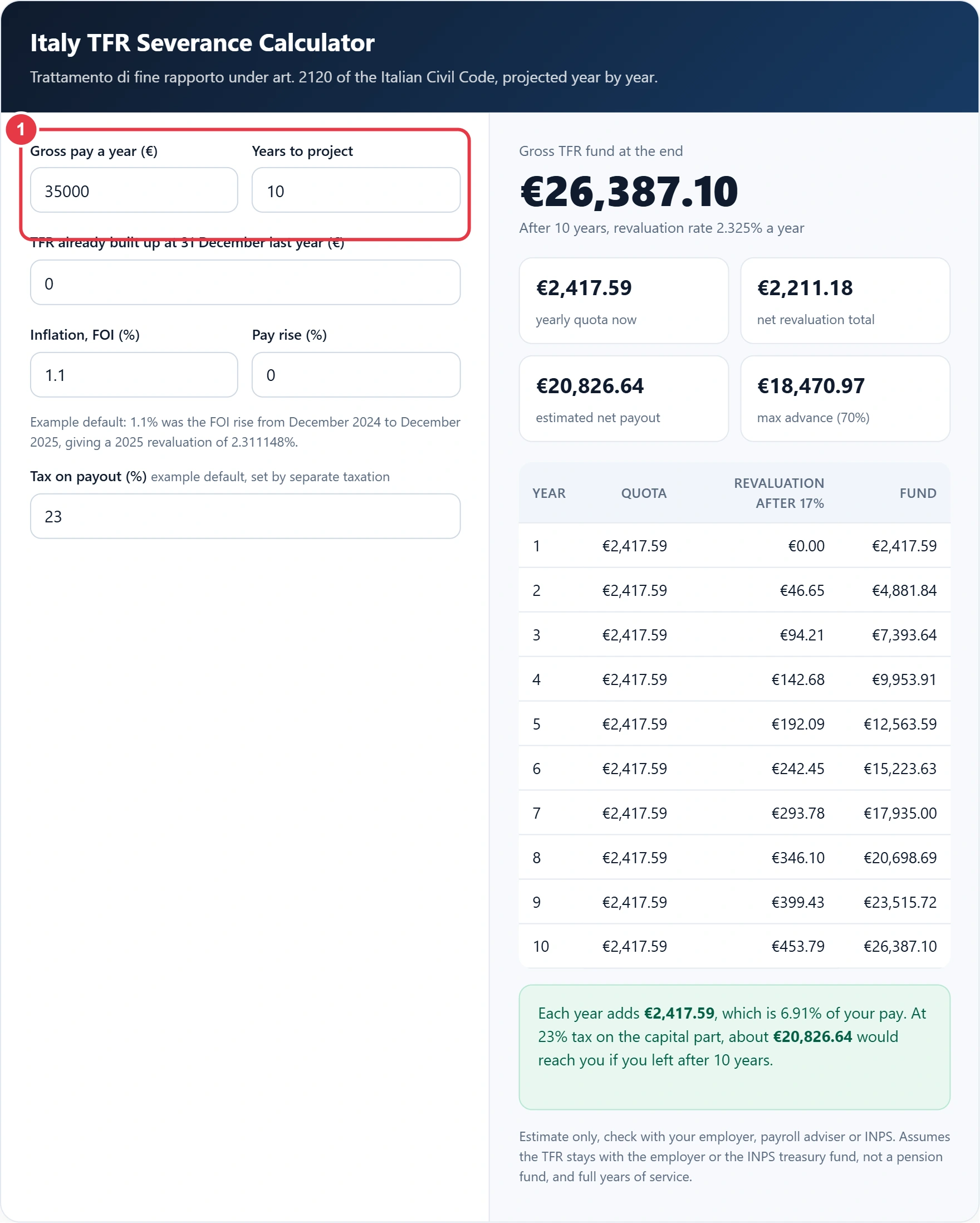
| Year | Quota | Revaluation after 17% | Fund |
|---|
Estimate only, check with your employer, payroll adviser or INPS. Assumes the TFR stays with the employer or the INPS treasury fund, not a pension fund, and full years of service.
This Italy TFR calculator helps private sector employees in Italy, including expats, estimate their trattamento di fine rapporto (TFR) severance fund in 2026 and beyond. It applies the 13.5 rule from article 2120 of the Italian Civil Code, the 0.50% contribution, the yearly revaluation linked to the index published by Istat, the Italian statistics institute, and the 17% substitute tax on that revaluation. Figures checked October 2026.
Quick answer: Your TFR grows each year by your gross pay divided by 13.5, minus 0.50% of pay, which is about 6.91% of salary. The Italy TFR calculator then revalues the fund every 31 December by 1.5% plus 75% of inflation, taxes that gain at 17%, and projects the total year by year.
In This Guide
What Is TFR (Trattamento di Fine Rapporto)?
TFR is a deferred severance payment that every Italian private sector employer must build up for each employee and pay out when the employment ends, whatever the reason, including resignation and dismissal. It is not a bonus: it is part of your pay held back each year and returned to you at the end, with inflation protection along the way.
In plain words: yearly quota = gross pay for the year ÷ 13.5, minus 0.50% of that pay. Then, every 31 December, revaluation = fund at the end of the previous year × (1.5% + 75% of the FOI inflation rate), and 17% of that revaluation is paid as substitute tax. The current year's quota is not revalued until the following December. For 2025 the FOI index rose 1.1%, giving a revaluation coefficient of 2.311148%.
How Much TFR Will I Get After 10 Years?
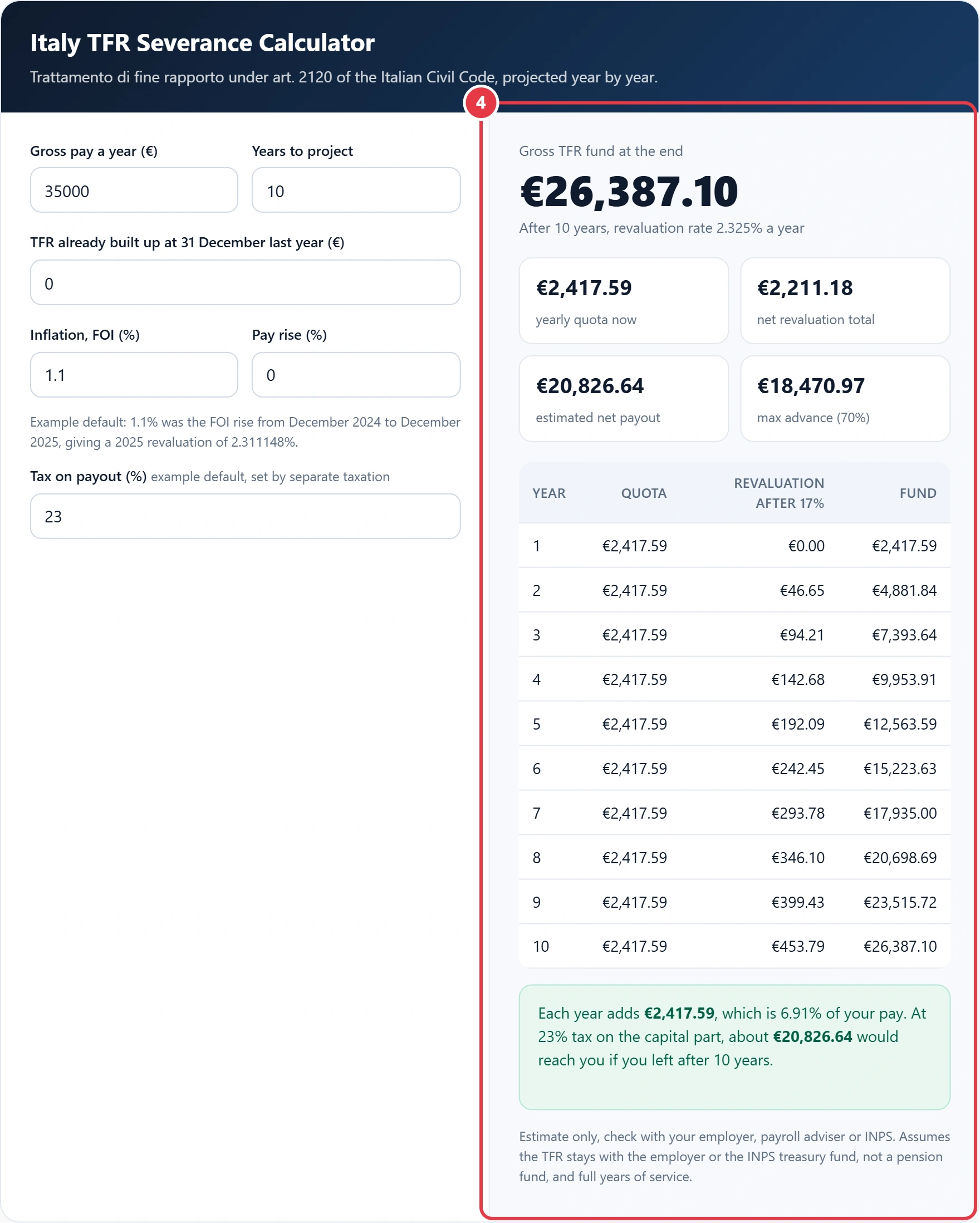
After 10 years you will have roughly three quarters of one year's gross pay in TFR if inflation stays near 1%, because ten quotas of 6.91% add up to 69% of a year's salary and revaluation adds a few points more. Take Marco, a logistics planner in Bologna earning €35,000 gross a year with no pay rises. His quota is €35,000 ÷ 13.5 = €2,592.59, minus €175 (0.50%), so €2,417.59 a year. With inflation at 1.1% the fund is revalued by 2.325% a year, or 1.93% after the 17% tax.
After 10 years Marco's fund reaches €26,387.10, of which €24,175.93 is capital and €2,211.18 is net revaluation. If his payout is taxed at an example rate of 23% on the capital part only, he would receive about €20,826.64. After year 8 he could ask for an advance of up to 70% of the fund for a first home or major medical costs.
| Gross pay a year | Pay ÷ 13.5 | Less 0.50% | Yearly TFR quota |
|---|---|---|---|
| €25,000 | €1,851.85 | €125.00 | €1,726.85 |
| €35,000 | €2,592.59 | €175.00 | €2,417.59 |
| €50,000 | €3,703.70 | €250.00 | €3,453.70 |
| €70,000 | €5,185.19 | €350.00 | €4,835.19 |
How to Use the Italy TFR Calculator
Step 1: Enter Your Pay and Years
Type your gross pay for the year, including the 13th and 14th month payments that are paid regularly, and the number of years to project. Leave out expense refunds, which do not count towards TFR.
Step 2: Add Your Existing TFR
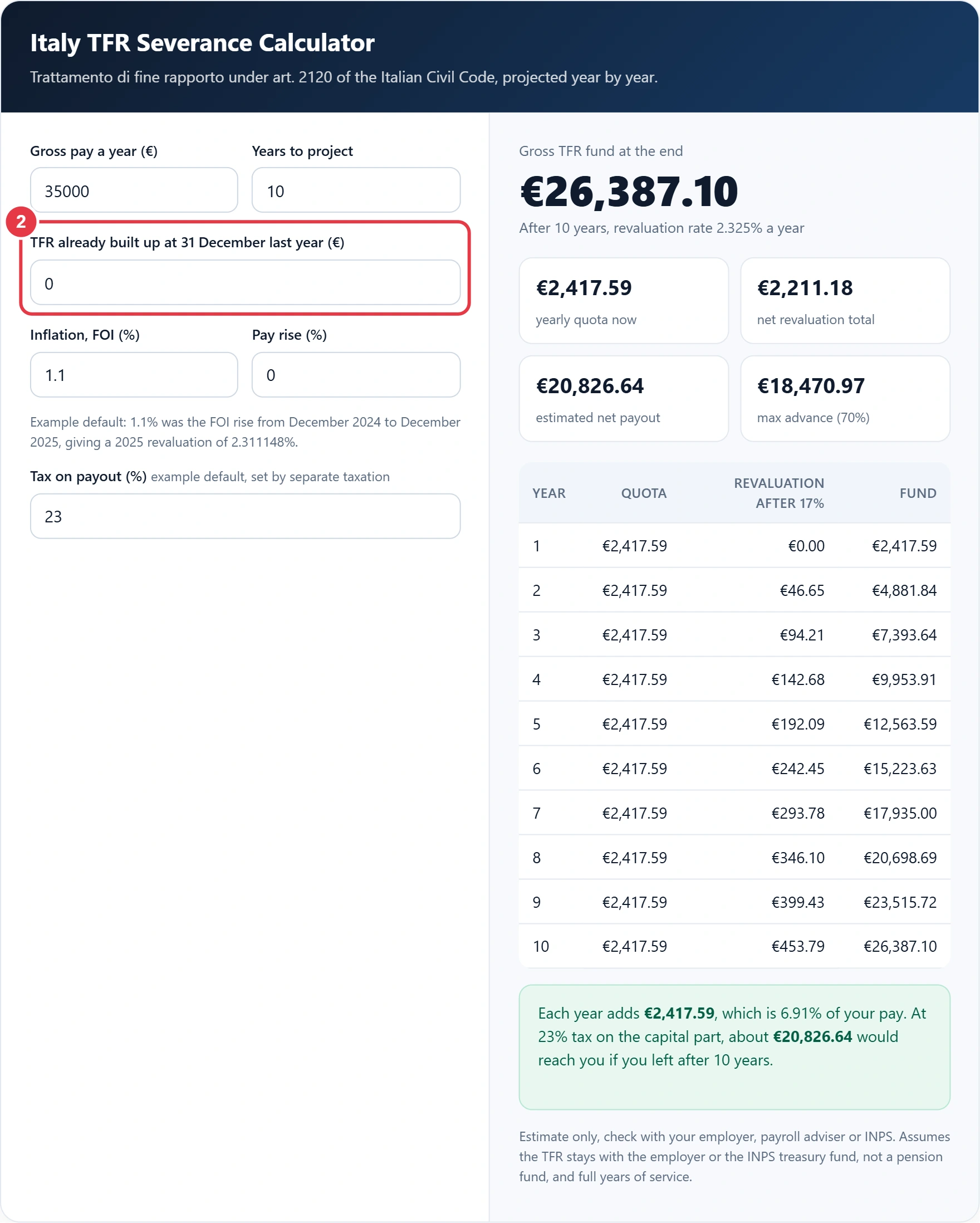
If you have already worked for the employer for a while, enter the TFR balance at the last 31 December. Many payslips (cedolino) show the fondo TFR figure, and some employers send a yearly statement.
Step 3: Set Inflation, Pay Rises and Tax
Enter the inflation you expect each year and any yearly pay rise. The payout tax box is an example rate: the real rate comes from the separate taxation rules and is recalculated by the Agenzia delle Entrate. To see how small yearly increases compound over a long career, the compound interest calculator shows the same effect on any growth rate you choose.
Step 4: Read Your TFR Projection
The Italy TFR calculator shows the gross fund, the current yearly quota, the total net revaluation, an estimated net payout and the maximum advance once you reach 8 years. The table lists every year with quota, revaluation after tax and closing balance.
When Is TFR Paid and How Is It Taxed?
TFR is paid when your employment ends, usually with the final pay or soon after, and it is taxed separately from your other income so it does not push your normal salary into a higher band. Key rules to know:
- The yearly revaluation is taxed at 17% as it is credited, so it is not taxed again on payout.
- The capital part is taxed under separate taxation (tassazione separata), based on an average rate, and the tax office may adjust it later.
- After at least 8 years with the same employer you can ask once for an advance of up to 70% of the fund, for a first home or extraordinary medical costs.
- You can choose to send future TFR to a supplementary pension fund instead, where different tax rules apply.
- Larger employers pass the TFR of staff who keep it to a treasury fund run by INPS, which pays it on the employer's behalf.
Large allowances, overtime and shift pay may or may not count towards TFR, and the answer often depends on your national collective agreement (CCNL), so check it if you receive large allowances. If you are comparing an Italian job with UK employment, the redundancy pay calculator shows how much smaller UK statutory redundancy pay can be, since it only applies after 2 years and only on redundancy.
</>Embed this calculator on your website
Add the free Italy TFR Severance Calculator to your own site or blog. Copy the code below and paste it into an HTML block. It resizes itself and works on phones.
How we checked this tool: the Tools Veria Editorial Team built this tool by hand, checked it against the official rules or published standards where they apply, and tested it against worked examples. Results are estimates for planning, not personal financial or tax advice. Read our editorial policy and disclaimer, or report an error.
Frequently Asked Questions
How is TFR calculated in Italy?
TFR is your gross pay for the year divided by 13.5, minus a 0.50% contribution, which is about 6.91% of pay. On €35,000 that is €2,417.59 a year, revalued every 31 December by 1.5% plus 75% of inflation.
What was the TFR revaluation rate for 2025?
The TFR revaluation coefficient for December 2025 was 2.311148%. It combines the fixed 1.5% with 75% of the 1.1% rise in the ISTAT FOI index between December 2024 and December 2025.
Do I get TFR if I resign in Italy?
Yes. TFR is paid whenever employment ends, including resignation, dismissal and the end of a fixed term contract. It is your deferred pay, so the reason for leaving does not change the amount.
How much TFR tax will I pay?
The yearly revaluation is taxed at 17% as it is credited. The capital part is taxed at payout under separate taxation, using an average rate based on your income, so the calculator treats that rate as an editable example.
Can I get a TFR advance to buy a house?
Yes, after at least 8 years with the same employer you can ask once for up to 70% of your TFR to buy a first home, or to cover extraordinary medical costs, with documents to prove it.
Does the 13th month count towards TFR?
Yes. The 13th and 14th month payments are regular pay, so they are included in the yearly pay that is divided by 13.5. Expense refunds and one off payments are normally left out.