
Grace found a banana bread recipe on an American food blog, and every ingredient is listed in cups. Her kitchen has digital scales but no cup measures, so she needs a reliable way of converting cups to grams baking quantities before she starts. Guessing is risky: a cup is a volume, and the weight it holds depends entirely on what goes into it.
Quick answer: For cups to grams baking conversions, remember that a metric cup holds 250 ml and a US cup about 236.6 ml, roughly 5.4% less. Weight depends on the ingredient: a metric cup of plain flour is about 125 g and honey about 340 g, so use the US column for American recipes.
There is a second complication. An American cup holds a little less than the 250 ml metric cup that Australian cooks, and plenty of British ones, reach for. Below you will find the gram weight of common ingredients for both, followed by Grace’s loaf and a friend’s flapjack recipe converted line by line.
In This Guide
Two cups that are not the same size
A metric cup, the one sold in most UK cookshops and used in Australian recipes, holds 250 ml. An American customary cup holds about 236.6 ml. That gap of roughly 13 ml sounds trivial, but it means every US cup holds about 5.4% less than its metric cousin.
For plain flour, the difference is about 6.7 g per cup. In a cake calling for three cups, Grace would add around 20 g too much flour if she used metric weights for an American recipe, enough to make a sponge noticeably drier. The history of the cup as a unit explains how these different sizes came about across countries.
A quick way to tell which cup a recipe uses: American sites tend to quote ovens in Fahrenheit and butter in sticks, while Australian and New Zealand recipes use Celsius and metric cups. When in doubt, check where the writer is based.
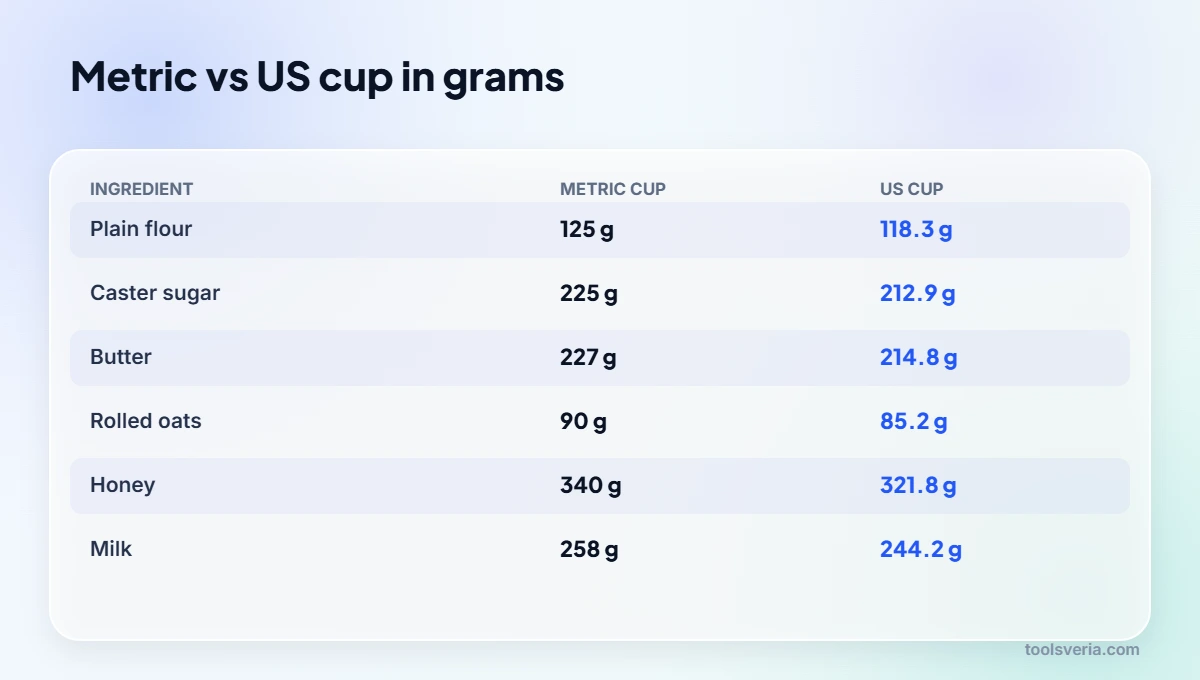
Cups to Grams Baking Weights for 13 Everyday Ingredients
In cups to grams baking, density is what turns volume into weight. Fluffy ingredients such as oats and cocoa trap air, so a cup weighs little. Dense ones such as honey are far heavier. The figures below are typical values for spooned and levelled cups, and the US column scales each metric weight by 236.6 divided by 250.
| Ingredient | Metric cup (250 ml) | US cup (236.6 ml) | Half US cup |
|---|---|---|---|
| Plain flour | 125 g | 118.3 g | 59.1 g |
| Self raising flour | 125 g | 118.3 g | 59.1 g |
| Caster sugar | 225 g | 212.9 g | 106.5 g |
| Granulated sugar | 200 g | 189.3 g | 94.6 g |
| Icing sugar | 125 g | 118.3 g | 59.1 g |
| Brown sugar, packed | 220 g | 208.2 g | 104.1 g |
| Butter | 227 g | 214.8 g | 107.4 g |
| Rolled oats | 90 g | 85.2 g | 42.6 g |
| Uncooked rice | 200 g | 189.3 g | 94.6 g |
| Cocoa powder | 100 g | 94.6 g | 47.3 g |
| Honey | 340 g | 321.8 g | 160.9 g |
| Water | 250 g | 236.6 g | 118.3 g |
| Milk | 258 g | 244.2 g | 122.1 g |
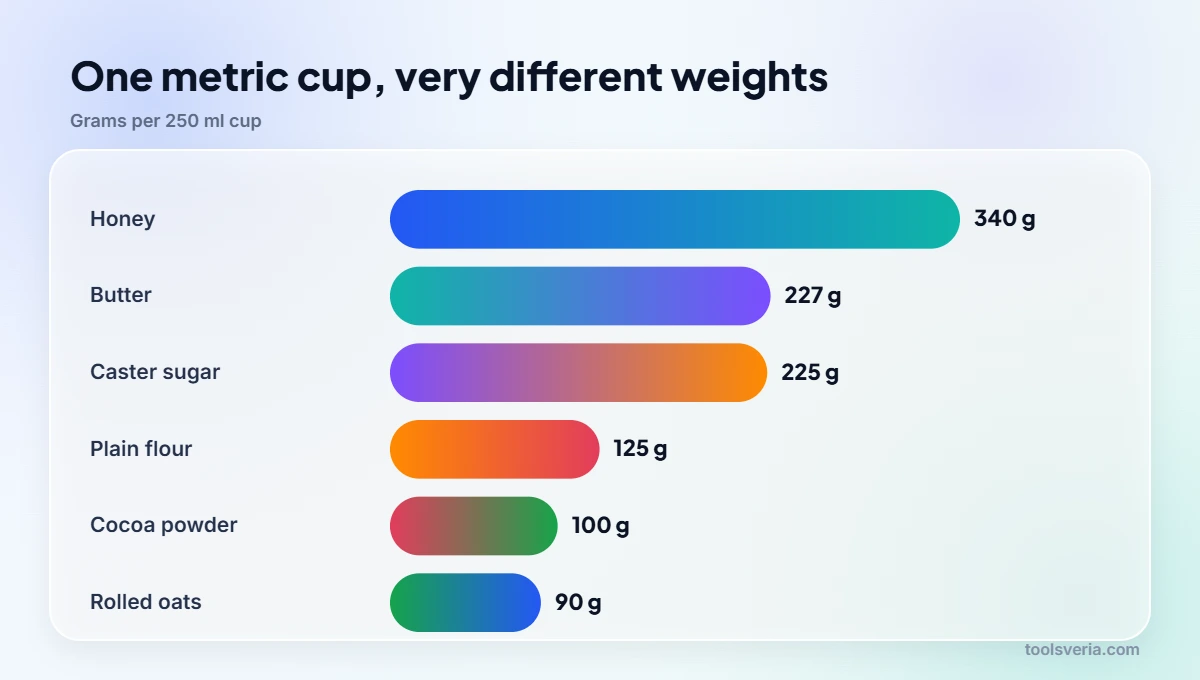
A cup of honey weighs almost four times as much as a cup of oats. That is why a single “cups to grams” number never works across a whole recipe, and why our converter asks for the ingredient first.
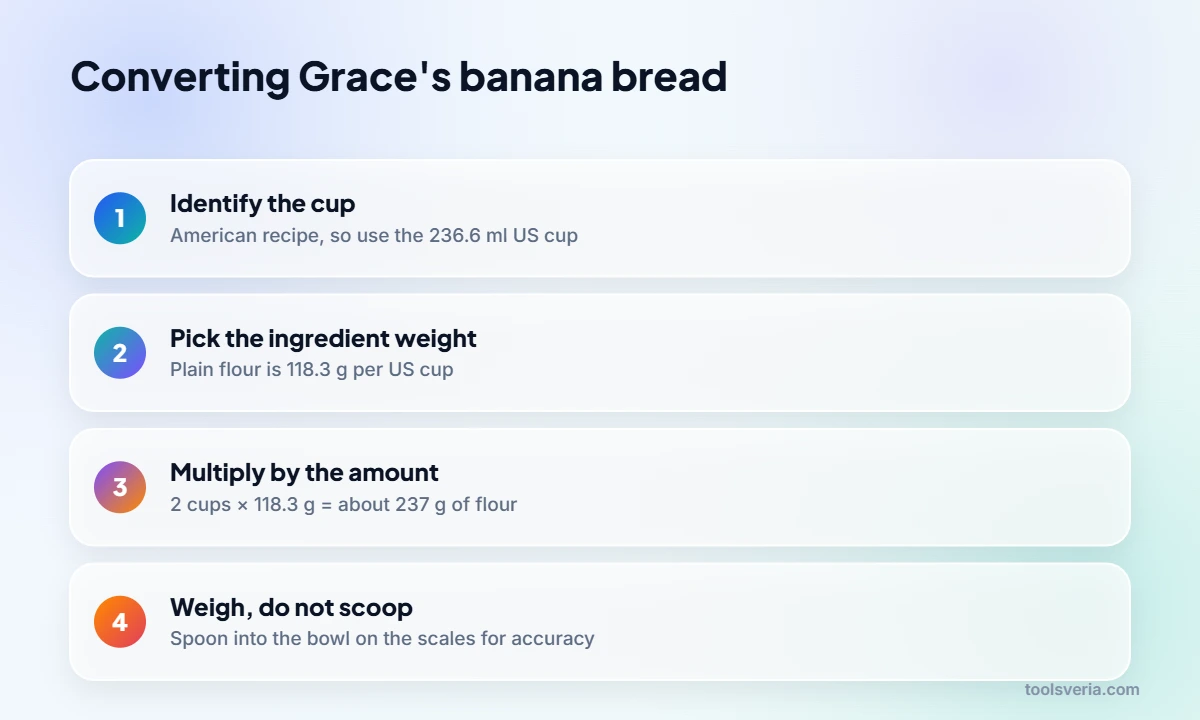
Grace’s American banana bread, converted
The blog lists 2 cups of plain flour, ¾ cup of granulated sugar, ½ cup of packed brown sugar, ½ cup of melted butter and ⅓ cup of milk. Since the writer is American, Grace uses the US column.
- Plain flour: 2 × 118.3 g = 236.6 g, so about 237 g.
- Granulated sugar: 0.75 × 189.3 g, roughly 142 g.
- Brown sugar, packed: 0.5 × 208.2 g, about 104 g.
- Butter: 0.5 × 214.8 g, about 107 g.
- Milk: one third of 244.2 g, about 81 g.
Fractions like ⅓ are the fiddliest part. If you prefer decimals before reaching for the calculator, our fraction to decimal converter turns ⅓ into 0.333 and ¾ into 0.75. The recipe also says 350°F, which is about 177°C. British recipes usually round this to 180°C, and the gas mark to Celsius converter confirms the matching gas mark for older ovens.
Lily’s Australian flapjacks in metric cups
Grace’s friend Lily follows a recipe from Melbourne that uses 250 ml cups: 1 cup of self raising flour, ½ cup of caster sugar, 1 cup of rolled oats and ¼ cup of cocoa powder. Here the metric column applies directly, giving 125 g of flour, 112.5 g of sugar, 90 g of oats and 25 g of cocoa.
Lily wants a bigger tray, scaling the recipe by one and a half. Multiplying each weight by 1.5 gives 187.5 g of flour, about 169 g of sugar, 135 g of oats and 37.5 g of cocoa. For less tidy scaling, such as turning a recipe for 6 into one for 10, our ratio calculator keeps every ingredient in proportion.
Why your weights might differ from ours
Every cups to grams baking figure here is approximate. How you fill the cup changes the result more than the cup size does. Scooping flour straight from the bag compresses it and can add a surprising amount, while spooning it in and levelling with a knife gives a lighter, more consistent cup. Brown sugar is different again, since recipes usually expect it pressed down firmly.
Liquids are the exception that makes life easier. Water weighs 1 g per ml, so a US cup is simply 236.6 g, and milk is only a little heavier at about 244 g. If your jug is marked in millilitres, measuring liquids by volume is perfectly accurate, and you can save the scales for flour, sugar and anything sticky.
Humidity, brand and how long a bag has sat in the cupboard all play a part too. If a converted recipe turns out dry, reduce the flour by 10 to 15 g next time and note the change on the printout. The broader overview of cooking weights and measures shows how widely kitchen units vary around the world, which is a good reason to weigh wherever possible.
Key points
- A metric cup holds 250 ml and a US cup about 236.6 ml, roughly 5.4% less.
- Weight depends on the ingredient: a metric cup of plain flour is about 125 g, honey about 340 g.
- Use the US column for American recipes and the metric column for Australian ones.
- Spoon and level dry ingredients, and weigh them where you can.
Frequently Asked Questions
My American cookie recipe wants 1½ cups of icing sugar. How many grams is that?
Using the US cup, 1.5 × 118.3 g gives about 177 g. In a metric cup the same amount would be 187.5 g.
Is a cup of butter really heavier than a cup of sugar?
Than granulated sugar, yes. A metric cup of butter is about 227 g against 200 g for granulated, though caster sugar at 225 g is close behind.
I only have a 250 ml measuring jug. Can I use it for a US recipe?
For liquids, yes: fill it to about 237 ml for each US cup. For dry ingredients, weighing is more accurate, since packing matters more than the container.
Why does ⅓ cup of honey weigh so much?
Honey is dense. A third of a US cup comes to roughly 107 g, more than a full US cup of rolled oats at 85.2 g.
Grace’s banana bread came out moist and evenly risen, and Lily’s larger tray of flapjacks vanished within a day. Check which cup your recipe uses, pick the right column, weigh rather than scoop, and American or Australian recipes become as dependable as any British one.