Convert UK or US cups to grams, or grams back to cups, for common baking ingredients.
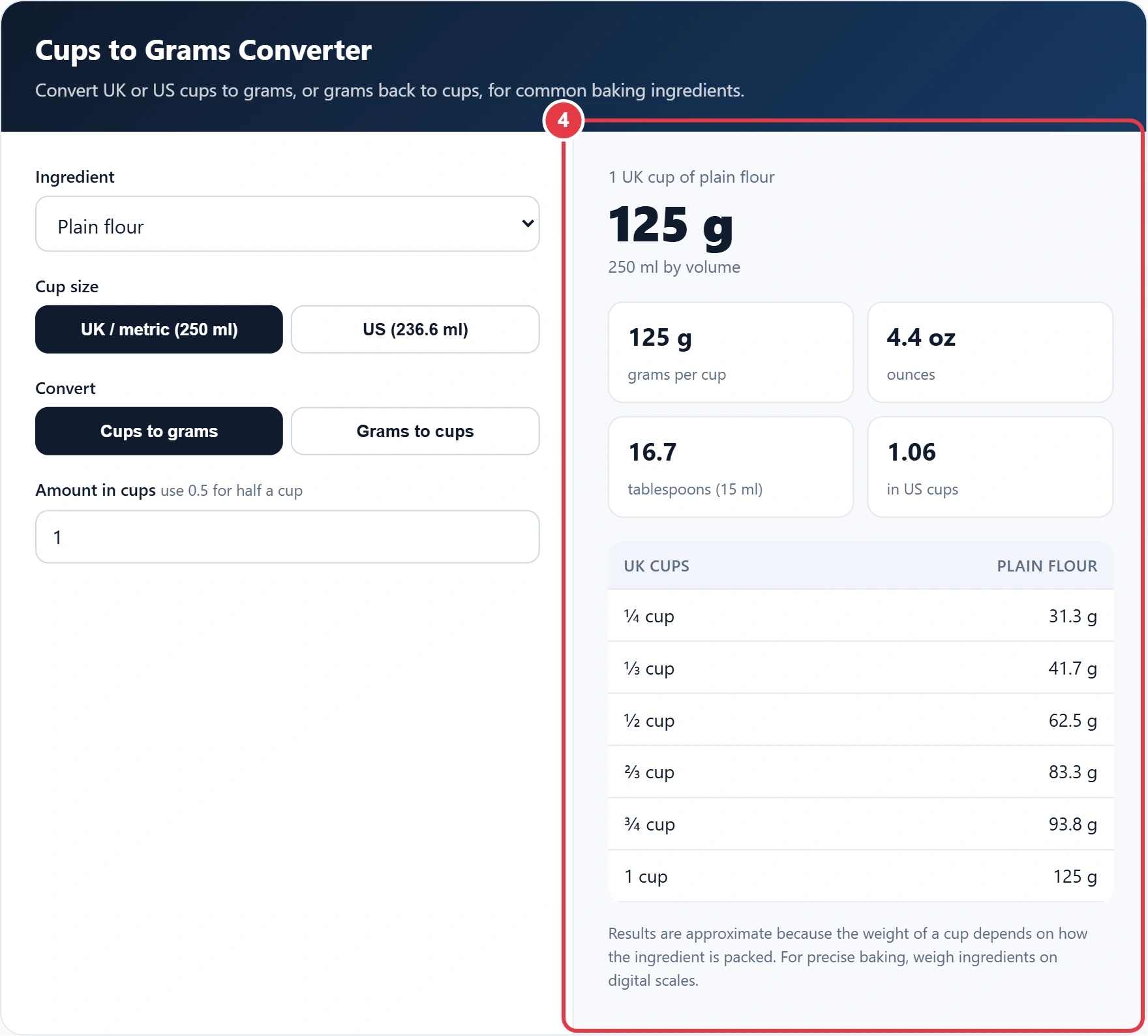
Results are approximate because the weight of a cup depends on how the ingredient is packed. For precise baking, weigh ingredients on digital scales.
American recipes, and plenty of modern British ones, measure dry ingredients in cups, while most UK kitchens rely on scales. This cups to grams converter turns a cup measure into grams for 13 common ingredients, using either the 250 ml metric cup or the 236.6 ml US customary cup that most American recipes assume. You can also convert grams back to cups when you want to share a family recipe with friends abroad.
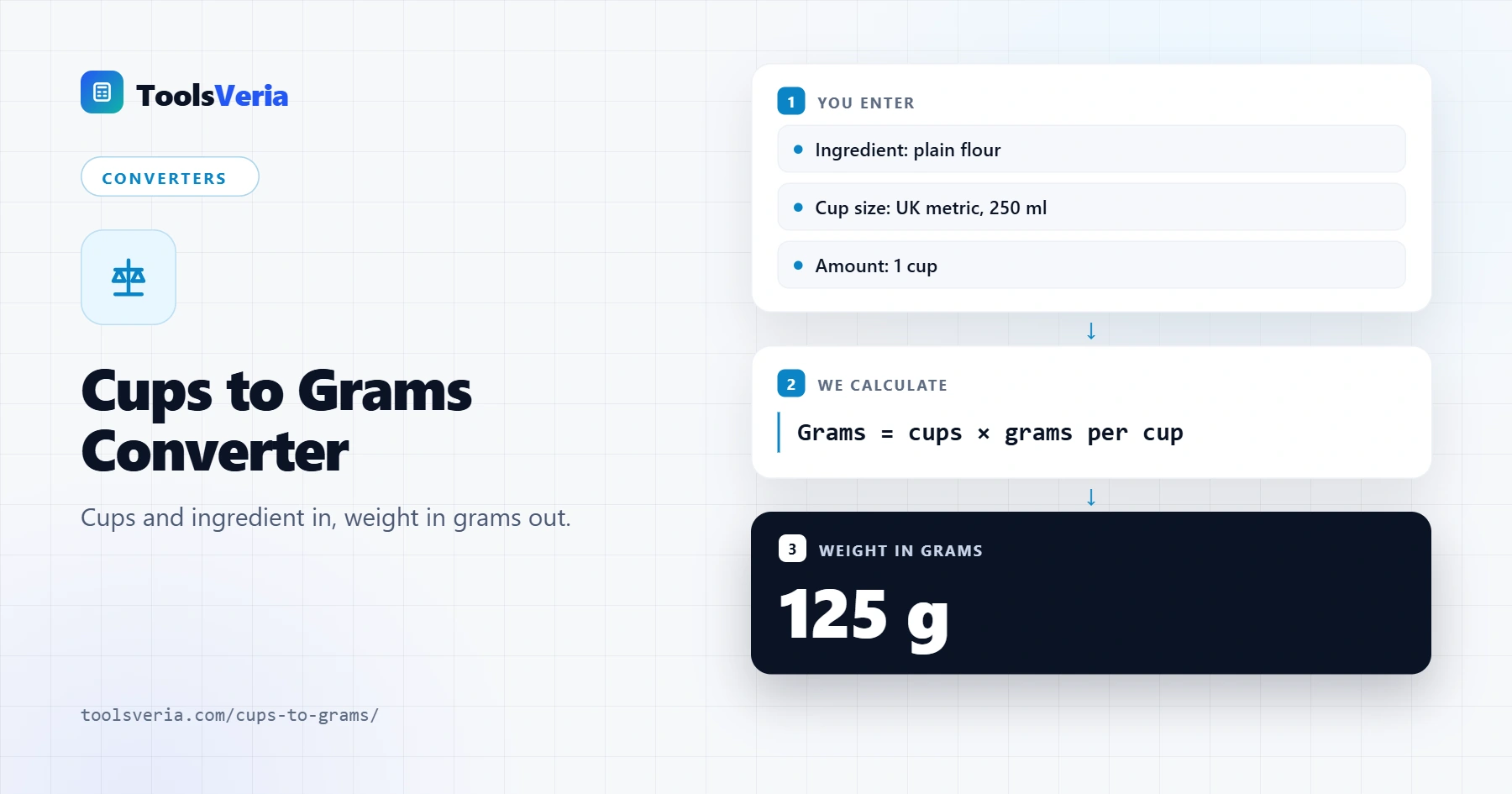
Quick answer: To convert cups to grams, multiply the number of cups by the typical grams per cup for that ingredient, because a cup measures volume, not weight. A 250 ml UK metric cup holds about 125 g of plain flour but around 340 g of honey, while a 236.6 ml US cup of plain flour weighs about 118.3 g.
In This Guide
What Is a Cup in Grams?
A cup is a measure of volume, not weight, so there is no single answer to how many grams are in a cup. Flour is light and full of air, while honey is dense and heavy. The same 250 ml cup holds about 125 g of plain flour but around 340 g of honey.
The formula is grams = cups × grams per cup for that ingredient. This converter uses typical weights for a 250 ml cup and scales them by 236.6 ÷ 250 when you choose US cups, so a US cup of plain flour comes out at about 118.3 g. To go the other way, it divides your grams by the grams per cup.
How Do You Use the Cups to Grams Converter?
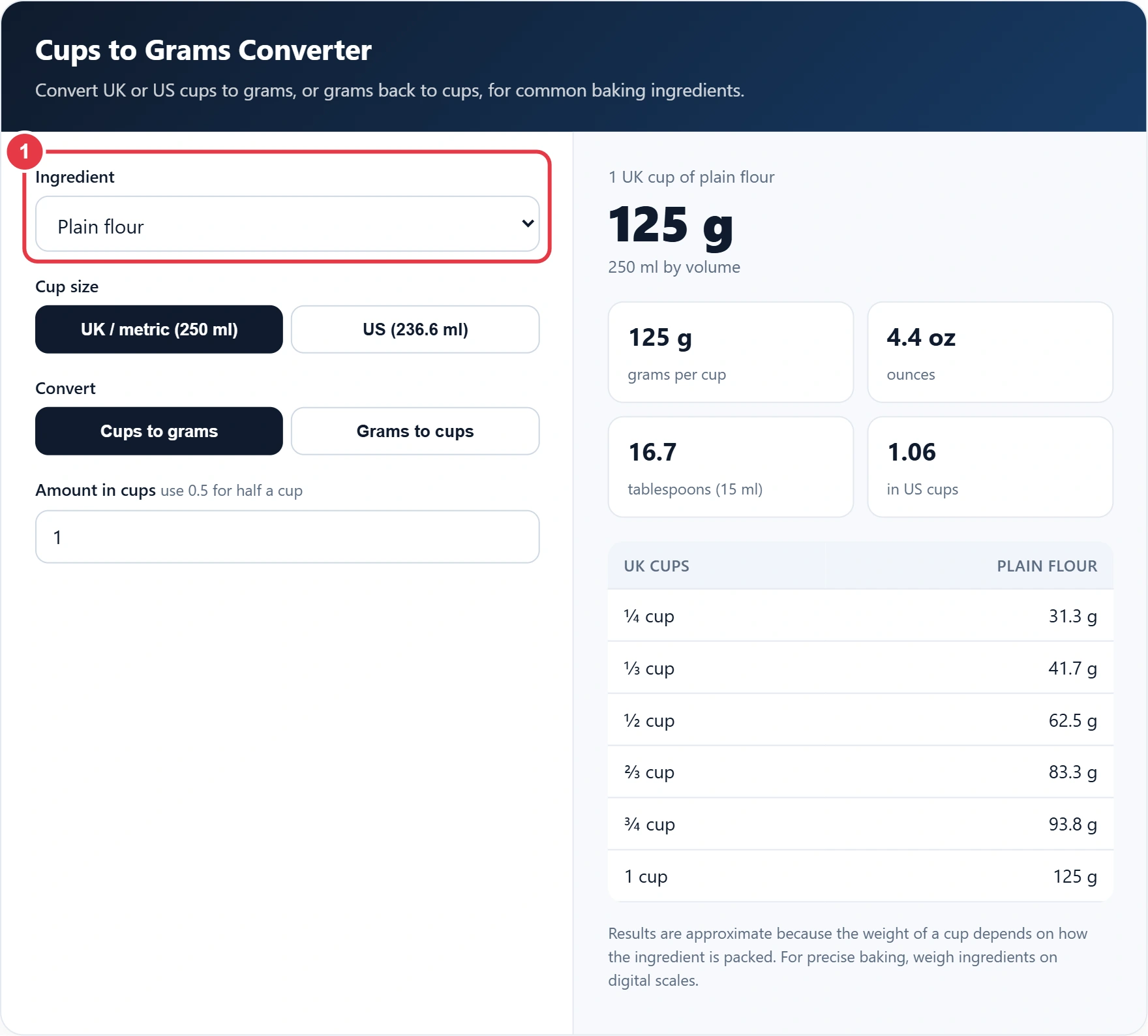
Step 1: Choose the Ingredient
Pick the ingredient from the list, which includes flours, sugars, butter, oats, rice, cocoa, honey, water and milk, each with its own typical weight per cup. Pick the ingredient from the list. Flours, sugars, butter, oats, rice, cocoa, honey, water and milk are all included, each with its own typical weight per cup.
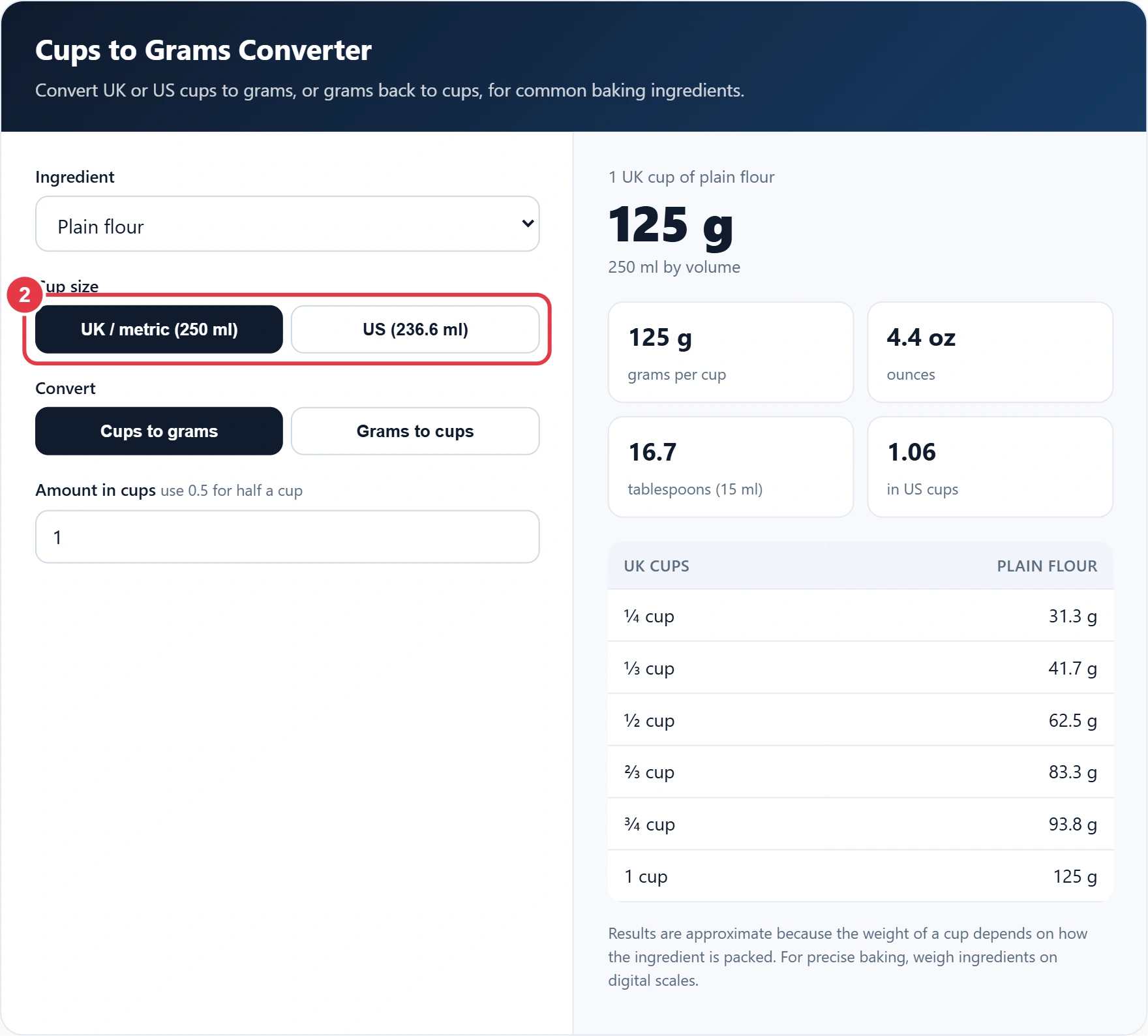
Step 2: Pick UK or US Cups
Choose UK / metric for recipes from the UK, Australia or New Zealand, which use a 250 ml cup, or US for American recipes. If the recipe gives its oven temperature in gas marks, the gas mark to Celsius converter sorts that out in a few seconds, so the whole recipe works in your kitchen.
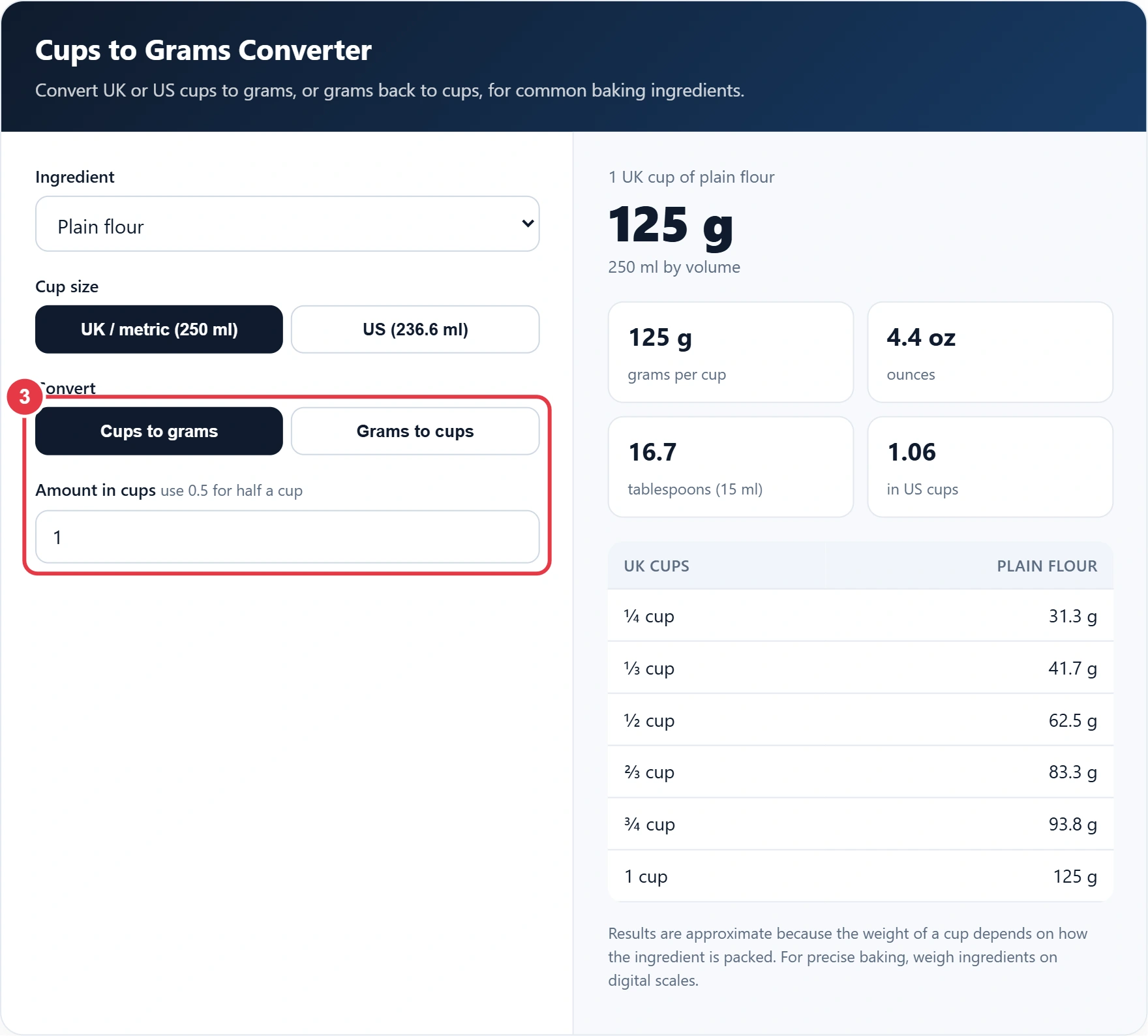
Step 3: Enter the Amount
Select Cups to grams or Grams to cups, then type the amount. Use decimals for part cups, so 0.5 is half a cup and 0.75 is three quarters. The fraction to decimal calculator turns awkward fractions such as ⅔ into a decimal you can enter here in seconds.
Step 4: Read the Results
The weight appears instantly, along with the volume in millilitres, the weight in ounces, the number of tablespoons and the equivalent in the other cup size. The chart underneath lists a quarter, a third, a half, two thirds, three quarters and a full cup of your ingredient, which is handy when scaling a recipe up or down.
How Many Grams Are in a Cup of Common Ingredients?
| Ingredient | 1 UK cup (250 ml) | 1 US cup (236.6 ml) |
|---|---|---|
| Plain or self raising flour | 125 g | 118.3 g |
| Caster sugar | 225 g | 212.9 g |
| Granulated sugar | 200 g | 189.3 g |
| Icing sugar | 125 g | 118.3 g |
| Brown sugar (packed) | 220 g | 208.2 g |
| Butter | 227 g | 214.8 g |
| Rolled oats | 90 g | 85.2 g |
| Rice (uncooked) | 200 g | 189.3 g |
| Cocoa powder | 100 g | 94.6 g |
| Honey | 340 g | 321.8 g |
| Water | 250 g | 236.6 g |
| Milk | 258 g | 244.2 g |
One UK cup (250 ml) holds about 125 g of plain flour, 225 g of caster sugar and 227 g of butter, while a US cup holds 118.3 g, 212.9 g and 214.8 g. These figures are typical averages. Flour that is sifted or spooned into the cup weighs less than flour scooped straight from the bag, and brown sugar is always measured packed. Kitchen scales remove the guesswork, which is why measuring ingredients by weight is the norm in British baking and gives the most consistent results every time you bake.
</>Embed this calculator on your website
Add the free Cups to Grams Converter to your own site or blog. Copy the code below and paste it into an HTML block. It resizes itself and works on phones.
How we checked this tool: the Tools Veria Editorial Team built this tool by hand, checked it against the official rules or published standards where they apply, and tested it against worked examples. Results are estimates for planning, not personal financial or tax advice. Read our editorial policy and disclaimer, or report an error.
Frequently Asked Questions
How many grams are in a cup of flour?
A 250 ml UK or metric cup of plain or self raising flour weighs about 125 g. A 236.6 ml US cup holds about 118 g.
How many grams of sugar are in a cup?
A 250 ml cup holds about 200 g of granulated sugar or 225 g of caster sugar. Icing sugar is much lighter at roughly 125 g a cup.
How many grams of butter are in a cup?
A 250 ml cup of butter weighs about 227 g. Many recipes give butter in grams or sticks as well, so check before converting.
Is a UK cup the same as a US cup?
Not quite. A UK or metric cup is 250 ml and a US cup is 236.6 ml, so a US cup holds about 5% less.
Why do cup to gram conversions vary?
Cups measure volume, so the weight depends on the density of the ingredient and how tightly it is packed. Sifted flour, for example, weighs less than scooped flour.
How many grams is half a cup?
It depends on the ingredient. Half a 250 ml cup of plain flour is about 62.5 g, while half a cup of granulated sugar is about 100 g.