Tom’s car failed its MOT on a Tuesday, and by Friday his landlord had announced a rent rise. Neither event was a disaster on its own, yet together they pushed him onto a credit card for the first time in years. Working out how much emergency fund UK households actually need is less about a magic number and more about matching the cash pot to the shocks your own life is likely to throw at you.
Four households follow below, each with different jobs, bills and risks. Their targets range from a few thousand pounds to more than twenty thousand, and the reasons behind that spread show how much emergency fund UK households like yours should hold.
Quick answer: The answer to how much emergency fund UK households need is usually three to six months of essential outgoings, held in an instant access savings account, as MoneyHelper suggests. A single renter spending £1,650 a month on essentials would aim for £4,950 to £9,900, while freelancers and sole earners often need six to nine months.
In This Guide
How Much Emergency Fund UK Households Need
Most UK households need between three and six months of essential spending set aside, which is the range MoneyHelper recommends for an instant access account. The word that matters is essential. Rent or mortgage, council tax, energy, food, travel to work, insurance and minimum debt payments count. Takeaways, streaming subscriptions and weekends away do not, because those are the first things you would cut if your income stopped.
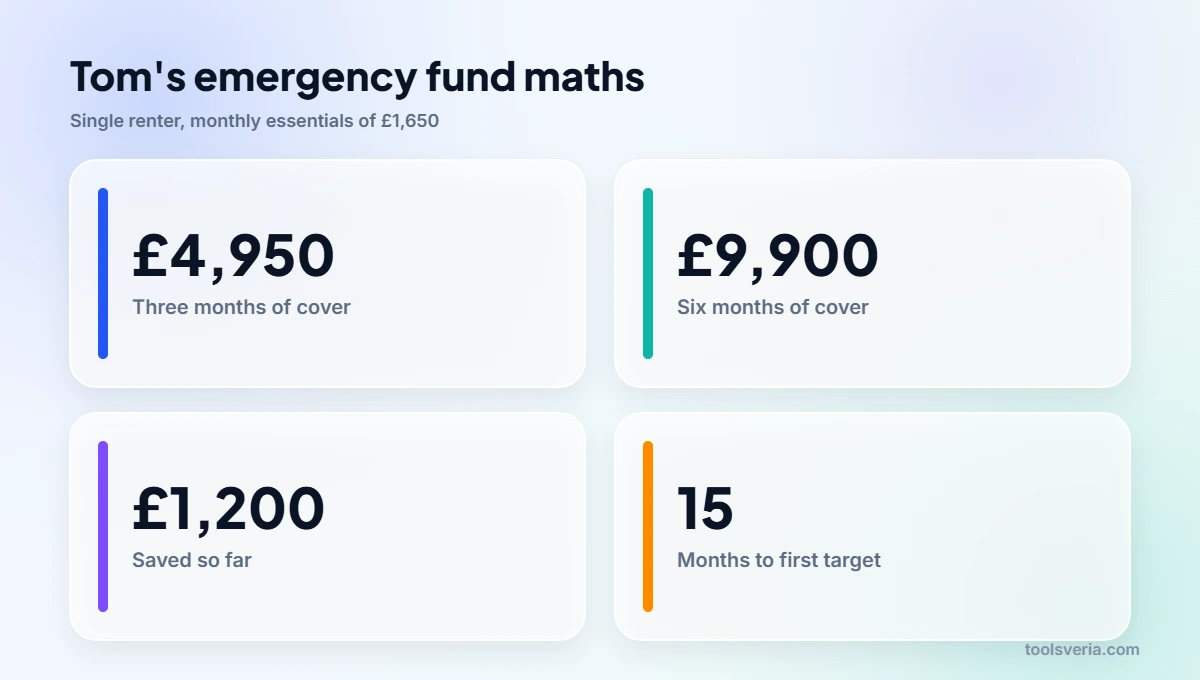
That distinction usually shrinks the target. Tom takes home £2,250 a month, but when he sat down with three months of bank statements he found that only £1,650 of it went on unavoidable costs. Three months of cover is therefore £4,950 rather than the £6,750 he had assumed, and that lower figure felt reachable. The MoneyHelper guidance on emergency savings uses the same essentials only approach, so your figure stays realistic rather than inflated.
Four UK households, four different targets
Tom: single, renting in Bristol
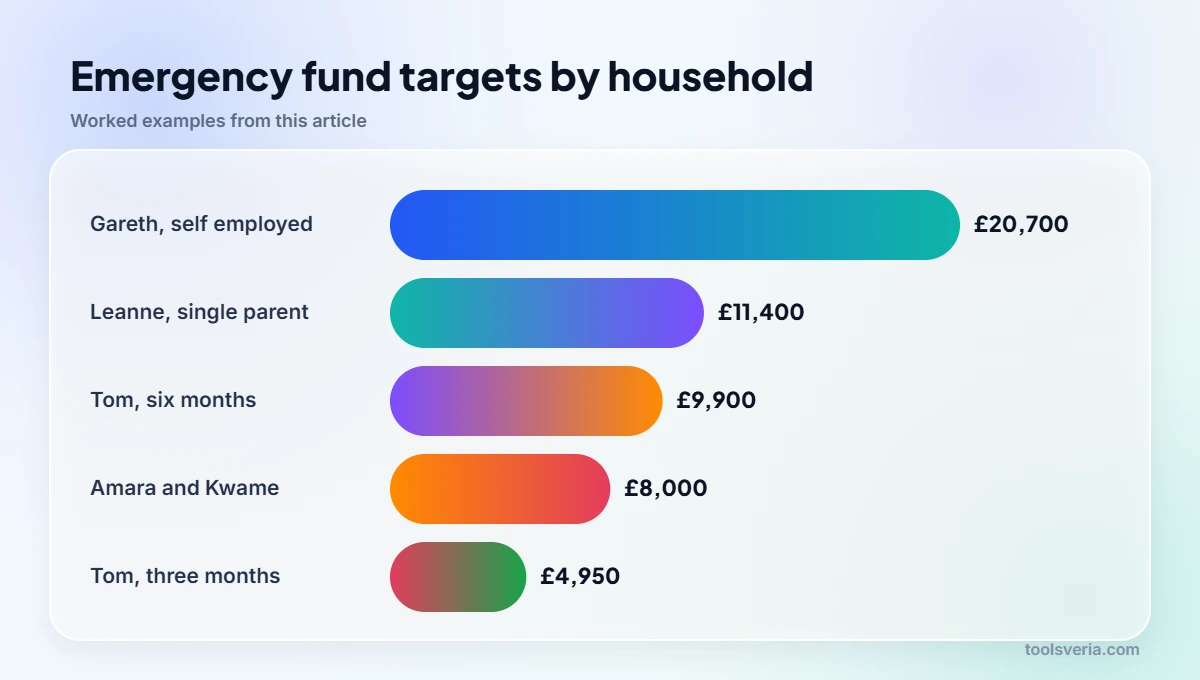
Tom works in IT support on a permanent contract. With £1,650 of monthly essentials, his first milestone is three months, or £4,950. He already has £1,200 in savings and can spare £250 a month, so the £3,750 gap closes in 15 months. Once there, he plans to keep going towards six months, which is £9,900.
Amara and Kwame: two incomes, a mortgage and a toddler
Their essentials come to £2,900 a month. Six months of everything would be £17,400, a daunting number. A sharper way for a two earner couple is to ask what happens if one salary vanishes. Amara takes home £2,100 and Kwame £1,900. If Amara lost her job, Kwame’s pay would leave a monthly shortfall of £1,000, and six months of that is £6,000. They add £2,000 for a large one off bill such as a boiler, giving a working target of £8,000.
Gareth: self employed electrician
Gareth’s work comes in waves, and a quiet winter once left him with almost nothing invoiced for two months. His essentials are £2,300 a month, and he holds nine months, which is £20,700. His tax money sits in a separate account, and he sizes that pot using our self employed tax calculator each quarter, so the buffer is never quietly raided to pay HMRC in January.
Leanne: single parent, sole earner
Leanne is a healthcare assistant with two children and nobody else’s wage to fall back on. Her essentials are £1,900 a month, and six months gives £11,400. Because school uniform, a broken washing machine or a sudden childcare gap are more likely for her than a job loss, she treats the first £2,000 as a bills buffer and the rest as income cover.
| Household | Monthly essentials | Months of cover | Target |
|---|---|---|---|
| Tom, single renter | £1,650 | 3, then 6 | £4,950, then £9,900 |
| Amara and Kwame, couple | £1,000 shortfall plus £2,000 bills buffer | 6 | £8,000 |
| Leanne, single parent | £1,900 | 6 | £11,400 |
| Gareth, self employed | £2,300 | 9 | £20,700 |
Should I aim for three, six or nine months?
Three months suits a household with two secure incomes and no dependants, six months suits most families and sole earners, and nine months or more suits the self employed and anyone in a sector where new jobs take a long time to land. Three questions quickly settle how much emergency fund UK savers in most situations need.
- How many incomes support the household? One income means more months.
- How quickly could you find similar work? Specialist roles and senior posts often take longer to replace.
- What would break first? An old car, an ageing boiler or a pet without insurance all argue for a separate bills buffer on top.
Contract and agency staff often sit between the employee and freelancer cases. If your contract runs to a fixed end date, count the weeks until that date and add the typical gap you have had between roles in the past. Our working days calculator is handy here, because a contract ending just before Christmas can mean several bank holidays with no billable days.
Where should a UK emergency fund be kept?
An emergency fund belongs in an instant access savings account or an easy access cash ISA, separate from your current account, so you can reach it within a day or two without penalties. Fixed term bonds and stocks and shares ISAs are poor homes for this money, since one locks it away and the other can fall in value in the very month you need it.
Safety matters as well as access, and the limit changed recently. From 1 December 2025, as the Bank of England explainer on the FSCS sets out, deposits are protected up to £120,000 per person at each authorised bank or building society, which comfortably covers every target in this article. Groups of banks can share a single licence, so check which brands count together if you split money around.
Interest helps a little. At an illustrative 4% AER, Tom’s £4,950 would earn roughly £198 in a year, well inside the £1,000 personal savings allowance for a basic rate taxpayer. Running his balance through the savings interest calculator shows how much sooner regular deposits plus interest reach the six month mark than deposits alone.

Should I clear debt or build the fund first?
Most people do best by saving a starter pot of about one month of essentials first, then putting extra money towards expensive debt, then finishing the full fund. A card charging around 25% interest costs far more than any savings account pays, but having no cash at all is how one surprise bill becomes new borrowing.
Tom followed that order. He paused at £1,650, cleared his £900 card balance over four months, then returned to saving at a higher rate because the card payment had disappeared. Seeing your target, gap and finish date side by side in the calculator makes it easier to stick to a sequence like his.
Key points
- MoneyHelper suggests three to six months of essential outgoings held in an instant access account.
- Count only unavoidable costs, which for Tom came to £1,650 out of £2,250 take home pay.
- Two earner couples can size the fund around losing the larger salary rather than all spending.
- Self employed workers often hold nine months and keep tax money in a separate account.
- The FSCS protects up to £120,000 per person per authorised bank from 1 December 2025.
Emergency Fund Terms UK Savers Should Know
Use these definitions to size an emergency fund UK households can rely on, separating essential costs from optional spending and choosing where the cash should sit.
- Emergency fund
- A pot of cash kept aside purely to cover unexpected costs or a sudden fall in income, so that borrowing is not needed. It is sized in months of essential outgoings rather than as a fixed sum, which ties the target to each household’s own bills.
- Essential outgoings
- Spending that would continue even if income stopped, such as rent or mortgage, council tax, energy, food and minimum debt repayments. Counting only these costs, rather than total spending, gives a smaller and more realistic savings target.
- Instant access savings account
- A deposit account that allows withdrawals at any time without notice or penalty. Its flexibility suits emergency money, which may be needed within days, even though fixed term accounts sometimes pay a higher rate in return for locking funds away.
- Income shortfall
- The gap between essential costs and the money still coming in if one earner loses their job. For Amara and Kwame, the shortfall is £1,000 a month, so six months of cover needs £6,000 rather than six months of total bills.
- Savings gap
- The difference between the target fund and what is already saved. Dividing it by the amount that can be put aside each month gives the number of months needed, as with Tom closing £3,750 at £250 a month in 15 months.
- MoneyHelper
- The free, government backed service that gives guidance on money and pensions in the UK. Its emergency savings guidance uses a range of three to six months of essential spending as the usual starting point for building a cash buffer.
Frequently Asked Questions
I live with my parents and pay £400 board. Do I still need six months?
You probably need less. If your essentials are £400 board plus £150 for travel and your phone, three months of cover is £1,650. Add a small buffer for your car or laptop, and aim higher once you move out and take on rent.
My partner and I keep separate money. Whose essentials count?
Count the shared bills plus your own fixed costs, then check what happens if either of you stops earning. Amara and Kwame found the bigger shortfall came from losing Amara’s £2,100, so they sized their joint pot around a £1,000 monthly gap.
Can my emergency fund sit in a cash ISA?
Yes, an easy access cash ISA works well, provided withdrawals are allowed without notice or penalty. Check the account terms first, because some cash ISAs restrict withdrawals or lose their bonus rate if you take money out during the year.
I used half my fund on a car repair. How fast should I rebuild it?
Treat refilling it as your first saving priority until it is back to target. If Tom spent £2,500 of a £4,950 pot, saving £250 a month would restore it in 10 months, or sooner if he pauses other goals for a while.
Tom now has a number written on a sticky note above his desk, and that single figure has made saving feel finite rather than endless. Put your own essentials into the calculator, choose the months that suit your household, and set up a standing order on payday. Figures checked October 2026.