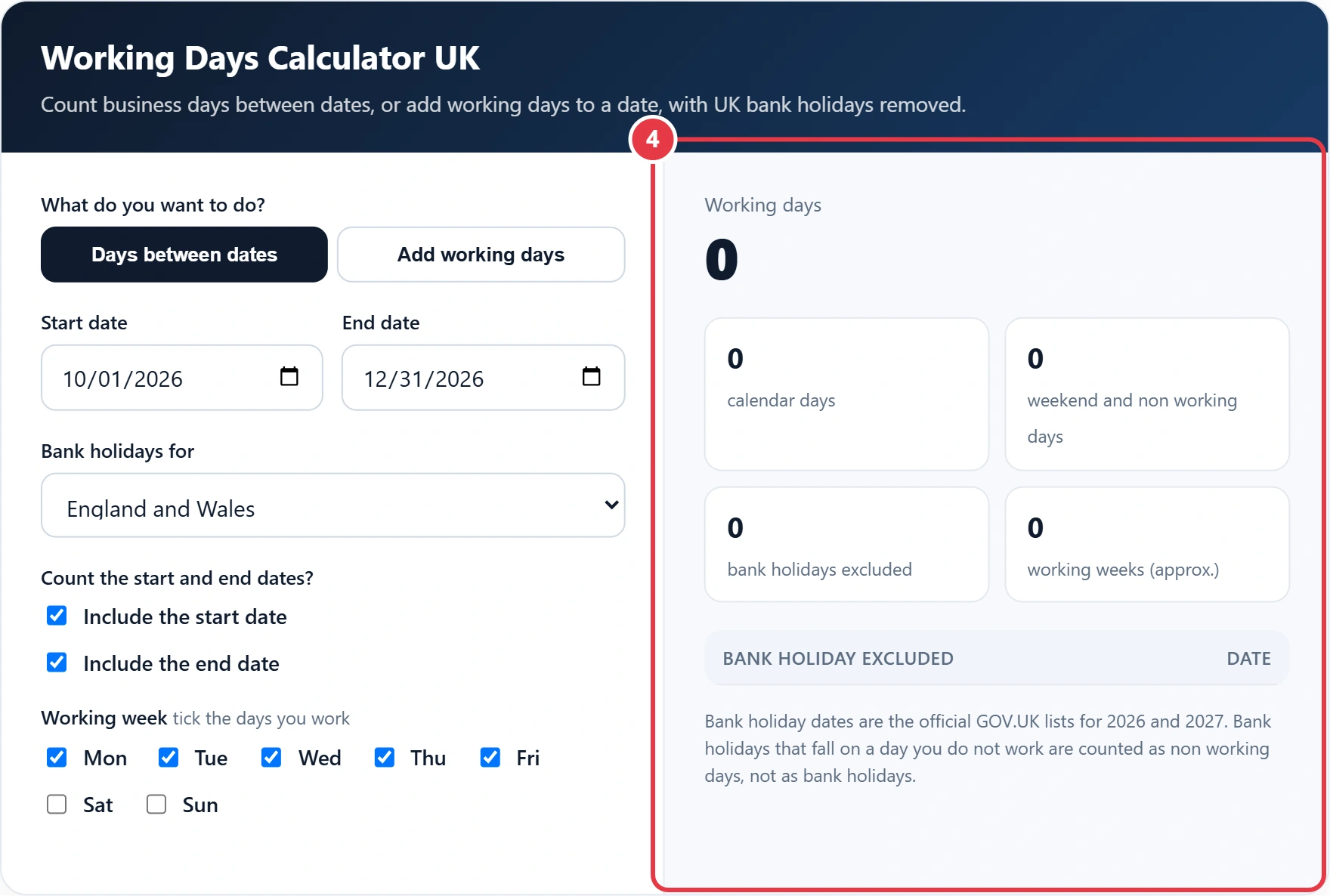
Count business days between dates, or add working days to a date, with UK bank holidays removed.
| Bank holiday excluded | Date |
|---|
Bank holiday dates are the official GOV.UK lists for 2026 and 2027. Bank holidays that fall on a day you do not work are counted as non working days, not as bank holidays.
Need to know how many business days sit between two dates, or which date falls 10 working days from today? This working days calculator UK counts Monday to Friday (or your own working week) and removes the official bank holidays for England and Wales, Scotland or Northern Ireland, taken from the GOV.UK bank holiday list. It is handy for notice periods, invoice terms, delivery estimates and project plans.
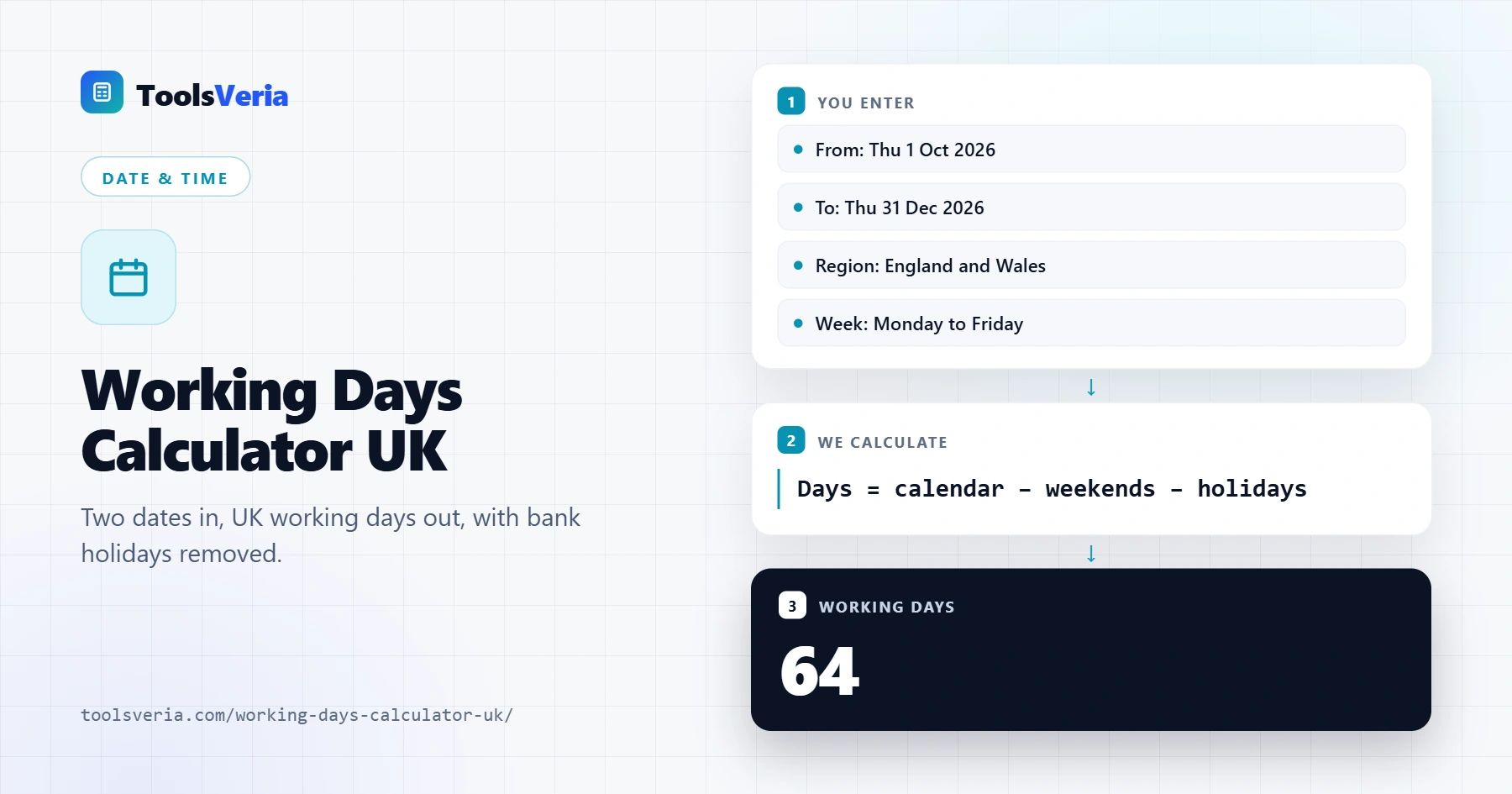
Quick answer: A working days calculator UK businesses use counts calendar days minus weekend days minus bank holidays on working days. For example, 1 October to 31 December 2026 has 92 calendar days and 26 weekend days, and removing Christmas Day and the Boxing Day substitute day leaves 64 working days in England and Wales.
In This Guide
What Is a Working Days Calculator?
A working day, often called a business day, is any day you would normally work. In the UK that usually means Monday to Friday, excluding bank holidays. Because bank holidays differ between the four nations, the same date range can give a different answer in Edinburgh than in London or Belfast.
The method is simple: working days = calendar days − weekend days − bank holidays on working days. For example, 1 October to 31 December 2026 has 92 calendar days, 26 of which are weekend days. In England and Wales, Christmas Day and the Boxing Day substitute day are removed, leaving 64 working days.
How Do You Use the Working Days Calculator UK?
Step 1: Choose a Mode and Enter Dates
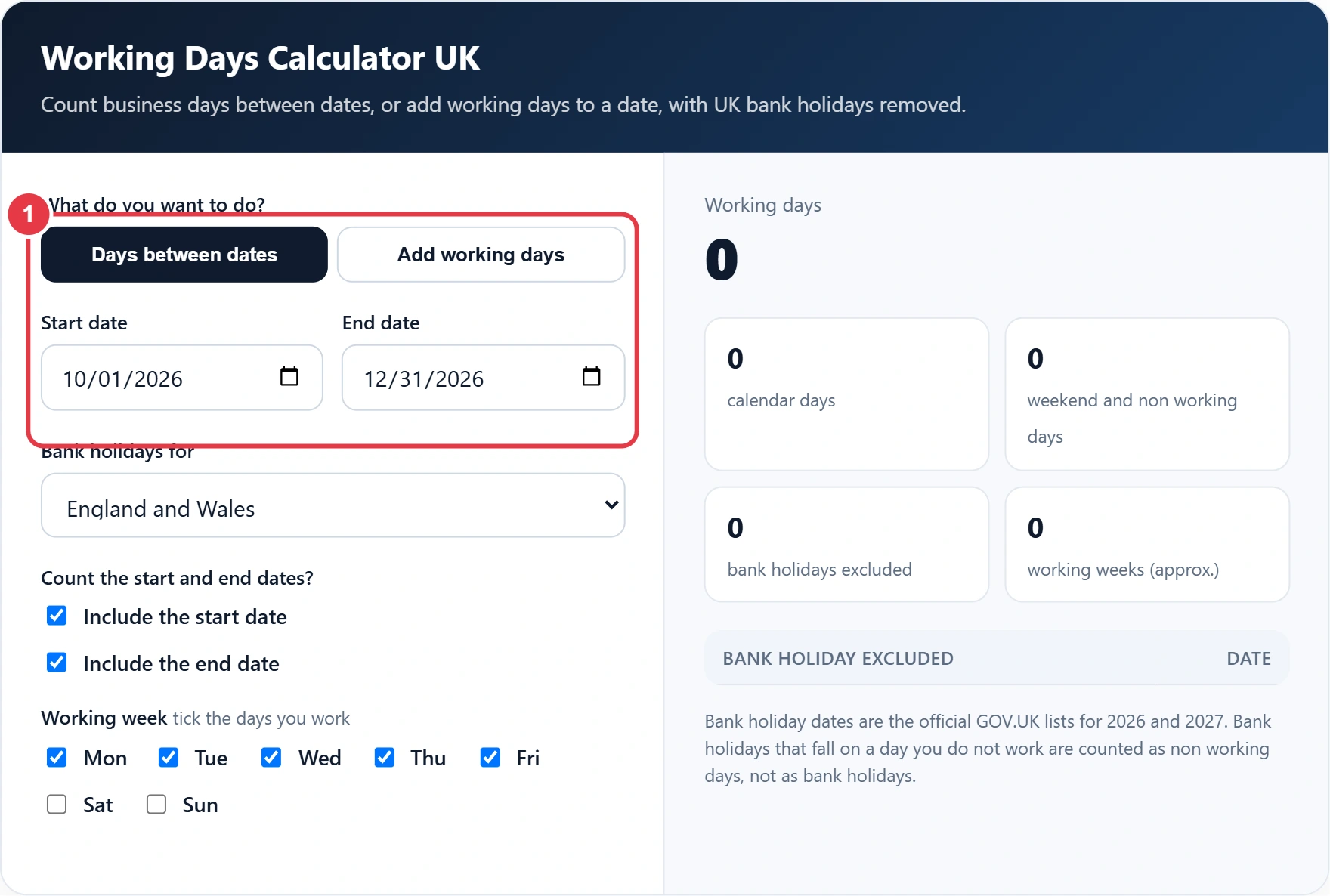
Select Days between dates to count business days in a range, or Add working days to find the date a set number of working days after a start date. Select Days between dates to count business days in a range, or Add working days to find the date a set number of working days after a start date, entering a negative number to count backwards. The time duration calculator is the better choice if you need the hours and minutes between two points, including multi day spans, rather than business days.
Step 2: Pick Your Region
Choose England and Wales, Scotland or Northern Ireland. The calculator then uses that nation's bank holidays for 2026 and 2027.
Step 3: Set Your Working Week
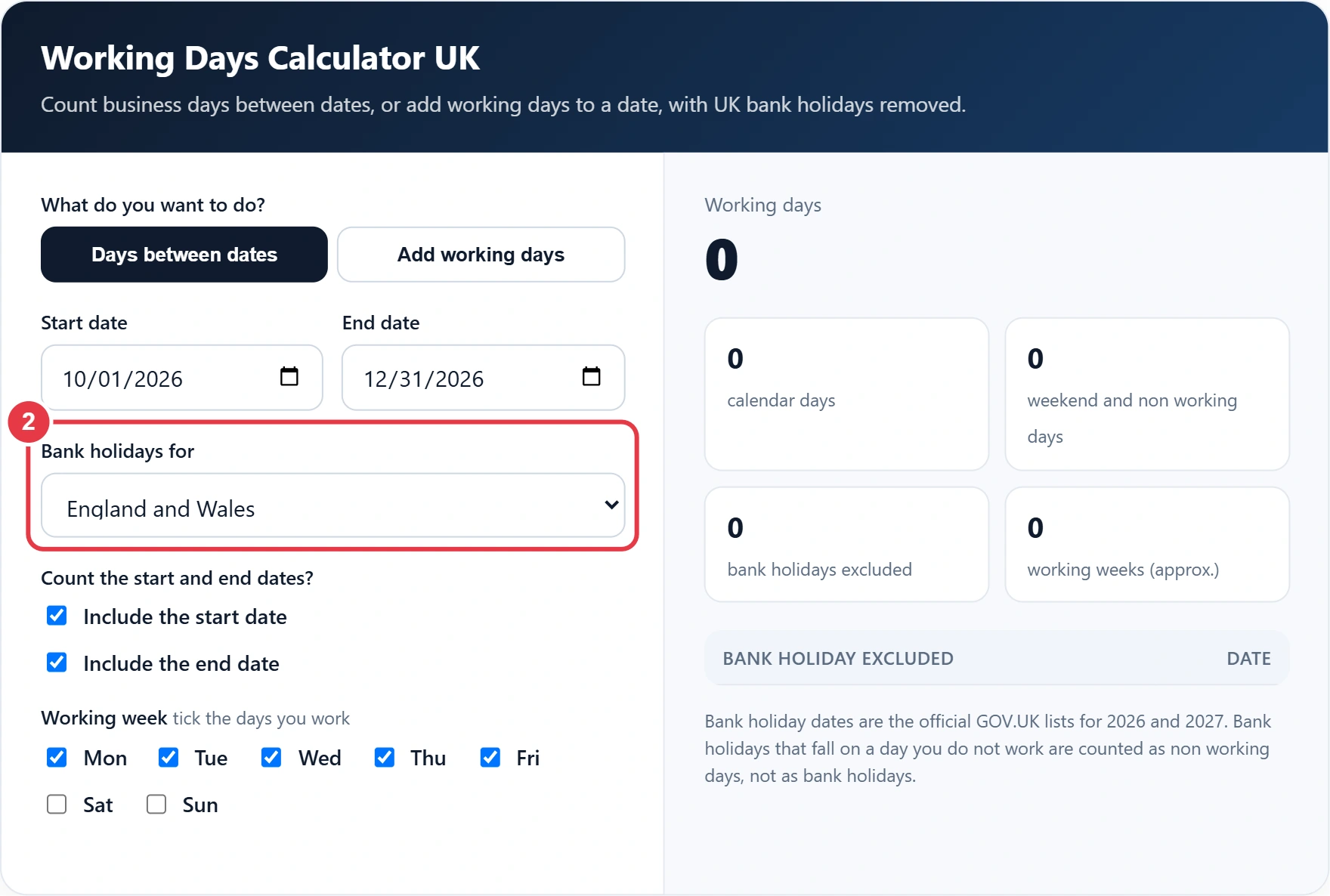
Decide whether the start and end dates should count. Then tick the days you actually work. If you work Tuesday to Saturday, untick Monday and tick Saturday, and the count adjusts straight away.
Step 4: Read Your Results
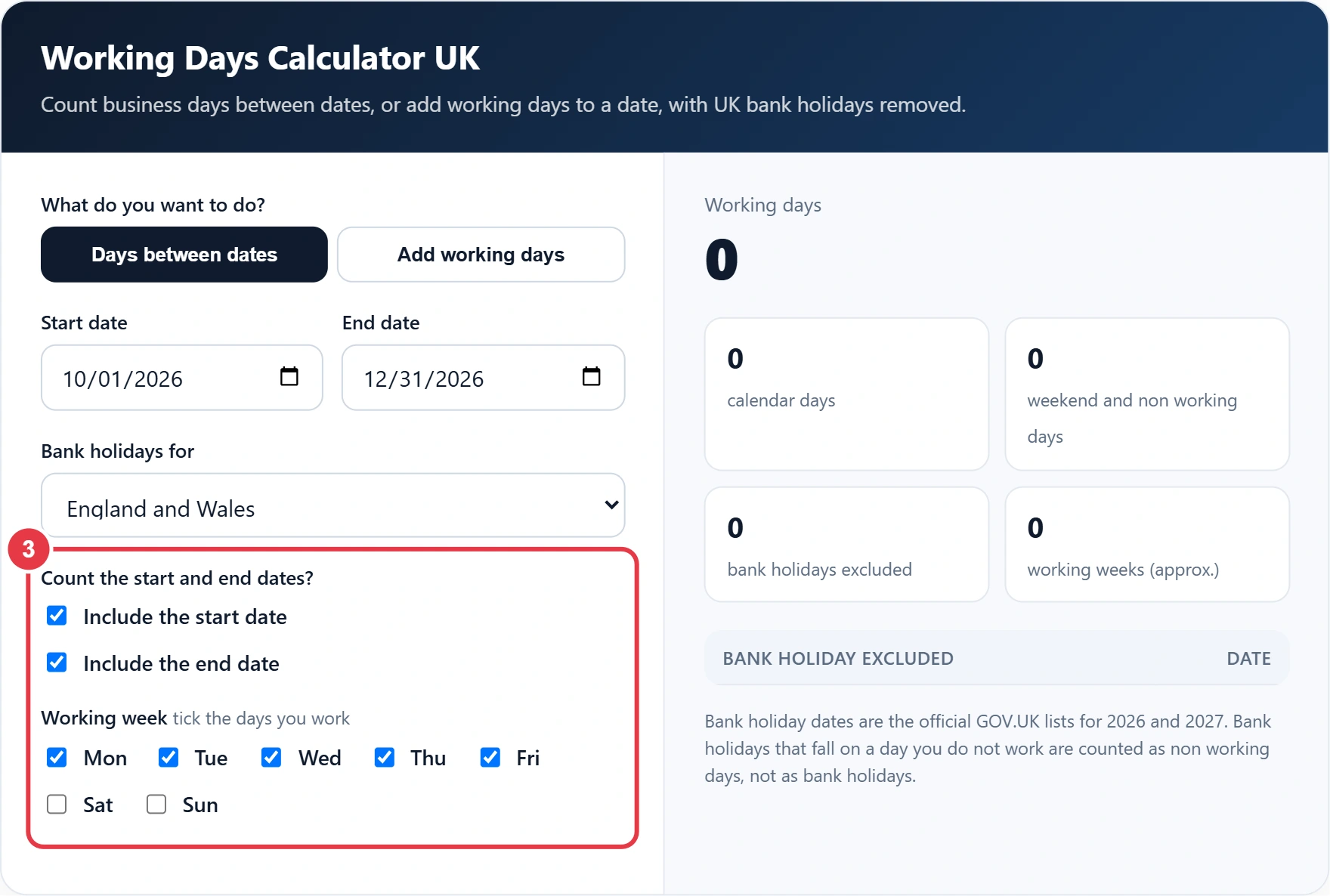
You will see the number of working days, calendar days, weekend days and bank holidays removed, plus a list of each bank holiday that was excluded so you can check the figure. If you need to turn that count into leave, the holiday pay calculator works out entitlement and pay for the days you work.
When Are the UK Bank Holidays in 2026?
| Date | Bank holiday | Where |
|---|---|---|
| Thu 1 Jan | New Year's Day | All UK |
| Fri 2 Jan | 2nd January | Scotland |
| Tue 17 Mar | St Patrick's Day | Northern Ireland |
| Fri 3 Apr | Good Friday | All UK |
| Mon 6 Apr | Easter Monday | England, Wales, Northern Ireland |
| Mon 4 May | Early May bank holiday | All UK |
| Mon 25 May | Spring bank holiday | All UK |
| Mon 15 Jun | World Cup bank holiday | Scotland |
| Mon 13 Jul | Battle of the Boyne (substitute day) | Northern Ireland |
| Mon 3 Aug | Summer bank holiday | Scotland |
| Mon 31 Aug | Summer bank holiday | England, Wales, Northern Ireland |
| Mon 30 Nov | St Andrew's Day | Scotland |
| Fri 25 Dec | Christmas Day | All UK |
| Mon 28 Dec | Boxing Day (substitute day) | All UK |
Bank holidays across the whole UK in 2026 fall on 1 January, 3 April, 4 May, 25 May, 25 December and 28 December, with extra dates in each nation. Employers do not have to give bank holidays off as paid leave, and many count them as part of the 5.6 weeks of statutory holiday. Check your contract and the GOV.UK holiday entitlement rules if you are working out leave or notice periods.
Key Working Days Calculator UK Terms Explained
These definitions explain the counting rules behind the working days calculator UK, helping you set deadlines, notice periods and payment terms with confidence.
- Business day
- A day on which normal commercial activity takes place, usually Monday to Friday excluding public holidays. Contracts, banks and couriers often express deadlines in business days, so the exact count affects when obligations fall due.
- Calendar days
- Every day in a period, including weekends and holidays. Subtracting non working days from this total gives the working day count, which is why the two figures differ for the same date range.
- Inclusive counting
- A choice about whether the start date, the end date or both are counted in a range. Including or excluding them can change the result by one or two days, so the convention should match the contract or policy.
- Working week pattern
- The specific days a person or business normally works, which may not be Monday to Friday. Part-time and shift workers need their own pattern so that days they never work are not counted.
- Notice period
- The length of warning that an employee or employer must give before a contract ends, or a party must give before a change takes effect. When it is stated in working days, bank holidays push the end date later.
</>Embed this calculator on your website
Add the free Working Days Calculator to your own site or blog. Copy the code below and paste it into an HTML block. It resizes itself and works on phones.
How we checked this tool: the Tools Veria Editorial Team built this tool by hand, checked it against the official rules or published standards where they apply, and tested it against worked examples. Results are estimates for planning, not personal financial or tax advice. Read our editorial policy and disclaimer, or report an error.
Frequently Asked Questions
How many working days are there in 2026 in the UK?
With a Monday to Friday week, 2026 has 261 weekdays. Removing the 8 bank holidays in England and Wales leaves 253 working days. Scotland and Northern Ireland have 10 bank holidays each, leaving 251.
Are bank holidays counted as working days?
No. Bank holidays are normally treated as non working days, so this calculator removes them from the count when they fall on a day you work.
What is a business day in the UK?
A business day is usually any Monday to Friday that is not a bank holiday. Some contracts define it differently, so always check the wording.
How do I add working days to a date?
Choose Add working days, enter the start date and the number of days. The calculator skips weekends and bank holidays and shows the resulting date.
Should I include the start date?
It depends on what you are counting. For a notice period or deadline that starts the next day, untick the start date. For a project that begins on the start date, keep it ticked.
Why is Scotland's count different from England's?
Scotland has its own bank holidays, such as 2nd January and St Andrew's Day, and does not have Easter Monday, so the number of working days can differ.