Priya has spotted a school office job advertised at “£30,000 pro rata”, three days a week. Before she gets excited, she needs to know what that pro rata salary will actually put in her account each month. The headline number is not her pay. It describes what someone doing the same job five days a week would earn, and her share is cut down to match the time she works.
Quick answer: A pro rata salary is the advertised full time salary × (your weekly hours ÷ full time weekly hours). On a £30,000 job with a 37.5 hour week, three days totalling 22.5 hours gives 0.6, or £18,000 a year, and your hourly rate stays the same as a full timer’s, at roughly £15.38.
The Latin phrase simply means in proportion. Below we follow Priya and a few other workers through the sums, then look at holiday, contracts that last only part of a year, and the take home figures for 2026/27, which turn out to be kinder to part timers than most people expect.
In This Guide
One ratio does all the work for a pro rata salary
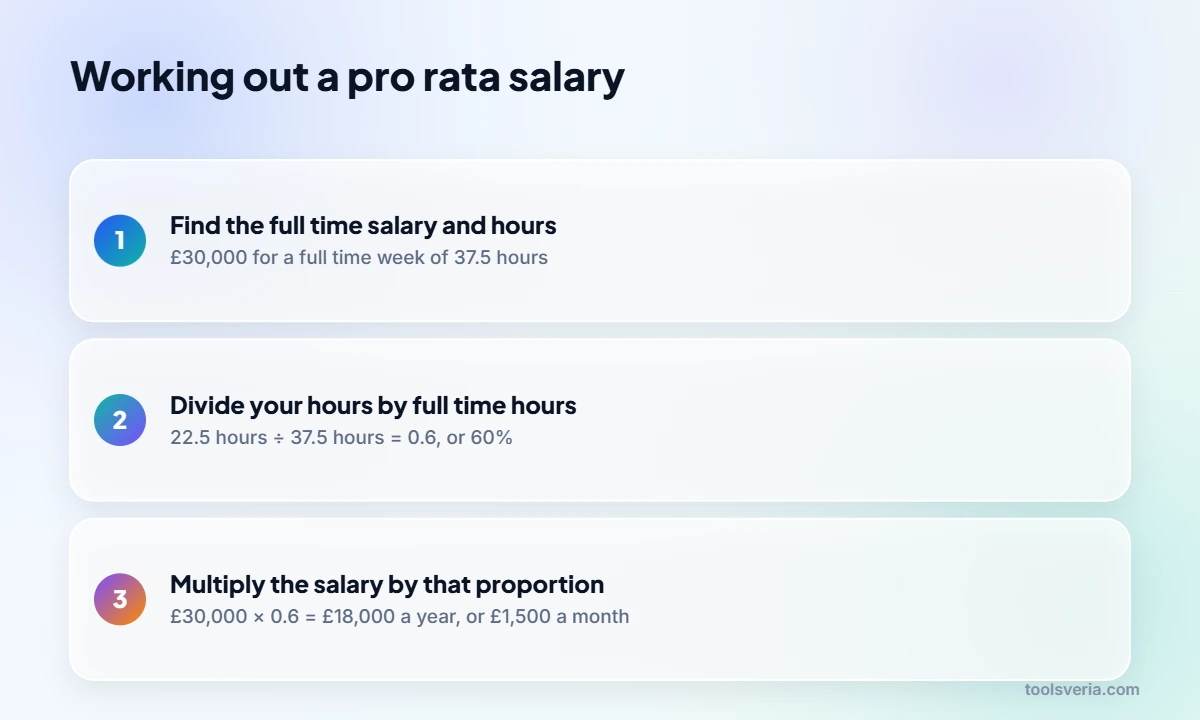
Priya’s sum has three ingredients: the advertised full time salary, the hours a full timer does in that job, and the hours she will do. Put them together like this:
- Her pay = advertised salary × (her weekly hours ÷ full time weekly hours)
Counting days instead of hours works just as well, as long as both sides use days. The detail people skip is the middle ingredient. Employers set their own full time week, usually 35, 37.5 or 40 hours, and it changes the answer. Priya’s 22.5 hours equal 60% of a 37.5 hour week, yet only 56.25% of a 40 hour week, so she asks HR which figure the school uses before doing anything else.
The law is on her side here. An employer cannot give a part timer a worse deal than a comparable full time colleague just because of the shorter hours, and the GOV.UK summary of part time worker rights explains that pay, leave and perks such as bonuses should match or be scaled down fairly. A proper pro rata calculation is how that fairness shows up on a payslip.
What Is a £30,000 Pro Rata Salary for Three Days a Week?
Priya: three full days
A 37.5 hour week over five days makes three days 22.5 hours, and 22.5 divided by 37.5 gives 0.6, so 0.6 of £30,000 is £18,000 a year. The school confirms a 37.5 hour week over five days, so Priya’s three days come to 22.5 hours. Dividing 22.5 by 37.5 gives 0.6, and 0.6 of £30,000 is £18,000 a year, or £1,500 a month before deductions. Her hourly rate does not shrink at all. A full timer on £30,000 works 37.5 hours for 52 weeks, which is roughly £15.38 an hour, and Priya earns that same rate.
Tom: five shorter days
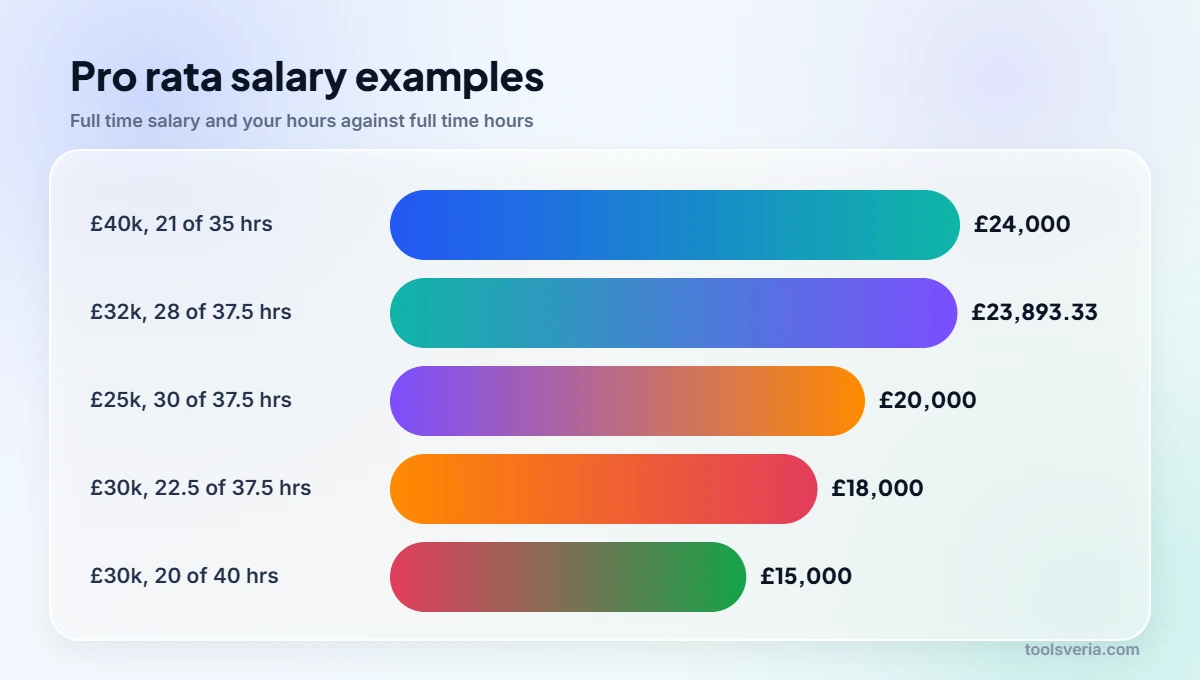
Tom does the school run, so he works five days but finishes early, totalling 28 hours. The role pays £32,000 for 37.5 hours. His proportion is 28 out of 37.5, about 74.67%, which makes his salary £32,000 × 28 ÷ 37.5, or £23,893.33 a year.
Grace: a six month cover contract
Time can be pro rated as well as hours. Grace takes six months of maternity cover on a £30,000 full time salary, so she earns half of it: £15,000. If she had covered the same post on Priya’s three day pattern, both cuts would apply, giving £18,000 × 6 ÷ 12, or £9,000. Some employers count calendar days for a part month and others count working days, so her contract decides. For awkward start and end dates, our working days calculator counts the days in any stretch, skipping weekends and bank holidays.
| Full time salary | Full time hours | Your hours | Proportion | Pro rata salary |
|---|---|---|---|---|
| £25,000 | 37.5 | 30 | 80% | £20,000 |
| £30,000 | 37.5 | 22.5 | 60% | £18,000 |
| £30,000 | 40 | 20 | 50% | £15,000 |
| £32,000 | 37.5 | 28 | 74.67% | £23,893.33 |
| £40,000 | 35 | 21 | 60% | £24,000 |
How Much Holiday Do Part Time Workers Get?
The legal minimum for nearly every worker is 5.6 weeks a year, which works out at 28 days for a five day week, and the statutory figure never goes above 28. Leave shrinks in step with pay. The legal minimum for nearly every worker is 5.6 weeks a year, which works out at 28 days for a five day week, and the statutory figure never goes above 28. Anyone on a fixed weekly pattern takes their usual working days and multiplies by 5.6.
For Priya that is 3 × 5.6, or 16.8 days. One trap: employers are allowed to fold bank holidays into those 5.6 weeks rather than give them on top, so someone who never works Mondays can feel short changed at Easter when they are not. People with no fixed pattern follow a different rule, building up leave at 12.07% of the hours they actually work, and the official holiday entitlement rules set out when each method applies.
The school is more generous than the law, offering 25 days plus the 8 bank holidays, 33 in total for a full timer. At 60%, Priya gets 19.8 days. If she wants to know what a day of that leave is worth in pounds, our holiday pay calculator puts a figure on it.
Why Do Part Timers Keep More Than 60% of Their Pay?
Gross pay falls to 60%, but tax and National Insurance do not fall in a straight line, because the tax free slices stay the same size. This is the pleasant surprise. Her gross pay falls to 60%, but tax and National Insurance do not fall in a straight line, because the tax free slices stay the same size. In 2026/27 every worker on a standard code has a £12,570 personal allowance, and the 8% employee National Insurance rate also only bites above £12,570. On a smaller salary, a bigger share sits inside those untaxed slices.
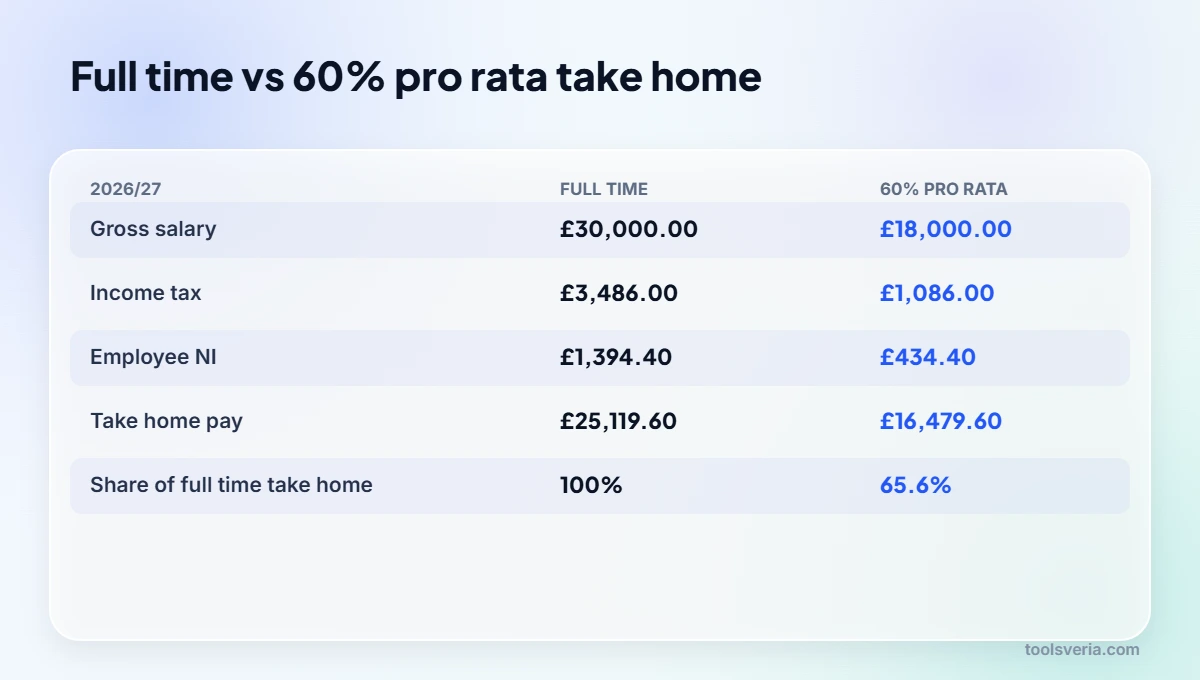
Here are both versions of the job side by side, assuming England, Wales or Northern Ireland, basic rate tax, a standard code and no other income:
| Annual salary | Income tax | Employee NI | Take home |
|---|---|---|---|
| £30,000 (full time) | £3,486.00 | £1,394.40 | £25,119.60 |
| £18,000 (60% pro rata) | £1,086.00 | £434.40 | £16,479.60 |
Priya’s net pay comes to roughly 65.6% of the full time net figure, even though she works 60% of the hours. Dropping two days costs her around £8,640 a year after deductions, not the £12,000 the gross figures suggest. Pension contributions, student loan repayments and salary sacrifice would all shift these numbers a little.
Some adverts quote an hourly rate rather than a salary. To flip between the two, or to check the hourly figure hiding inside a pro rata offer, our hourly to annual salary calculator does the conversion both ways.
Slips that cost part timers money
- Budgeting on the advertised figure. Priya nearly planned around £30,000 when her real salary is £18,000.
- Guessing the full time week. A 35, 37.5 or 40 hour base gives three different answers for the same hours.
- Counting time on site instead of contracted hours. An unpaid lunch break does not belong in the ratio.
- Expecting a premium for extra shifts. Plenty of part time contracts pay extra hours at the normal rate until you pass the full time week, and when an enhanced rate does kick in, our overtime calculator shows what those hours earn.
Key points
- Scale the advertised salary by your hours over the employer’s full time hours: 22.5 of 37.5 gives 60%.
- Your hourly rate should equal a full timer’s in the same role, about £15.38 on £30,000.
- Statutory leave is 5.6 times your weekly working days, never more than 28 days.
- Fixed allowances mean a 60% salary keeps about 65.6% of full time take home pay.
Frequently Asked Questions
An advert says £25,000 pro rata for 22.5 hours. What would I really earn?
If the full time week is 37.5 hours, you would work 60% of it and earn £15,000 a year. Check the employer’s full time hours first, since a 40 hour base lowers the figure.
I work Monday, Tuesday and Wednesday. How do I work it out by days?
Put your three days over the five day full time week, giving 0.6, then apply it to the salary. On £30,000 that comes to £18,000.
Will my payslip show £18,000 a year, or less after tax?
The £18,000 is gross. Tax and National Insurance come off it, leaving about £16,479.60 in 2026/27 before any pension or student loan deductions.
I never work Mondays. Do I lose out on bank holidays?
Not if your employer handles it properly. Your total leave is 5.6 times your weekly days, 16.8 days on a three day week, and bank holidays can be taken from that total rather than added on.
Priya took the job in the end, knowing her real salary, her 19.8 days of leave and a net income well above 60% of the full time figure. Confirm the full time hours, run the ratio and judge any part time offer on take home pay, and you will see exactly what it is worth.