Model both government bonuses from your highest balance, month by month.
| Year | Paid in | Highest balance | Balance at end |
|---|
Uses the GOV.UK rules: up to £50 a calendar month, first bonus 50% of the highest balance in years 1 and 2, final bonus 50% of any rise in the highest balance in years 3 and 4. The account pays no interest. Bonuses go to your bank account, not into Help to Save. Estimate only: HMRC confirms the actual amounts.
This help to save calculator is for people on Universal Credit in the UK who hold, or want to open, a Help to Save account and need to know what the government bonus will be. It follows the GOV.UK bonus rules month by month, tracks your highest balance, tests withdrawals and dates both payouts. Figures checked October 2026.
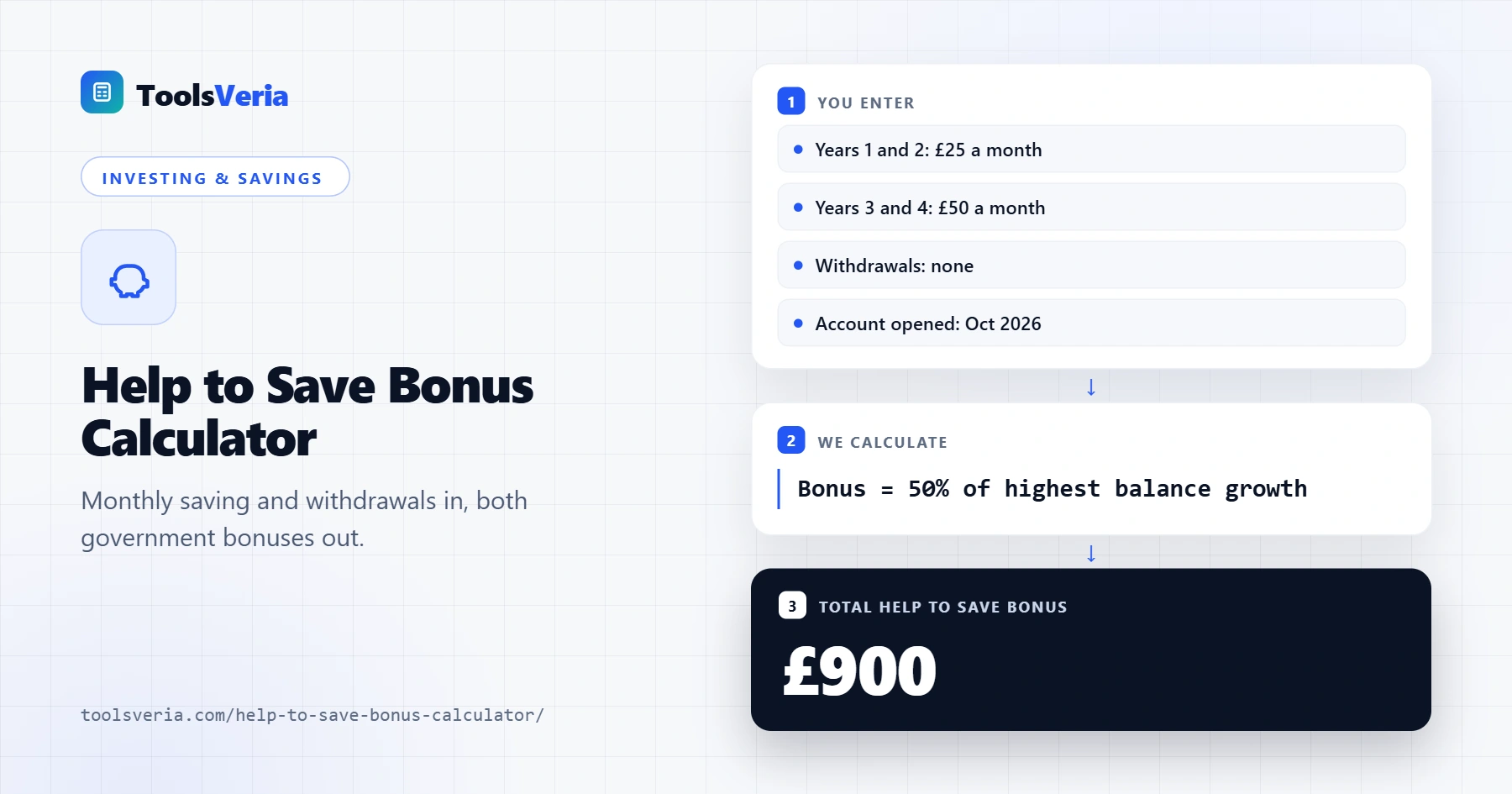
Quick answer: Help to Save pays a 50% bonus twice. At year 2 you get half of your highest balance so far, and at year 4 half of any rise in that highest balance. Saving the £50 monthly maximum earns £600 plus £600, so a help to save calculator shows £1,200 on £2,400 saved.
In This Guide
What Is the Help to Save Bonus?
The Help to Save bonus is a tax free government top up of 50p for every £1 of savings growth, paid at the end of the second and fourth years of a four year account. You can pay in between £1 and £50 each calendar month, and the account itself pays no interest, so the bonus is the whole reward.
The formula in plain words: first bonus equals half of the highest balance you reach in months 1 to 24. Final bonus equals half of the amount by which the highest balance in months 25 to 48 beats that earlier peak. If the later peak is not higher, the final bonus is zero. The bonus is based on the highest balance, not on what you paid in, which is why withdrawals matter more in some months than others.
How to Use the Help to Save Calculator
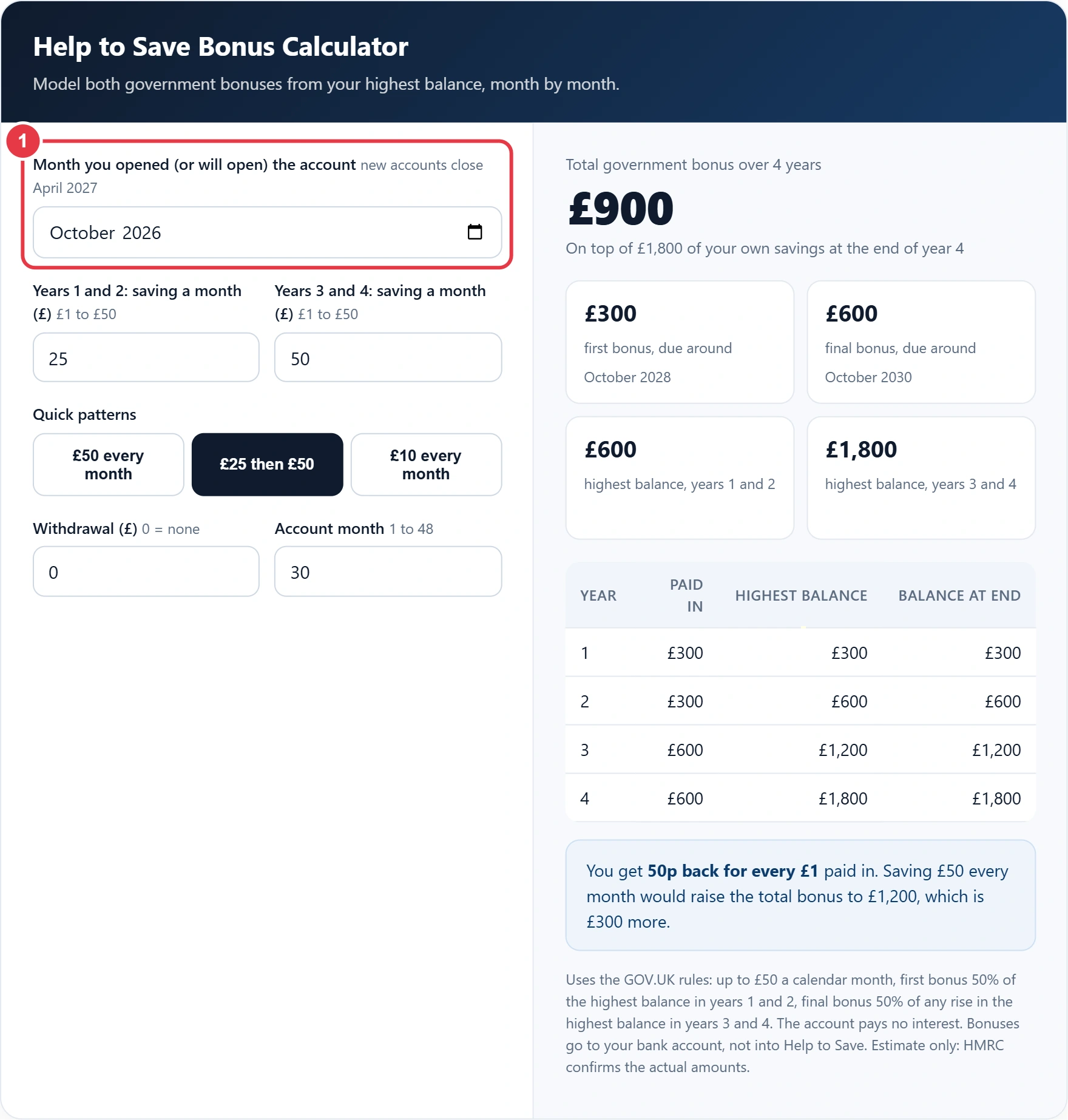
Step 1: Enter the Month You Opened the Account
Pick the month your account started, or the month you plan to open it. The calculator adds 24 and 48 months to show roughly when each bonus is due. If you choose a month after April 2027 it warns you, because the current scheme stops taking new accounts then.
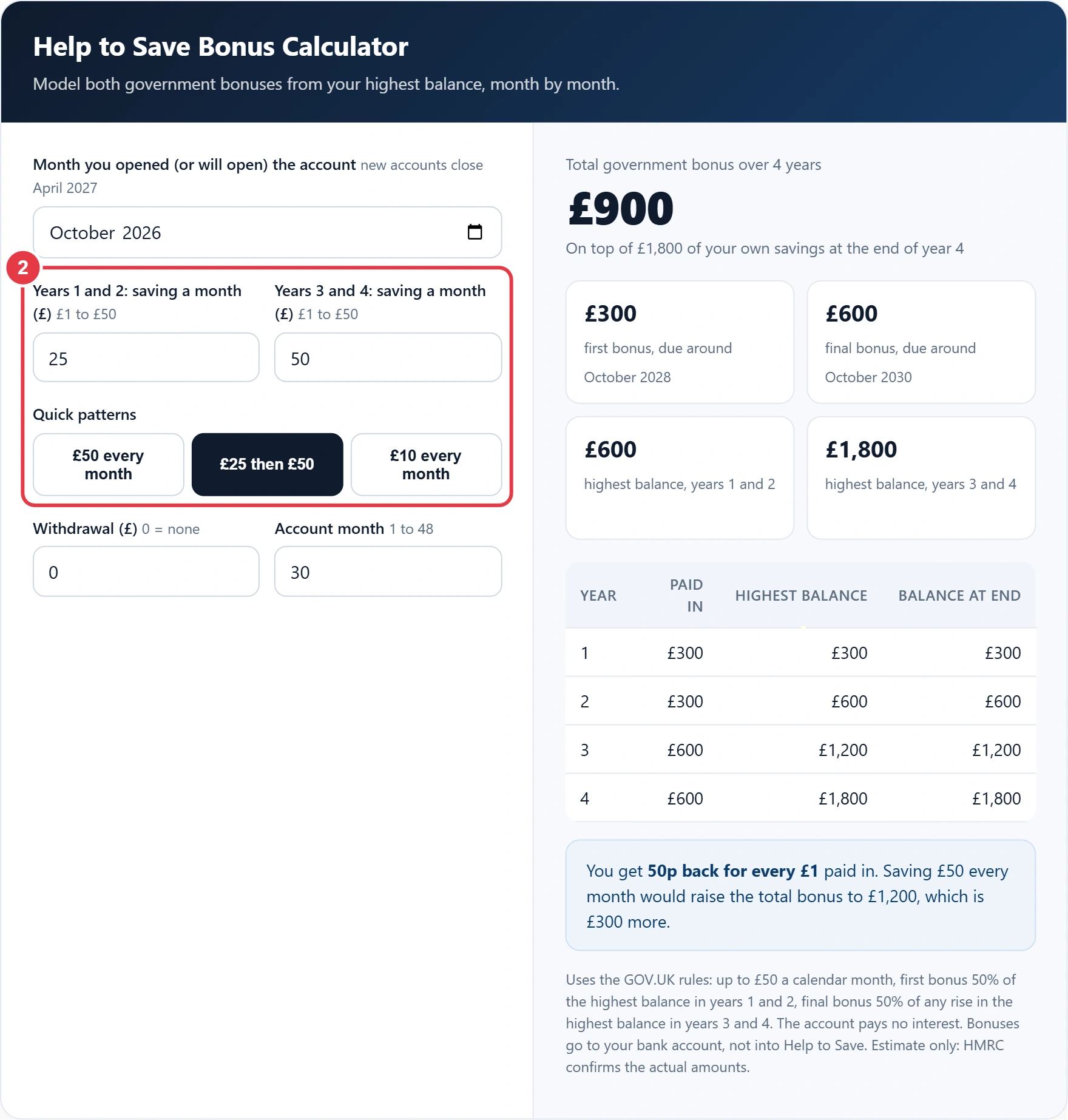
Step 2: Set Your Monthly Saving
Enter what you pay in each month during years 1 and 2, then during years 3 and 4. Anything above £50 is capped at £50, because that is the most HMRC accepts in one calendar month. The quick pattern buttons fill in three common choices so you can compare them in one click.
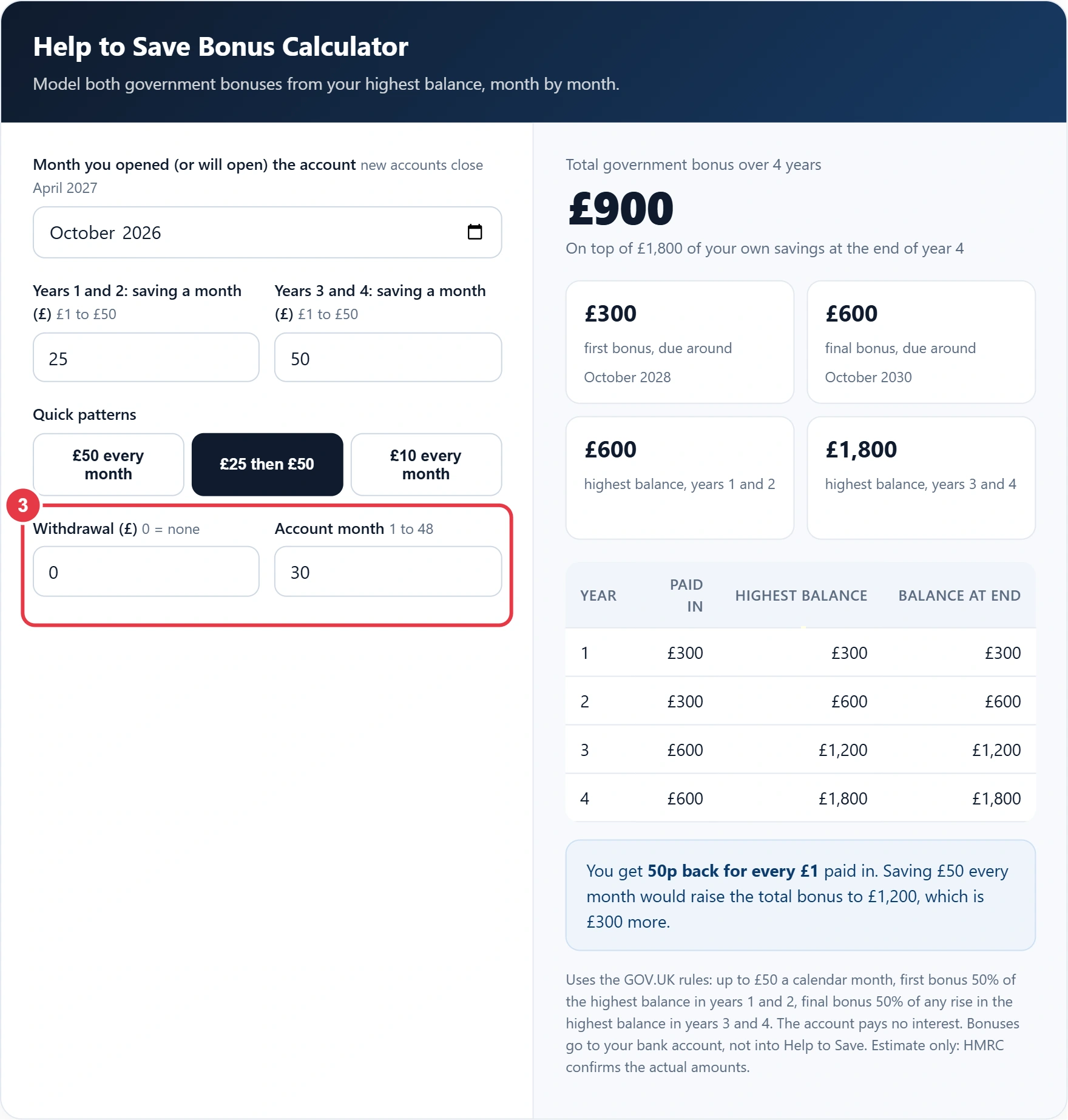
Step 3: Add a Withdrawal if You Expect One
Type an amount and the account month it comes out, from 1 to 48. Month 30, for example, is the sixth month of year 3. A withdrawal never cancels a bonus you have already been paid, but it lowers the balance you have to beat, so the tool shows exactly how much final bonus it costs.
Step 4: Read Both Bonuses
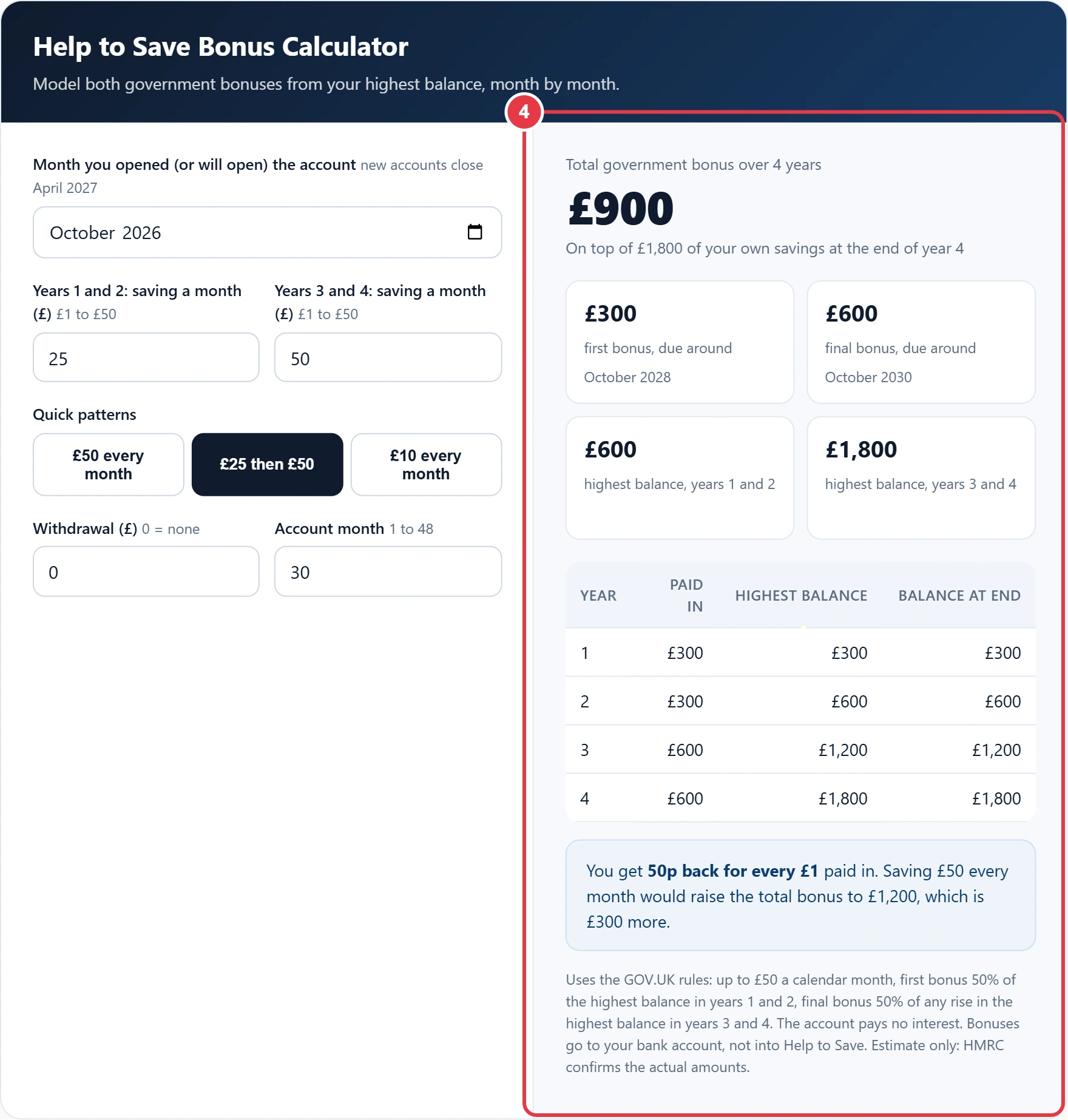
The headline is your total bonus. Below it you see each bonus with its due month, the two highest balances that drive them and a year by year table of money paid in, the peak balance and the closing balance. The message box tells you whether you reach the £1,200 maximum and what would close the gap.
How Much Bonus Will I Get From Help to Save?
You get up to £1,200: half of your highest balance by month 24, plus half of any growth in that highest balance by month 48. Steady saving earns 50p for every £1 you leave in the account, and the table shows typical patterns with no withdrawals.
| Monthly saving | Saved by month 48 | Year 2 bonus | Year 4 bonus | Total bonus |
|---|---|---|---|---|
| £10 every month | £480 | £120 | £120 | £240 |
| £25 every month | £1,200 | £300 | £300 | £600 |
| £25, then £50 from month 25 | £1,800 | £300 | £600 | £900 |
| £50, then £25 from month 25 | £1,800 | £600 | £300 | £900 |
| £50 every month | £2,400 | £600 | £600 | £1,200 |
Worked example: Aisha opens an account in October 2026 and saves £25 a month. Her balance peaks at £600 in month 24, so her first bonus is £300, due around October 2028. She then saves £50 a month, her balance peaks at £1,800 in month 48, and her final bonus is half of the £1,200 rise, which is £600. She ends with £1,800 of her own money and £900 of bonuses.
Do Withdrawals Reduce the Help to Save Bonus?
Withdrawals do not reduce a bonus already paid, but they can shrink the next one because both bonuses use your highest balance. Money taken out after your peak in years 1 and 2 has no effect on the first bonus. Money taken out in years 3 and 4 lowers the balance you need to push past the earlier peak.
Worked example: Ben saves £50 every month. His first bonus is £600 on a £1,200 peak. In month 30 he takes out £300 for a car repair, leaving £1,200. Paying £50 a month for the remaining 18 months takes him to £2,100, so his final bonus is half of £900, which is £450 instead of £600. The help to save calculator above shows that £150 cost straight away.
Before you dip into this account, check whether another pot can cover the bill. An emergency fund calculator helps you size a separate rainy day fund, so your Help to Save balance can keep climbing until month 48.
Who Can Open a Help to Save Account?
You can open an account if you get Universal Credit and you, together with your partner on a joint claim, had take home pay of £1 or more in your last monthly assessment period, and you live in the UK. Partners on a joint claim apply separately and can each have their own account. If you later stop claiming Universal Credit, you keep the account and both bonuses.
Timing matters. The current scheme closes to new accounts in April 2027, and the government response to its Help to Save reform consultation says a reformed, permanent scheme should open for registration in 2028 with the same four year term and 50% bonus. Anyone eligible today who wants the current terms should open before April 2027.
Will Help to Save Affect My Universal Credit?
Help to Save bonuses do not affect Universal Credit or Housing Benefit, according to GOV.UK. The money you save does count as savings, but personal savings of £6,000 or less, including your Help to Save balance, do not reduce either benefit. If you are working out family costs, the Universal Credit childcare calculator shows a different part of the same claim.
Tips to Get the Full £1,200
- Pay £50 in every calendar month. A missed month cannot be made up later, because the limit resets on the 1st.
- If you must withdraw, do it in year 2 after your balance has peaked, then rebuild in years 3 and 4 so the second peak still rises.
- Keep the account open to the end. Closing early forfeits the next bonus, and you cannot open another account.
- Bonuses are paid to your bank account. Moving them into an easy access account, and checking growth with a savings interest calculator, keeps that money earning.
</>Embed this calculator on your website
Add the free Help to Save Bonus Calculator to your own site or blog. Copy the code below and paste it into an HTML block. It resizes itself and works on phones.
How we checked this tool: the Tools Veria Editorial Team built this tool by hand, checked it against the official rules or published standards where they apply, and tested it against worked examples. Results are estimates for planning, not personal financial or tax advice. Read our editorial policy and disclaimer, or report an error.
Frequently Asked Questions
What is the maximum Help to Save bonus?
The maximum is £1,200 over four years: £600 at the end of year 2 and £600 at the end of year 4. You reach it by paying in £50 every calendar month for 48 months, a total of £2,400, without dropping below your earlier highest balance.
How is the Help to Save final bonus calculated?
The final bonus is 50% of the difference between your highest balance in years 3 and 4 and your highest balance in years 1 and 2. If the later peak is £1,800 and the earlier one was £600, the final bonus is £600.
Does Help to Save pay interest?
No. A Help to Save account pays no interest. Your return comes only from the two government bonuses, which add 50p for every £1 of growth in your highest balance, up to £1,200 in total.
When is the Help to Save bonus paid?
The first bonus is paid after the end of year 2 and the final bonus after the end of year 4, counted from the date you opened the account. Both go into your bank account, not into the Help to Save account.
Can I open a Help to Save account in 2027?
You can open one until the current scheme closes to new accounts in April 2027. The government plans to open registration for a reformed scheme in 2028, still with a four year account and a 50% bonus.
Is the Help to Save bonus taxed?
No. Help to Save bonuses are tax free, and GOV.UK says they do not affect Universal Credit or Housing Benefit. Your savings count as capital, but £6,000 or less in personal savings does not change either benefit.