New taxable value and property tax for a parent to child transfer or a 55+ home move.
Estimate only, not legal or tax advice. Based on the California State Board of Equalization rules for Revenue and Taxation Code sections 63.2 and 69.6. Exemptions, special assessments and supplemental bills are not included. Your county assessor decides the final value.
This California Prop 19 calculator works out the new taxable value and yearly property tax when California parents pass their family home to a child, and when a homeowner aged 55 or over, severely disabled or hit by a disaster moves their base year value to a new home in 2026. It applies the rules of Proposition 19, approved by voters in November 2020, using the adjusted amounts published by the State Board of Equalization. Figures checked October 2026.
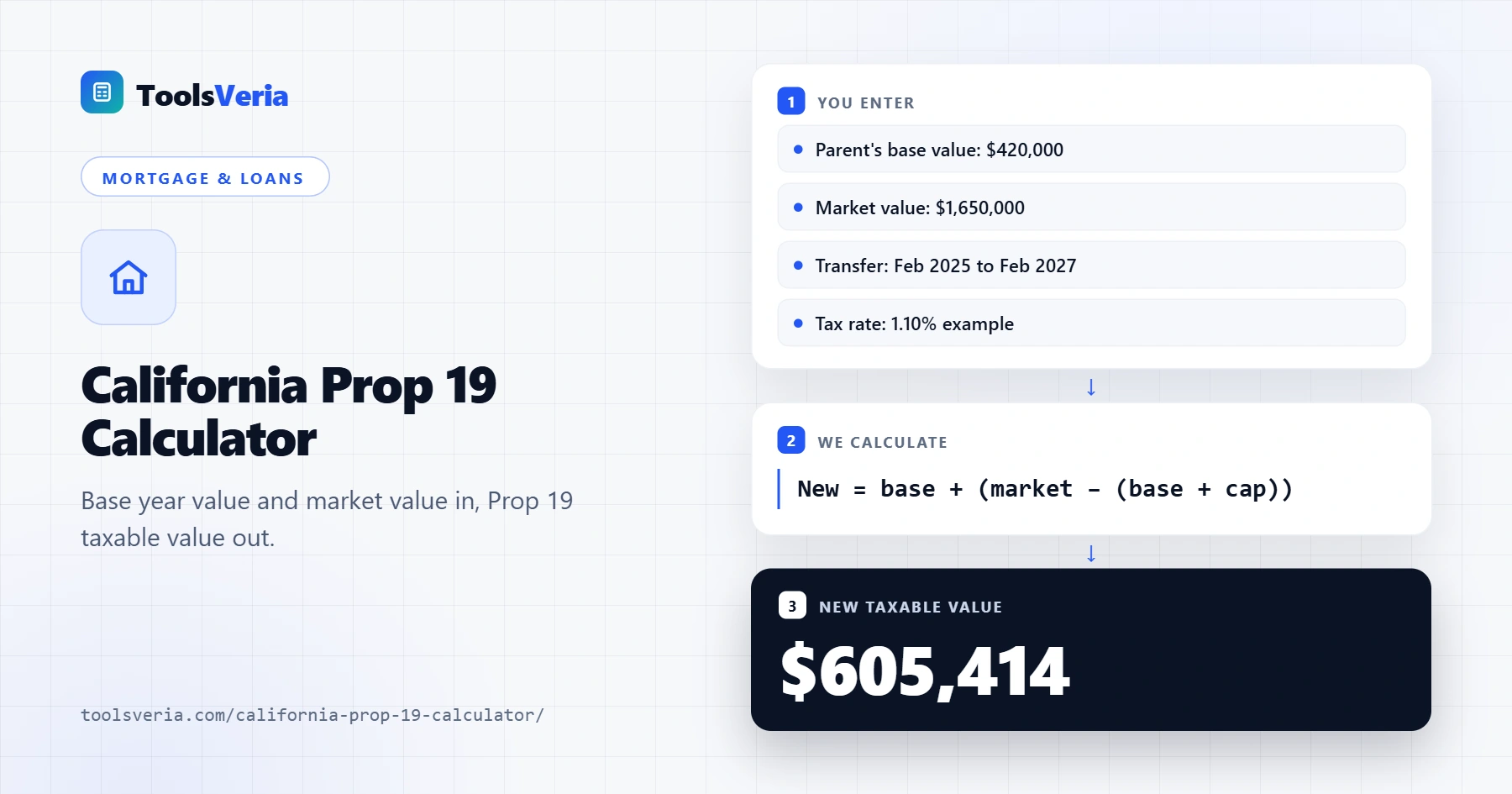
Quick answer: A child keeps the parent's factored base year value if the home becomes their principal residence, but any market value above that base plus $1,044,586 is added. A California Prop 19 calculator shows a $420,000 base on a $1,650,000 home becomes $605,414. Transfers from 16 February 2025 to 15 February 2027 use $1,044,586.
In This Guide
What Is Prop 19?
Prop 19 is the California constitutional amendment that limits the parent to child property tax exclusion to the family home or family farm and lets older, disabled and disaster hit homeowners move their tax base anywhere in the state. It replaced Props 58 and 193 for transfers from 16 February 2021, and the old Props 60 and 90 for base year transfers from 1 April 2021.
The formula for inherited homes in plain words: value cap = factored base year value + exclusion amount. If market value is at or below the cap, the child keeps the factored base year value. If it is above, the new taxable value is the factored base year value plus the market value minus the cap. For the 55+ move: compare the new home's price with 100%, 105% or 110% of the old home's sale price and add any excess to the old base year value.
How to Use the California Prop 19 Calculator
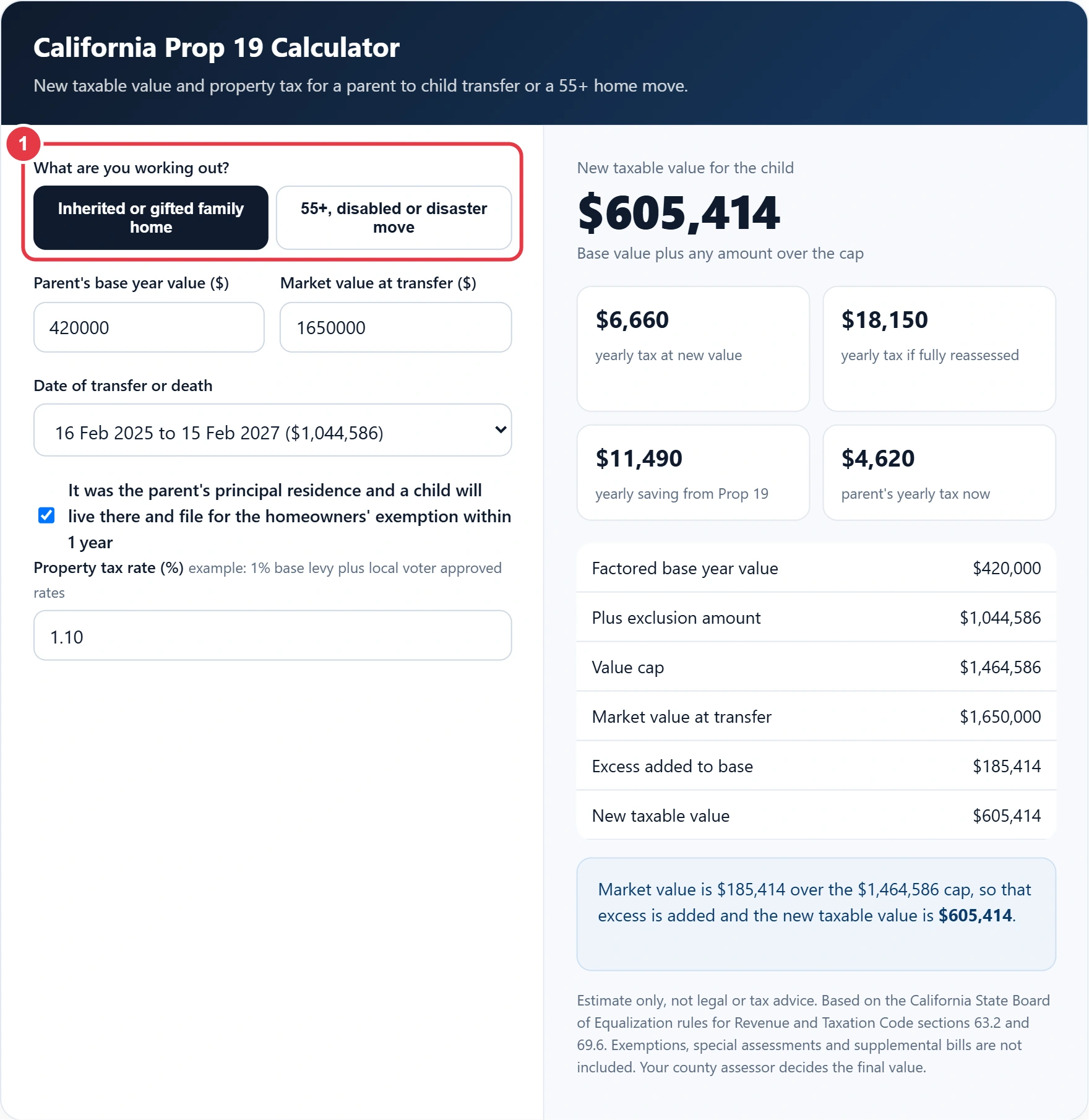
Step 1: Choose the Type of Transfer
Pick the inherited or gifted family home if a parent passed the home to a child, including through a trust. Pick the 55+, disabled or disaster move if you are selling your own home and buying or building a replacement within two years.
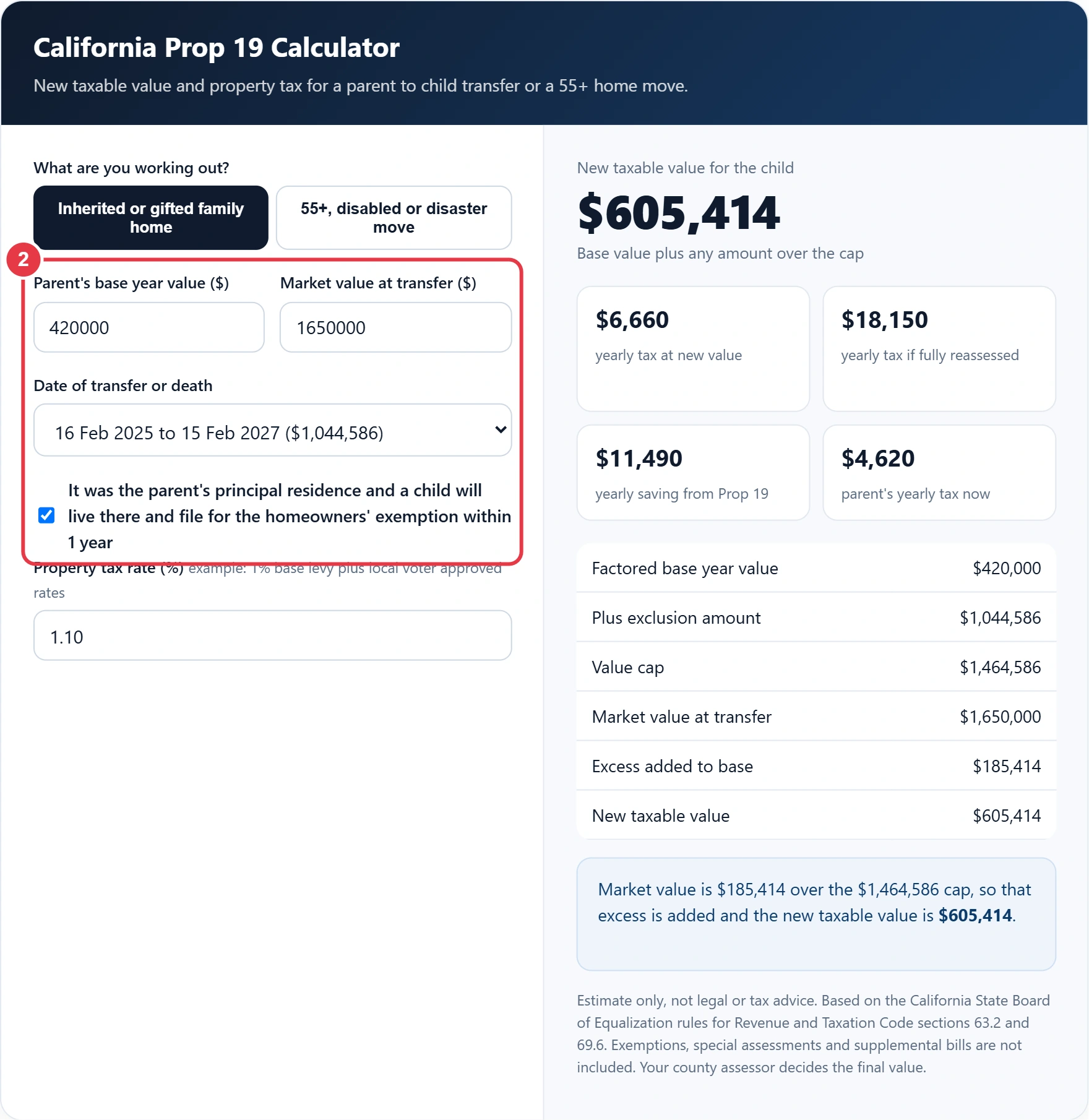
Step 2: Enter the Values and Date
The factored base year value is the taxable value on the parent's latest tax bill: the Prop 13 value plus the yearly inflation factor, before exemptions. Enter the market value on the date of death or gift and pick the matching date band, because the exclusion amount is adjusted every two years.
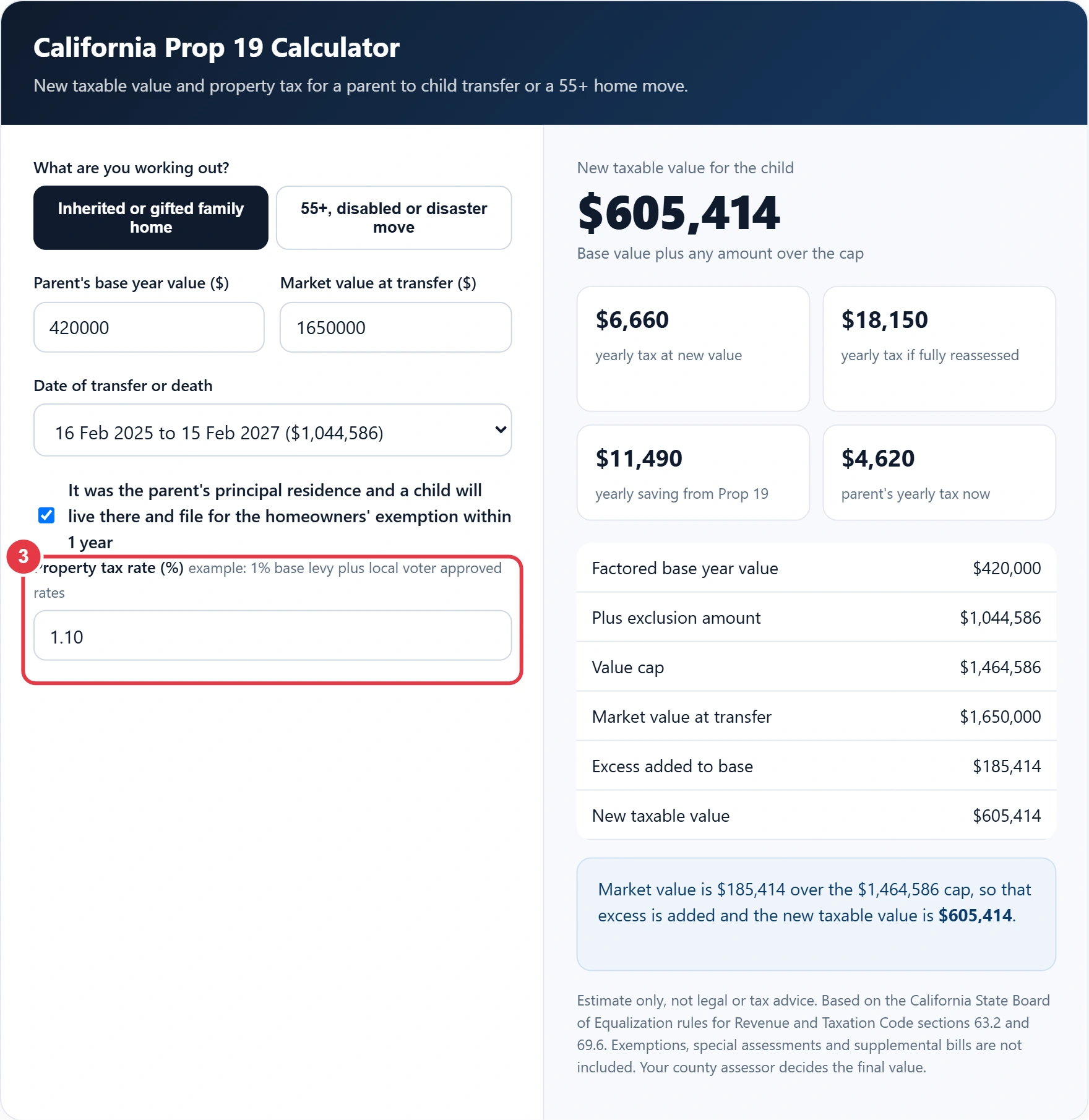
Step 3: Enter Your Tax Rate
California sets a basic levy of 1% of taxable value under Proposition 13, and voter approved bonds push most bills a little higher. The 1.10% default is an example only, so copy the rate from your county tax bill for a closer figure.
Step 4: Read the Results
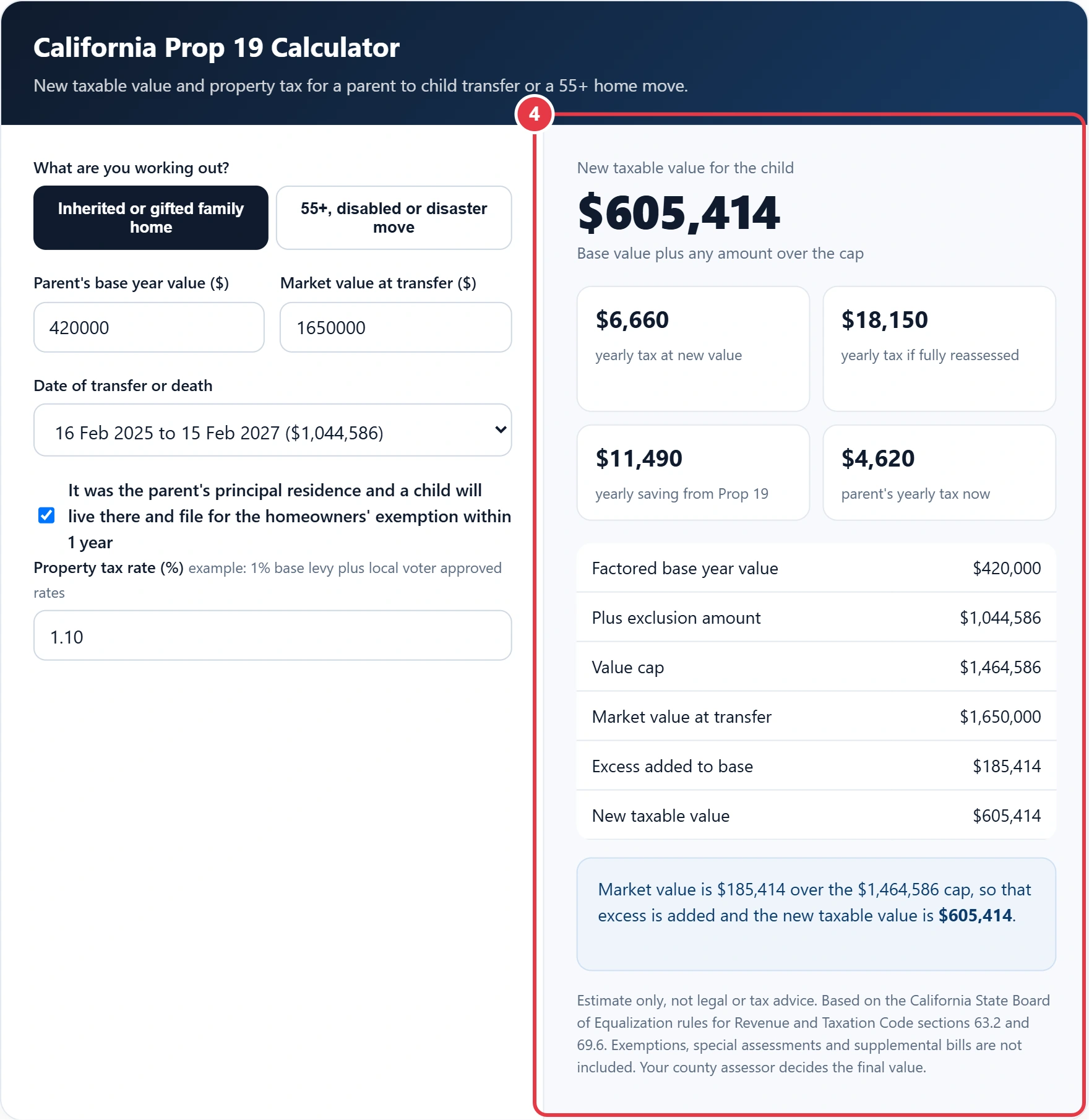
You see the new taxable value, the yearly tax on it, the tax if the home were fully reassessed to market value and the yearly saving Prop 19 gives. The breakdown table shows each step, which is the same order the county assessor follows when it works out the value.
How Is Property Tax Calculated on an Inherited House Under Prop 19?
Property tax on an inherited house under Prop 19 is the tax rate multiplied by the parent's factored base year value plus any market value above the cap. The cap uses the amount for the date of transfer, set by the Board of Equalization from the California house price index.
| Date of transfer | Exclusion amount added to the base |
|---|---|
| 16 Feb 2021 to 15 Feb 2023 | $1,000,000 |
| 16 Feb 2023 to 15 Feb 2025 | $1,022,600 |
| 16 Feb 2025 to 15 Feb 2027 | $1,044,586 |
Worked example: after their father dies in March 2026, the Nguyen siblings inherit his San Jose home, worth $1,650,000, with a factored base year value of $420,000. The cap is $420,000 + $1,044,586 = $1,464,586. The home is worth $185,414 more than that, so the new taxable value is $605,414. At an example rate of 1.10%, the yearly tax is about $6,660 instead of $18,150 on full reassessment, as long as one sibling moves in and files for the homeowners' exemption within a year.
Does Prop 19 Apply to Inherited Rental Property?
No, an inherited rental or second home is reassessed to market value under Prop 19, because the exclusion only covers a family home that was the parent's principal residence and becomes the child's, or a family farm. Grandchildren qualify only if their parent who was the grandparent's child has died. If the child later moves out, the home is reassessed from the next lien date.
Families weighing whether to keep and pay down a mortgage on the home can use the mortgage overpayment calculator to compare options alongside the new tax bill. Siblings who inherit together should agree early who will live there: the Board of Equalization says the exclusion can apply as long as at least one of them makes it their principal residence and claims the exemption.
How Does the Prop 19 55+ Base Year Transfer Work?
Homeowners aged 55 or over, severely disabled, or whose home was hit by a wildfire or natural disaster can move their base year value to a replacement home anywhere in California, up to three times, if it is bought or built within two years of the sale. A replacement bought before the sale is compared with 100% of the old sale price, within a year after with 105%, and in the second year with 110%.
Worked example: Linda, 67, sells her Sacramento home for $900,000 with a base year value of $310,000 and buys a $1,050,000 home in San Diego eight months later. The test value is $900,000 × 105% = $945,000. The extra $105,000 is added, so her new taxable value is $415,000. Unlike the Texas homestead exemption calculator, which takes a fixed sum off value, Prop 19 carries your old value with you to the new home.
Deadlines matter: the family home claim (form BOE-19-P) should be filed within three years of the transfer or before the home is sold to a third party, and the homeowners' exemption within one year. This California Prop 19 calculator gives an estimate, so confirm the figure with your county assessor before you decide whether to keep, rent or sell.
What the Key California Prop 19 Terms Mean
These terms explain the property tax concepts behind the California Prop 19 calculator, helping you follow how a base year value is kept, adjusted or replaced.
- Base year value
- The assessed value set for a California property when it was last bought or newly built, used as the starting point for property tax. Under Proposition 13 it rises only by a limited yearly inflation factor until a reassessment event occurs.
- Factored base year value
- The base year value after annual inflation adjustments have been applied. It is the taxable value shown on the current bill before exemptions, and it is the figure a child may inherit under the family home exclusion.
- Parent to child exclusion
- A rule that lets a family home pass from parent to child without full reassessment, provided the child uses it as a principal residence. Under Prop 19 it is limited by an exclusion amount that is adjusted every two years.
- Base year value transfer
- The ability of homeowners aged 55 or over, severely disabled people and disaster victims to carry their existing tax base to a replacement home anywhere in California, with any excess purchase price added to the transferred value.
- Reassessment
- A county assessor's revaluation of a property to current market value after a change in ownership or new construction. It usually raises the taxable value sharply, which is what the Prop 19 exclusions are designed to limit.
- County assessor
- The local official responsible for valuing every taxable property in a California county. The assessor processes Prop 19 claims, decides the final taxable value and applies any homeowners' exemption the occupant files for.
</>Embed this calculator on your website
Add the free California Prop 19 Calculator to your own site or blog. Copy the code below and paste it into an HTML block. It resizes itself and works on phones.
How we checked this tool: the Tools Veria Editorial Team built this tool by hand, checked it against the official rules or published standards where they apply, and tested it against worked examples. Results are estimates for planning, not personal financial or tax advice. Read our editorial policy and disclaimer, or report an error.
Frequently Asked Questions
How do you calculate Prop 19 on an inherited home?
Add the exclusion amount, $1,044,586 for transfers from 16 February 2025 to 15 February 2027, to the parent's factored base year value. If market value is higher, add the difference to the base. A $420,000 base on a $1,650,000 home gives $605,414.
What is the Prop 19 exclusion amount for 2026?
It is $1,044,586 for transfers between 16 February 2025 and 15 February 2027, adjusted from $1 million by the State Board of Equalization using the California house price index. It was $1,022,600 for the two years before and is next adjusted in February 2027.
Does an inherited house get reassessed in California?
Yes, unless the child makes it their principal residence and files for the homeowners' exemption within one year. Then the parent's factored base year value carries over, plus any market value above the base plus $1,044,586. Rentals and second homes are fully reassessed.
Can I transfer my property tax base at 55 in California?
Yes. Under Prop 19, owners aged 55 or over can move their base year value to a replacement home anywhere in California up to three times, within two years of selling. Any amount over 100%, 105% or 110% of the old sale price is added.
Does Prop 19 apply to a rental property inherited from parents?
No. The parent to child exclusion covers only the family home that was the parent's principal residence and becomes the child's, plus family farms. An inherited rental property is reassessed to its market value from the date of transfer.
What is the deadline for a Prop 19 claim?
File the claim for the parent to child exclusion within three years of the transfer, or before the home is transferred to a third party, and file for the homeowners' exemption within one year of the transfer. Your county assessor handles both.