Check whether an offer or a traffic source is earning more than it costs, click by click.
Some networks quote EPC per 100 clicks rather than per click, so both are shown. ROI here is profit divided by costs; ROAS is commission divided by costs.
This affiliate ROI and EPC calculator tells affiliate marketers how much each click on their links earns and whether a campaign makes a profit once ad spend, writers and software are paid for. Because EPC (earnings per click) is the figure many affiliate marketing networks use to rank offers, it is the quickest way to compare two programmes that pay very different commission rates on very different products.
Quick answer: An affiliate ROI and EPC calculator divides commission by clicks to give earnings per click, then works out ROI as profit ÷ costs × 100. A 2% converting offer paying £15 and a 1% offer paying £30 both earn £0.30 a click, and your break even cost per click equals your EPC.
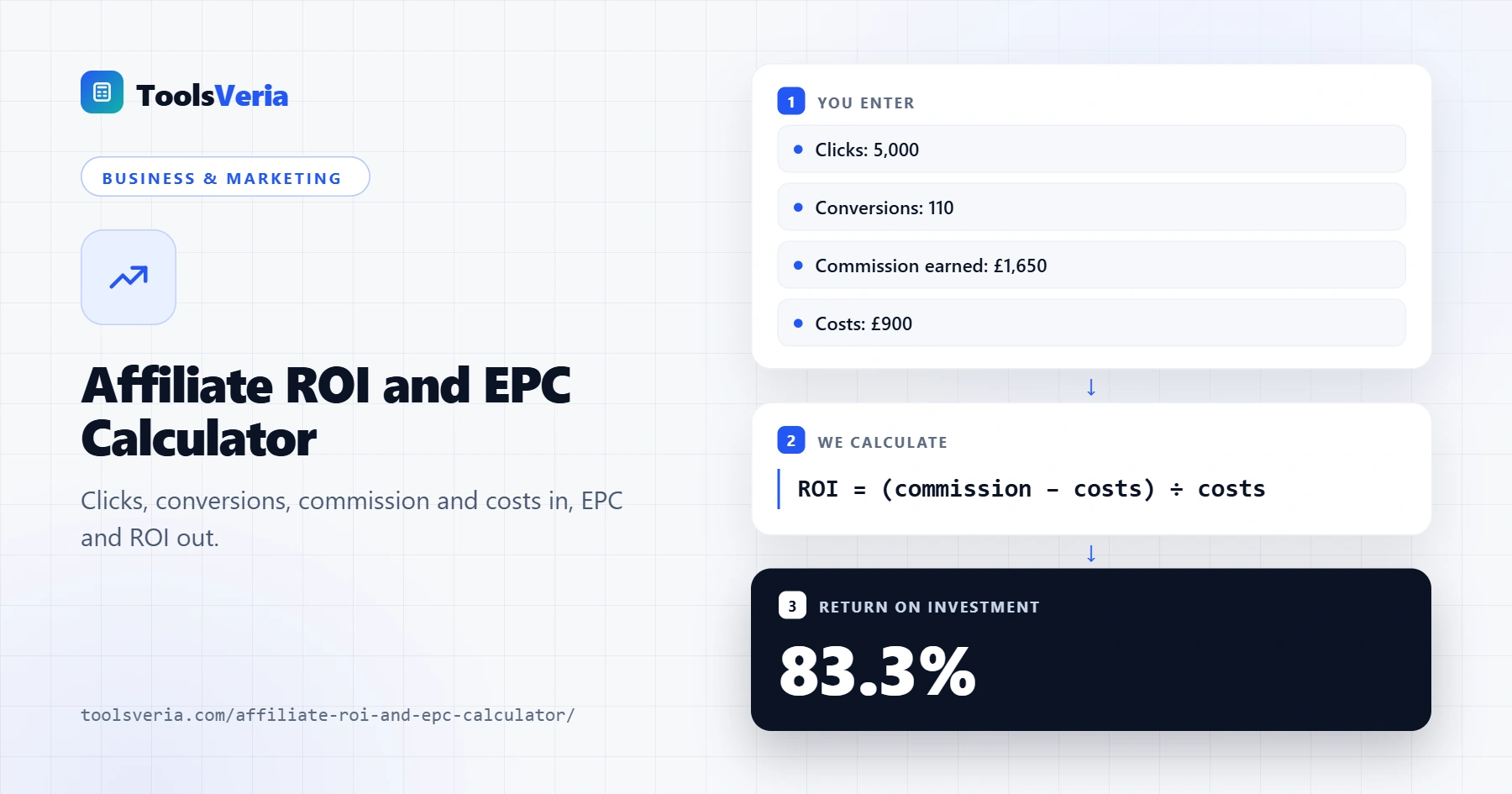
In This Guide
What Is Affiliate EPC and ROI?
EPC is the average commission earned per affiliate link click, and affiliate ROI is the profit made for every unit of money spent on the campaign, shown as a percentage. EPC rolls conversion rate and commission size into one number, so a 2% converting offer paying £15 and a 1% offer paying £30 both earn £0.30 a click.
The formulas are EPC = commission ÷ clicks, EPC per 100 clicks = EPC × 100, profit = commission − costs and ROI = profit ÷ costs × 100. Your break even cost per click equals your EPC: pay more than that per click and the campaign loses money.
How to Use the Affiliate ROI and EPC Calculator
Step 1: Enter Clicks and Conversions
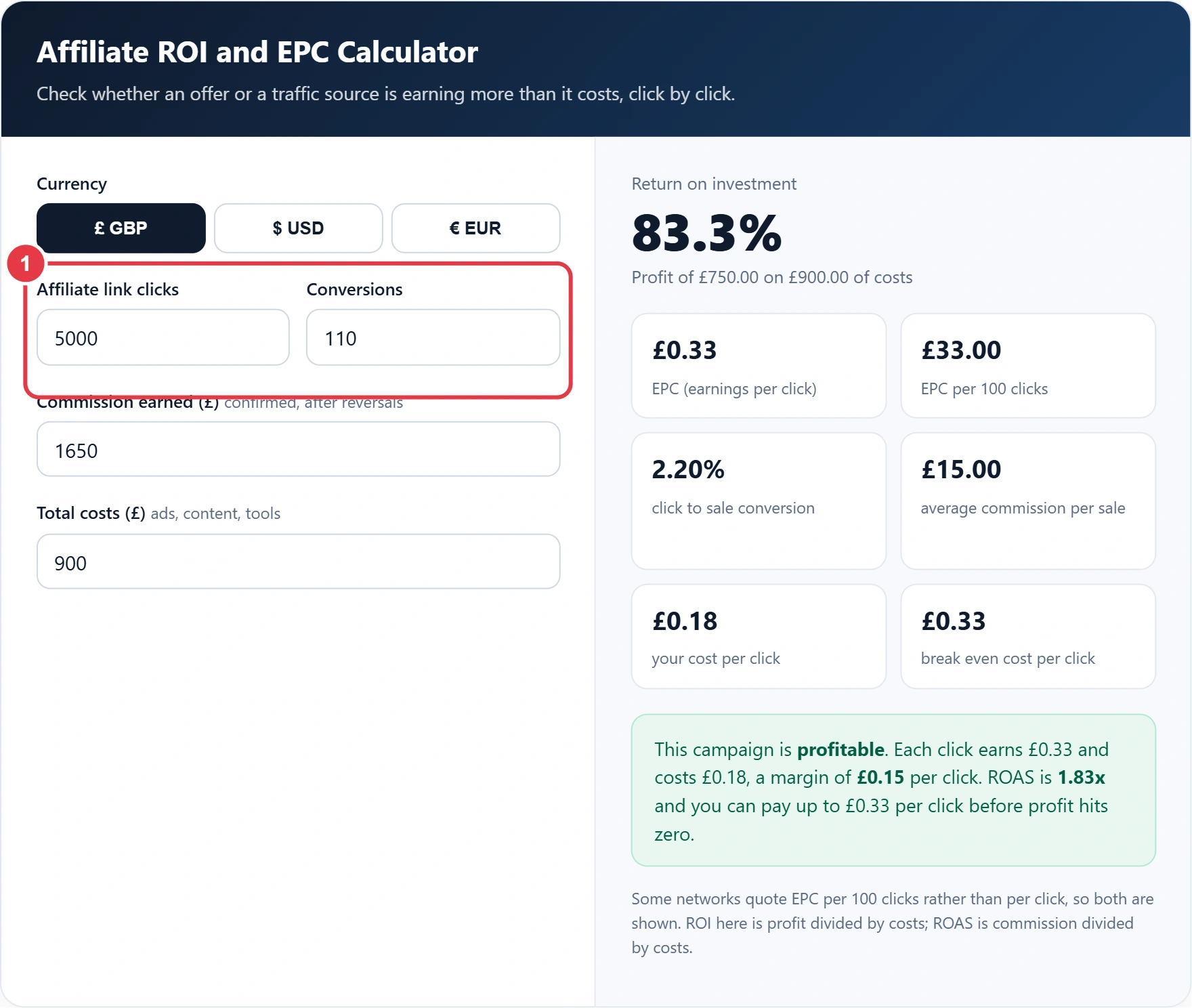
Choose your currency and enter outbound clicks on your affiliate links plus confirmed sales or sign ups for the same period. Use the network's click count where possible so it matches the commission report.
Step 2: Enter Commission Earned
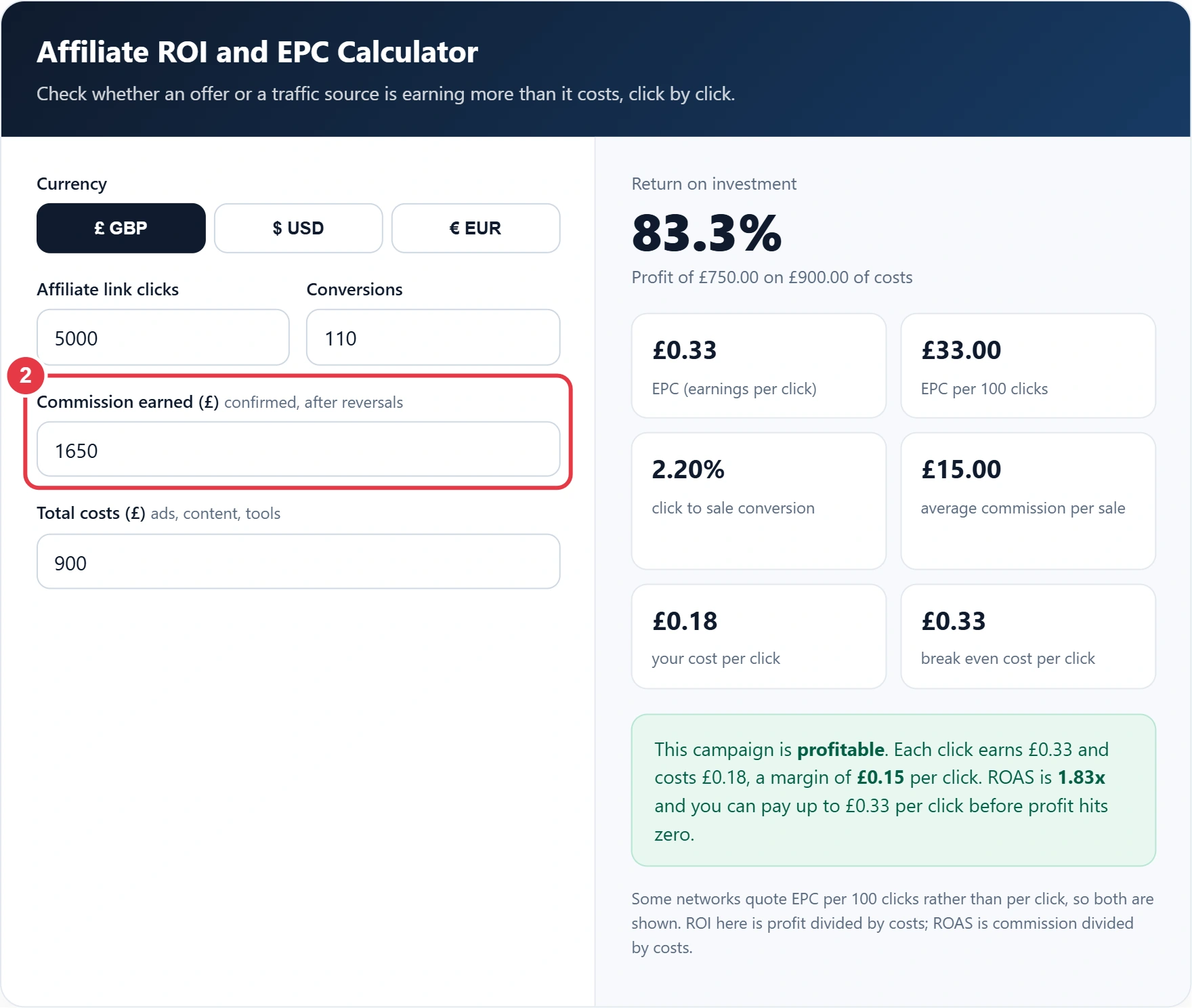
Use approved commission after returns, not pending totals. To model commission before you have real data, the CPC and CTR calculator helps you estimate click volume from impressions, which you can then pair with an expected sale rate.
Step 3: Add Your Costs
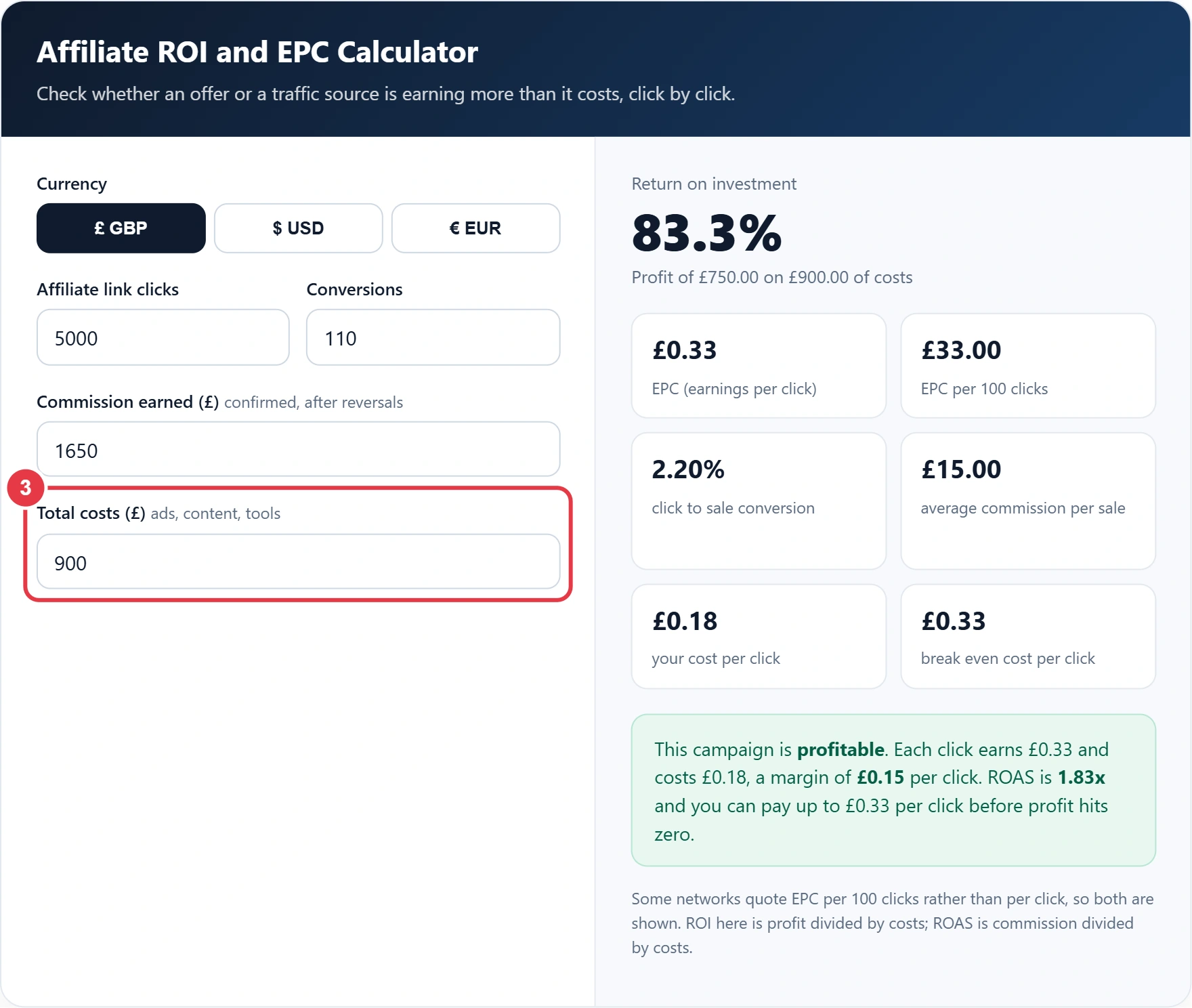
Include paid traffic, freelance writing, hosting share and tools for the period. Leaving out content costs makes organic campaigns look free when they are not.
Step 4: Read EPC, ROI and Break Even CPC
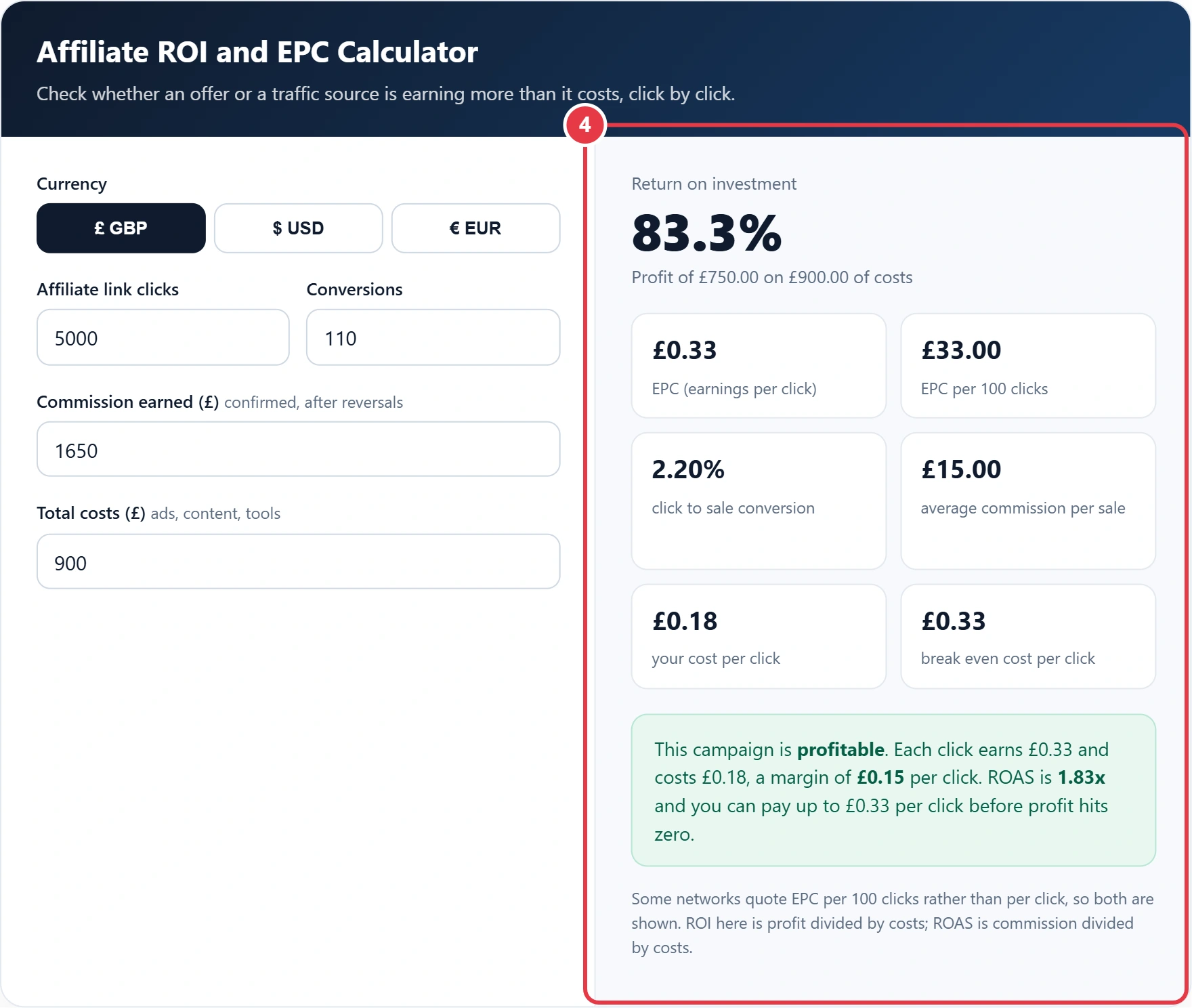
The results show ROI, EPC per click and per 100 clicks, conversion rate, average commission, your actual cost per click and the most you could pay per click to break even.
What Is a Good EPC for Affiliate Marketing?
A good EPC is any figure comfortably above what each click costs you, because EPC on its own says nothing about profit. Take Aisha, who promotes a meal kit offer with Pinterest ads. Her 5,000 clicks produced 110 sign ups and £1,650 of confirmed commission against £900 of ad spend and pin design.
| Metric for Aisha | Working | Result |
|---|---|---|
| EPC | £1,650 ÷ 5,000 | £0.33 |
| EPC per 100 clicks | £0.33 × 100 | £33.00 |
| Conversion rate | 110 ÷ 5,000 | 2.20% |
| Cost per click | £900 ÷ 5,000 | £0.18 |
| Profit | £1,650 minus £900 | £750 |
| ROI | £750 ÷ £900 | 83.3% |
Aisha keeps £0.15 on every click and could bid up to £0.33 before the campaign stops paying. The ROAS calculator puts the same spend at 1.83x in revenue terms, a useful check before she scales up. Paid promotion like hers must be labelled, and the ASA affiliate marketing advice explains how to mark pins and posts as ads so readers know before they click.
Key Terms for the Affiliate ROI and EPC Calculator
These definitions explain each metric in the affiliate ROI and EPC calculator, so you can compare offers fairly and spot campaigns that lose money.
- Earnings per click (EPC)
- Total commission divided by the number of affiliate link clicks. It merges conversion rate and payout into one figure, which is why networks use it to rank offers that pay very different amounts per sale.
- Return on investment (ROI)
- Profit expressed as a percentage of the money spent to earn it. For an affiliate campaign, profit is confirmed commission minus ad spend, content and tools, so a negative ROI means the campaign is costing more than it earns.
- Return on ad spend (ROAS)
- Revenue divided by advertising cost, usually written as a multiple such as 1.83x. Unlike ROI it ignores profit, so a campaign can show ROAS above 1 while still losing money once other costs are counted.
- Break-even cost per click
- The highest price you can pay per click before a campaign stops making money. It equals the EPC, so any paid traffic bought above that figure produces a loss on average.
- Conversion rate
- The percentage of clicks that end in a confirmed sale or sign-up. Small changes matter: in the meal kit example, 110 conversions from 5,000 clicks gives 2.20%, and that rate feeds directly into EPC.
- Pending versus approved commission
- Pending commission is tracked but not yet validated; approved commission has survived returns checks and will be paid. ROI and EPC should use approved figures, otherwise reversals later make a campaign look better than it really was.
</>Embed this calculator on your website
Add the free Affiliate ROI and EPC Calculator to your own site or blog. Copy the code below and paste it into an HTML block. It resizes itself and works on phones.
How we checked this tool: the Tools Veria Editorial Team built this tool by hand, checked it against the official rules or published standards where they apply, and tested it against worked examples. Results are estimates for planning, not personal financial or tax advice. Read our editorial policy and disclaimer, or report an error.
Frequently Asked Questions
How do you calculate EPC in affiliate marketing?
Divide total commission by the number of clicks on your affiliate links. Earning £1,650 from 5,000 clicks gives an EPC of £0.33, which networks quoting per 100 clicks would show as £33.00.
Why do networks show EPC per 100 clicks?
Per click figures for low priced offers are often a few pence, which are hard to compare at a glance. Multiplying by 100 turns £0.33 into £33.00, making differences between offers easier to read.
How do I calculate affiliate ROI?
Subtract total costs from commission earned, divide by costs and multiply by 100. £1,650 commission and £900 costs gives £750 profit and an ROI of 83.3%.
What is the maximum I should pay per click?
Your break even cost per click equals your EPC. With an EPC of £0.33, paying more than £0.33 per click loses money, so most affiliates bid well below that to leave a margin.
What is the difference between ROI and ROAS?
ROI divides profit by costs, while ROAS divides revenue by ad spend. The same £1,650 commission on £900 of spend is 83.3% ROI but a ROAS of 1.83x.
Should I use pending or approved commission for EPC?
Use approved commission after reversals for decisions about spend. Pending figures include orders that may still be returned or rejected, so they make EPC and ROI look higher than you will be paid.