Measure today's conversion rate, then see what reaching a higher target would add in orders and revenue.
Conversion rate = conversions ÷ visitors × 100. The target figures assume the same traffic and average value, so they show the effect of conversion rate on its own.
Doubling your traffic is expensive. Persuading a slightly bigger share of existing visitors to buy is often far cheaper, and that is what conversion rate optimisation, or CRO, is about. This conversion rate calculator shows your current rate and revenue per visitor, then puts a figure on what conversion rate optimisation could add if you hit a target. It works for online shops, lead generation sites, booking forms and app sign ups.
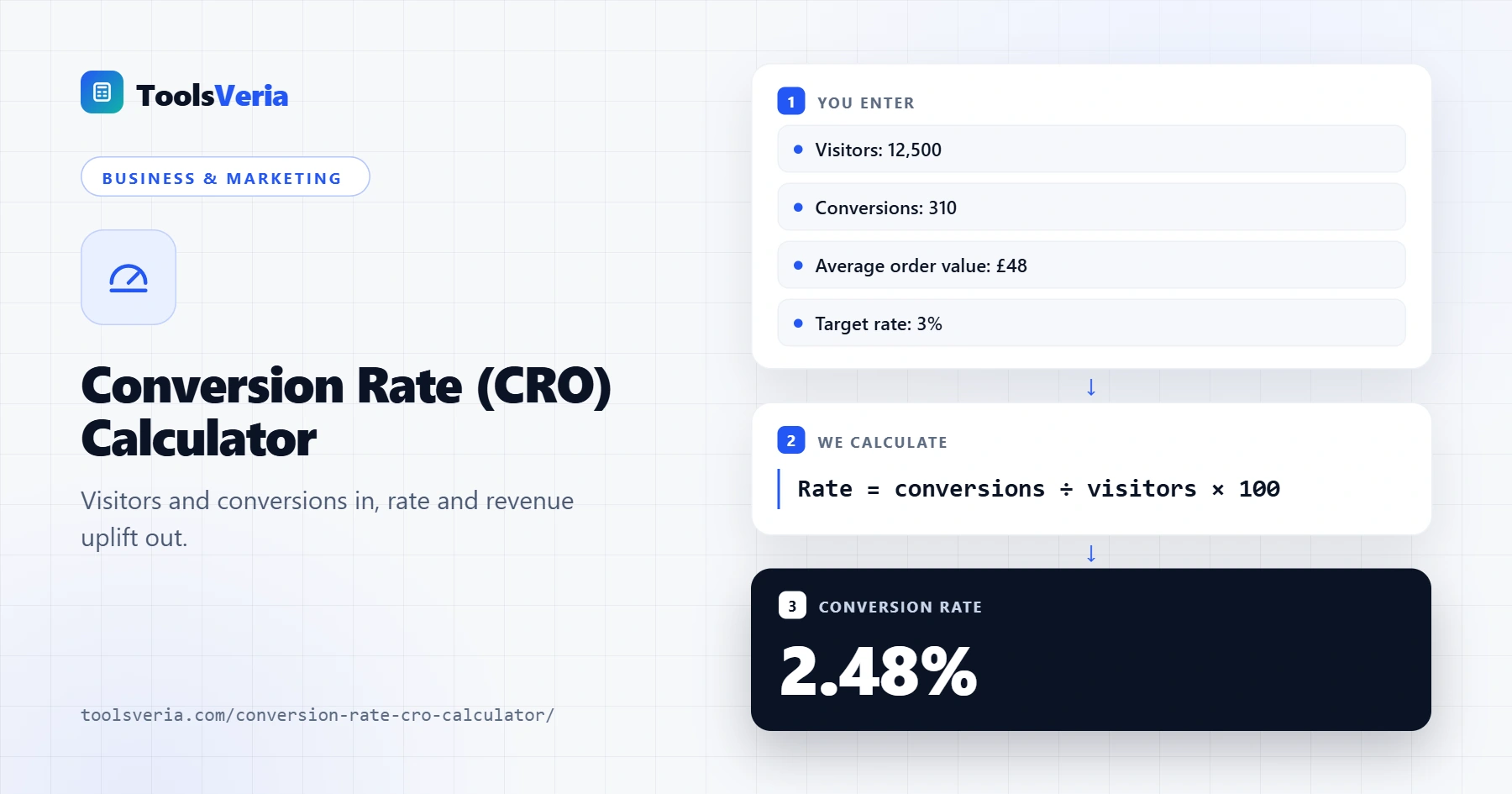
Quick answer: A conversion rate calculator uses the formula conversions ÷ visitors × 100. For example, 310 orders from 12,500 visitors is a 2.48% conversion rate, and with a £48 average order each visitor is worth £1.19. Lifting the rate to 3% on the same traffic would add £3,120 a month.
In This Guide
What Is a Conversion Rate?
A conversion is whatever action counts as success on your site: an order, a quote request, a booking or a newsletter sign up. Your conversion rate is the percentage of visitors who complete it: conversion rate = conversions ÷ visitors × 100. Decide up front whether you count users or sessions and stick with it, because the two give different rates.
Revenue per visitor joins the rate and the order value into one figure: revenue ÷ visitors, or conversion rate × average order value. It is the most useful single number for judging a site change, because it rises whether you convert more people or sell them more each time.
How to Use the Conversion Rate Calculator for CRO
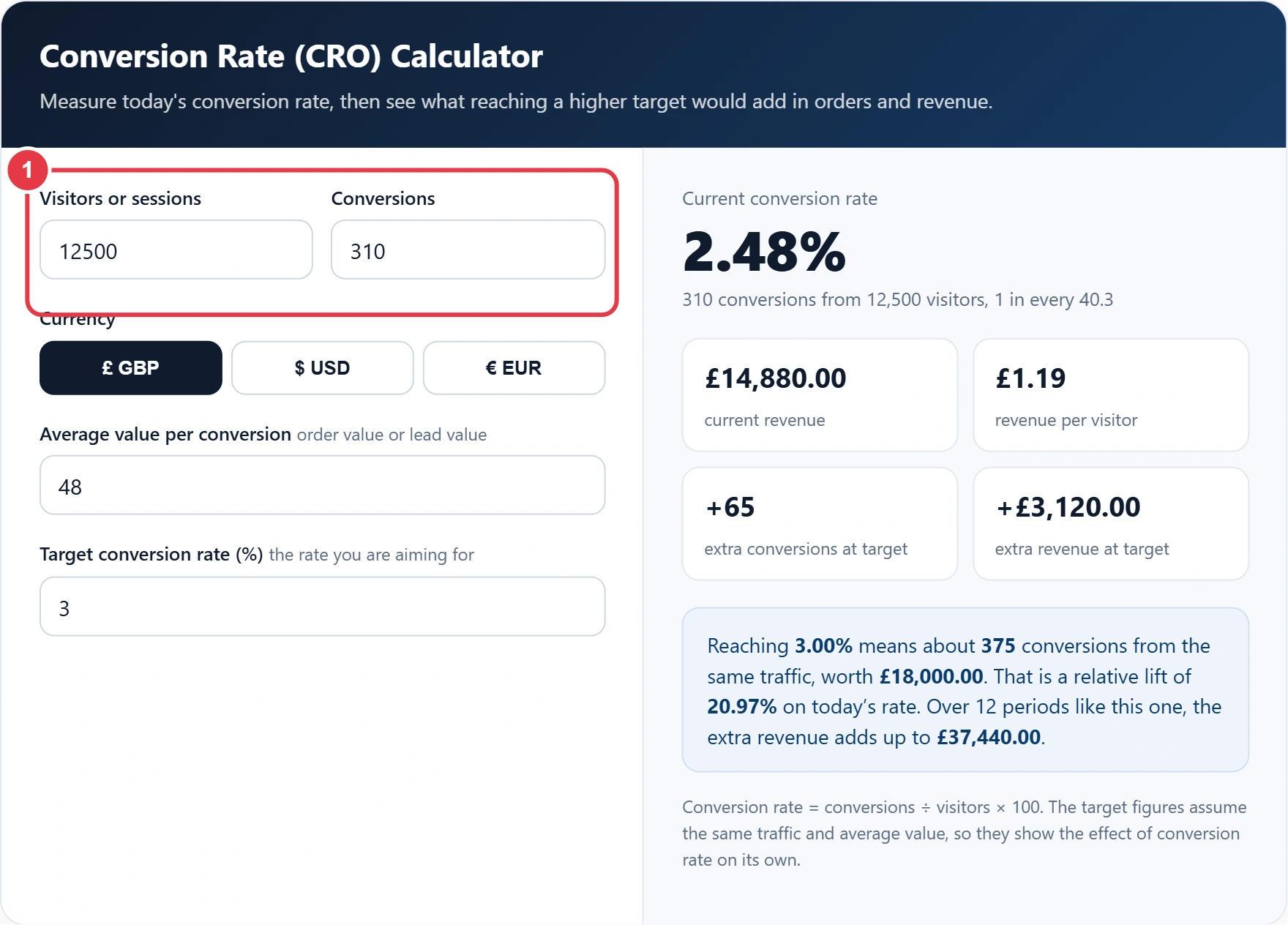
Step 1: Enter Visitors and Conversions
Take both figures from your analytics for the same period, ideally a full month so weekday and weekend patterns even out. Filter out internal staff traffic if you can.
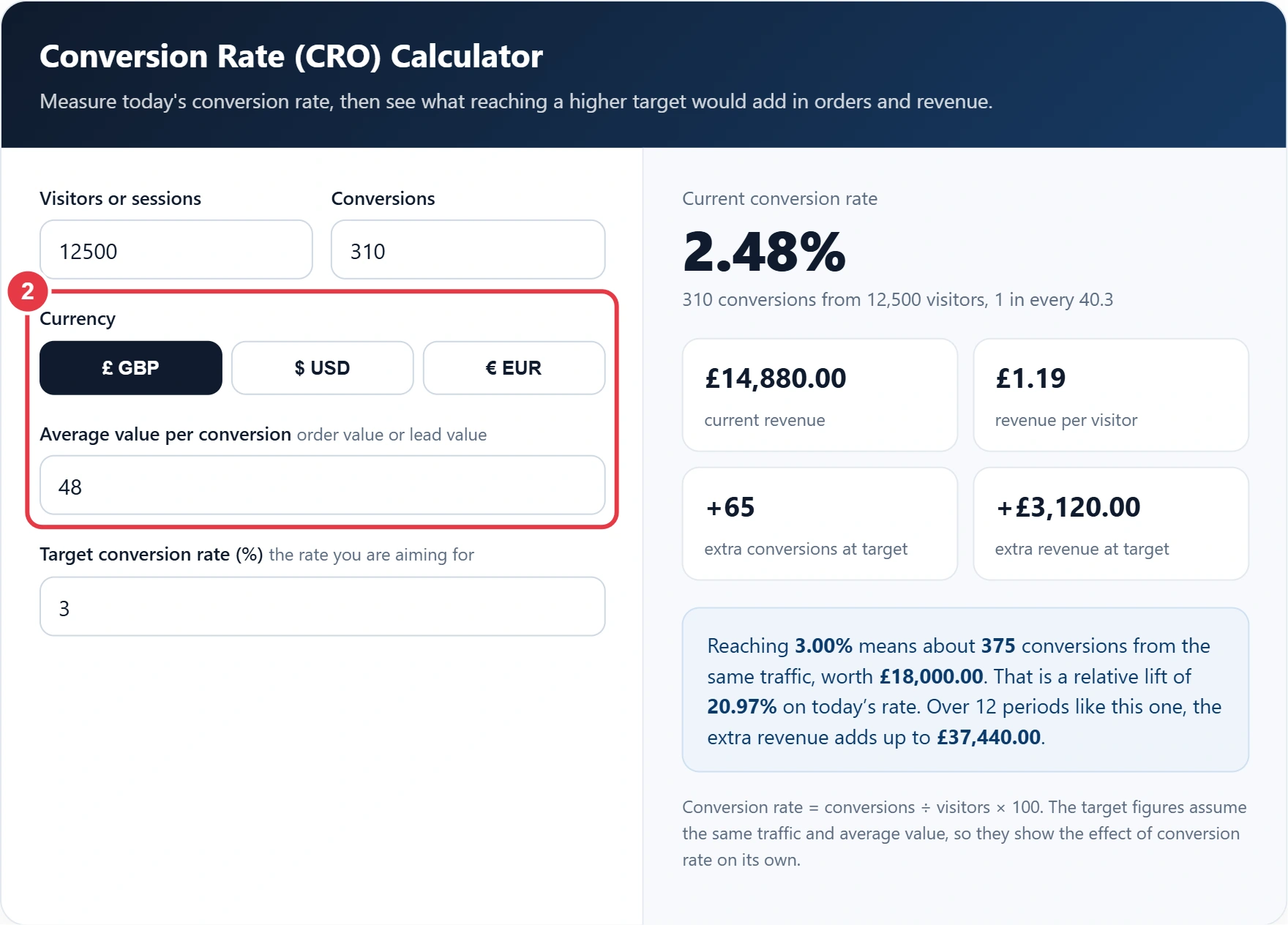
Step 2: Choose a Currency and Enter Average Value
Pick £, $ or € and enter your average order value. For lead generation, use what a lead is worth to you, for example average deal size times the share of leads that become customers.
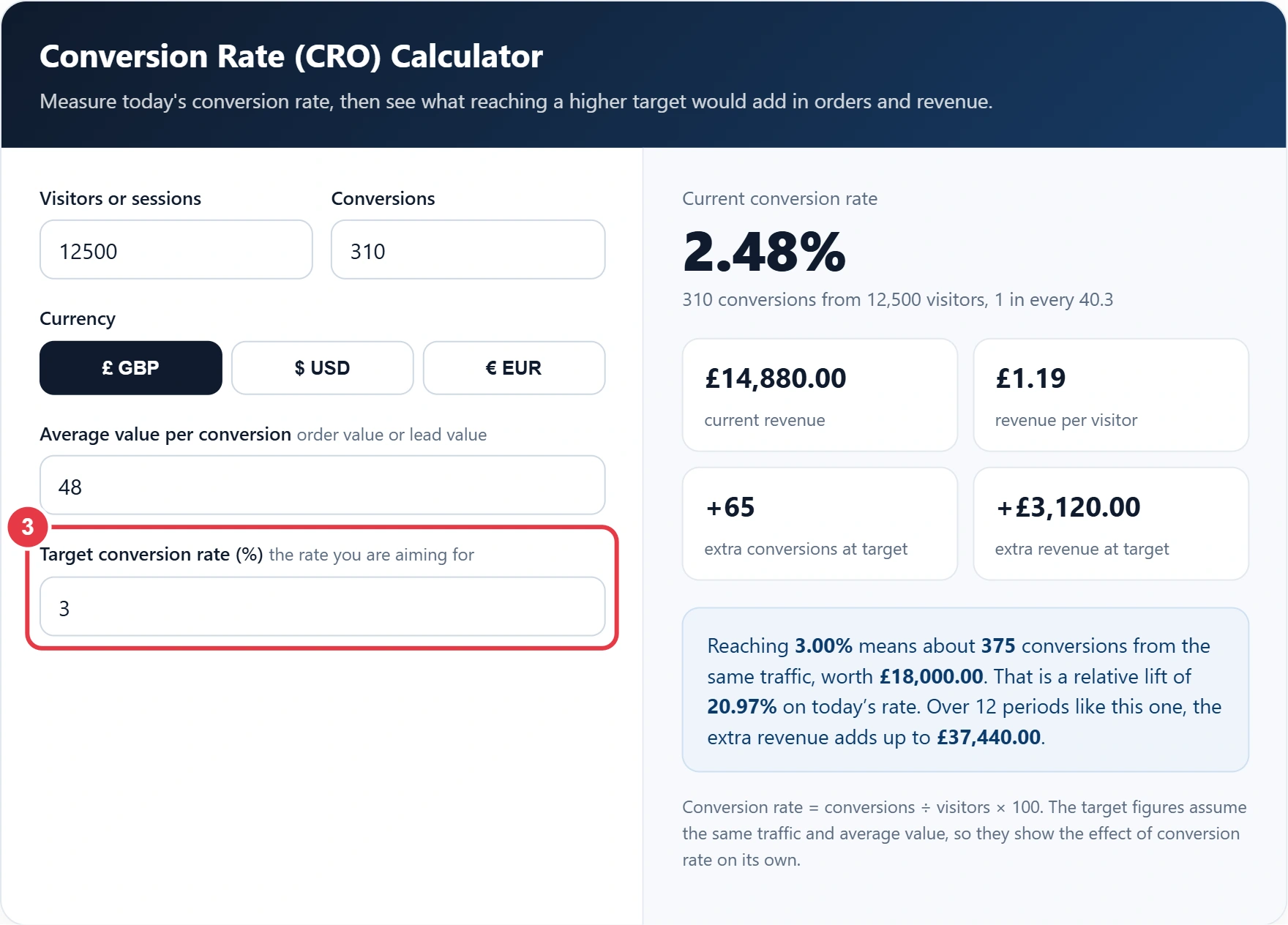
Step 3: Set a Target Conversion Rate
Choose a realistic next step rather than an industry headline. Moving from 2.5% to 3% is a meaningful goal for many shops. To check the relative gap between two rates, the percentage increase calculator shows that a move from 2.5% to 3% is a 20% improvement, not half a percent, which matters when you brief a designer or agency.
Step 4: Read the Results
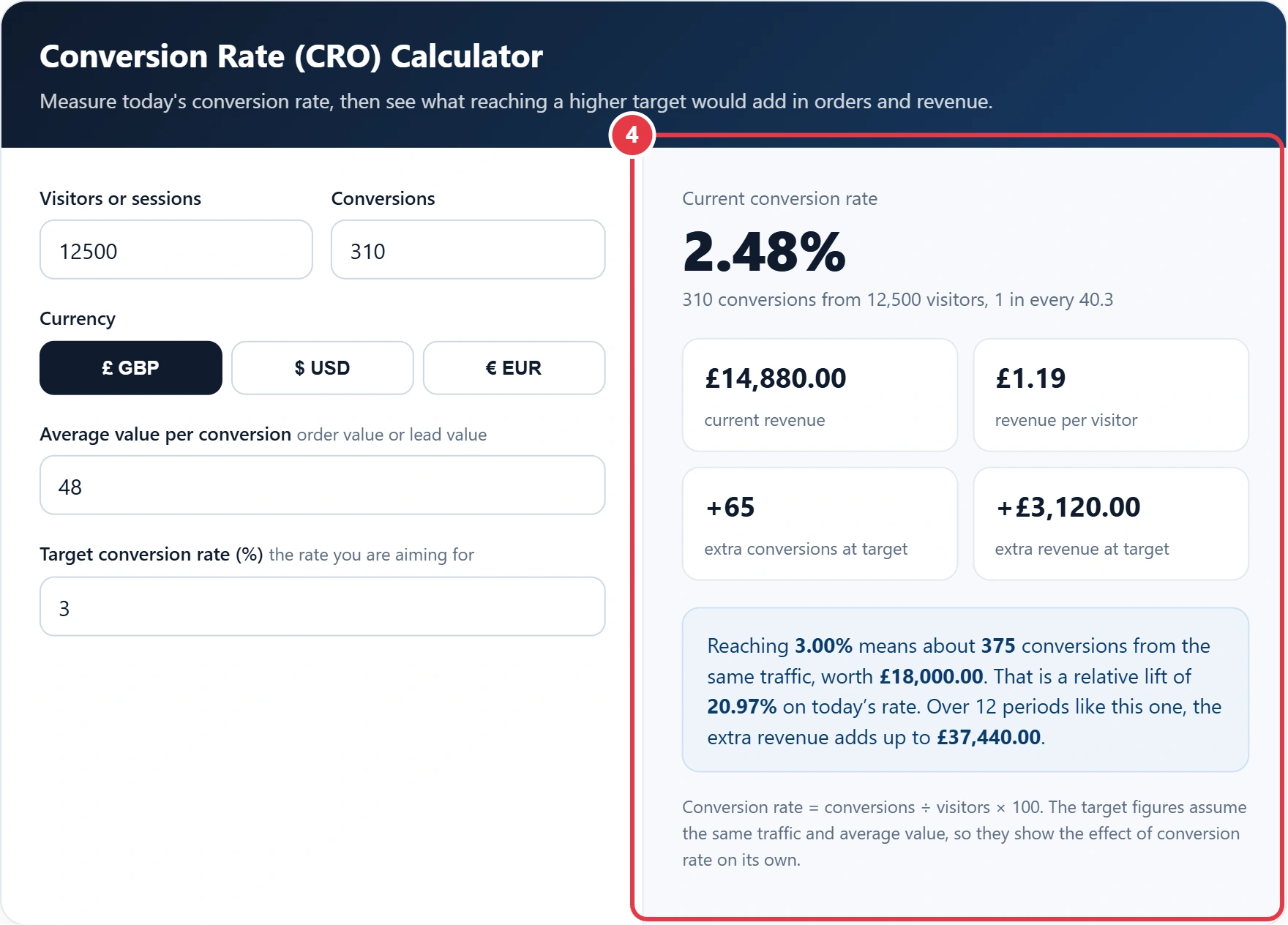
You will see your current rate, revenue, revenue per visitor, and the extra conversions and revenue at your target. The summary box also shows the relative lift needed and a rough twelve period total.
Worked Example: An Online Candle Shop
Oliver sells hand poured candles online. In September his shop had 12,500 visitors and 310 orders, with an average order of £48. His conversion rate is 310 ÷ 12,500 = 2.48%, revenue is £14,880 and each visitor is worth £1.19. If a simpler checkout lifts his rate to 3%, the same traffic would bring 375 orders and £18,000, an extra £3,120 a month.
| Conversion rate | Orders from 12,500 visitors | Revenue at £48 | Revenue per visitor |
|---|---|---|---|
| 2.0% | 250 | £12,000 | £0.96 |
| 2.48% | 310 | £14,880 | £1.19 |
| 3.0% | 375 | £18,000 | £1.44 |
| 4.0% | 500 | £24,000 | £1.92 |
Before celebrating a higher rate after a change, confirm it is real with an A/B test on enough traffic. Extra revenue is not extra profit either, so run the uplift through the profit margin calculator before deciding how much a redesign is really worth to the business.
The GOV.UK service manual has a clear guide on measuring completion rate for online services, and its advice on defining the start and end of a journey applies just as well to a checkout.
Key Conversion Rate Optimisation Terms Explained
These definitions explain the metrics behind the conversion rate calculator, helping you judge whether a site change really improves orders, leads and revenue.
- Conversion
- Any visitor action a business defines as a successful outcome, such as completing a purchase, submitting a quote form or booking an appointment. Defining it precisely before measuring is essential, because the rate depends entirely on what is counted.
- Conversion rate optimisation
- The structured practice of improving a website or app so a larger share of existing visitors complete a goal. It relies on research, analytics and controlled experiments rather than buying more traffic, which usually costs far more.
- Revenue per visitor
- Total revenue divided by the number of visitors in the same period. It combines conversion rate with order value, so it captures improvements from persuading more people to buy and from persuading buyers to spend more.
- Average order value
- The mean amount spent per completed order, found by dividing revenue by the number of orders. For lead generation sites, an equivalent value per lead is estimated from typical deal size and the share of leads that close.
- Relative lift
- The proportional change between an old and a new conversion rate, expressed as a percentage of the old rate. It differs from the percentage point change, so a small absolute rise can represent a large relative improvement.
- A/B testing
- A controlled experiment that shows two versions of a page to randomly split audiences and compares their conversion rates. Running it until enough traffic has been collected helps separate a genuine improvement from ordinary random variation.
</>Embed this calculator on your website
Add the free Conversion Rate Calculator to your own site or blog. Copy the code below and paste it into an HTML block. It resizes itself and works on phones.
How we checked this tool: the Tools Veria Editorial Team built this tool by hand, checked it against the official rules or published standards where they apply, and tested it against worked examples. Results are estimates for planning, not personal financial or tax advice. Read our editorial policy and disclaimer, or report an error.
Frequently Asked Questions
How do I calculate my conversion rate?
Divide conversions by visitors and multiply by 100. 310 orders from 12,500 visitors gives a conversion rate of 2.48%.
Should I use sessions or users for conversion rate?
Either works if you are consistent. Users gives a higher rate, because one person who visits three times before buying counts once.
Is going from 2% to 3% a 1% increase?
It is a rise of 1 percentage point, but a relative increase of 50%. Agencies and tools often quote the relative figure.
What is revenue per visitor?
Revenue divided by visitors, which equals conversion rate multiplied by average order value. It captures gains from both more buyers and bigger baskets.
Why did my conversion rate fall when traffic went up?
New traffic from broad campaigns or viral posts is often less ready to buy, so the rate can fall even while total sales rise.
How long should I measure before trusting a conversion rate?
Use at least two full weeks, ideally a month, so weekday, weekend and payday patterns are all included.