Follow your traffic from first visit to paying customer and see where the numbers fall away.
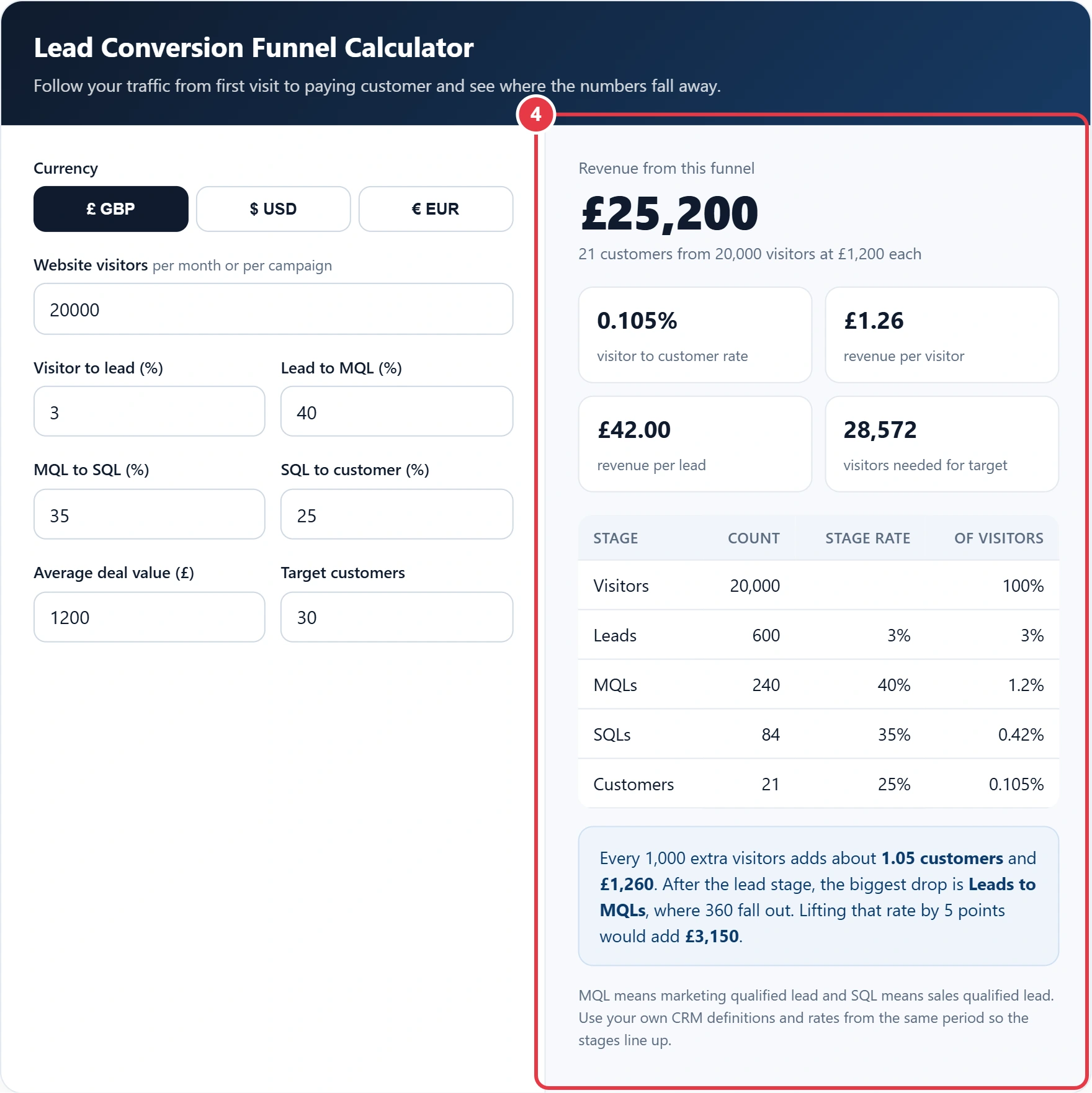
| Stage | Count | Stage rate | Of visitors |
|---|
MQL means marketing qualified lead and SQL means sales qualified lead. Use your own CRM definitions and rates from the same period so the stages line up.
This lead conversion funnel calculator shows marketing and sales teams how many website visitors become leads, MQLs, SQLs and paying customers, and what that is worth in revenue. It is built on the classic purchase funnel model but uses the stage names most B2B CRMs use, so you can drop in your own reporting numbers and spot the weakest step in seconds.
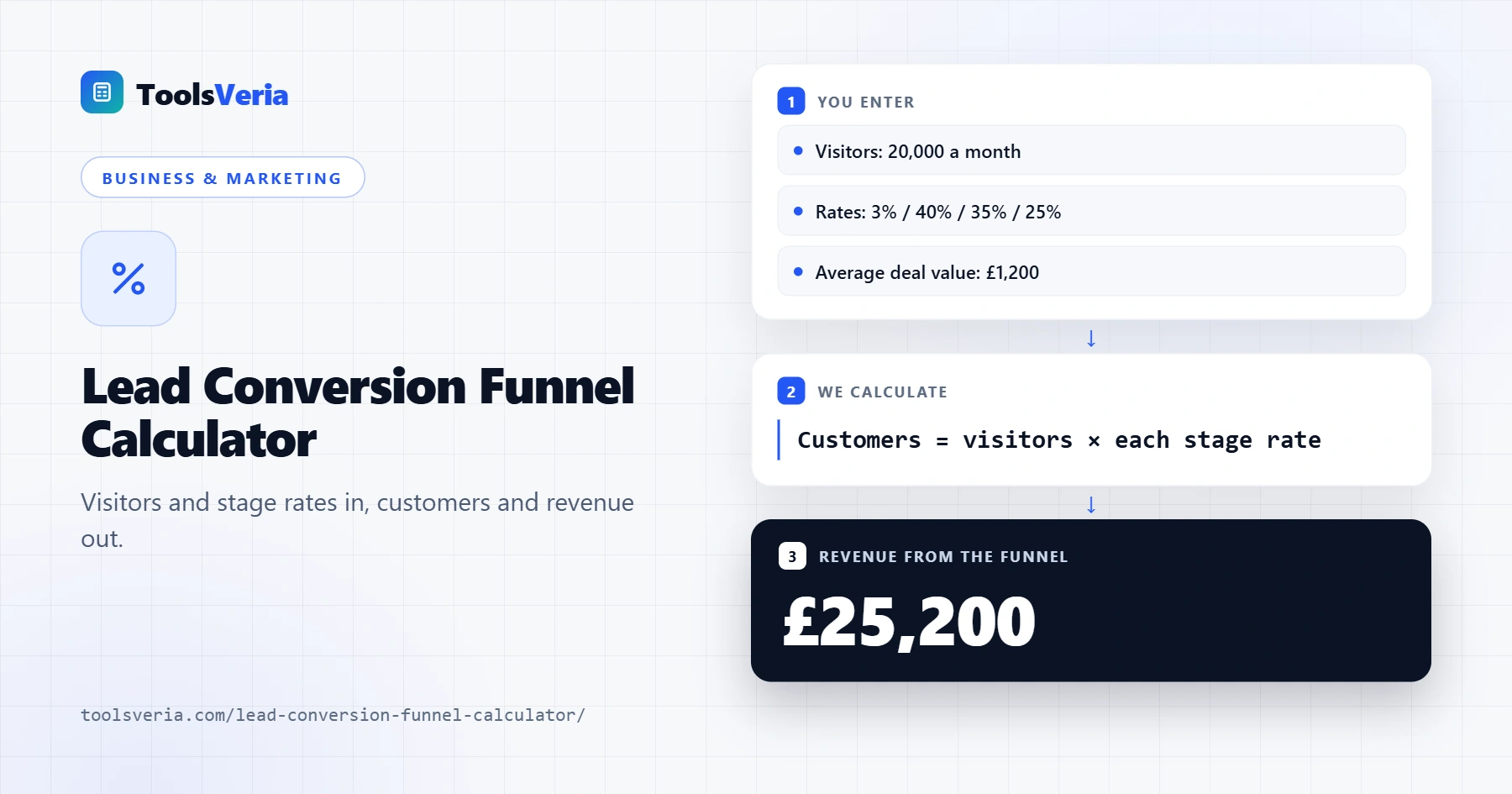
Quick answer: A lead conversion funnel calculator multiplies visitors by each stage rate: visitor to lead, lead to MQL, MQL to SQL and SQL to customer. For example, 20,000 visitors at 3%, 40%, 35% and 25% give 21 customers, worth £25,200 at £1,200 each. At a 0.105% overall rate you need about 953 visitors per customer.
In This Guide
What Is a Lead Conversion Funnel?
A lead conversion funnel is the sequence of stages a prospect passes through between first visit and signed deal, with a conversion rate measured at each step. The usual B2B stages are visitor, lead (someone who filled in a form), marketing qualified lead (MQL, fits your profile and showed intent), sales qualified lead (SQL, accepted by sales for a real conversation) and customer.
The maths multiplies through: customers = visitors × visitor to lead rate × lead to MQL rate × MQL to SQL rate × SQL to customer rate, and revenue = customers × average deal value. Because the rates multiply, a small gain at any one stage lifts revenue by the same percentage.
How to Use the Lead Conversion Funnel Calculator
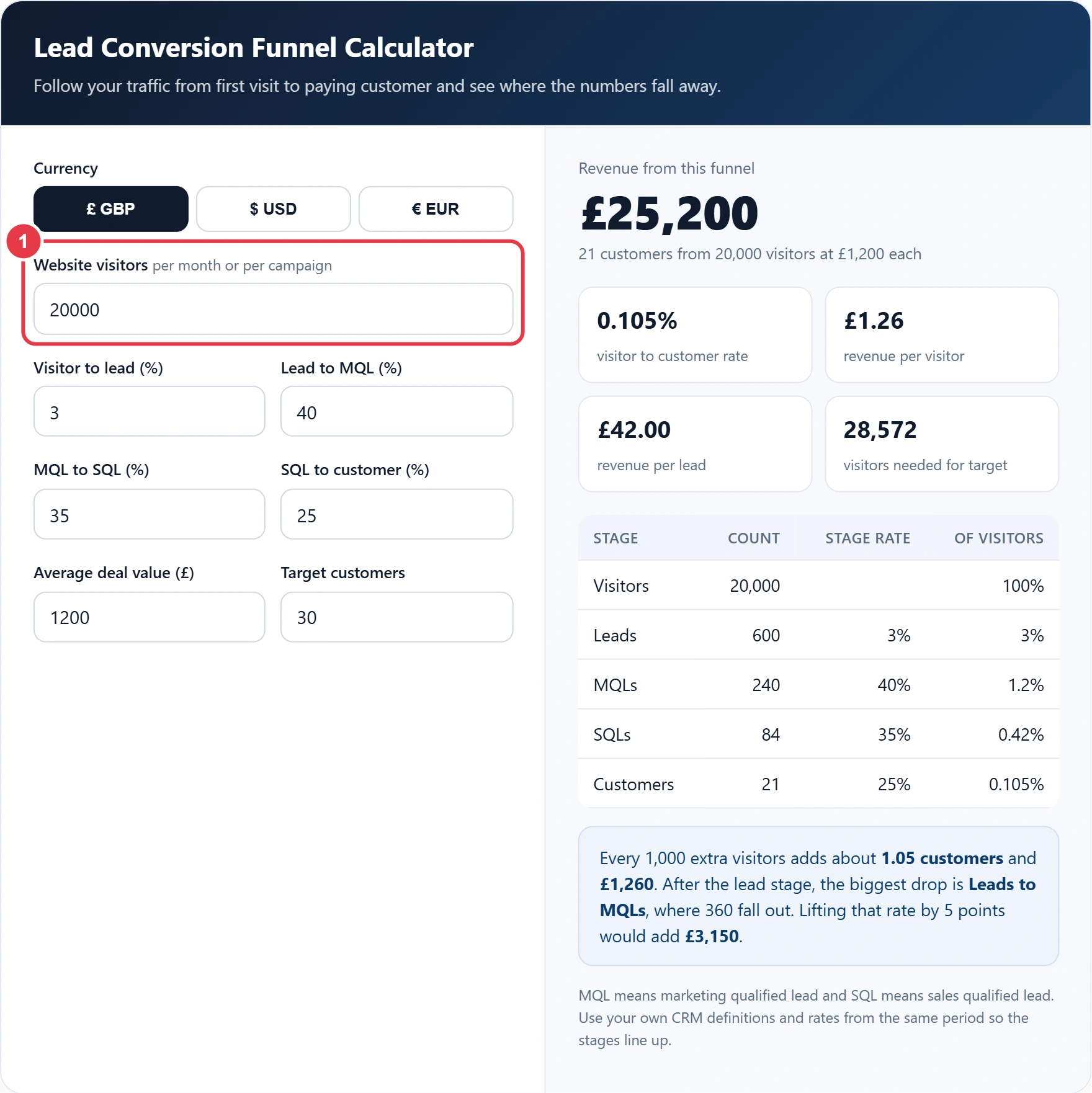
Step 1: Enter Your Visitors
Pick your currency and enter unique visitors for the period you are reviewing, such as a month or a single campaign. Use the same date range for every other figure.
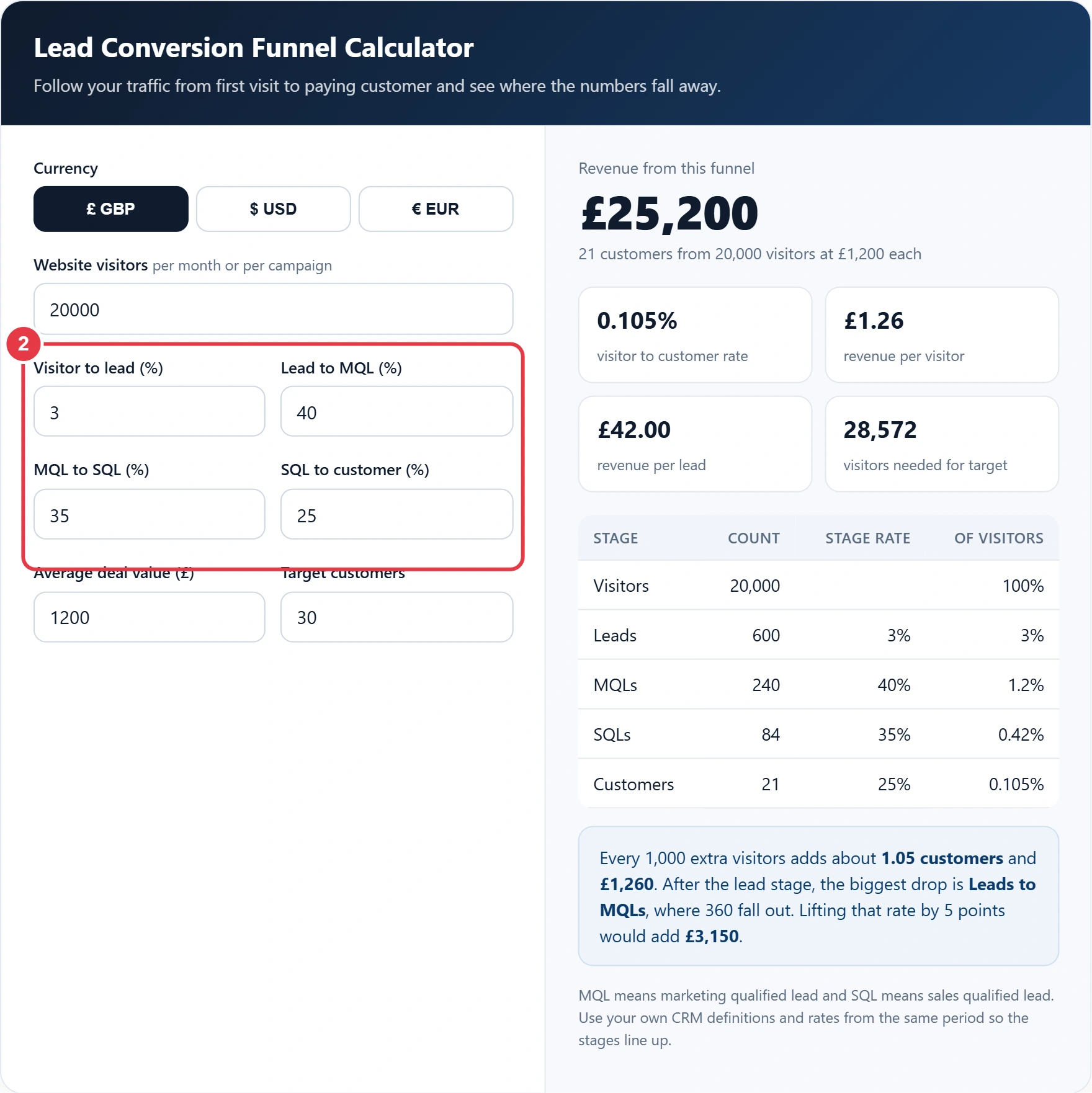
Step 2: Add Each Stage Rate
Enter the percentage that moves from one stage to the next, not the share of all visitors. If your first figure is unclear, the conversion rate calculator turns raw form fills and sessions into a clean percentage you can paste straight in here.
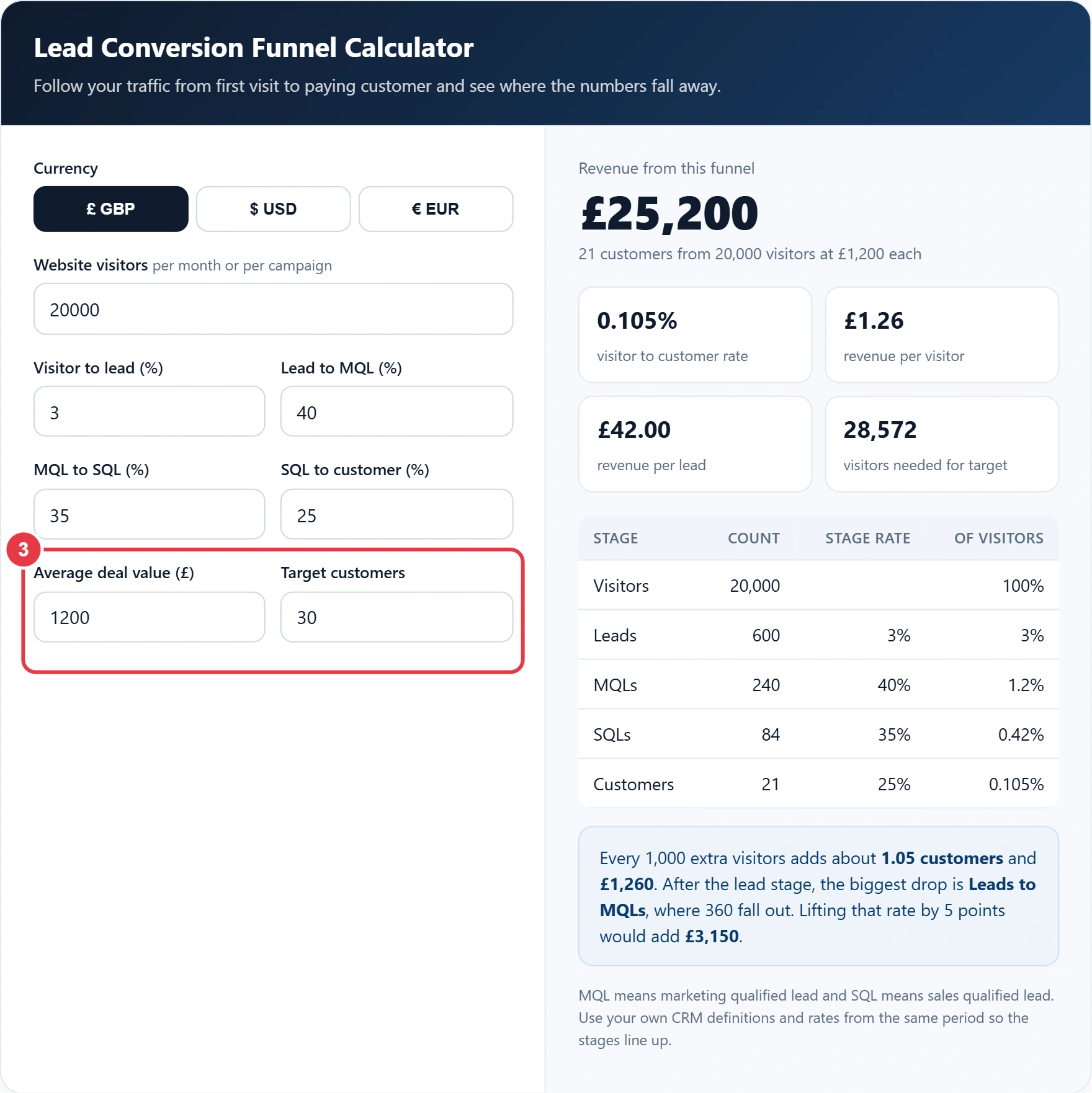
Step 3: Set Deal Value and Target
Average deal value is first year revenue per new customer. The target customers box works backwards to tell you how much traffic the current funnel needs to hit that number.
Step 4: Read the Funnel
The table shows each stage as a count, a stage rate and a share of visitors. Compare revenue per lead with what you pay for a lead, and the customer acquisition cost calculator will show whether each new account is profitable once sales time is counted.
How Many Visitors Do I Need to Win One Customer?
Divide 1 by your overall visitor to customer rate: at 0.105% you need about 953 visitors per customer. Take Hannah, who runs marketing for an accounting software firm in Bristol. Her 20,000 monthly visitors convert at 3% into 600 leads, 40% of those become 240 MQLs, 35% become 84 SQLs and 25% close, giving 21 customers worth £1,200 each, or £25,200.
| Change for Hannah | Customers | Revenue |
|---|---|---|
| Current funnel | 21 | £25,200 |
| Visitor to lead 3% to 4% | 28 | £33,600 |
| MQL to SQL 35% to 45% | 27 | £32,400 |
| Traffic up to 28,572 | 30 | £36,000 |
Hannah's board wants 30 customers a month, which needs 28,572 visitors at today's rates. Fixing the MQL handover first is usually cheaper than buying traffic, and a clear definition of what a qualified lead looks like, as covered in this overview of lead generation, stops sales and marketing arguing over the numbers. Once you know your deal value over the full relationship, the customer lifetime value calculator tells you how much you can afford to spend at the top of the funnel.
Lead Conversion Funnel Terms Explained
These terms explain each stage the lead conversion funnel calculator tracks, so marketing and sales teams can agree definitions and find the weakest step.
- Lead
- A visitor who shares contact details, usually by filling in a form, downloading a resource or booking a demo. It is the first point at which an anonymous visit becomes a named prospect that can be followed up.
- Marketing qualified lead (MQL)
- A lead that matches the target customer profile and has shown enough interest, such as repeat visits or content downloads, to be worth passing to sales. The scoring rules behind it vary between businesses.
- Sales qualified lead (SQL)
- A lead the sales team has reviewed and accepted as a genuine prospect for a buying conversation. The handover from MQL to SQL is often where marketing and sales definitions clash.
- Stage conversion rate
- The percentage of people at one stage who move to the next, rather than the share of all visitors. Because every stage rate multiplies through, improving any single step lifts final revenue in the same proportion.
- Overall conversion rate
- The share of total visitors who end up as paying customers, found by multiplying all stage rates together. Its reciprocal tells you how many visitors are needed for each new customer.
- Average deal value
- The typical first year revenue from one new customer. Multiplying it by the customer count gives funnel revenue, and dividing that revenue by leads shows what each lead is worth against what it costs to buy.
</>Embed this calculator on your website
Add the free Lead Conversion Funnel Calculator to your own site or blog. Copy the code below and paste it into an HTML block. It resizes itself and works on phones.
How we checked this tool: the Tools Veria Editorial Team built this tool by hand, checked it against the official rules or published standards where they apply, and tested it against worked examples. Results are estimates for planning, not personal financial or tax advice. Read our editorial policy and disclaimer, or report an error.
Frequently Asked Questions
What is the difference between an MQL and an SQL?
An MQL is a lead marketing judges ready for sales based on fit and behaviour, such as a pricing page visit. An SQL is one the sales team has reviewed and accepted as a genuine buying opportunity worth a call or demo.
How do I calculate overall funnel conversion rate?
Multiply the stage rates together. For example, 3% × 40% × 35% × 25% equals 0.105%, so 21 of every 20,000 visitors become customers. Dividing customers by visitors gives the same answer.
Should stage rates be a share of visitors or of the previous stage?
Use the previous stage. Lead to MQL at 40% means 40% of leads become MQLs, not 40% of visitors. The calculator shows the share of visitors separately in the last table column.
How do I calculate revenue per lead?
Divide total revenue by the number of leads. In the default example, £25,200 from 600 leads is £42 per lead, which is the most you could pay per lead before losing money on first year revenue.
Why does improving one stage by 10% raise revenue by 10%?
The stages multiply, so a 10% relative gain at any single stage carries straight through to customers and revenue. Pick the stage where that gain is cheapest to achieve.
How many visitors do I need for a target number of customers?
Divide the target by your overall conversion rate. Thirty customers at 0.105% needs 30 ÷ 0.00105, which is 28,572 visitors when rounded up.