Add VAT to a net price or remove it from a gross price at any Irish rate.
Irish VAT rates for 2026 as published by Revenue. Check which rate applies to your goods or services before invoicing.
Whether you are pricing a job, checking an invoice or filing a return, this VAT calculator Ireland tool adds or removes Irish VAT in one step. Pick any of the rates set by Revenue's current VAT rates, from the 23% standard rate to 0%, or enter a custom rate, and see the net amount, VAT and gross total in euro.
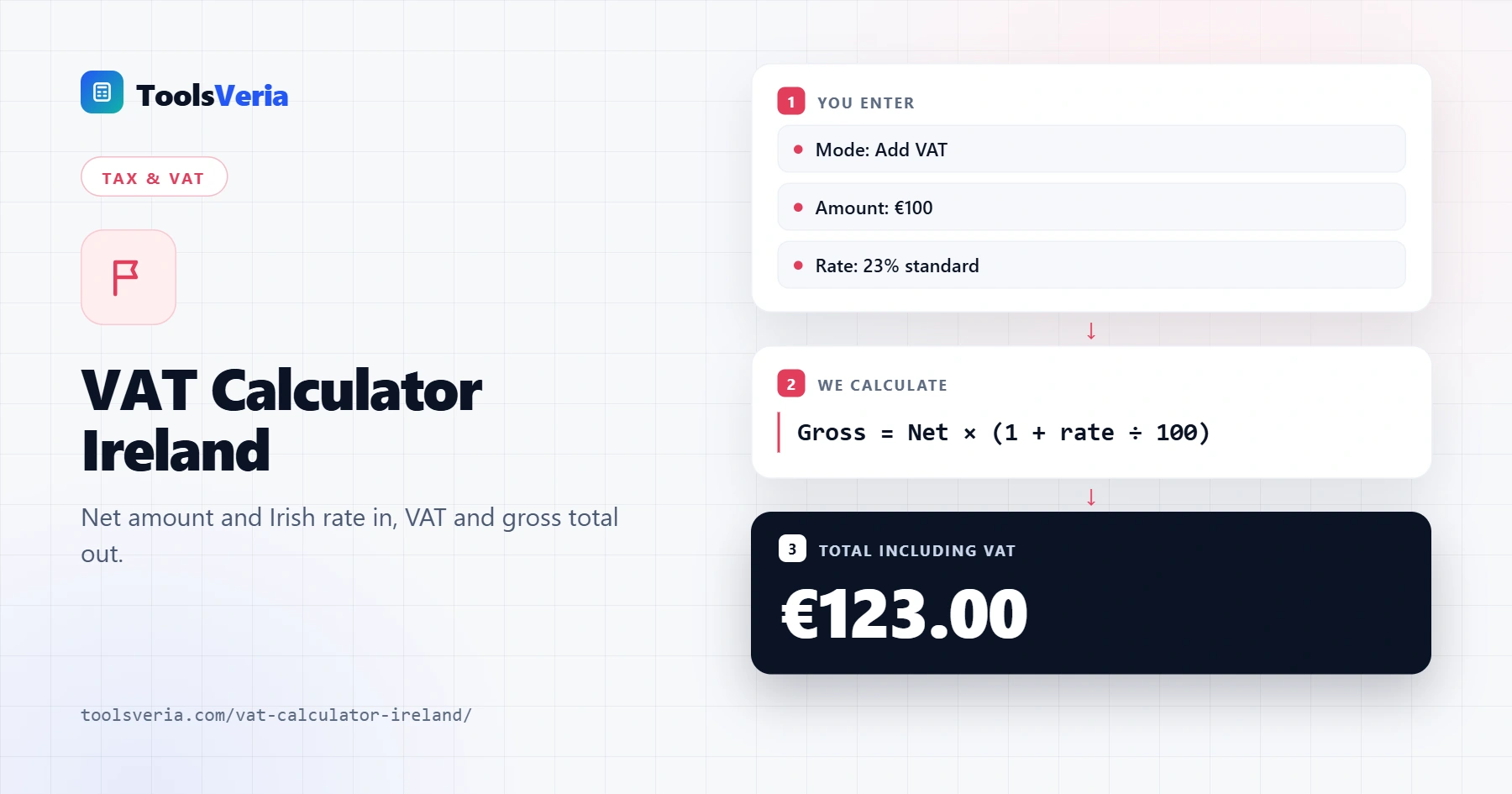
Quick answer: A VAT calculator Ireland tool adds VAT with net × (1 + rate ÷ 100) = gross, so €100 at the 23% standard rate becomes €123. To remove VAT, use gross ÷ (1 + rate ÷ 100) = net, so €123 ÷ 1.23 = €100. Taking 23% off the gross figure wrongly gives €94.71.
In This Guide
What Is an Irish VAT Calculator?
Value Added Tax is charged on most goods and services sold in Ireland. VAT registered businesses add it to their prices and pay it over to Revenue. An Irish VAT calculator works out the tax for you in either direction, which saves errors on quotes, receipts and expense claims.
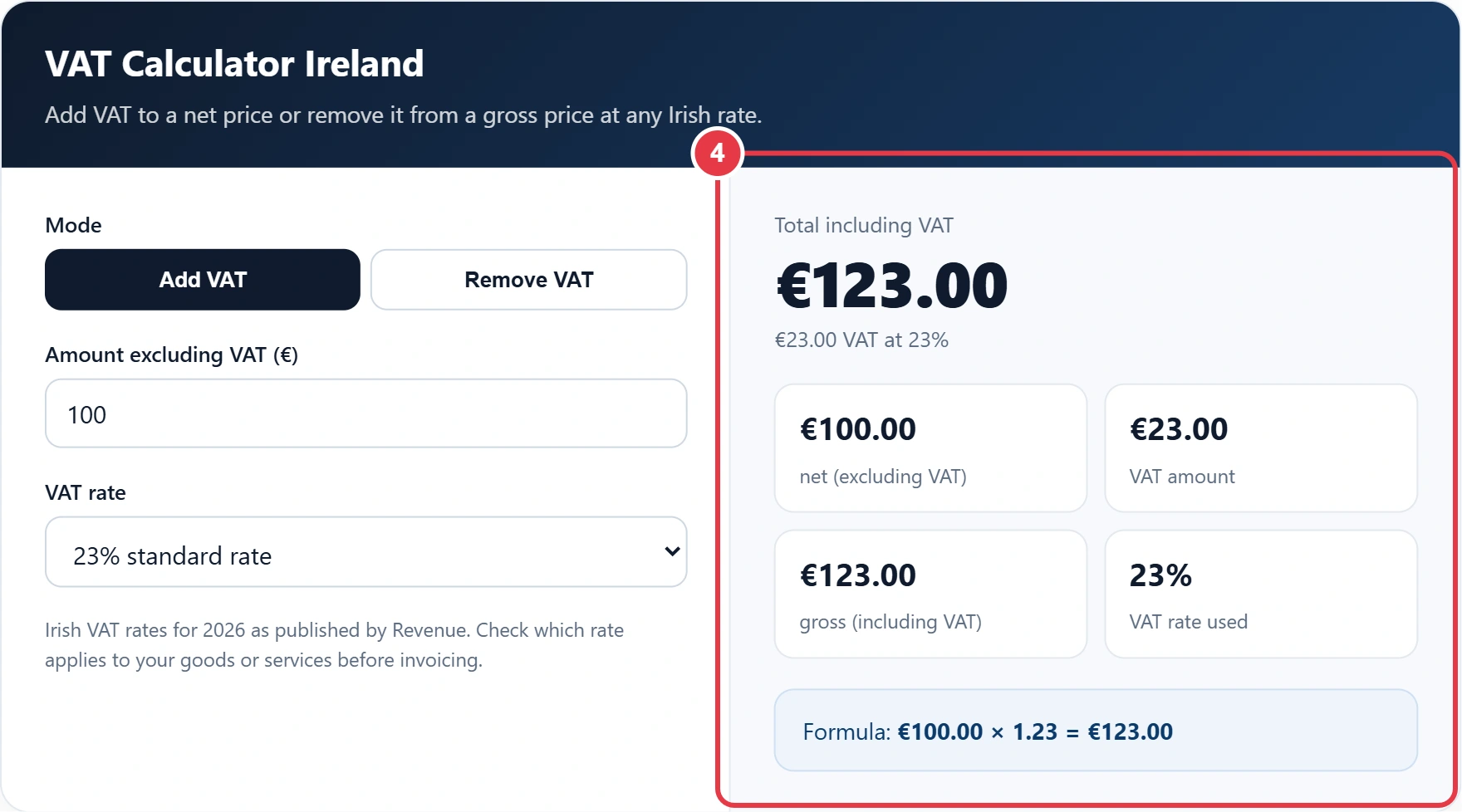
To add VAT, use net × (1 + rate ÷ 100) = gross, so €100 at 23% becomes €123. To remove VAT, use gross ÷ (1 + rate ÷ 100) = net, so €123 ÷ 1.23 = €100. A common mistake is taking 23% off the gross figure, which gives €94.71 instead of the correct €100.
How Do You Use the VAT Calculator Ireland?
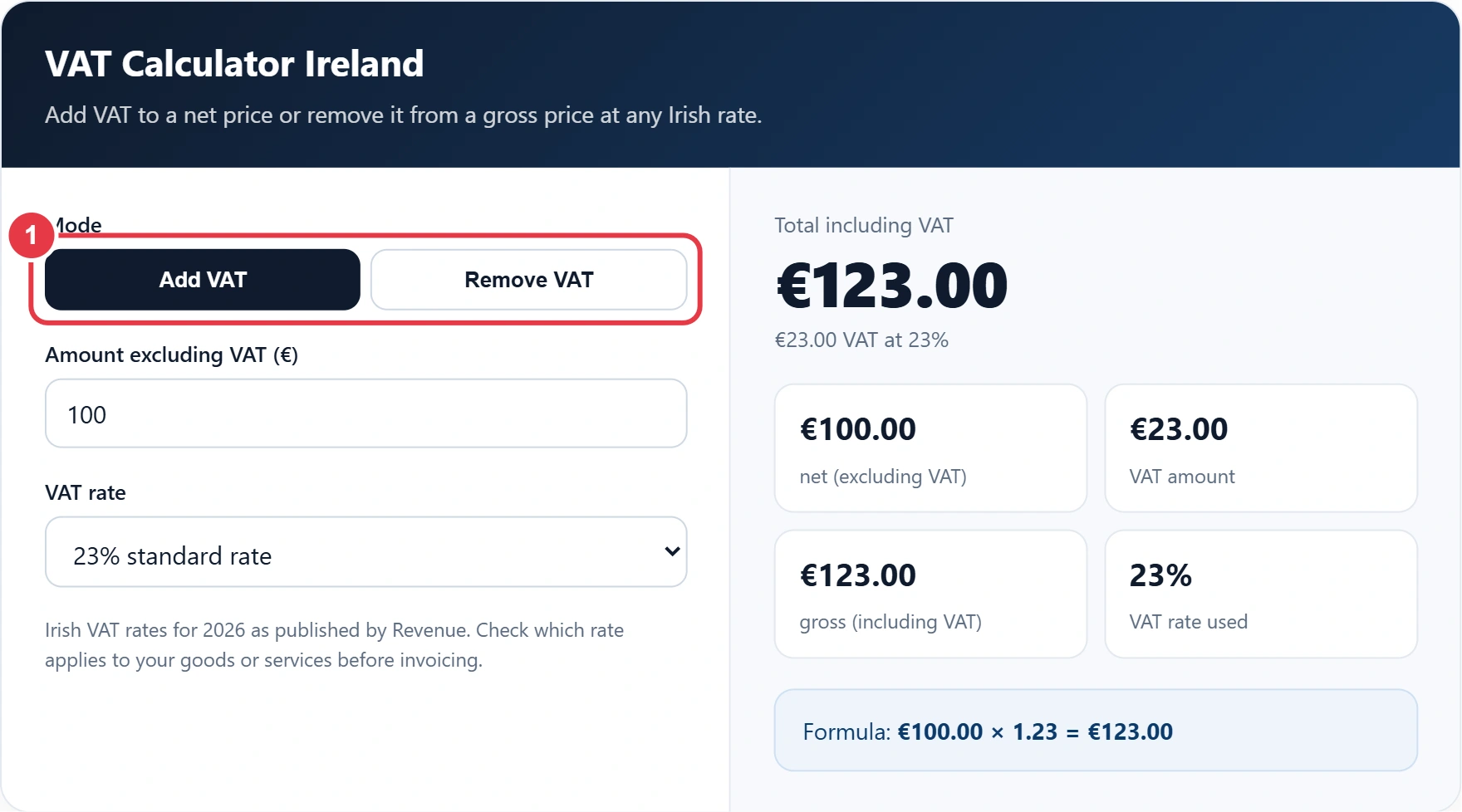
Step 1: Choose Add or Remove VAT
You select Add VAT if your figure is a net price before tax, or Remove VAT if it already includes VAT. Select Add VAT if your figure is a net price before tax. Select Remove VAT if it already includes VAT, such as a shop receipt or a supplier's gross total.
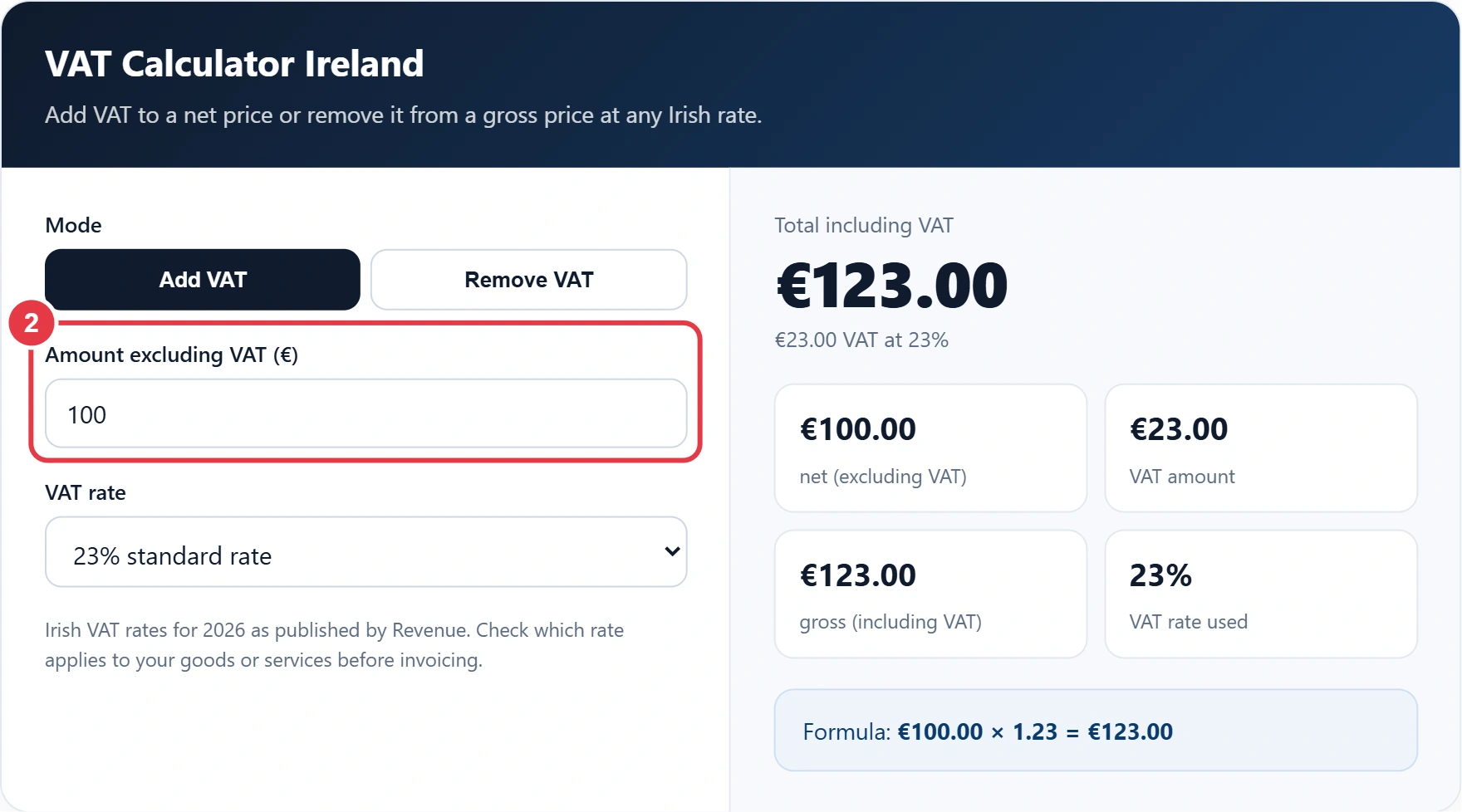
Step 2: Enter the Amount
Type the amount in euro. The label changes to remind you whether the calculator expects a figure excluding or including VAT.
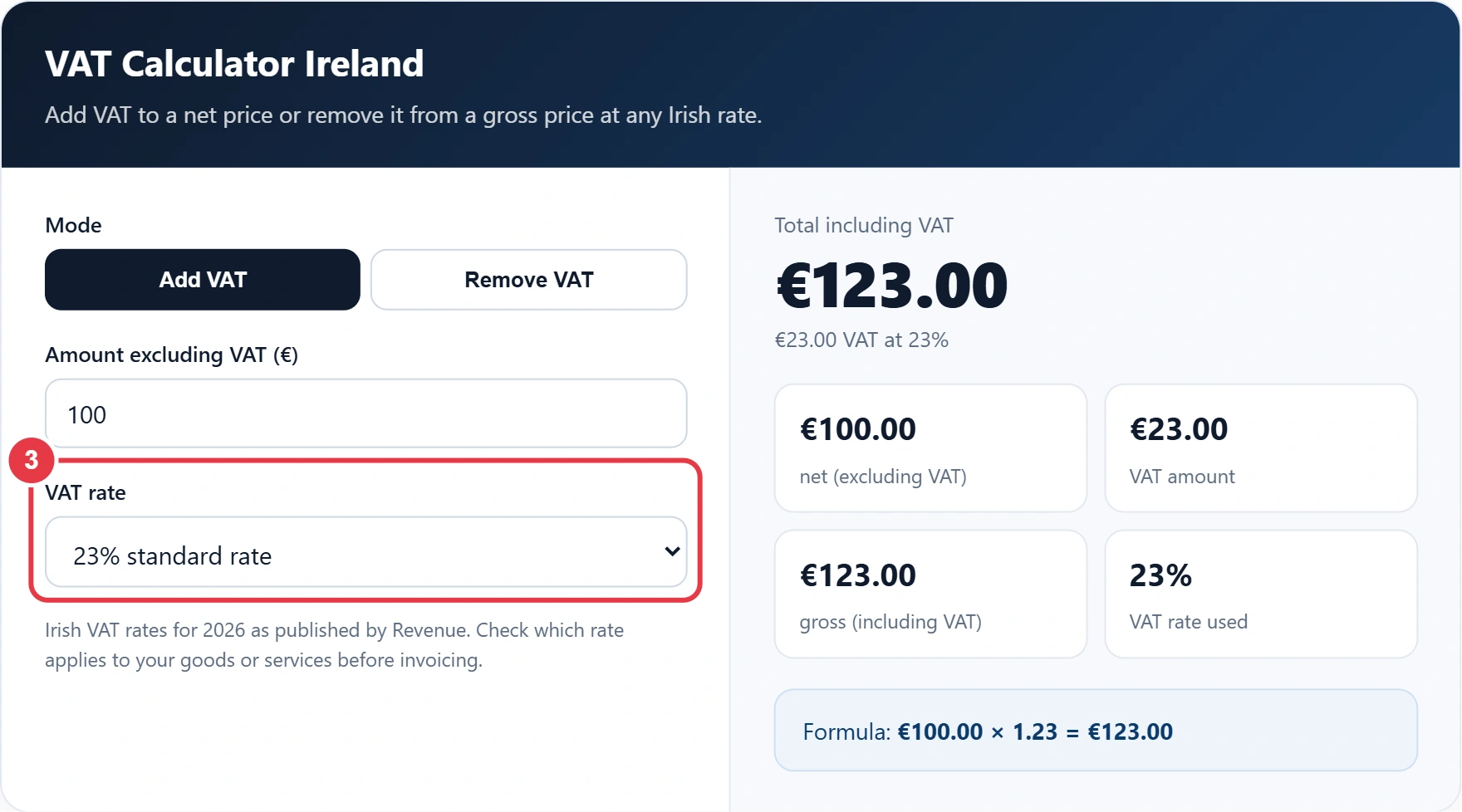
Step 3: Pick the VAT Rate
Choose 23%, 13.5%, 9%, 4.8% or 0% from the list, or select Custom to enter any other rate. For UK prices in pounds, the reverse VAT calculator uses the 20% UK rate instead, while Custom is handy for an older invoice or another EU country's rate.
Step 4: Read the Results
You get the net amount, the VAT, the gross total and the formula used, so you can show your working on a quote or invoice. If you are setting a selling price, the markup calculator works out the margin before VAT is added. Results are rounded to the nearest cent.
What Are the Irish VAT Rates for 2026?
| Rate | Name | Examples of what it applies to |
|---|---|---|
| 23% | Standard rate | Most goods and services, including adult clothing, electrical goods, alcohol and professional services |
| 13.5% | Reduced rate | Building and construction work, repair and cleaning services, and some fuels |
| 9% | Second reduced rate | Gas and electricity, newspapers, sports facilities, and from 1 July 2026 restaurant and catering food and hairdressing |
| 4.8% | Livestock rate | Livestock, greyhounds and the hire of horses |
| 0% | Zero rate | Most food, children's clothing and footwear, oral medicines and books |
Ireland has a 23% standard rate, a 13.5% reduced rate, a 9% second reduced rate, a 4.8% livestock rate and a 0% zero rate for items such as most food and books. Rates depend on exactly what is supplied, and some items have detailed conditions. The plain English guide to Value Added Tax from Citizens Information is a good starting point, and Revenue's VAT rates database lists the rate for individual items if you are still unsure.
Irish VAT Terms You Should Know
These definitions explain the Irish rates and rules behind the VAT calculator Ireland tool, helping you pick the right rate and price work correctly in euro.
- Revenue Commissioners
- The Irish government body, usually called Revenue, that collects taxes and duties and publishes the official VAT rates. VAT registered businesses file returns with it and pay over the tax they charge customers.
- Standard rate
- Ireland's main VAT rate of 23%, which applies to any goods or services not placed in a lower band. It covers items such as adult clothing, electrical goods and professional services.
- Second reduced rate
- The 9% band in Irish VAT, used for selected goods and services including gas and electricity, newspapers and sports facilities. It sits below the 13.5% reduced rate that covers building and repair work.
- Livestock rate
- A special Irish VAT rate of 4.8% that applies mainly to the sale of live animals for food production and related agricultural supplies. It is far lower than other bands to support the farming sector.
- VAT inclusive pricing
- Showing a single price that already contains the tax, as Irish retailers do for consumers. Extracting the VAT from such a price requires dividing by one plus the rate, not deducting the rate itself.
</>Embed this calculator on your website
Add the free VAT Calculator Ireland to your own site or blog. Copy the code below and paste it into an HTML block. It resizes itself and works on phones.
How we checked this tool: the Tools Veria Editorial Team built this tool by hand, checked it against the official rules or published standards where they apply, and tested it against worked examples. Results are estimates for planning, not personal financial or tax advice. Read our editorial policy and disclaimer, or report an error.
Frequently Asked Questions
What is the standard VAT rate in Ireland?
The standard rate of VAT in Ireland is 23%. It applies to most goods and services that do not qualify for a reduced or zero rate.
How do I add 23% VAT to a price?
Multiply the net price by 1.23. For example, €200 × 1.23 = €246, of which €46 is VAT.
How do I remove 23% VAT from a price?
Divide the gross price by 1.23. For example, €246 ÷ 1.23 = €200, so the VAT was €46.
What does the 9% VAT rate apply to in Ireland?
It covers gas and electricity, newspapers and sports facilities. From 1 July 2026 it also applies to restaurant and catering food and to hairdressing.
What is the 4.8% VAT rate for?
The 4.8% livestock rate applies to supplies of livestock and greyhounds and to the hire of horses.
Which items are zero rated for VAT in Ireland?
Zero rated items include most food, children's clothing and footwear, oral medicines and books. VAT is charged at 0%, but businesses can still reclaim VAT on their costs.