2026 rules: up to 5 non cash benefits a year, worth no more than €1,500 in total.
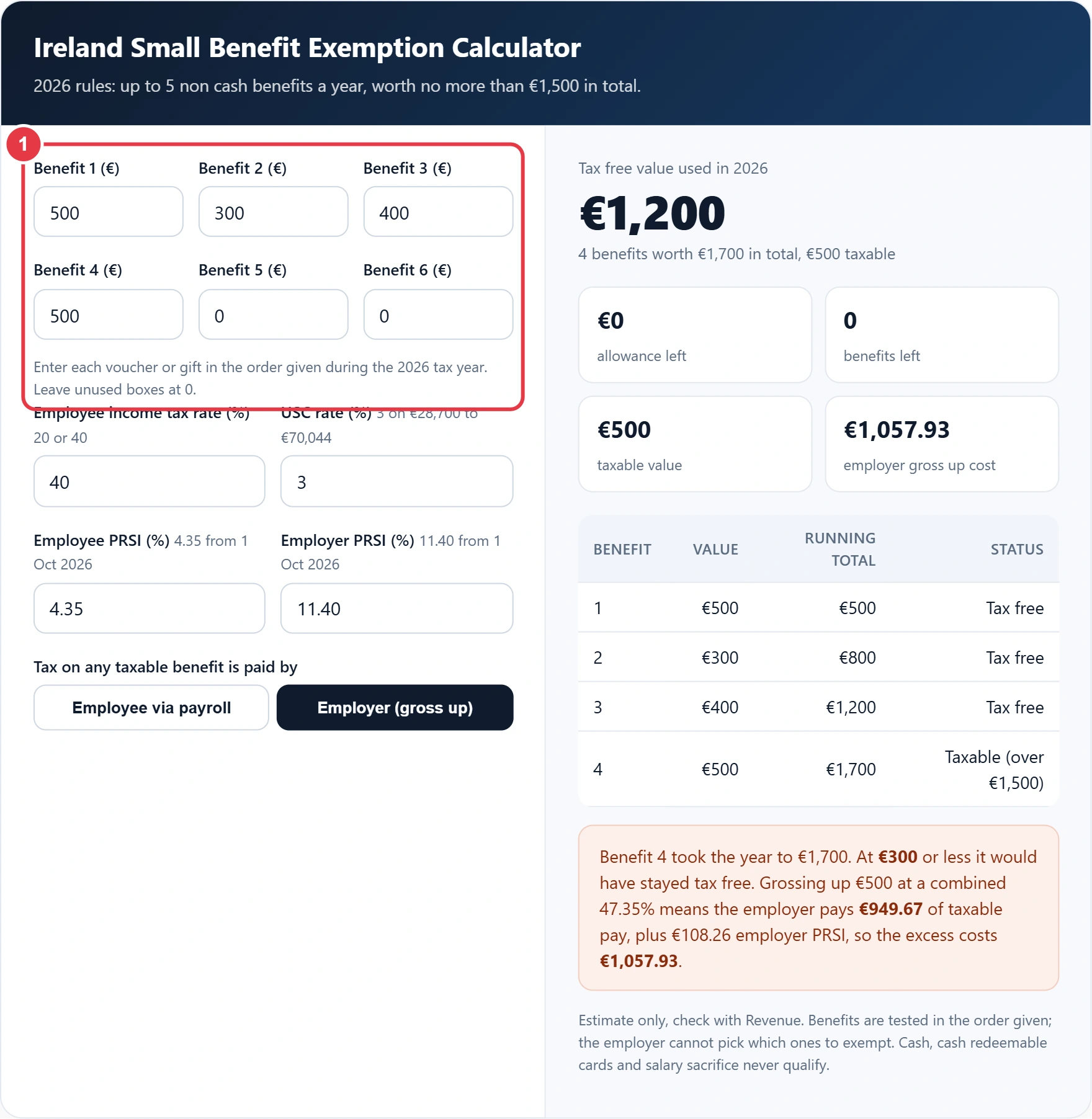
Enter each voucher or gift in the order given during the 2026 tax year. Leave unused boxes at 0.
| Benefit | Value | Running total | Status |
|---|
Estimate only, check with Revenue. Benefits are tested in the order given; the employer cannot pick which ones to exempt. Cash, cash redeemable cards and salary sacrifice never qualify.
This calculator is for Irish employers, payroll teams and directors who want to check the small benefit exemption Ireland rules for the 2026 tax year before buying another round of staff vouchers. You list each gift in the order given and it shows which are tax free, how much of the yearly limit is left, and what any excess costs once the Revenue Commissioners treat it as pay through PAYE, USC and PRSI on the employee's payslip. Figures checked October 2026.
Quick answer: Under the small benefit exemption Ireland rules for 2026, an employer can give each employee up to 5 non cash benefits a year with a combined value of up to €1,500, free of income tax, USC and PRSI. A benefit that pushes the year's total above €1,500, or a sixth benefit, is taxable in full.
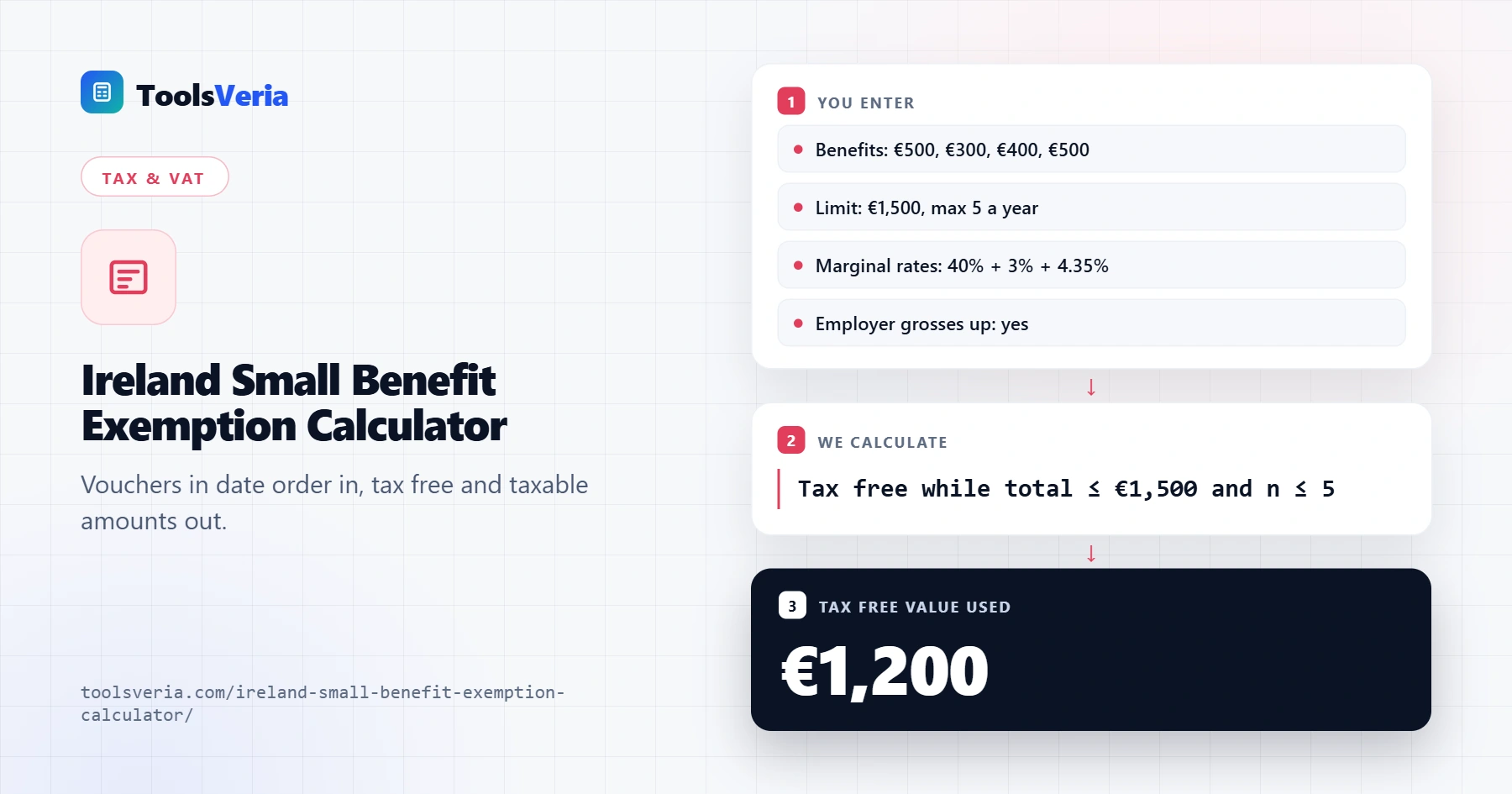
In This Guide
What Is the Small Benefit Exemption in Ireland?
The small benefit exemption is a relief in section 112B of the Taxes Consolidation Act 1997 that lets an employer reward staff with vouchers or goods that are not taxed as pay. It covers income tax, USC and both employee and employer PRSI, so a €300 voucher costs the business €300 and reaches the employee as €300.
The test in plain words: take each benefit in the order it was given, add it to the running total, and it is exempt only if it is one of the first five and the running total is still €1,500 or less. Revenue's Tax and Duty Manual confirms the employer cannot choose which benefits to exempt, and that a benefit which breaks the limit is taxable on its whole value, not just the part above €1,500. The current limits apply from 1 January 2025 to 31 December 2029.
| Tax years | Maximum benefits a year | Combined value limit |
|---|---|---|
| Up to 2021 | 1 | €500 |
| 2022 to 2024 | 2 | €1,000 |
| 2025 to 2029 (includes 2026) | 5 | €1,500 |
How Much Can an Employer Give Tax Free in 2026?
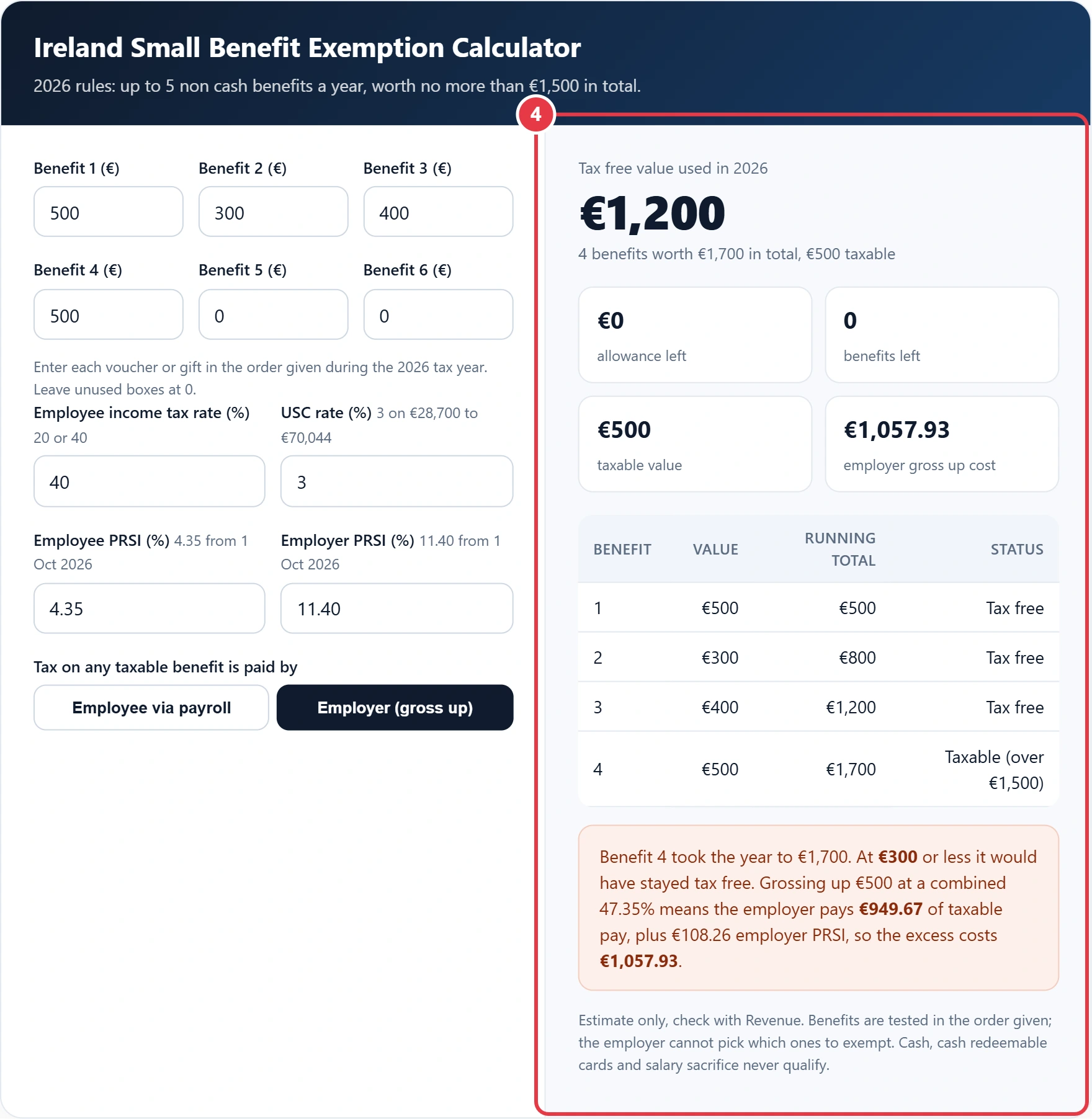
An employer can give up to €1,500 tax free per employee in 2026, split across no more than five benefits. Take Aoife, a developer at a Cork software firm. She received a €500 voucher in March, €300 in June and €400 in September, a running total of €1,200 and all exempt. In December the firm plans a €500 Christmas voucher. That takes the year to €1,700, so the whole €500 becomes taxable. Had the December voucher been €300, the year would have ended at exactly €1,500 with nothing to pay.
The value counts per employee, not per company, so a firm with 40 staff could give €60,000 in total if every person stays within their own €1,500. Small fees or postage paid when buying vouchers are ignored for the threshold, but a card that can be cashed in, even partly, never qualifies.
How to Use the Ireland Small Benefit Exemption Calculator
Step 1: Enter Each Benefit in Date Order
Type the value of every voucher, hamper or gift given to one employee since 1 January 2026, oldest first. Order matters, because the rules test benefit one, then benefit two, and so on. A sixth box is there so you can see what happens when a business gives one gift too many.
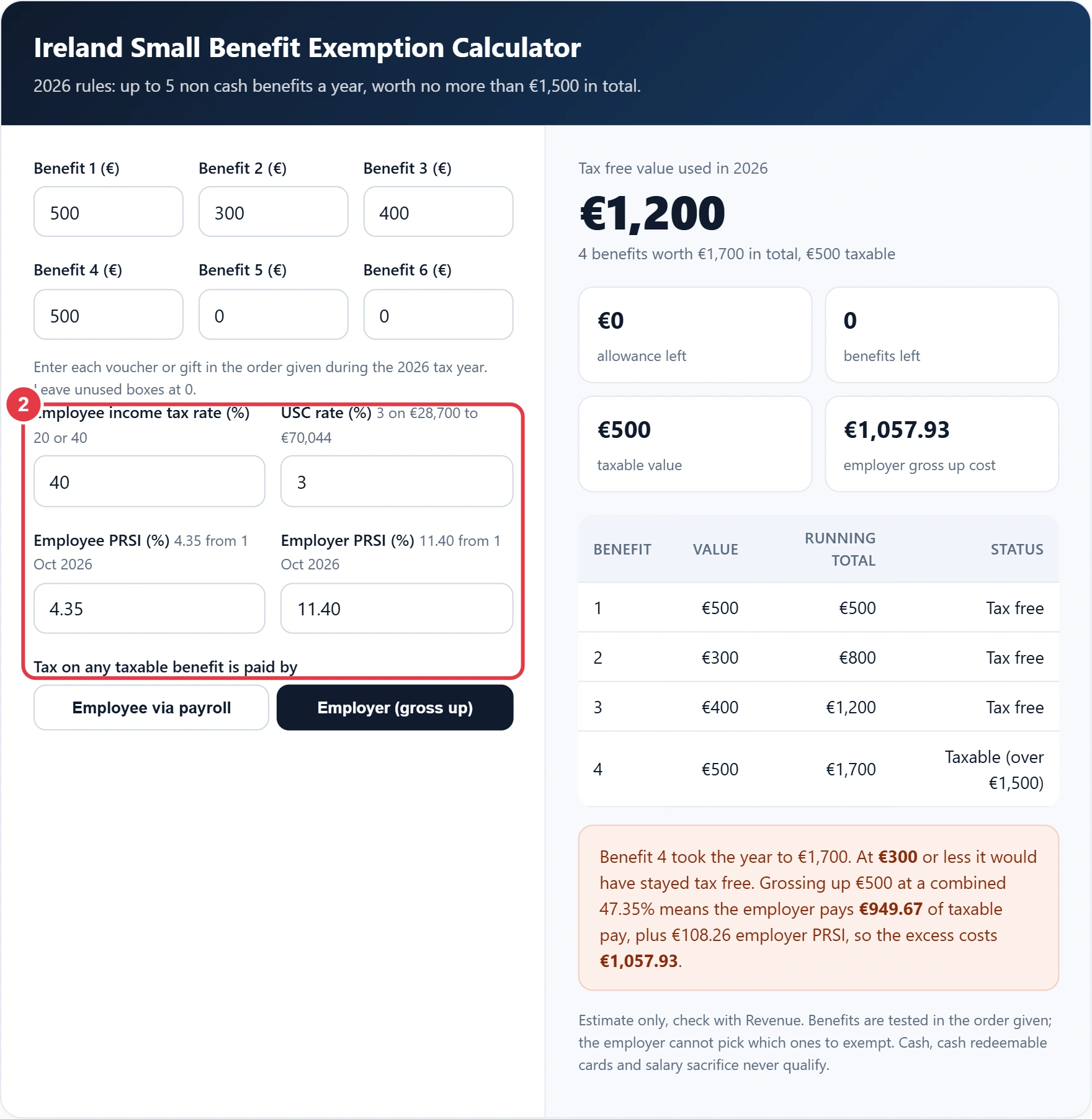
Step 2: Set the Employee's Marginal Rates
The defaults suit a typical higher rate employee in late 2026: 40% income tax, 3% USC and 4.35% employee PRSI, with 11.40% employer PRSI. Revenue sets the 2026 standard rate band for a single person at €44,000, so someone on a lower salary pays 20% instead. USC is 0.5% on the first €12,012, 2% on the next €16,688, 3% on the next €41,344 and 8% above that.
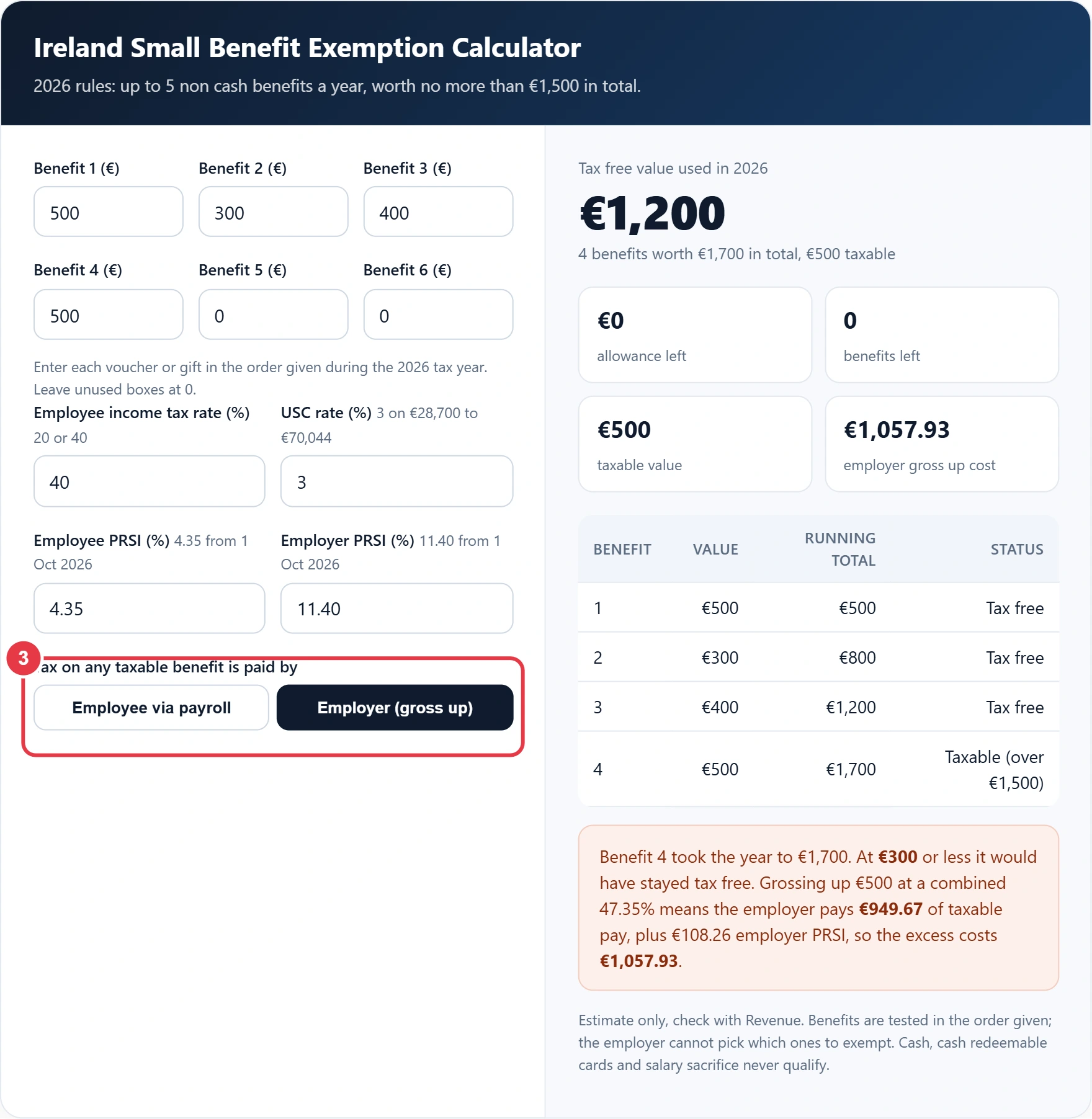
Step 3: Choose Who Pays the Tax
Pick Employee via payroll if the taxable benefit simply goes through the payslip. Pick Employer (gross up) if the company wants the employee to receive the full value with no deduction. Grossing up costs more, because the tax the employer pays is itself taxable pay.
Step 4: Read the Results
You see the tax free value used, the allowance and number of benefits left, the taxable value and the extra cost. The table marks each benefit as tax free or taxable with the reason, and the message box tells you the most a failing voucher could have been worth while staying exempt.
What Happens If a Voucher Goes Over €1,500?
The voucher that breaks the limit is taxed in full as pay through PAYE, USC and PRSI, while the earlier benefits stay exempt. In Aoife's case the €500 December voucher is taxable. If she pays the tax herself at a combined 47.35%, she loses €236.75 from her payslip. If her employer grosses it up, it must put through €949.67 of pay (€500 ÷ 0.5265), and with €108.26 employer PRSI the voucher really costs €1,057.93 instead of €500.
Compare that with a cash bonus. To hand Aoife €1,500 in cash after deductions, the firm would need to pay €2,849.00 gross plus €324.79 employer PRSI, a total of €3,173.79. The same €1,500 in qualifying vouchers costs €1,500. That gap is why most Irish employers plan their gifts around the limit, and the Ireland VAT calculator helps when you need the VAT inclusive price of the goods or services the vouchers are meant to buy.
Which Benefits Qualify Under the Small Benefit Exemption Ireland Rules?
A benefit qualifies if it is not cash, cannot be swapped for cash, is not given in place of salary and is reported to Revenue on or before the day it is given. In practice that means:
- Shop vouchers, multi store gift cards and experience vouchers that can only be spent on goods or services.
- Physical gifts such as a hamper, a bike or a tablet, valued at what the employer paid.
- Not cash, bank transfers, prepaid cards that allow ATM withdrawals, or anything offered under a salary sacrifice.
- Directors can receive small benefits from their own company on the same terms as staff.
- Each benefit must be included in the employer's enhanced reporting to Revenue with its date and value.
The small benefit exemption Ireland limit resets on 1 January, so unused allowance cannot be carried forward into 2027. Other tax free benefits, such as a travel pass or the cycle to work scheme, are separate reliefs covered in the wider overview of taxation in Ireland, and they do not use up any of the €1,500. The Ireland retirement lump sum tax calculator is the companion tool for directors planning a pension exit, which is taxed under entirely separate rules from staff vouchers and gifts.
</>Embed this calculator on your website
Add the free Ireland Small Benefit Exemption Calculator to your own site or blog. Copy the code below and paste it into an HTML block. It resizes itself and works on phones.
How we checked this tool: the Tools Veria Editorial Team built this tool by hand, checked it against the official rules or published standards where they apply, and tested it against worked examples. Results are estimates for planning, not personal financial or tax advice. Read our editorial policy and disclaimer, or report an error.
Frequently Asked Questions
What is the small benefit exemption limit in Ireland for 2026?
The 2026 limit is up to 5 non cash benefits per employee, worth no more than €1,500 in total over the tax year. These limits apply from 2025 to 2029 and cover income tax, USC and PRSI.
Is only the amount above €1,500 taxed?
No. The benefit that takes the running total above €1,500 is taxable on its full value. A €500 voucher given when €1,200 is already used is taxed on all €500, not just €200.
Can I give one €1,500 voucher tax free?
Yes. A single non cash voucher of exactly €1,500 qualifies, but it uses the whole allowance for 2026, so any further benefit that year is taxable.
What happens to a sixth voucher in the same year?
A sixth benefit is taxable in full even if the total stays under €1,500. For example, six €200 vouchers total €1,200, but only the first five, worth €1,000, are tax free.
Can the employer choose which vouchers are exempt?
No. Revenue tests benefits in the order they are given, so the first five within €1,500 qualify. An employer cannot leave out an early voucher to exempt a larger one later.
Do company directors get the small benefit exemption?
Yes. Directors who are paid through payroll can receive up to 5 benefits worth €1,500 in 2026 from their own company, as long as the vouchers are non cash and reported to Revenue.