Jobseeker's Pay-Related Benefit by 13 week period, with the flat rate payment for comparison.
| Period | Weekly | Total |
|---|
Estimate only, using the Department of Social Protection rates for claims from 31 March 2025, checked October 2026. Your actual rate uses Revenue records of your average weekly gross earnings over the 12 months up to 8 weeks before you lost your job. Payments may be taxable. Check with the Department of Social Protection or Citizens Information.
This pay related jobseekers benefit calculator estimates what Jobseeker's Pay-Related Benefit (JPRB) will pay you each week in Ireland in 2026 if you lose your job, based on your earnings and your PRSI contribution record. It applies the 60%, 55% and 50% rates, the weekly caps and the €125 minimum, then compares the result with the flat rate Jobseeker's Benefit. Figures checked October 2026 against gov.ie and Citizens Information.
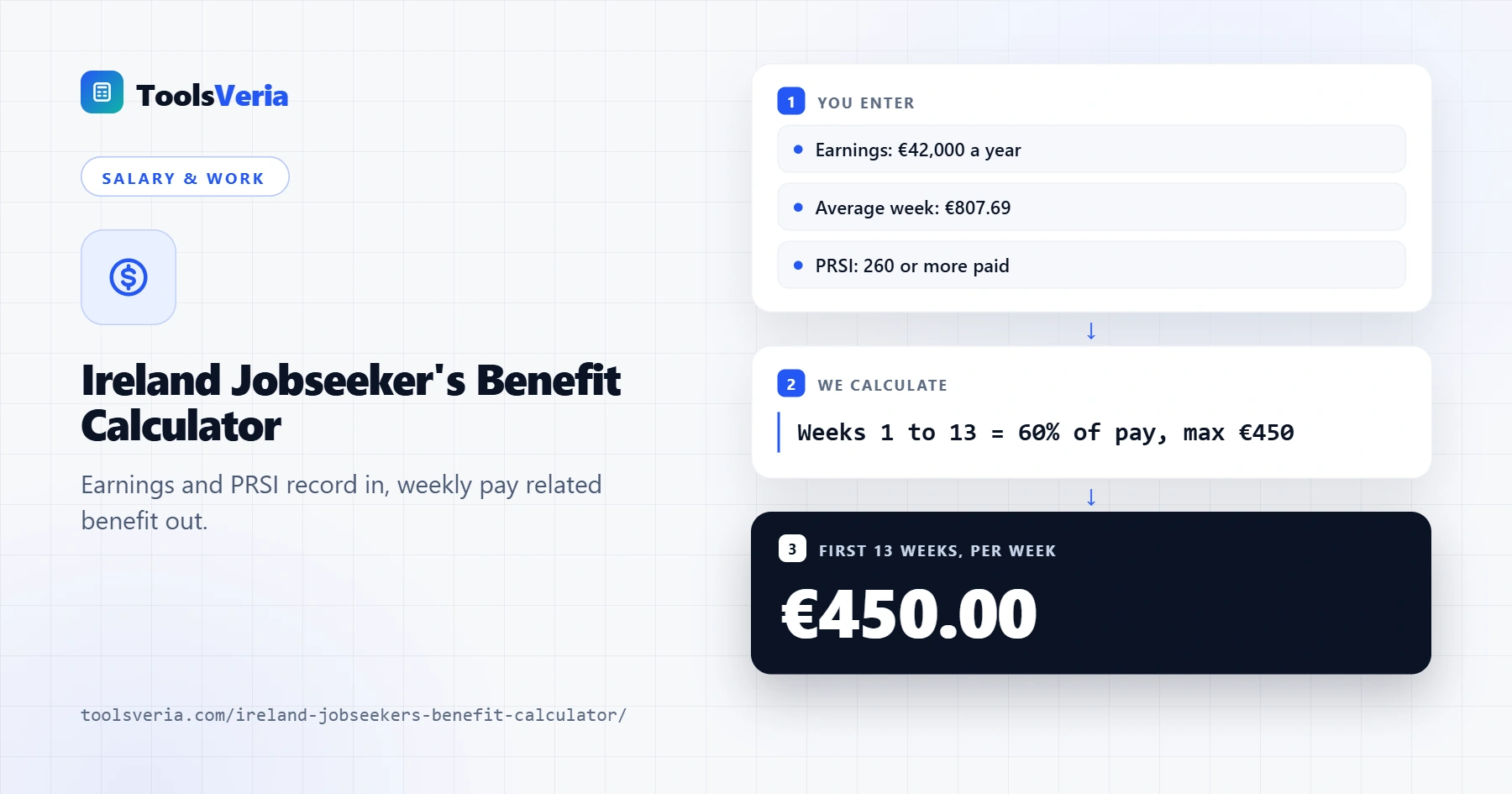
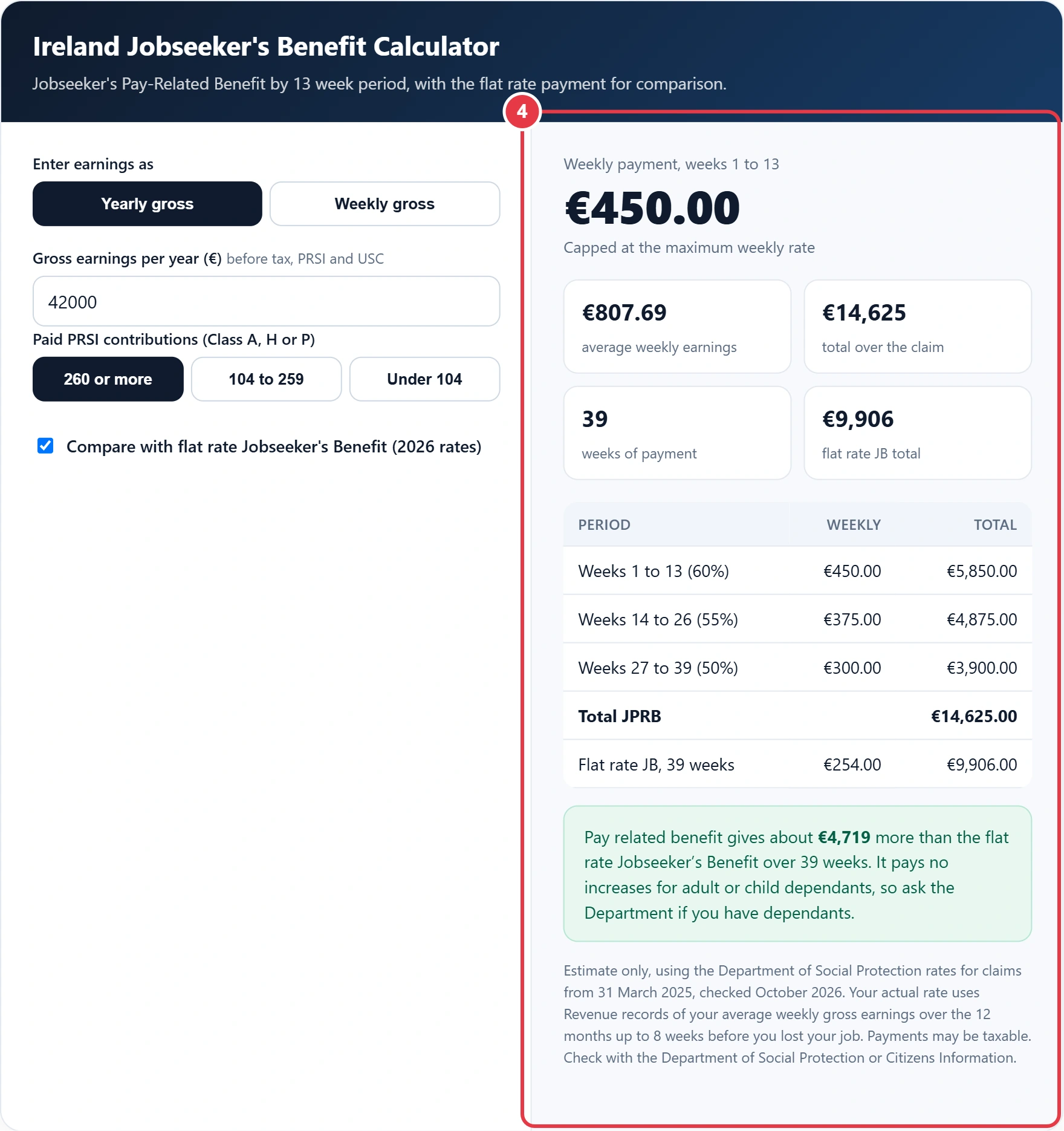
Quick answer: With 260 or more PRSI contributions, JPRB pays 60% of your average weekly earnings up to €450 for 13 weeks, then 55% up to €375, then 50% up to €300. A pay related jobseekers benefit calculator shows €42,000 a year gives €450, €375 and €300, or €14,625 in total.
In This Guide
What Is Jobseeker's Pay-Related Benefit?
Jobseeker's Pay-Related Benefit is an Irish social insurance payment for people who become fully unemployed on or after 31 March 2025, paid as a percentage of what they earned rather than a flat amount. It is run by the Department of Social Protection and paid weekly, on a Wednesday.
The formula in plain words: take your average gross weekly earnings over the 12 months up to 8 weeks before you lost your job, multiply by the rate for the period, and cap it. With 260 or more paid contributions, that is 60% capped at €450 for weeks 1 to 13, 55% capped at €375 for weeks 14 to 26 and 50% capped at €300 for weeks 27 to 39. With 104 to 259 contributions it is 50% capped at €300 for 26 weeks. No payment falls below €125 a week.
How to Use the Pay Related Jobseekers Benefit Calculator
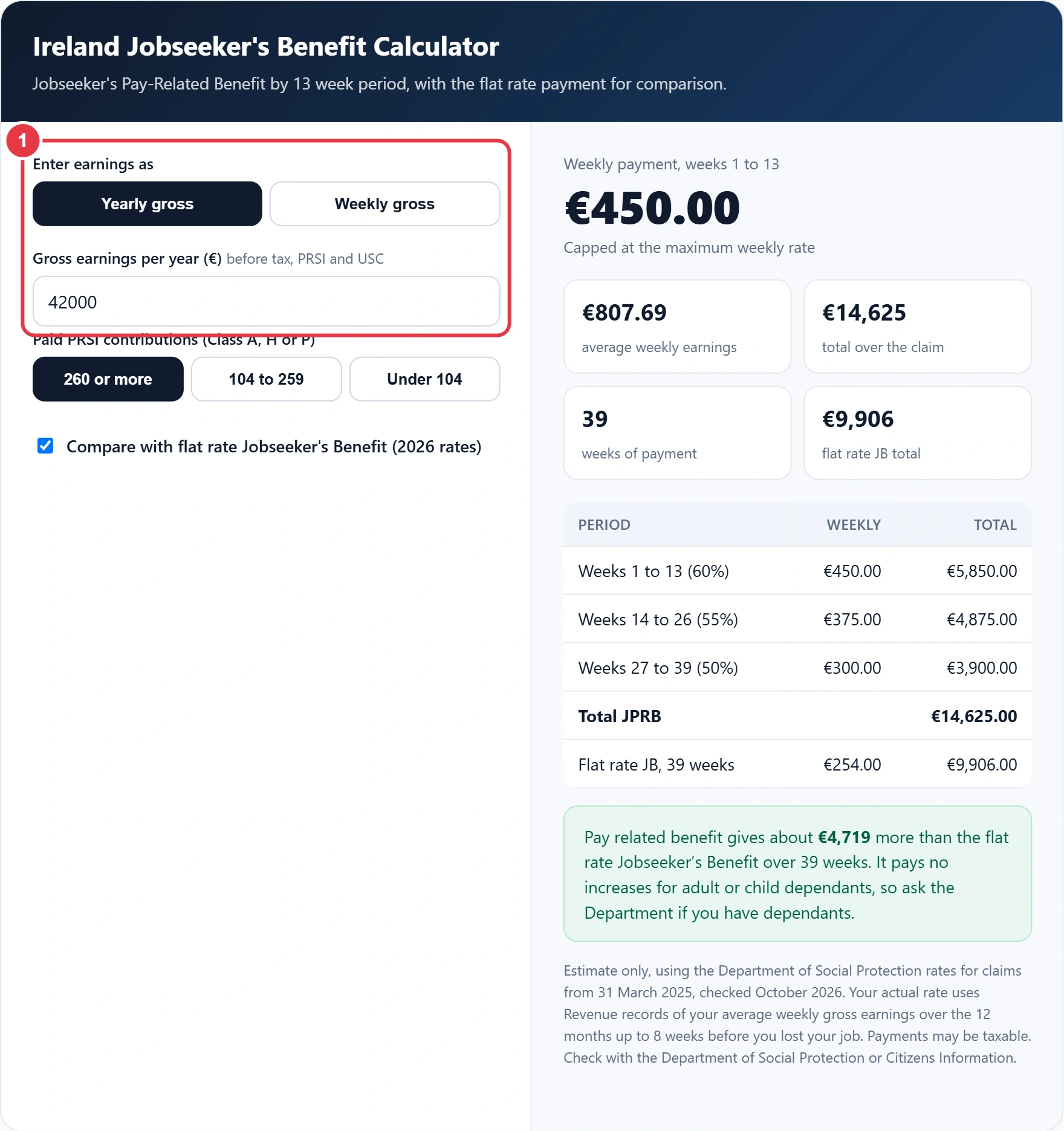
Step 1: Enter Your Earnings
Choose yearly or weekly and enter gross pay before tax, PRSI and USC. The Department uses Revenue's record of your actual pay, so a recent pay rise, overtime or a gap in work will change the real figure. If you are paid by the hour, the hourly to annual salary calculator turns your rate and hours into a yearly figure you can enter here.
Step 2: Choose Your PRSI Record
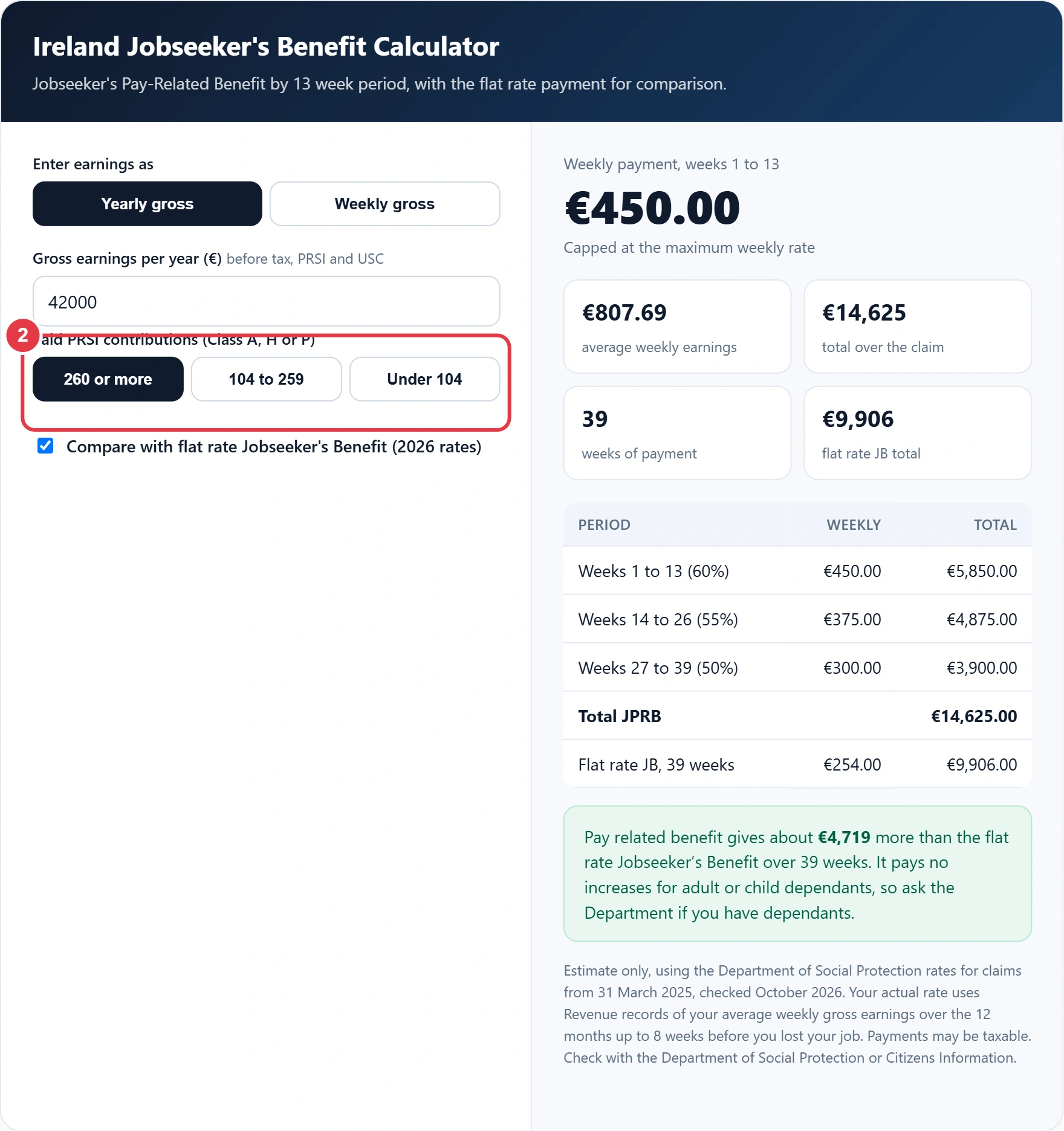
Pick how many paid Class A, H or P contributions you have. 260 is about five years of full time work. If you are unsure, the Department can confirm the exact count from your PRSI record.
Step 3: Compare With Flat Rate Jobseeker's Benefit
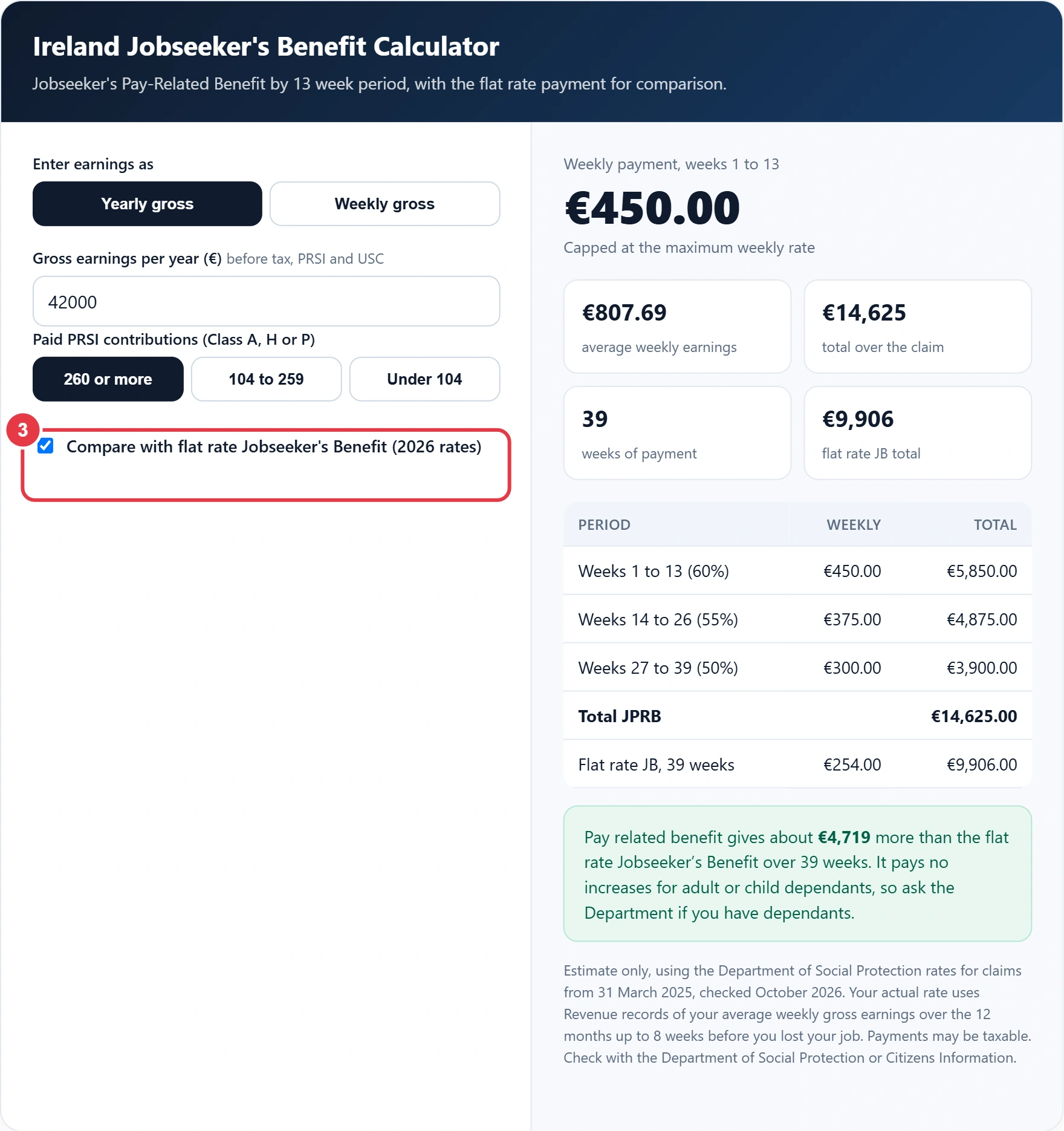
Leave the comparison ticked to see the 2026 flat rate Jobseeker's Benefit: €254 a week if you earned €300 or more, with lower rates below that, for 9 months with 260 contributions or 6 months with fewer.
Step 4: Read Your Payments
The headline is your weekly payment for the first period. The table shows each 13 week period and its total, and the box shows how much more or less pay related benefit gives than the flat rate payment over the same weeks.
How Much Is Jobseeker's Pay-Related Benefit in 2026?
JPRB pays between €125 and €450 a week in 2026, depending on your earnings and the stage of your claim. The caps bite at €750 a week of earnings for the first period, about €682 for the second and €600 for the third, so anyone earning above €750 a week gets the maximum in every period.
| Average weekly earnings | Weeks 1 to 13 | Weeks 14 to 26 | Weeks 27 to 39 | Total (260+ contributions) |
|---|---|---|---|---|
| €200 | €125 (minimum) | €125 | €125 | €4,875 |
| €400 | €240 | €220 | €200 | €8,580 |
| €600 | €360 | €330 | €300 | €12,870 |
| €750 | €450 | €375 (cap) | €300 (cap) | €14,625 |
| €1,000 | €450 (cap) | €375 (cap) | €300 (cap) | €14,625 |
Worked example: Ciarán, a logistics coordinator in Galway, earned €42,000 a year, an average of €807.69 a week, and has 11 years of PRSI. 60% of his earnings is €484.62, so he gets the €450 cap for 13 weeks, then €375 and €300, a total of €14,625 over 39 weeks. Flat rate Jobseeker's Benefit would pay €254 for 39 weeks, €9,906, so pay related benefit gives him €4,719 more.
Aoife, a retail supervisor in Cork with three and a half years of contributions, earned €30,000, or €576.92 a week. With 104 to 259 contributions she gets 50%, €288.46 a week, for 26 weeks, a total of €7,499.96, against €6,604 on the flat rate.
Who Qualifies for Jobseeker's Pay-Related Benefit?
You qualify if you are under 66, became fully unemployed on or after 31 March 2025 and meet all three PRSI tests: at least 104 paid contributions at Class A, H or P; at least 4 at Class A or H in the 10 weeks before you apply; and at least 26 at Class A or H in the 52 weeks before your first day of unemployment. Because even the top rate is well below most salaries, an emergency fund sized to your essential costs helps cover the gap. Citizens Information confirms you cannot work while getting JPRB, a break of up to 13 weeks lets you restart the same claim, and the payment may be taxable.
Is Pay Related Benefit Better Than Jobseeker's Benefit?
For most people who earned more than about €425 a week, yes: 60% of €425 is €255, just above the €254 flat rate. JPRB pays no increases for a qualified adult or children, while flat rate Jobseeker's Benefit can, so a claimant with a dependent partner and children should ask the Department of Social Protection which payment leaves them better off. The Department of Social Protection decides the final rate from your records, so use this pay related jobseekers benefit calculator as an estimate before you apply on MyWelfare.
</>Embed this calculator on your website
Add the free Ireland Jobseekers Benefit Calculator to your own site or blog. Copy the code below and paste it into an HTML block. It resizes itself and works on phones.
How we checked this tool: the Tools Veria Editorial Team built this tool by hand, checked it against the official rules or published standards where they apply, and tested it against worked examples. Results are estimates for planning, not personal financial or tax advice. Read our editorial policy and disclaimer, or report an error.
Frequently Asked Questions
How much is pay related jobseekers benefit per week?
Jobseeker's Pay-Related Benefit pays 60% of your average weekly earnings, up to €450, for the first 13 weeks if you have 260 or more PRSI contributions. It then drops to 55%, up to €375, and 50%, up to €300. The minimum is €125.
How long can I get Jobseeker's Pay-Related Benefit?
You can get it for up to 39 weeks, about 9 months, with 260 or more paid PRSI contributions. With 104 to 259 contributions you can get it for up to 26 weeks, about 6 months, at 50% of earnings capped at €300.
How are earnings worked out for Jobseeker's Pay-Related Benefit?
The Department of Social Protection uses Revenue records to find your average weekly gross earnings over the 12 months up to 8 weeks before you lost your job. Earnings of €42,000 a year work out at about €807.69 a week.
What is the minimum Jobseeker's Pay-Related Benefit?
The minimum payment is €125 a week, whatever your earnings, provided you meet the PRSI conditions. Someone who earned €200 a week would get €125 rather than 60% of €200, which is €120.
Do you get extra for children on Jobseeker's Pay-Related Benefit?
No. JPRB pays no increases for a qualified adult or child dependants. Flat rate Jobseeker's Benefit can include those increases, so people with dependants should check which payment gives them more before applying.
Is Jobseeker's Pay-Related Benefit taxable?
Yes, you may have to pay income tax on all of your Jobseeker's Pay-Related Benefit, according to gov.ie. Check your tax credits with Revenue after you start claiming so that any tax due is collected correctly.