Sophie and three university friends booked a cottage in Cornwall months ago, and the group chat has finally reached the awkward bit: who pays for petrol, and how much? Her sat nav shows 290 miles each way. Pinning down the fuel cost road trip UK drivers face for a journey like this takes three numbers and one conversion that most people forget.
Below, Sophie’s 580 mile round trip is costed in her own petrol car, in a friend’s diesel estate and with a full roof box. Then the bill is shared out, including the tricky case of a passenger who only rides one way.
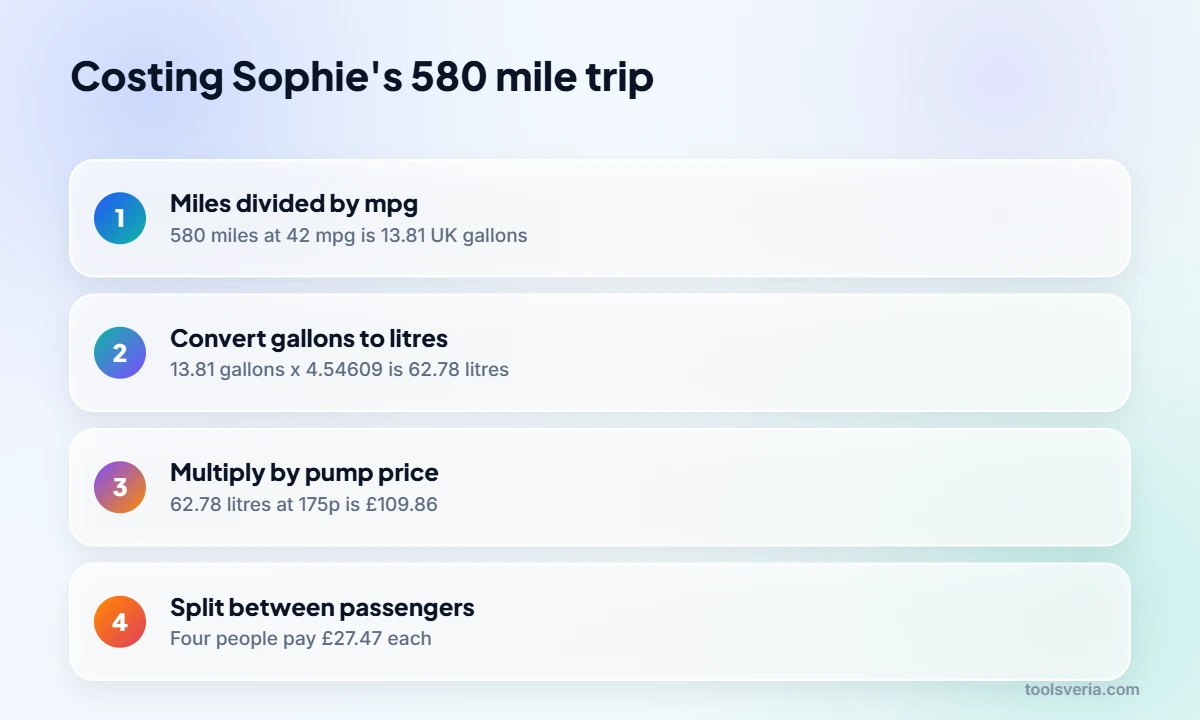
Quick answer: To work out the fuel cost road trip UK drivers face, divide the miles by the car’s mpg, multiply by 4.54609 litres per UK gallon, then multiply by the pump price. A 580 mile round trip at 42 mpg and an example 175p a litre uses 62.78 litres of petrol and costs £109.86, about 18.9p a mile.
In This Guide
How to Calculate the Fuel Cost Road Trip UK Drivers Face
The fuel cost of a road trip equals the distance in miles, divided by the car’s miles per gallon, multiplied by 4.54609 to turn UK gallons into litres, multiplied by the price per litre. The conversion step trips people up because British cars quote economy in gallons while forecourts sell by the litre.
Sophie’s hatchback averages 42 mpg on her trip computer. Here is her outward and return journey worked through in order.
- 580 miles divided by 42 mpg gives 13.81 gallons.
- 13.81 gallons multiplied by 4.54609 gives 62.78 litres.
- 62.78 litres at 175p a litre gives £109.86.
- £109.86 divided by 580 miles works out at about 18.9p a mile.
The 175p figure is only an example, because pump prices move every week. Before setting off, Sophie compares her local forecourt with the weekly road fuel prices published on GOV.UK and uses whichever is closer to where she will actually fill up, often a supermarket rather than a motorway services.
Is a petrol or diesel car cheaper for a long trip?
A diesel car is often cheaper over a long motorway trip despite a higher price per litre, because diesel engines usually cover more miles on each gallon. Whether it wins for you depends entirely on the two cars being compared, so run both through the same sum.
Sophie’s friend Kieran offers his diesel estate, which returns 55 mpg on long runs. Using an example price of 200p a litre, the same 580 miles burns 47.94 litres and costs £95.88, or roughly 16.5p a mile. That is £13.98 cheaper than Sophie’s hatchback even though each litre costs 25p more.
| Car and load | Economy | Example price per litre | Litres for 580 miles | Trip cost | Cost per mile |
|---|---|---|---|---|---|
| Sophie’s petrol hatchback | 42 mpg | 175p | 62.78 | £109.86 | 18.9p |
| Kieran’s diesel estate | 55 mpg | 200p | 47.94 | £95.88 | 16.5p |
| Petrol hatchback with roof box | 36 mpg | 175p | 73.24 | £128.17 | 22.1p |
| Petrol hatchback driven gently | 48 mpg | 175p | 54.93 | £96.13 | 16.6p |
Hire cars and some newer models show economy in litres per 100 km instead of mpg. If the dashboard reads 6.5 L/100km, our litres per 100 km to mpg converter turns that into UK mpg, ready for the same calculation.

How much do luggage and driving style change the cost?
Extra weight, a roof box and higher motorway speeds can all cut your real mpg, and a drop of just a few mpg adds pounds to every long trip. Sophie’s numbers show the spread clearly. If a roof box and four people’s luggage pulled her hatchback down to 36 mpg, the trip would cost £128.17, which is £18.31 more than her normal figure.
The opposite is also true. Smooth acceleration, steady speeds and correct tyre pressures are among the habits in the Energy Saving Trust advice on efficient driving, and if those lifted her to 48 mpg the bill would fall to £96.13. Between the worst and best cases in the table, the same car on the same road varies by £32.04.
Your trip computer is a better guide than the brochure figure, but it is worth checking it once. Fill to the brim, reset the trip meter, then brim again after a week and enter the litres and miles into our mpg calculator, which gives the genuine figure to use when you plan your next long drive.
How should you split fuel costs between passengers?
The simplest fair split divides the total fuel cost equally between everyone in the car, driver included. For Sophie’s trip at £109.86, four people pay £27.47 each, a figure everyone can check against their own receipt.
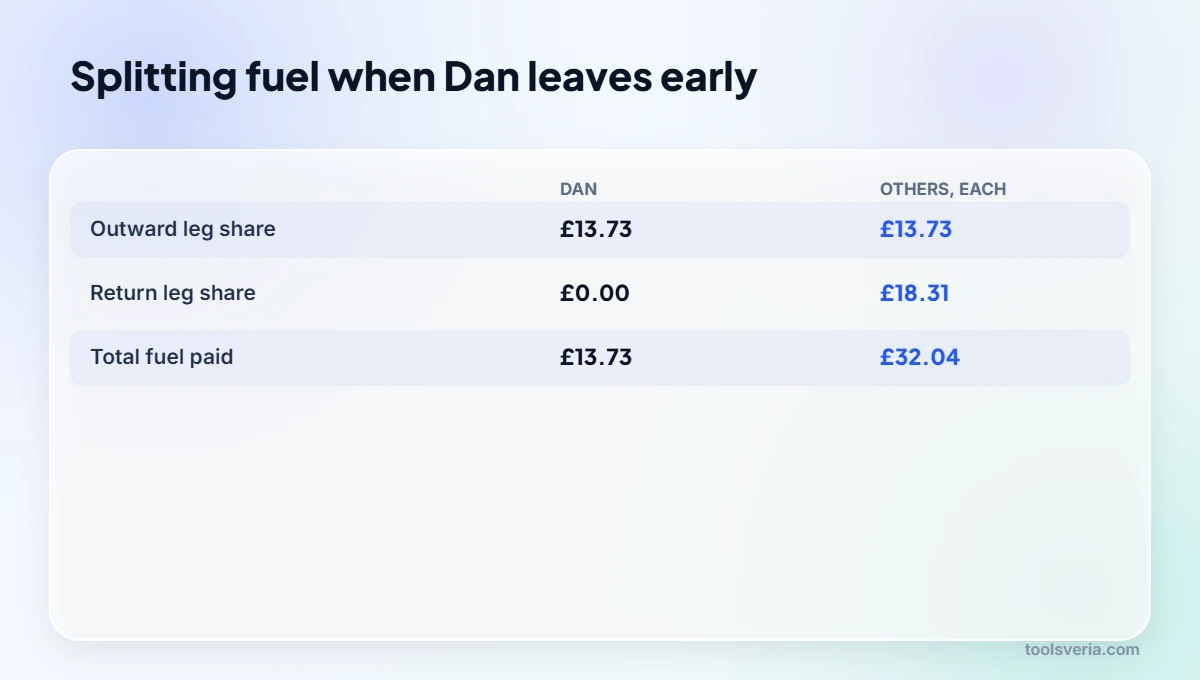
It gets more interesting when people travel different distances. Kieran’s friend Dan joins the outward journey but gets the train home on Sunday. Each leg costs £54.93 in Sophie’s car, so the outward leg divides by four at £13.73 a head and the return leg divides by three at £18.31 a head. Dan pays £13.73, while Sophie and the other two pay £32.04 each, and the total still comes to £109.86.
Some groups also give the driver a break, since they supply the car, the insurance and the concentration. A common compromise is for passengers to cover fuel between them while the driver pays parking or tolls. Whatever you agree, settle it before the trip rather than at the last service station.
What if the road trip is partly for work?
Business journeys in your own car can be reimbursed at HMRC approved mileage rates, which from 2026/27 are 55p a mile for cars and vans for the first 10,000 business miles and 25p a mile after that. Those rates cover running costs as well as fuel, so they sit well above the 18.9p a mile Sophie’s petrol actually costs.
Suppose Kieran drives the same 580 miles to a client site in Truro. At 55p a mile his employer can pay £319 tax free, and our mileage allowance calculator works out any shortfall he could claim in tax relief if they pay less. A colleague riding with him on the same business trip can add the 5p passenger rate.
Key points
- Trip fuel cost equals miles divided by mpg, multiplied by 4.54609, multiplied by the price per litre.
- A 580 mile trip at 42 mpg and 175p a litre costs £109.86, about 18.9p a mile.
- A 55 mpg diesel at 200p a litre covers the same trip for £95.88.
- Dropping from 42 to 36 mpg with a loaded roof box adds £18.31 to the same journey.
- HMRC business mileage for cars is 55p a mile for the first 10,000 miles in 2026/27.
Fuel Cost Road Trip UK Terms Explained
These terms help you understand the fuel cost road trip UK drivers face, from the gallon conversion to the habits and loads that change your mpg.
- Round trip distance
- The combined mileage of the outward and return legs of a journey. Using it rather than the one way figure is essential for an accurate fuel budget, and it also forms the basis for sharing costs among regular passengers.
- Aerodynamic drag
- The resistance air exerts on a moving vehicle, which rises steeply with speed. Roof boxes, bike racks and open windows increase it, forcing the engine to burn more fuel to hold the same motorway pace.
- Diesel engine efficiency
- Diesel engines compress air to a much higher ratio than petrol engines and burn a denser fuel, extracting more energy from each litre. This usually gives better economy on long steady runs, offsetting a higher price per litre.
- Litres per 100 km
- A fuel consumption measure used across Europe and in many hire cars, stating how many litres a vehicle uses to cover 100 kilometres. Lower is better, the reverse of mpg, so the two must be converted before comparison.
- Cost sharing
- Dividing the expense of a car journey among passengers, typically in proportion to the distance each travels. Sharing fuel costs without making a profit is generally treated differently from a commercial passenger service.
- Eco-driving
- A set of driving habits, such as smooth acceleration, early gear changes, steady speeds and anticipating traffic, that reduce fuel use. Applied on a long trip, small gains in economy turn into noticeable savings.
Frequently Asked Questions
My car’s mpg on the brochure is 55 but I only see 44. Which should I use?
Use the 44 you actually see, because real roads, loads and weather rarely match test conditions. On a 580 mile trip at 175p a litre, 44 mpg costs £104.87 while 55 mpg would suggest £83.90, an error of about £21.
Why does my answer come out wrong when I use 3.785 litres per gallon?
That is the smaller US gallon. UK mpg figures use the imperial gallon of 4.54609 litres, so using 3.785 understates the litres you need by about 17% and makes every UK trip look cheaper than it really is.
Should the driver pay a share of the fuel?
Splitting equally including the driver is the most common approach, so four people share £109.86 at £27.47 each. Some groups let the driver off fuel in return for using their car, which raises each passenger’s share to £36.62.
Does the fuel figure include tolls, parking or the Dartford Crossing?
No, a fuel cost calculation covers fuel only. Add road tolls, crossing charges, clean air zone fees and parking separately, then split those on whatever basis your group agrees before you leave.
Sophie’s group settled on her car, a single fill on the way down and an equal £27.47 each, with Dan paying his one way share. Put your own mileage, mpg and receipt price into the calculator and the group chat argument is over in a minute. Figures checked October 2026.