Switch between litres per 100 km and miles per gallon in both directions.
Formulas: UK mpg = 282.481 ÷ L/100km. US mpg = 235.215 ÷ L/100km. The same division works in reverse.
| L/100km | UK mpg | US mpg |
|---|---|---|
| 4 | 70.6 | 58.8 |
| 5 | 56.5 | 47.0 |
| 6 | 47.1 | 39.2 |
| 7 | 40.4 | 33.6 |
| 8 | 35.3 | 29.4 |
| 10 | 28.2 | 23.5 |
| 12 | 23.5 | 19.6 |
European car reviews and spec sheets quote fuel use in litres per 100 km, while UK drivers think in miles per gallon. This l/100km to mpg converter turns one into the other instantly, showing UK and US mpg side by side. The maths is a simple reciprocal, explained in the fuel economy overview on Wikipedia, and you can switch direction to convert mpg back into L/100km.
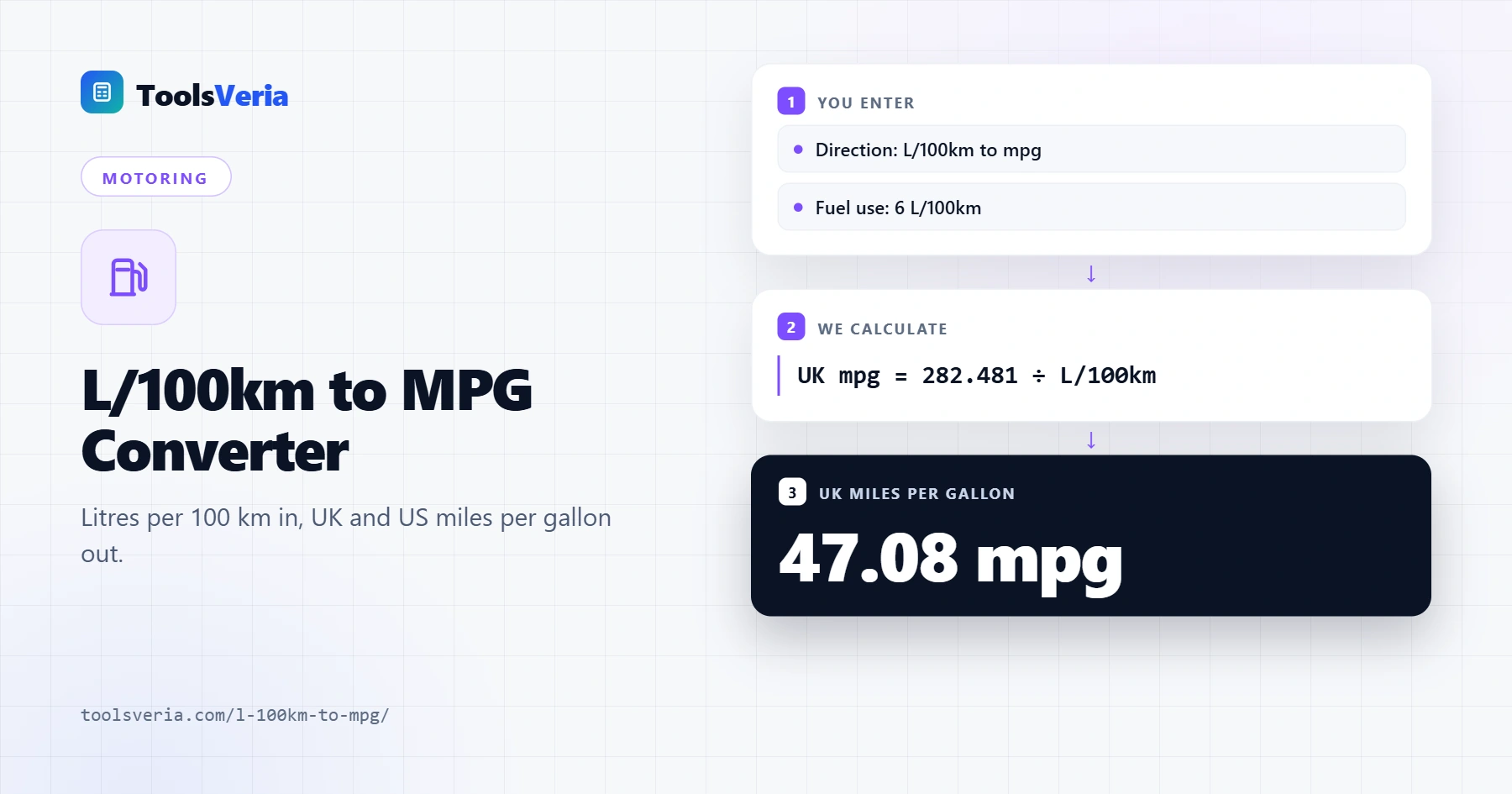
What Is the Difference Between L/100km and MPG?
L/100km measures fuel consumption: how many litres a car burns to travel 100 km, so a lower number is better. MPG measures fuel economy: how many miles the car travels on one gallon, so a higher number is better. Because one is the inverse of the other, halving L/100km doubles mpg.
The formulas are UK mpg = 282.481 ÷ L/100km and US mpg = 235.215 ÷ L/100km. The constants come from 100 km in miles multiplied by the litres in a gallon: 4.54609 for a UK gallon and 3.785 for a US gallon. So 6 L/100km is 282.481 ÷ 6 = 47.08 UK mpg, or 39.20 US mpg. To go the other way, divide the same constant by the mpg.
How to Use the L/100km to MPG Converter
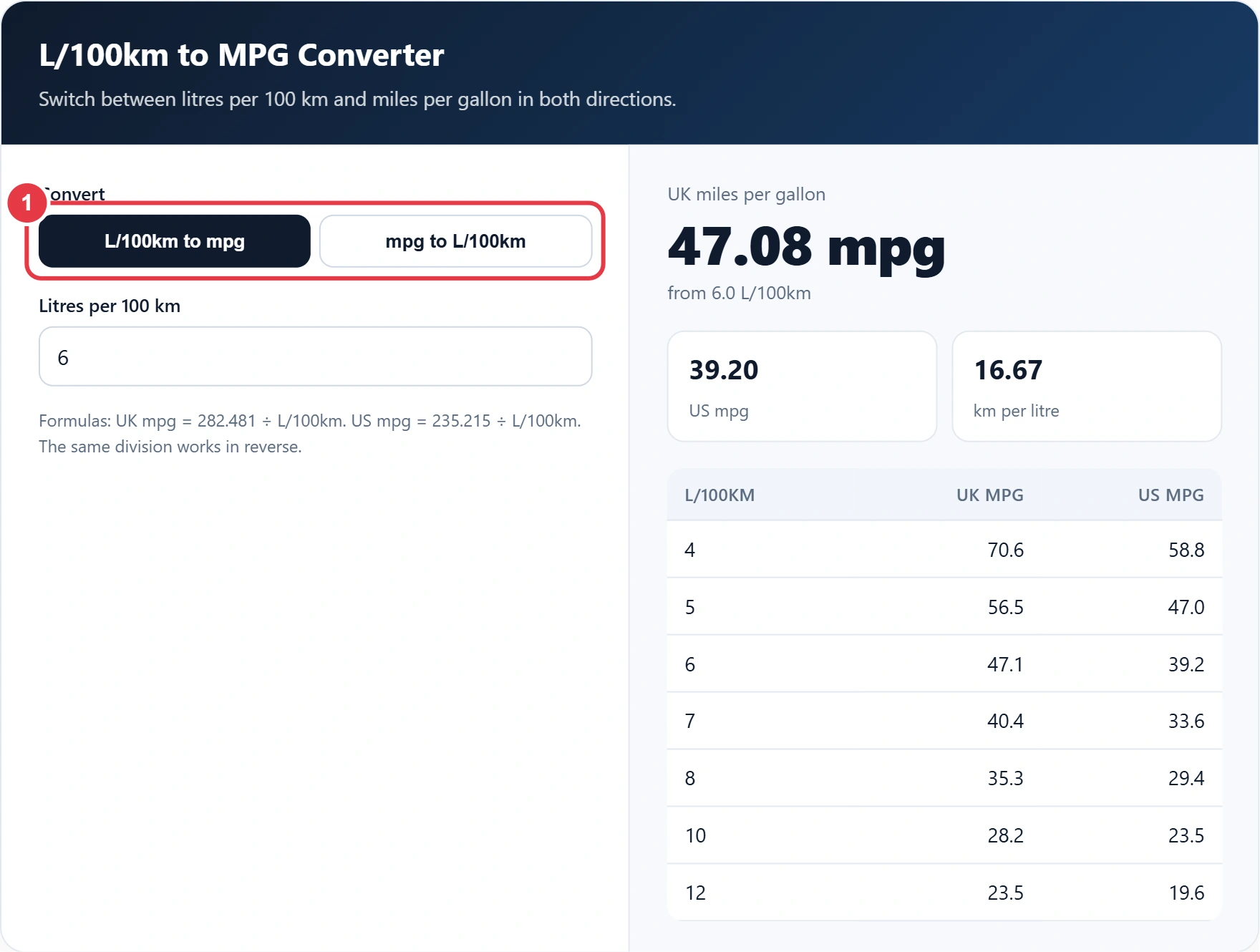
Step 1: Choose the Direction
Select L/100km to mpg to convert a European figure, or mpg to L/100km if you start with miles per gallon. In mpg mode, pick UK or US gallons to match your source.
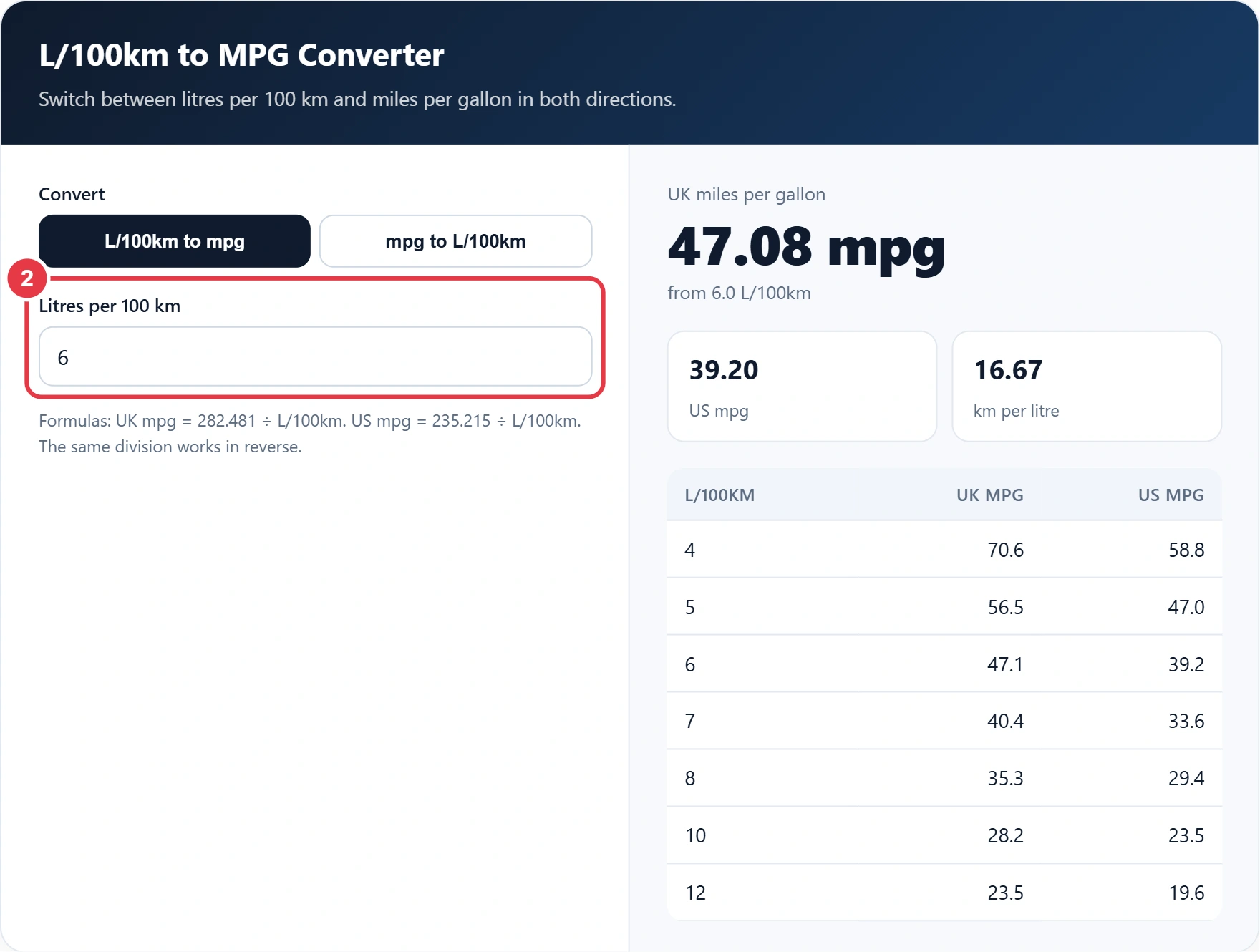
Step 2: Enter Your Figure
Type the consumption from the brochure, review or trip computer. Decimals are fine, so 5.4 L/100km or 52.3 mpg both work.
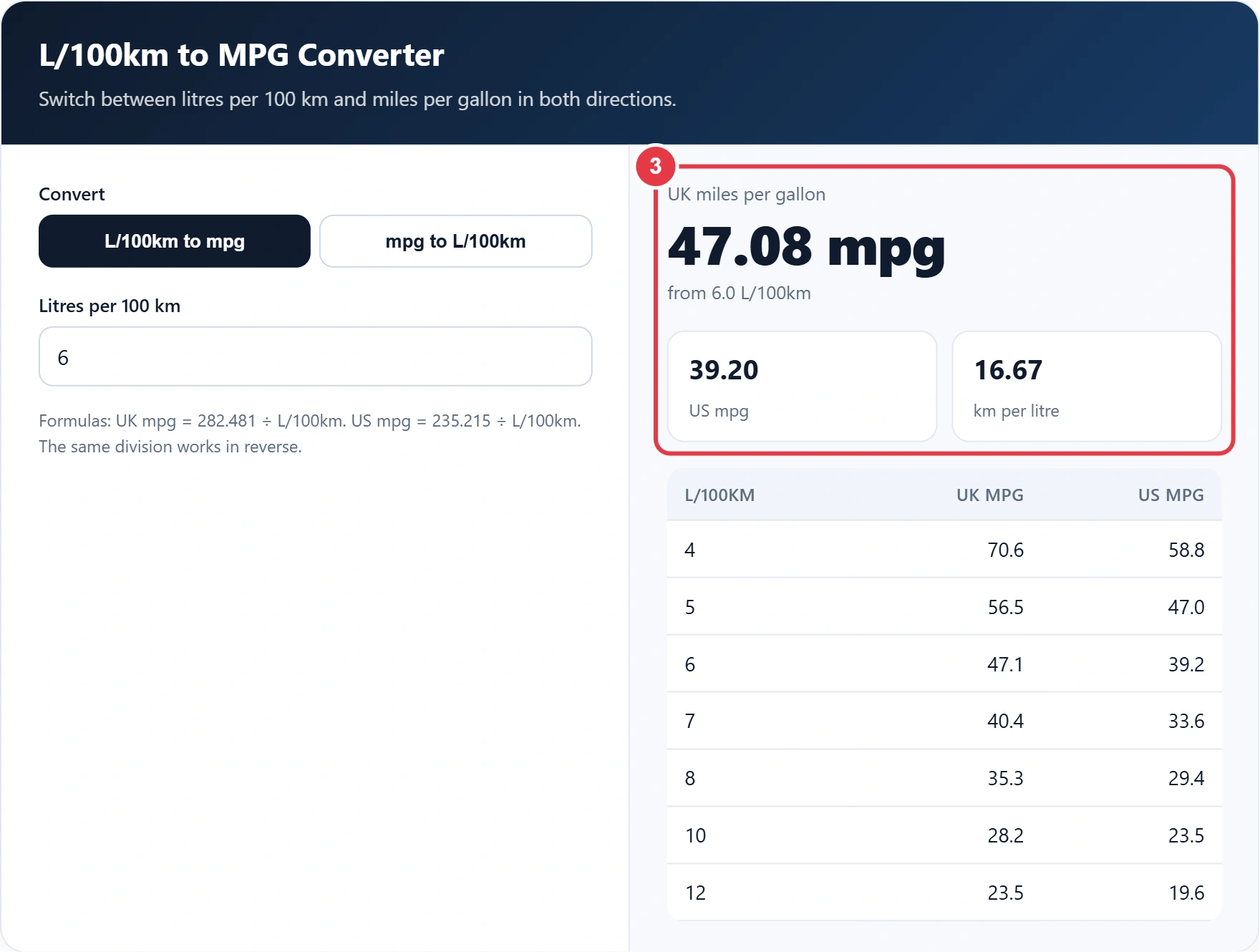
Step 3: Read the Result
The main figure updates as you type, and once you know the mpg you can check your real world figure from a fill up with the MPG calculator. Below it you get the other gallon type and km per litre, which is common in Asia and Latin America.
Step 4: Check the Conversion Table
The table lists common values so you can compare cars at a glance without typing each one in. If you drive for work, the mileage allowance calculator shows what HMRC lets you claim per mile, whatever your car's economy.
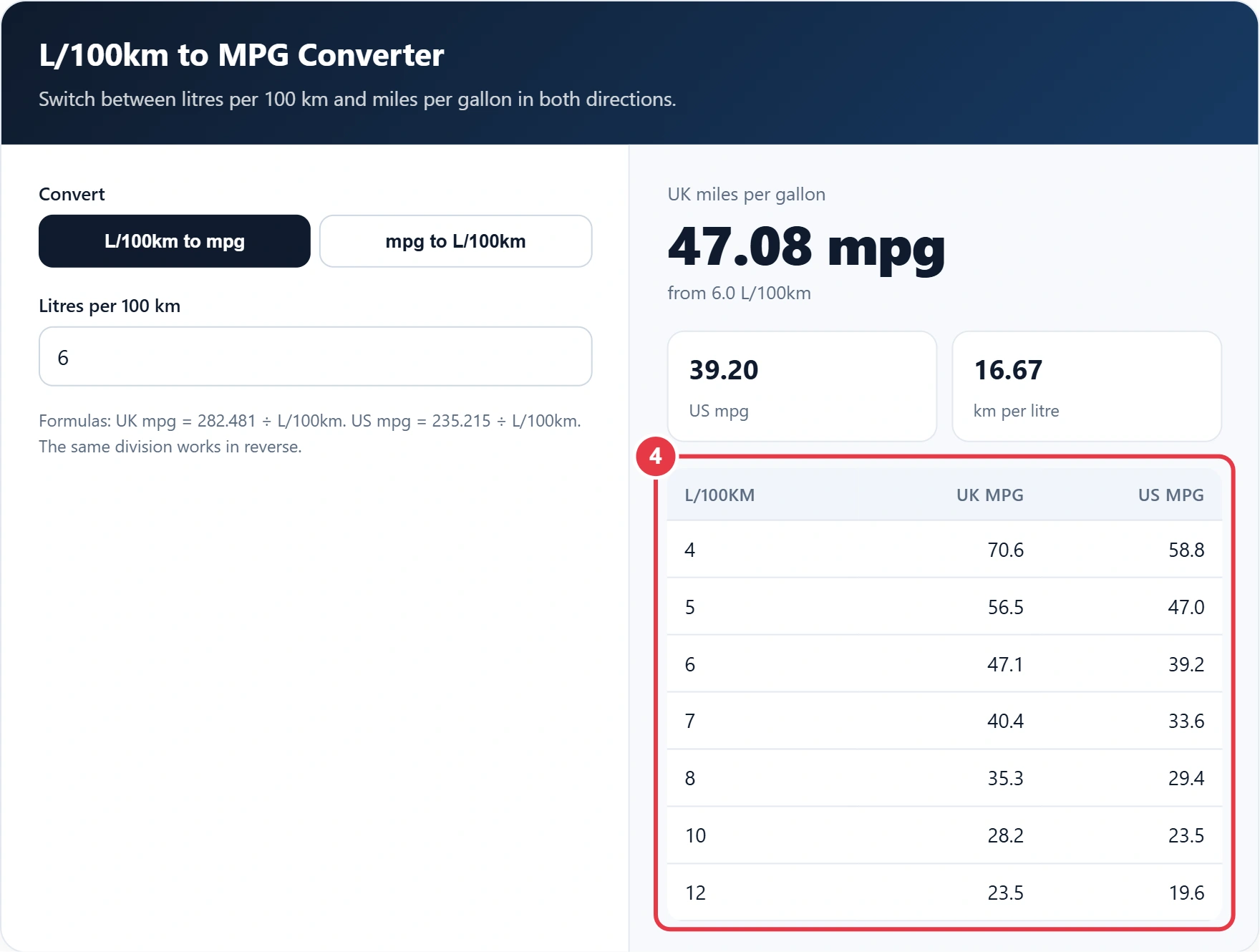
L/100km to MPG Conversion Table
| L/100km | UK mpg | US mpg |
|---|---|---|
| 3 | 94.2 | 78.4 |
| 4 | 70.6 | 58.8 |
| 5 | 56.5 | 47.0 |
| 6 | 47.1 | 39.2 |
| 7 | 40.4 | 33.6 |
| 8 | 35.3 | 29.4 |
| 10 | 28.2 | 23.5 |
| 12 | 23.5 | 19.6 |
Remember that gaps between cars look bigger at the thirsty end of the scale in L/100km and at the efficient end in mpg. When comparing running costs, the Energy Saving Trust guide to efficient driving shows how much your driving style can shift either number.
Frequently Asked Questions
How do I convert L/100km to mpg?
Divide 282.481 by the L/100km figure for UK mpg, or 235.215 for US mpg. For example, 5 L/100km is 56.5 UK mpg.
How do I convert mpg to L/100km?
Divide 282.481 by UK mpg, or 235.215 by US mpg. So 50 UK mpg is 5.65 L/100km.
Is a lower L/100km better?
Yes. L/100km is fuel used per distance, so a lower number means the car burns less fuel.
Why are UK and US mpg different?
A UK gallon is 4.546 litres and a US gallon is 3.785 litres. The bigger UK gallon makes UK mpg about 20% higher for the same car.
What is 7 L/100km in mpg?
7 L/100km is about 40.4 UK mpg or 33.6 US mpg.
What is a good L/100km figure?
Under 5 L/100km (over 56 UK mpg) is very economical. Most family petrol cars use 5 to 7 L/100km in real driving.