Mark’s hatchback promises 55 mpg in the brochure, but his weekly £70 fuel spend suggests otherwise. Learning how to calculate mpg for himself takes one fill up, one receipt and a trip meter reading, and it tells him what the car really does on his commute rather than in a test lab. The only awkward part for British drivers is that forecourts charge by the litre while economy is still quoted in miles per imperial gallon.
Quick answer: Here is how to calculate mpg in the UK: divide the litres on your fuel receipt by 4.54609 to get UK gallons, then divide the miles driven by that gallon figure. For example, 400 miles on 45 litres is 9.8986 gallons, which gives 40.41 mpg. A brim to brim fill gives the most accurate result.
Below you will find the litres to gallons step, a measuring routine that beats the dashboard, two real trips worked through, a pence per mile figure for budgeting and a quick way to read European L/100km ratings.
In This Guide
How to calculate MPG: the formula in plain English
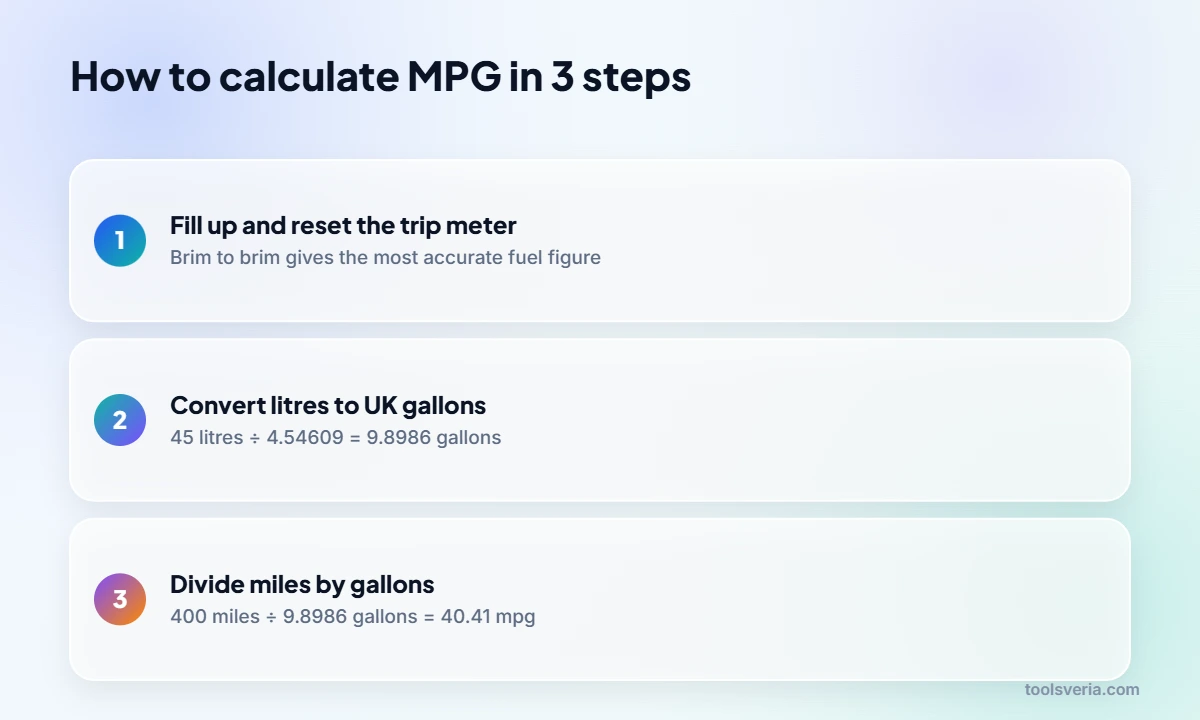
Your receipt shows litres, so the sum has two moves rather than one:
- Turn the litres on the receipt into UK gallons by dividing by 4.54609.
- Take the miles on the trip meter and divide them by that gallon figure.
That 4.54609 is not a rounding. A British gallon holds exactly that many litres, whereas the American one holds just 3.785411784, as the Wikipedia entry on the gallon sets out. So when a US car site says a model does 33 mpg, the same car would read around 40 in British units. Before trusting a figure from a forum or overseas review, find out which gallon the writer had in mind.
How Do You Measure Fuel Use Accurately?
Treat the fuel pump as a measuring jug using the brim to brim method, which is more reliable than a trip computer because trip computers tend to flatter the car by a few mpg. Mark’s dashboard shows a running average, yet trip computers tend to flatter the car by a few mpg. A far better test treats the fuel pump as a measuring jug. Drivers call it the brim to brim method, and it is the most reliable way to learn how to calculate mpg:
- Fill up and stop the moment the nozzle clicks; resist squeezing in a little extra.
- Zero the trip meter before you pull away.
- Use the car as you normally would until at least half the tank has gone, and preferably more.
- Return to the same pump if possible, fill to the first click again, then write down the litres on the receipt and the miles on the trip meter.
Whatever goes in at that second visit equals what the engine burned over those miles. Sticking to one pump matters because cut off points vary slightly between nozzles, and a longer stretch of driving dilutes any small error. Mark repeats the test for three tanks and averages the results, which gives him a number he can rely on.
Worked examples: from litres to miles per gallon
Trip one, mostly A roads. Mark covers 400 miles and the refill takes 45 litres. Dividing 45 by 4.54609 gives 9.8986 gallons, and 400 split across 9.8986 gallons comes out at 40.41 mpg.
Trip two, a week in town. School runs and queues add up to 412 miles, and the pump swallows 52.3 litres. That equals 11.5044 gallons, so the car returned 412 divided by 11.5044, or 35.81 mpg. Losing four or five mpg to traffic lights and cold starts is completely normal.
Both trips translate into the other units like this:
| Trip | UK mpg | US mpg | L/100km | Cost per mile at 150p a litre |
|---|---|---|---|---|
| 400 miles on 45 litres | 40.41 | 33.65 | 6.99 | 16.88p |
| 412 miles on 52.3 litres | 35.81 | 29.82 | 7.89 | 19.04p |
We picked 150p a litre purely to make the sums tidy, since forecourt prices move week to week. Put the price from your own receipt in its place and the pence per mile column shifts in proportion.
How Do You Work Out Fuel Cost per Mile?
Take the total on the receipt and divide it by the miles, so £67.50 spread over 400 miles gives 16.88p for every mile driven. Once you know how to calculate mpg, comparing two cars is easy, but a household budget needs pence. Take the total on the receipt and divide it by the miles. On trip one, 45 litres at 150p came to £67.50, and spreading £67.50 over 400 miles gives 16.88p for every mile Mark drove.
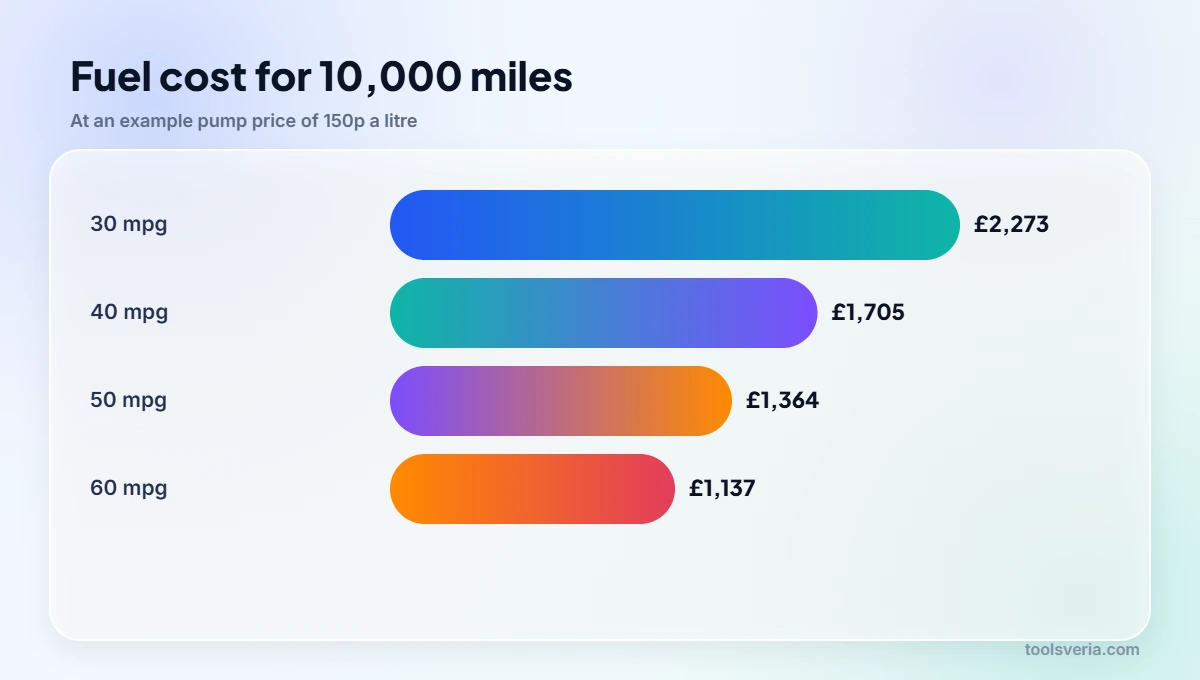
Have only an mpg rating to go on, say from a used car advert? Multiply 4.54609 by the pump price in pence, then divide by the mpg, and you have pence per mile. Here is what that does across 10,000 miles at the same 150p example price.
| Fuel economy | Cost per mile | Fuel for 10,000 miles | Cost for 10,000 miles |
|---|---|---|---|
| 30 mpg | 22.73p | 1,515.4 litres | £2,273.05 |
| 40 mpg | 17.05p | 1,136.5 litres | £1,704.78 |
| 50 mpg | 13.64p | 909.2 litres | £1,363.83 |
| 60 mpg | 11.37p | 757.7 litres | £1,136.52 |
Upgrading from a 30 mpg car to a 40 mpg one cuts more than £560 from a 10,000 mile fuel bill at that price, yet going from 50 to 60 mpg trims only about £227. The first ten mpg of improvement saved more than twice as much as the last ten, so a pricier, thriftier car may not earn back its premium. Feeding the monthly figure into our PCP calculator lets you set the finance cost of a newer model against the fuel you would actually save.
Using your own car for work trips? Fuel is only one slice of what each mile costs you, and HMRC’s approved rates are meant to cover the wider running costs. Run your business miles through the mileage allowance calculator to see how much your employer can repay without any tax due.
How Do You Convert L/100km to MPG?
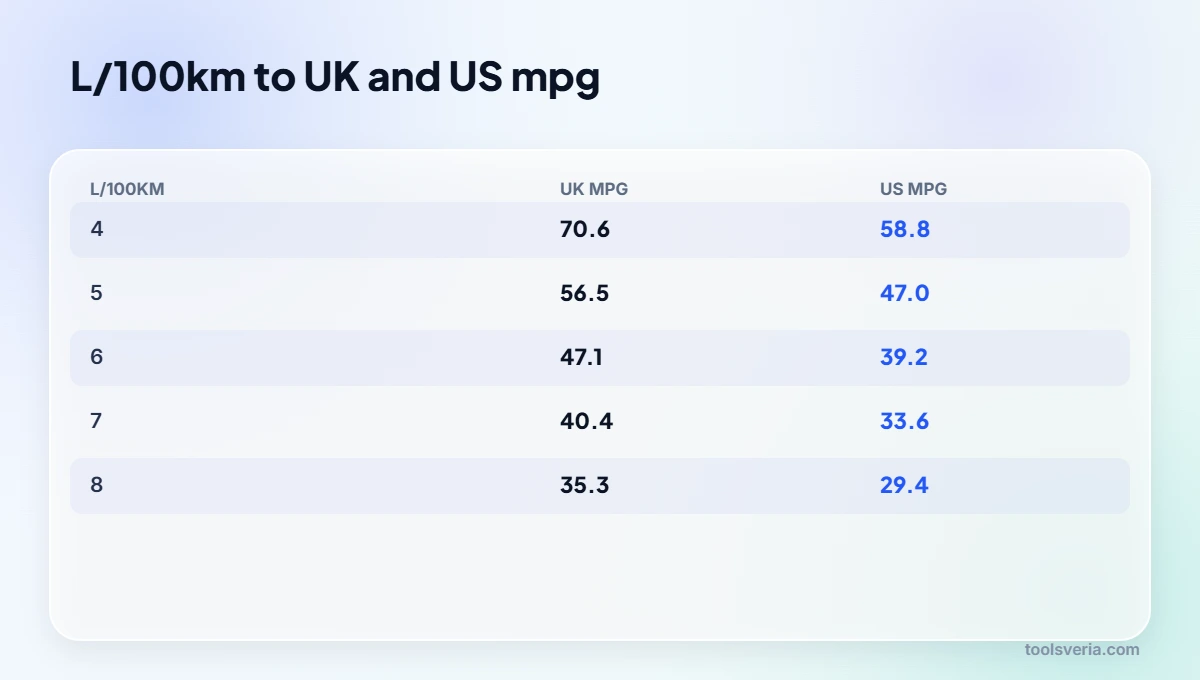
For British mpg, divide 282.481 by the L/100km value, and for American mpg use 235.215 instead, where a smaller L/100km number means a thriftier car. Continental brochures and some manufacturer sites list consumption as litres per 100 kilometres, where a smaller number means a thriftier car. For British mpg, divide 282.481 by the L/100km value; for American mpg, use 235.215 instead.
| L/100km | UK mpg | US mpg |
|---|---|---|
| 4 | 70.6 | 58.8 |
| 5 | 56.5 | 47.0 |
| 6 | 47.1 | 39.2 |
| 7 | 40.4 | 33.6 |
| 8 | 35.3 | 29.4 |
Spotted a car in a German listing rated at 5.4 L/100km? Rather than reach for a calculator app, paste it into the L/100km to mpg converter, which returns UK and US figures side by side so you can compare it fairly with a British advert.
Why your real MPG differs from the official figure
Mark’s 55 mpg brochure claim came from a controlled lab cycle that every new model runs through identically. That makes it a fair yardstick between cars, but not a forecast for his driveway. Out on real roads, cold mornings, congestion, hills, a roof box, the air conditioning, soft tyres and 75 mph motorway stints all chip away at it. Very short hops do the most damage, since a cold engine drinks noticeably more until it reaches temperature.
Driving style can claw a surprising amount back. The Energy Saving Trust’s efficient driving tips cover easing off the accelerator, anticipating junctions and checking tyre pressures, and each change can be tested against your next brim to brim result.
Key points
- MPG = miles driven ÷ (litres used ÷ 4.54609).
- Brim to brim over at least half a tank beats the trip computer.
- Pence per mile = receipt total ÷ miles, or 4.54609 × pence per litre ÷ mpg.
- UK mpg = 282.481 ÷ L/100km, roughly 1.2 times the US number.
Frequently Asked Questions
My receipt says 45 litres and I drove 400 miles. What mpg is that?
40.41 mpg. The 45 litres equal 9.8986 UK gallons, and 400 divided by 9.8986 lands on that figure.
My dashboard says 44 mpg but my own sums say 40. Which do I believe?
Trust the brim to brim result. Most dashboards err on the generous side, so a manual check over a full tank shows how far yours drifts.
An American review says my car does 33 mpg. Is it worse than the UK one?
No, it is the same car measured with a smaller gallon of 3.785 litres instead of 4.546. Our trip one read 33.65 in US units and 40.41 in UK units, roughly a 20% gap.
My petrol car dropped from 40 to 35 mpg this winter. Should I worry?
Probably not on its own, as our town trip showed a similar drop to 35.81 mpg. Check tyre pressures, clear out heavy items and note how many short trips you did before assuming a fault.
Once the 4.54609 step is second nature, working out economy takes under a minute at the pump. Log it for a few tanks, convert it into pence per mile, and every journey, from the school run to a weekend away, comes with a real price tag attached.