Tom’s 07:42 from Reading crawled into London 35 minutes late after a signal failure, and he shrugged it off as part of commuting. His colleague Jess, on the same train, spent four minutes on her phone and got £12.30 back. Knowing how to claim Delay Repay is the only difference between them, because the money is not paid unless you ask for it.
Most train companies in Great Britain run the same scheme with the same delay bands, yet each one presents it on its own form with its own wording. The steps and sums below work for any operator, with worked examples for singles, returns, season tickets and cancelled trains.
Quick answer: To claim Delay Repay, apply online to the train company whose service was delayed within 28 days of travel, with a photo of your ticket or your smartcard details. Most operators pay 25% of the single fare for a 15 minute delay, 50% for 30 minutes, 100% for 60 minutes and the full return fare after 2 hours.
In This Guide
How much Delay Repay can you claim?
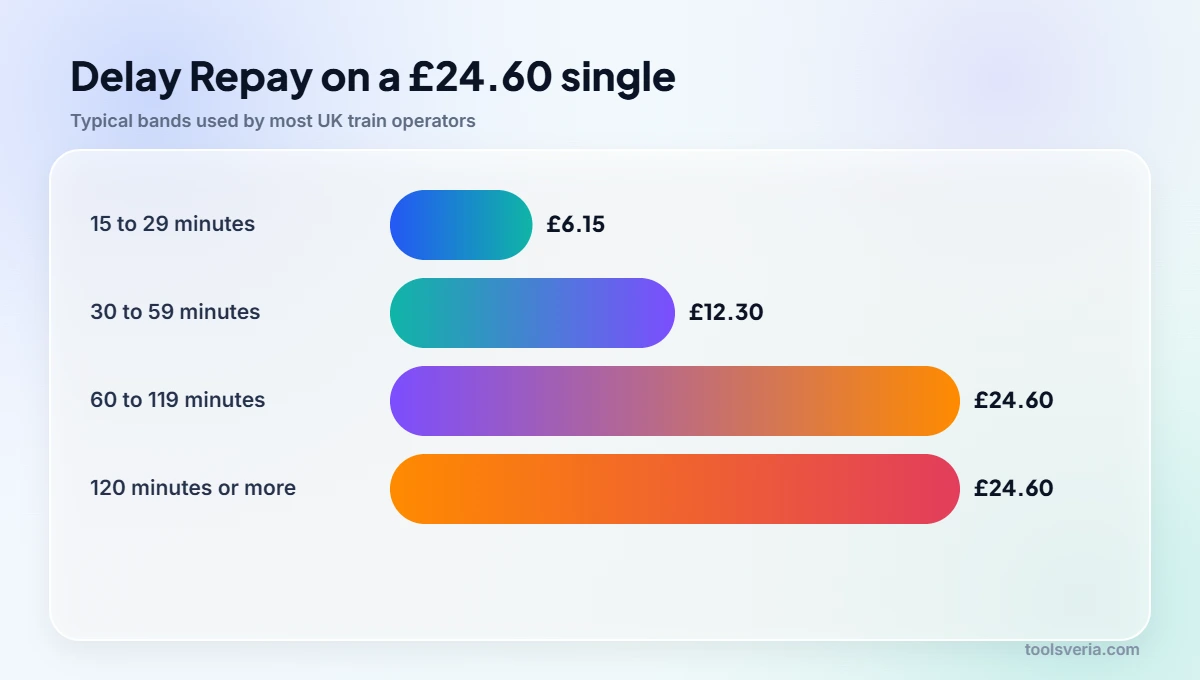
Delay Repay pays a percentage of the fare for the delayed leg of your journey, based on how late you reached your final destination compared with the timetable. The bands below are the ones the Department for Transport set out when it extended compensation to 15 minute delays, and they are what most operators now use.
| Delay at your destination | Single ticket | Return ticket (delayed leg) | Example on a £24.60 single |
|---|---|---|---|
| 15 to 29 minutes | 25% of the single | 25% of that leg | £6.15 |
| 30 to 59 minutes | 50% of the single | 50% of that leg | £12.30 |
| 60 to 119 minutes | 100% of the single | 100% of that leg | £24.60 |
| 120 minutes or more | 100% of the single | 100% of the whole return | £24.60 |
Jess paid £24.60 for an anytime single and arrived 35 minutes late, which puts her in the 50% band: £12.30. Had the train been 14 minutes late she would have received nothing, because the scheme starts at 15 minutes. Our time duration calculator settles borderline cases quickly when you have the scheduled and actual arrival times from the station screens or a live train app.
The 15 minute band arrived in stages rather than all at once across the network. The GOV.UK announcement from October 2016 introduced it first on Govia Thameslink routes, and other franchises followed. A small number of services may still start paying at 30 minutes, so check the operator’s own page if your route is unusual.
How does Delay Repay work on a return ticket?
On a return ticket, Delay Repay is worked out on the half of the fare that covers the delayed leg, unless the delay is 2 hours or more, when the whole return fare is paid. Operators describe this in two ways that reach the same answer.
Priya bought a £48 off peak return from Birmingham to Manchester and was 45 minutes late coming home. Some operators treat her return as two £24 singles and pay 50% of £24. Others, including GWR, quote the percentage against the full return, and halve the bands to 12.5%, 25% and 50%. Either way she receives £12. If her journey home had run 2 hours 10 minutes late, she would get the full £48.
Split tickets need one extra step. If you bought two tickets for one journey, claim against the whole trip on a single claim and upload both tickets, because the delay is measured at your final destination, not at the station where the tickets changed.
How to claim Delay Repay step by step
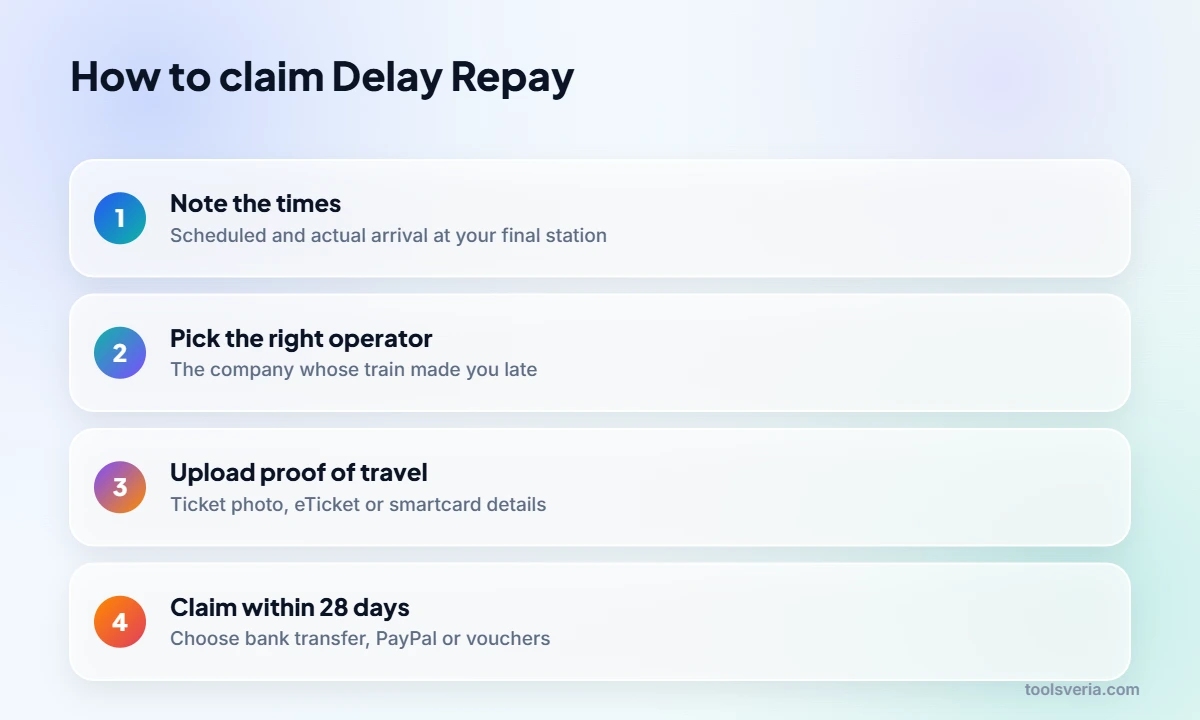
- Note your scheduled and actual arrival times at your final station, and screenshot the delay if you can.
- Find the train company whose service made you late. On a journey with a change, that is the operator of the delayed train, not always the one that sold the ticket.
- Open that operator’s Delay Repay page and fill in the journey, ticket type and price.
- Upload proof of travel: a photo of a paper ticket, an eTicket or barcode, or your smartcard, Oyster or contactless card details.
- Choose how to be paid. Most offer bank transfer, PayPal or rail vouchers, and some let you donate the payment to charity.
Claims must reach the operator within 28 days of the delayed journey. Jess travelled on 7 October 2026, so her last day to claim is 4 November 2026, and our days between dates calculator confirms any deadline in seconds. Govia Thameslink Railway says it aims to reply within 20 working days, and many claims are paid much sooner outside periods of heavy disruption.
Several operators now send automatic Delay Repay messages to people who booked through their own app or registered a smartcard. If you get one, check the amount against the bands above before accepting, because it may be based on the wrong ticket price.
Can season ticket holders claim Delay Repay?
Yes, season ticket holders can claim Delay Repay for each delayed journey, using a value per journey found by dividing the season ticket price by a set number of trips. The bands then apply to that per journey figure in the same way as a single.
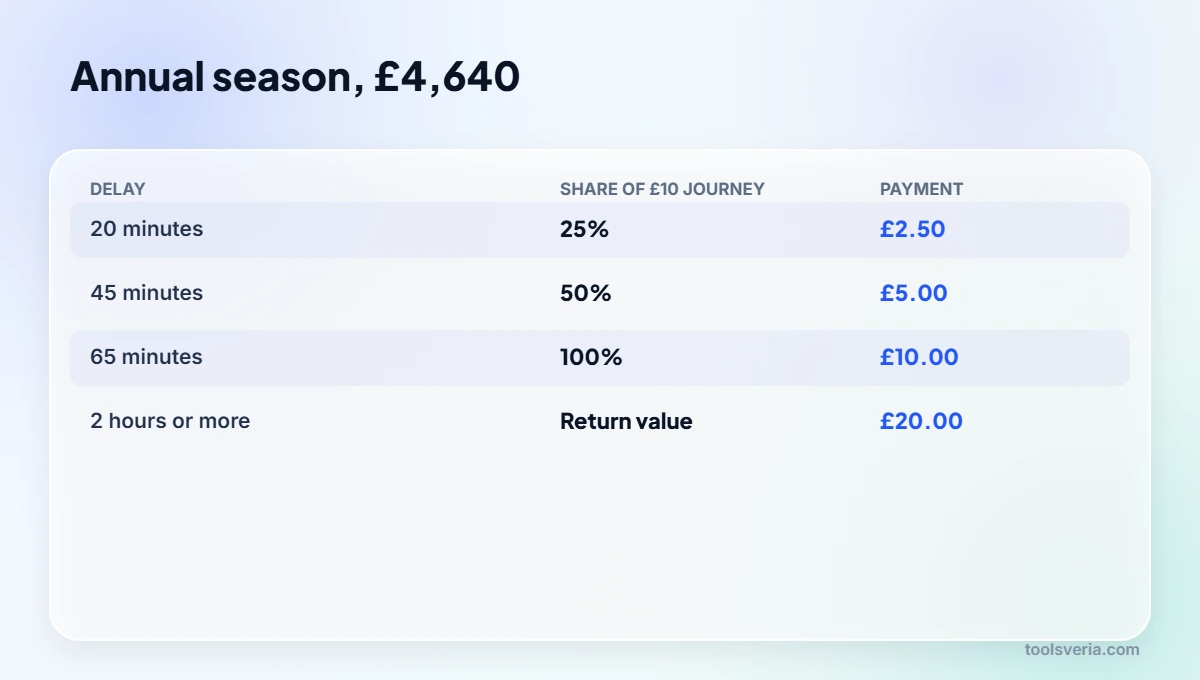
Govia Thameslink Railway, which runs Thameslink, Southern and Great Northern, divides an annual season by 464 journeys and a weekly season by 10. Marcus pays £4,640 a year, which works out at £10 per journey. A 20 minute delay is worth £2.50, a 65 minute delay £10, and a delay of 2 hours or more £20, the value of a return. Flexi Season tickets on those routes are divided by 16.
Divisors are not the same everywhere. East Midlands Railway uses different figures for each ticket length, so the same £4,640 season can give a different per journey value on another route. Small sums add up for a daily commuter: twelve 20 minute delays in a year at £2.50 each is £30 that most season holders never collect.
What if your train is cancelled?
If your train is cancelled, Delay Repay is based on how late you finally reached your destination on the next available service, compared with the time your original train was due. A cancellation that leaves you 50 minutes late pays the same as a 50 minute delay.
Siobhan’s 18:05 from Brighton was cancelled and the next train got her home 52 minutes after her original arrival time. On her £18.40 single that is 50%, or £9.20. If she decides not to travel at all because of the cancellation, she should ask for a full refund of the unused ticket instead, since you cannot claim Delay Repay for a journey you did not make.
Disruption announced well in advance, such as weekend engineering work already in the timetable, usually does not count, because the delay is measured against the timetable in force on the day. Compare the cost of driving instead with our fuel cost calculator when a planned closure lands on a long trip.
What to do if your claim is rejected
If a Delay Repay claim is rejected, ask the operator to review it first, quoting the train time, the delay and your ticket details. Common reasons are a blurred ticket photo, the wrong operator, or a claim sent after the 28 day limit.
If the operator’s final answer still looks wrong, the Rail Ombudsman can look at the complaint for free. Losses beyond the fare, such as a taxi or a missed connection you had paid for, fall outside Delay Repay, but section 49 of the Consumer Rights Act 2015 requires services to be provided with reasonable care and skill, and some passengers use it to ask for extra costs on top of the standard payment. Keep receipts if you plan to try.
Key points
- Delay Repay usually pays 25% of the single fare for a 15 to 29 minute delay and 50% for 30 to 59 minutes.
- A delay of 60 to 119 minutes pays 100% of the single, and 2 hours or more pays the full return fare.
- Claims must be made within 28 days of the delayed journey, with proof of travel.
- Season tickets are paid per journey, for example an annual season divided by 464 on Govia Thameslink routes.
- Unresolved complaints can go to the free Rail Ombudsman after the operator’s final response.
Delay Repay Terms Rail Passengers Should Know
These terms explain the rules behind how to claim Delay Repay, so you can work out which operator to contact and what compensation band applies.
- Delay Repay
- A passenger compensation scheme used by most train companies in Great Britain that refunds part of a fare when a train arrives late. Payment is not automatic, so the passenger must submit a claim with proof of travel.
- Delay band
- A range of minutes late that fixes the percentage of the fare refunded. The bands start at 15 minutes and step up at 30, 60 and 120 minutes, so a single minute can move a claim into the next band.
- Train operating company
- The business that runs passenger services on a route under contract. A Delay Repay claim goes to the company whose train caused the delay, which may differ from the company that sold the ticket.
- Final destination
- The station at the end of the whole journey, where lateness is measured against the timetable. Delays at interchange stations do not set the payout; only the arrival time at the last station counts.
- Split ticketing
- Buying separate tickets for parts of one journey, often to cut the overall fare. For compensation, the journey is treated as a whole, so all the tickets are uploaded together in a single claim.
- Season ticket compensation
- Delay Repay for weekly, monthly or annual tickets, worked out from a daily value of the season ticket rather than a single fare. The same delay bands are then applied to that daily figure.
Frequently Asked Questions
My train was 14 minutes late. Is there any point claiming?
No, Delay Repay starts at 15 minutes, so a 14 minute delay pays nothing. Check the arrival time at your final station carefully, though, because a delay of exactly 15 minutes on a £24.60 single is worth £6.15.
I changed trains and two companies were involved. Who do I claim from?
Claim from the company whose train caused the delay, and include the whole journey on that one claim. The delay is measured at your final destination, so a late first train that makes you miss a connection counts in full.
I forgot to claim for a delay five weeks ago. Is it too late?
Usually yes, because most operators require Delay Repay claims within 28 days of the journey. Five weeks is 35 days, so the claim will normally be refused, although you can still ask the operator to use its discretion.
Do I get more for a first class ticket?
Yes, Delay Repay is a percentage of the price you paid, so a dearer ticket returns more. A £60 first class single delayed by 40 minutes pays 50%, which is £30, against £12.30 on a £24.60 standard single.
Jess now claims every delay over 15 minutes and keeps a note of the 28 day deadline, while Marcus has started logging his short delays. Put your own fare and minutes late into the calculator before you claim so you know what to expect. Figures checked October 2026.