For National Rail journeys in Great Britain. Choose your operator's scheme and ticket, then enter how late you arrived at your destination.
| Delay at destination | Rate | Per leg |
|---|
An estimate using the standard Delay Repay bands. Each train company sets its own terms, exclusions and claim window, so check the operator's Delay Repay page before you claim.
This delay repay calculator shows rail passengers in Great Britain how much compensation they can claim when a train arrives late, for single, return and every type of season ticket. It applies the standard Delay Repay bands, splits season tickets into journeys the way train companies do, and gives you the date your 28 day claim window closes.
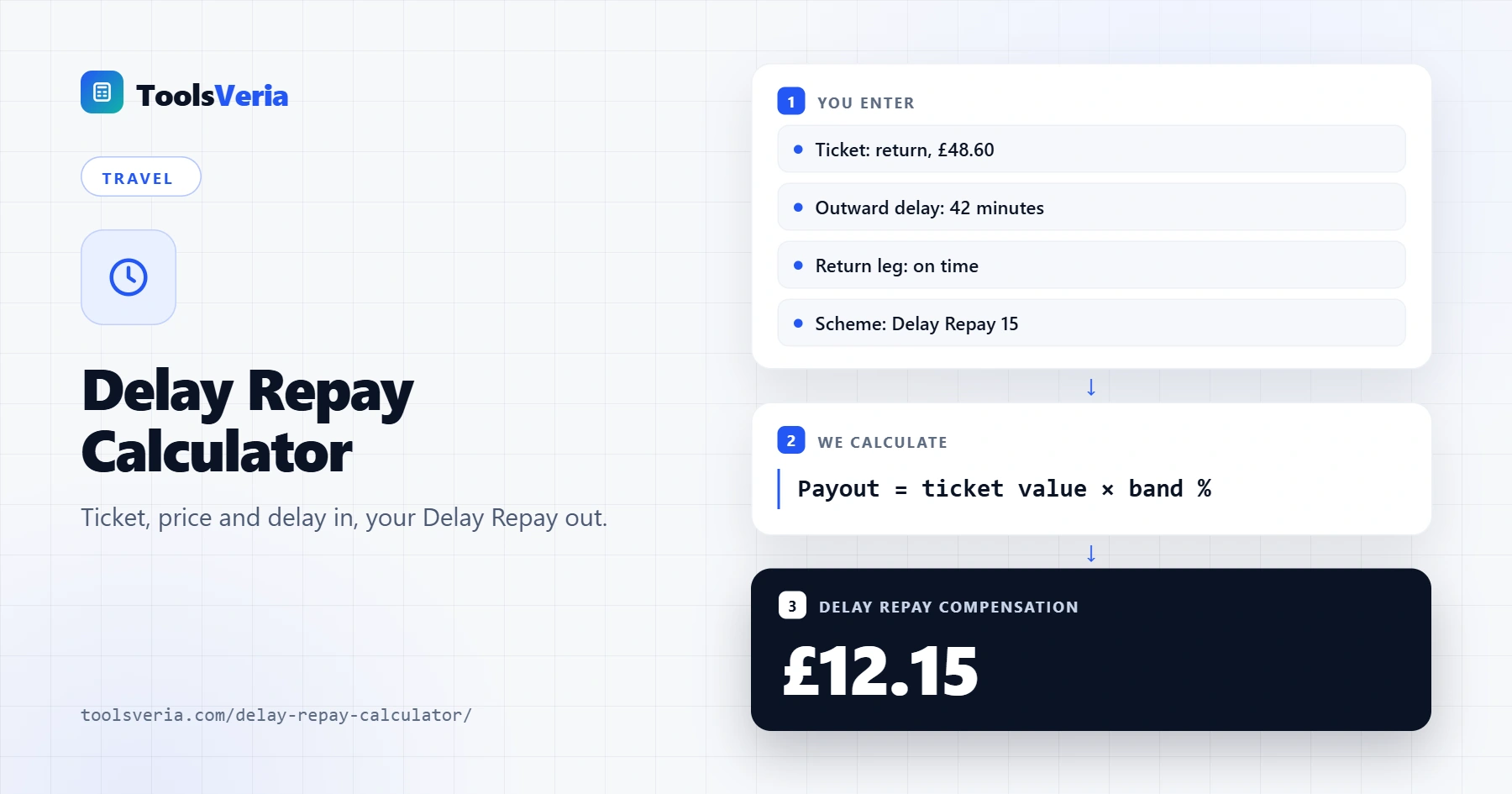
Quick answer: under Delay Repay 15 you get 25% of a single fare for a 15 to 29 minute delay, 50% for 30 to 59 minutes and 100% for an hour or more. Returns pay half those rates per delayed leg. The delay repay calculator shows £12.15 back for a 42 minute delay on a £48.60 return.
In This Guide
What Is Delay Repay?
Delay Repay is the national compensation scheme that train companies in Great Britain use to pay passengers back when they arrive late, whatever caused the delay. The formula in plain words: find the value of the delayed leg, which is the fare for a single or return, or the price divided by an agreed number of journeys for a season ticket, then multiply it by the percentage for your delay band.
The 15 minute band is newer than the scheme itself, and it is the one most commuters now rely on. The GOV.UK announcement of Delay Repay 15 confirmed that passengers can claim 25% of the single fare for delays between 15 and 29 minutes, and most operators in England now use it. A few, including ScotRail and CrossCountry, still start at 30 minutes, which is called Delay Repay 30.
How to Use the Delay Repay Calculator
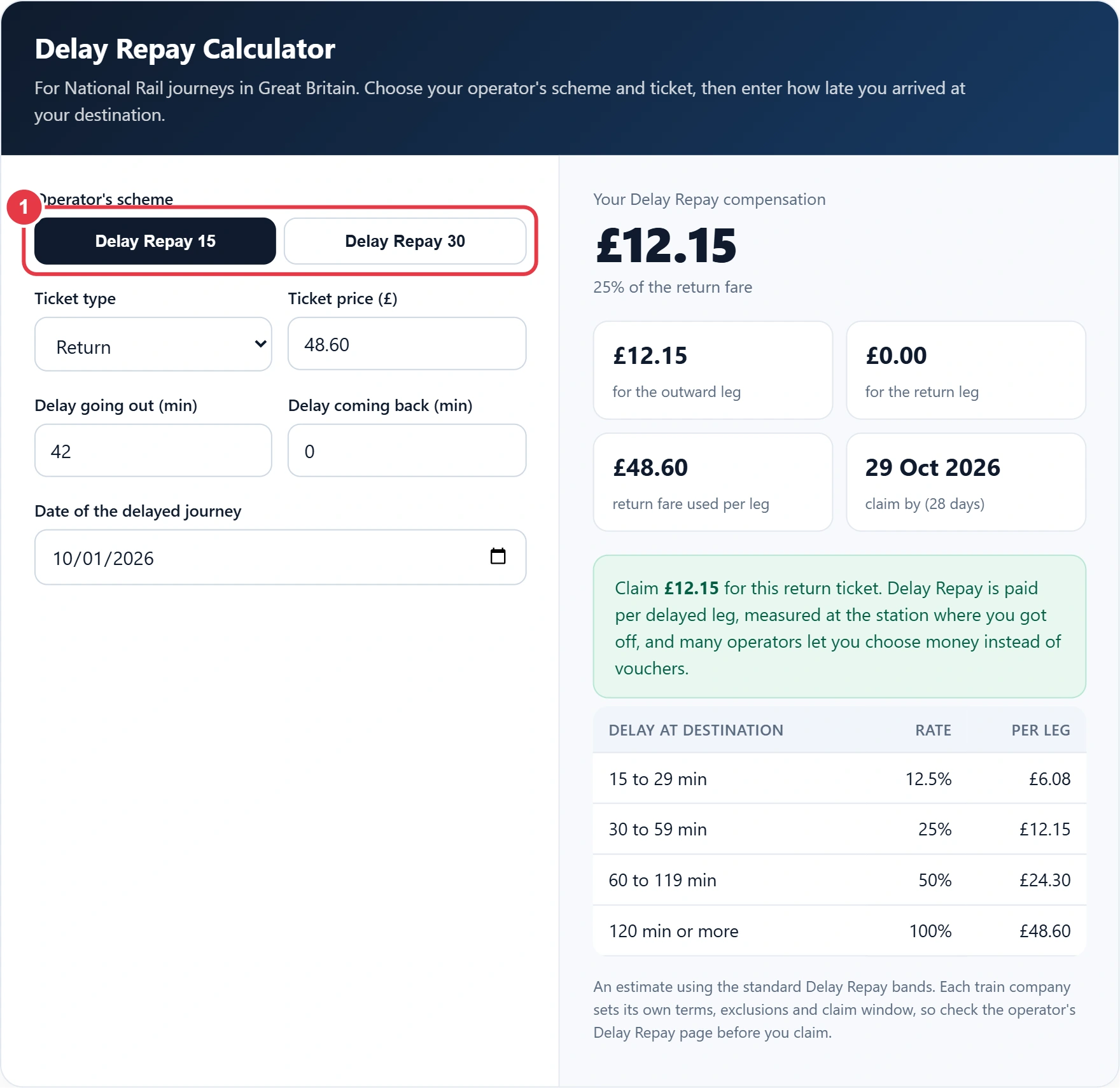
Step 1: Choose the Scheme
Pick Delay Repay 15 if the train company that ran the late train pays from 15 minutes, or Delay Repay 30 if it starts at 30. The company's own Delay Repay page says which one applies, and the claim goes to the operator of the delayed train even if you bought the ticket elsewhere.
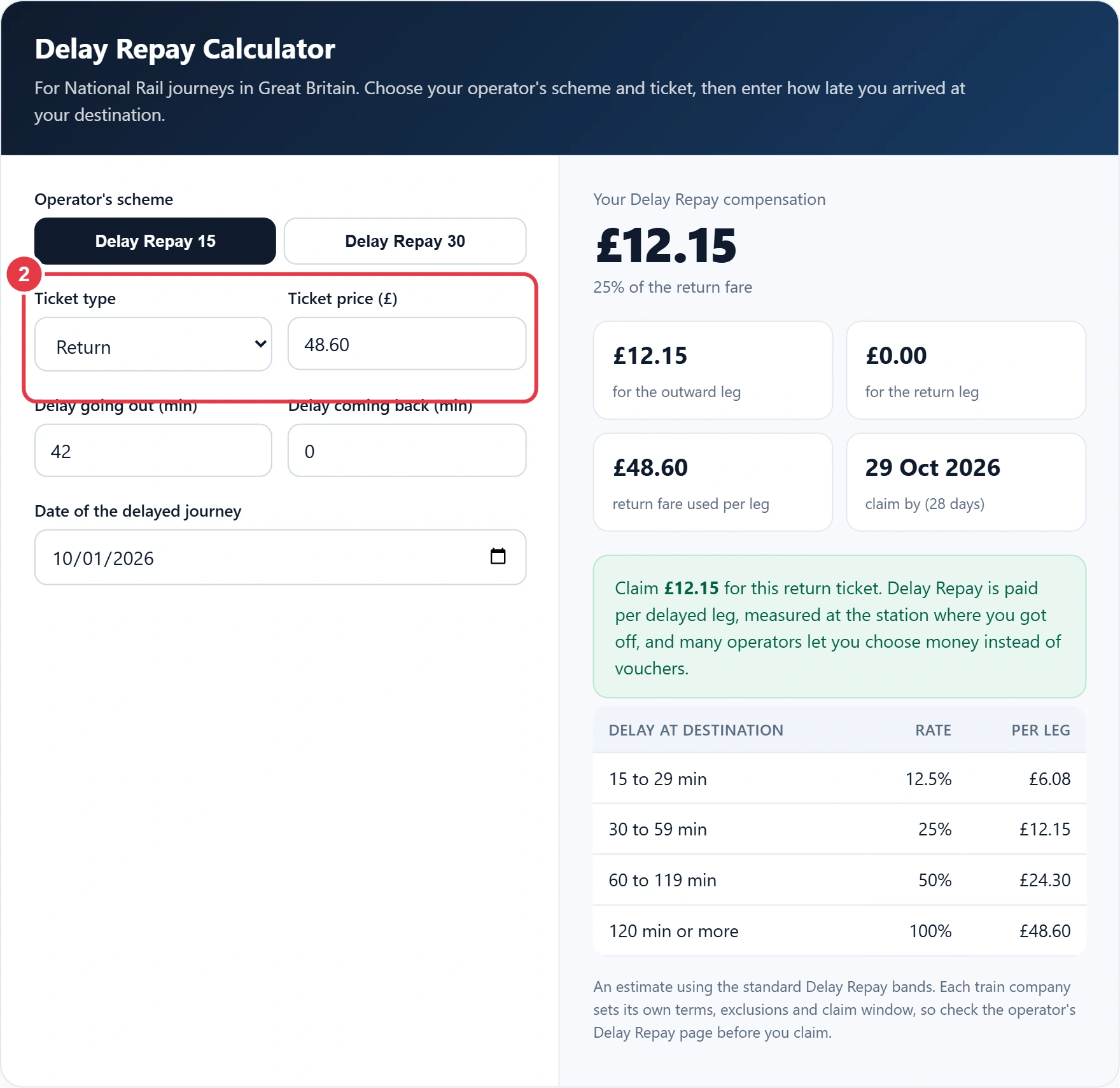
Step 2: Enter Your Ticket
Choose single, return or the length of your season ticket, then type what you paid. For a season ticket enter the full price, such as £5,568 for an annual season, and the tool divides it into journeys for you.
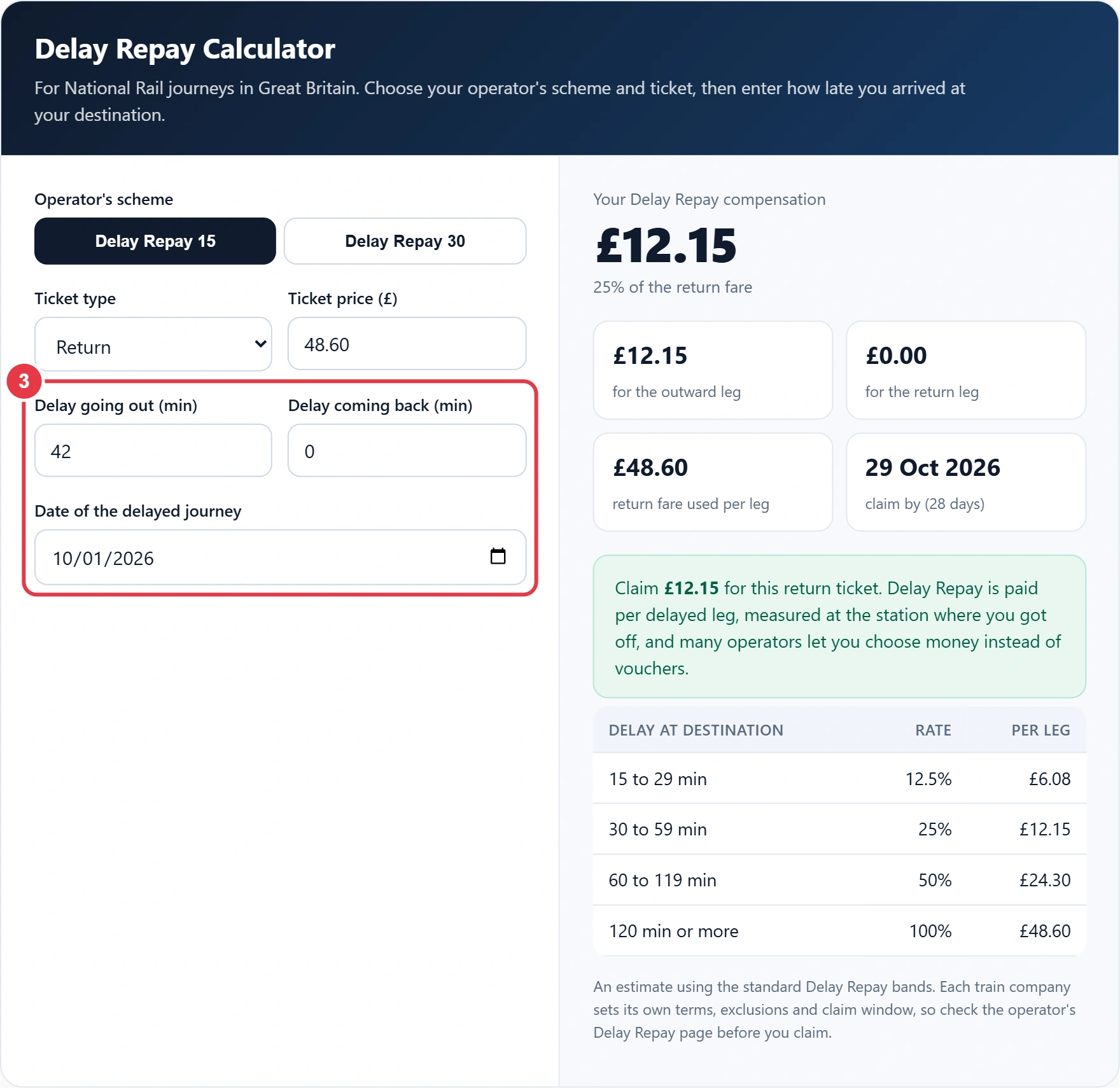
Step 3: Enter the Delay
Enter how many minutes late you reached your destination, not how late the train left. For a return or season ticket you can add a second delay for the journey home. Add the journey date to see the last day to claim.
Step 4: Read Your Compensation
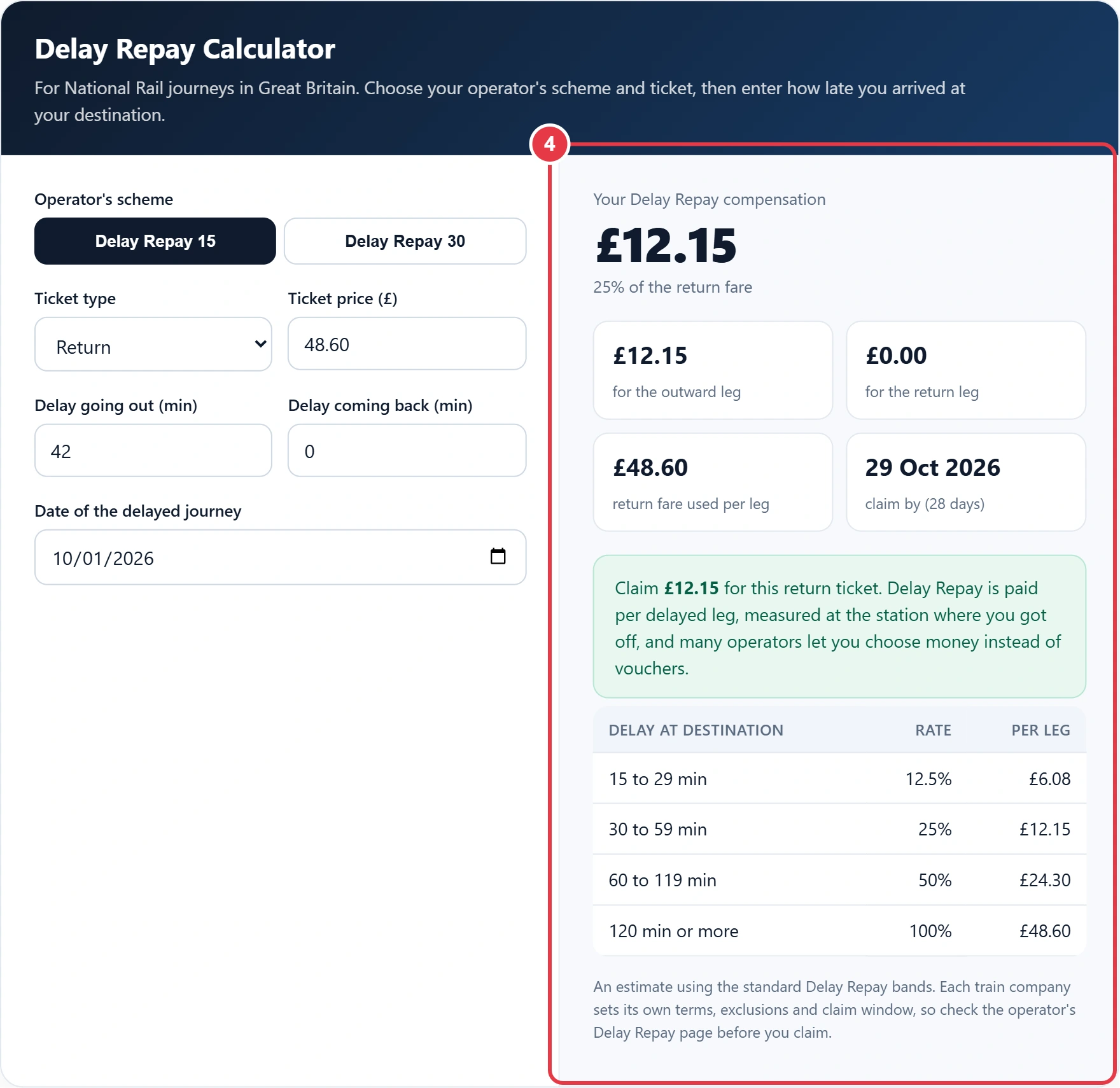
The large figure in the delay repay calculator is your total claim. The tiles split it by leg, show the value the percentage is applied to, and give the claim deadline. The table shows what this ticket would pay at every delay band, which helps when the arrival time is close to a boundary.
How Much Delay Repay Will I Get?
You get between 25% and 100% of the fare for the delayed leg, depending on how late you arrived. Worked example: Tom buys an off peak return for £48.60 and his outward train reaches his destination 42 minutes late, while his journey home runs on time. A delay of 30 to 59 minutes on a return pays 25% of the return fare, so the delay repay calculator gives him £12.15. Had he been 2 hours late, he would get the full £48.60 back.
| Delay at destination | Single ticket | Return ticket (per leg) | Season ticket (per leg) |
|---|---|---|---|
| 15 to 29 minutes (DR15 only) | 25% | 12.5% | 25% of journey value |
| 30 to 59 minutes | 50% | 25% | 50% of journey value |
| 60 to 119 minutes | 100% | 50% | 100% of journey value |
| 120 minutes or more | 100% | 100% | 100% of return journey value |
If both legs of a return are delayed, each leg is claimed separately, but the total cannot exceed the price of the ticket. Two 40 minute delays on a £48.60 return pay £12.15 each, or £24.30 in total.
How Is Delay Repay Calculated for Season Tickets?
Season ticket Delay Repay is calculated by dividing the ticket price by a fixed number of single journeys, then applying the normal band to that journey value. Train companies use 10 journeys for a weekly season, 16 for a flexi season, 40 for a monthly, 120 for a quarterly, 240 for a 6 month and 464 for an annual season. Pick your season length in the delay repay calculator and it applies the right divisor for you.
Worked example: Amira's annual season costs £5,568, so each journey is worth £12.00. A 35 minute delay pays 50% of that, or £6.00, and a delay of 2 hours or more pays the full return journey value of £24.00. Small claims add up quickly for commuters, and on a bad month ten 20 minute delays under Delay Repay 15 would return £30.
How Long Do I Have to Claim Delay Repay?
Most train companies ask you to claim within 28 days of the delayed journey. You need the ticket or a photo of it, the date and times of travel and the stations, and some operators fill in the delay automatically if you bought online or used a smartcard. The passenger rules behind refunds sit in the National Rail Conditions of Travel, which every operator follows, while each company publishes its own Delay Repay terms on top.
- Ask for money: rail vouchers are often the default, but many operators offer a bank transfer or card refund if you select it.
- Count the minutes carefully: the time duration calculator gives the exact gap between the booked and actual arrival times.
- Compare with driving: if delays are regular, the fuel cost calculator shows what the same trip would cost by car.
- Engineering works: delays caused by planned works that were in the timetable when you bought the ticket are usually excluded.
Results are an estimate based on the standard bands; check the train company's own Delay Repay page before you claim. Figures checked October 2026 against GOV.UK and operator terms.
</>Embed this calculator on your website
Add the free Delay Repay Calculator to your own site or blog. Copy the code below and paste it into an HTML block. It resizes itself and works on phones.
How we checked this tool: the Tools Veria Editorial Team built this tool by hand, checked it against the official rules or published standards where they apply, and tested it against worked examples. Results are estimates for planning, not personal financial or tax advice. Read our editorial policy and disclaimer, or report an error.
Frequently Asked Questions
How much compensation do I get for a 30 minute train delay?
A 30 to 59 minute delay pays 50% of a single fare or 25% of a return fare for that leg under Delay Repay. On a £48.60 return that is £12.15, and on a £20 single it is £10.
What is the difference between Delay Repay 15 and Delay Repay 30?
Delay Repay 15 pays from a 15 minute delay, giving 25% of a single fare for 15 to 29 minutes. Delay Repay 30 starts at 30 minutes, so shorter delays earn nothing. Above 30 minutes both schemes pay the same rates.
Can I claim Delay Repay on both legs of a return ticket?
Yes. Each delayed leg is claimed separately using the return rates of 12.5%, 25%, 50% or 100% of the return fare. The combined claim cannot be more than the price you paid for the ticket.
How is Delay Repay worked out for an annual season ticket?
The annual price is divided by 464 to give a single journey value, then the delay band is applied. An annual season costing £5,568 is worth £12.00 a journey, so a 45 minute delay pays £6.00.
How long do I have to claim Delay Repay?
Most train companies require a claim within 28 days of the delayed journey. A delay on 1 October 2026 should be claimed by 29 October 2026. Check the operator's terms, as a few set different windows.
Is Delay Repay paid if the delay was caused by weather or strikes?
Delay Repay is usually paid whatever the cause, including weather. Delays from planned engineering works or a strike timetable published before you bought your ticket are often excluded, so read the operator's terms.