Find your monthly and annual churn, how long a typical customer stays and what that customer is worth.
Annual churn = 1 minus (1 minus monthly churn) to the power of 12. Lifetime = 1 ÷ monthly churn. Lifetime value here is revenue, not profit, and assumes churn stays steady.
A subscription business can sign up new customers every week and still go nowhere if too many slip away out the back door. This customer churn rate calculator turns two simple counts into the numbers that matter: monthly churn, the churn rate compounded over a year, how long a typical customer stays and what they are worth in revenue. It works for software, gyms, box schemes, agencies on retainers or any business that bills customers repeatedly.
Quick answer: A customer churn rate calculator divides customers lost by customers at the start of the period. Annual churn is 1 minus (1 minus monthly churn) to the power of 12, and average lifetime is 1 ÷ monthly churn. So 3% monthly churn means 30.62% annual churn, not 36%, and a typical customer staying about 33 months.
In This Guide
What Is Customer Churn Rate?
Churn rate is the share of the customers you started a period with who cancelled or stopped paying during it. New sign ups are left out of the main figure on purpose, because they hide losses: a business that wins 140 customers and loses 60 looks healthy on net growth, yet it is still leaking 3% of its base each month. Monthly churn is customers lost ÷ customers at the start.
Annual churn is not simply monthly churn times 12, because each month you lose a slice of a smaller group. The correct figure is 1 minus (1 minus monthly churn) to the power of 12. Average lifetime is 1 ÷ monthly churn, so 3% churn means a typical customer stays about 33 months. Multiply that lifetime by monthly revenue per customer and you get a simple lifetime value.
How to Use the Customer Churn Rate Calculator
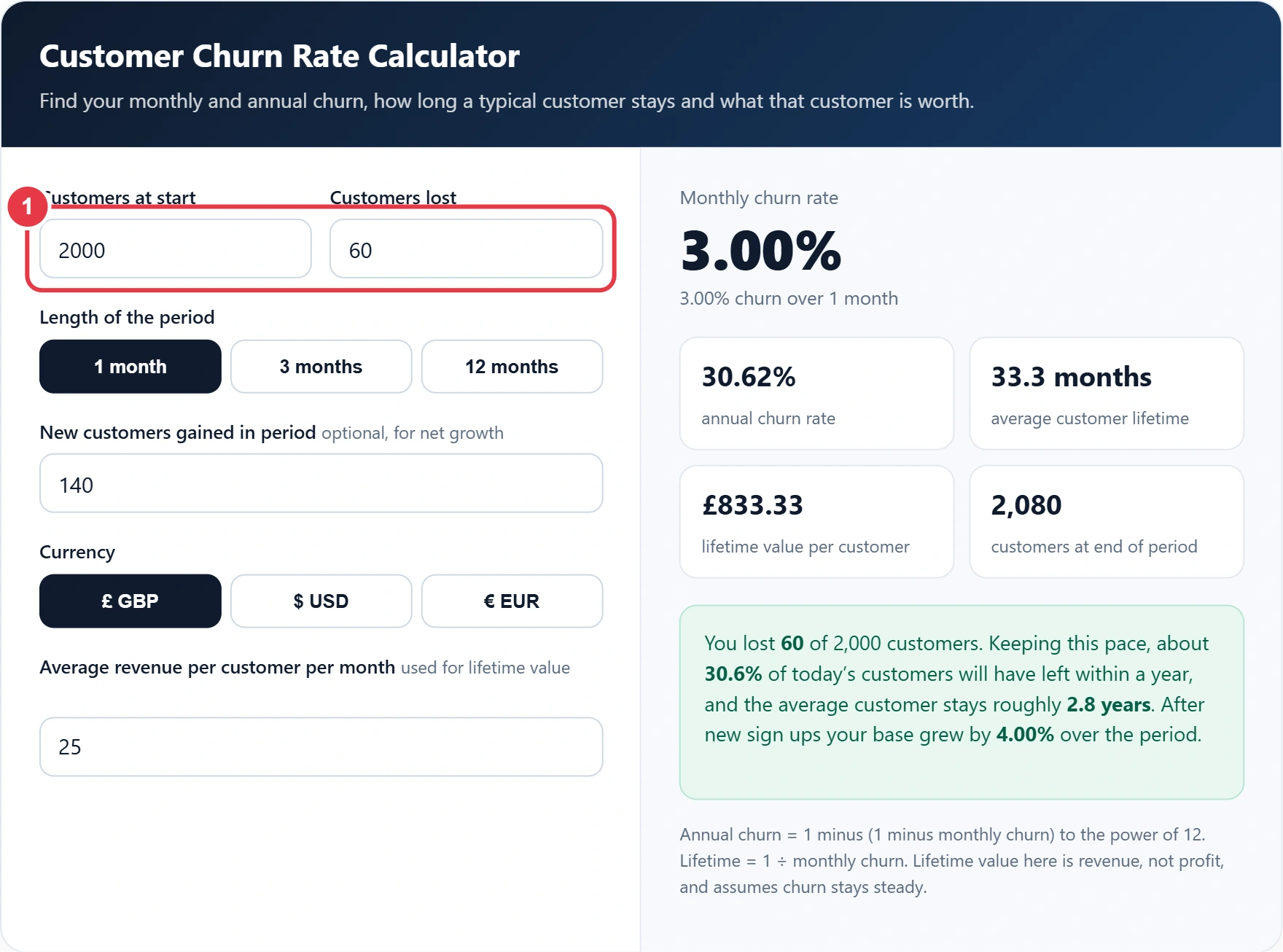
Step 1: Enter Customers at the Start and Customers Lost
Take the number of paying customers on the first day of the period, then count how many of those cancelled, lapsed or failed to renew by the last day. Leave out anyone who joined and left inside the same period.
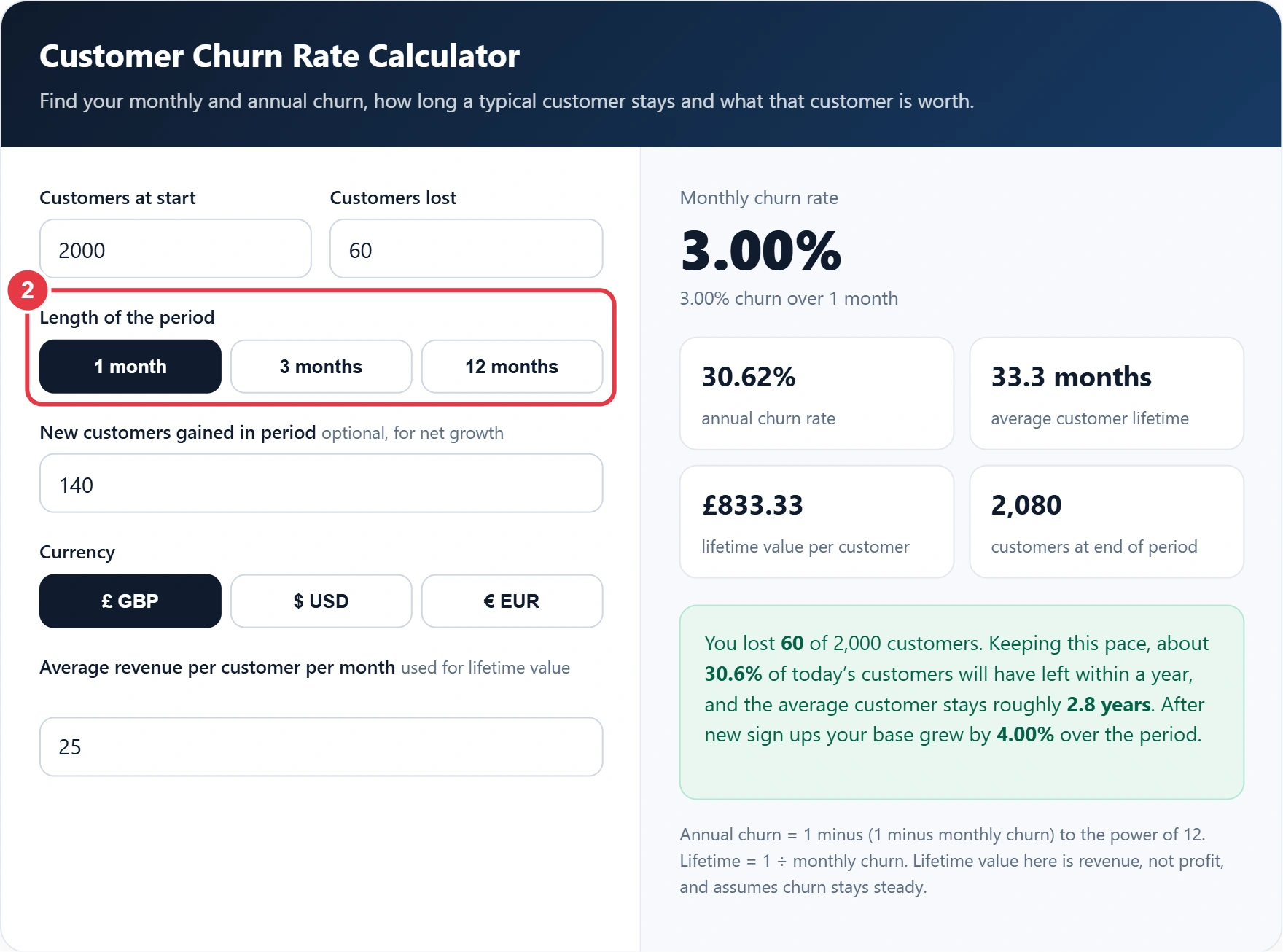
Step 2: Choose the Period Length
Pick 1 month, 3 months or 12 months to match your data. If you measured a quarter, the calculator converts the quarterly loss into an equivalent compounded monthly rate so every result sits on the same basis.
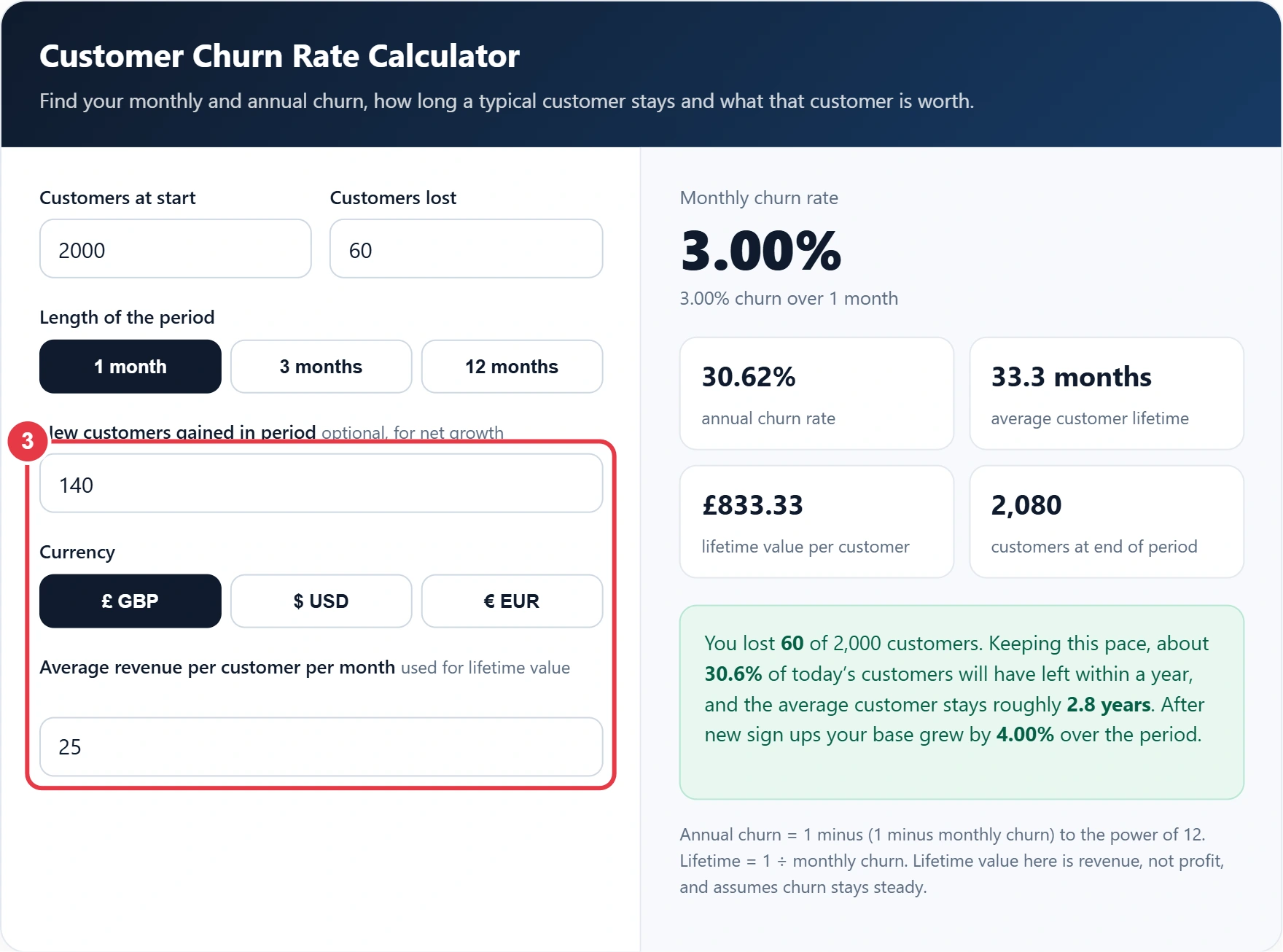
Step 3: Add New Customers and Revenue
New customers only feed the net growth message and the end of period count. Choose £, $ or € and enter average monthly revenue per customer to see lifetime value. If you want to see what a 10% price rise does to that figure, the percentage increase calculator gives you the new price quickly, and you can paste it straight back in here.
Step 4: Read Your Churn Results
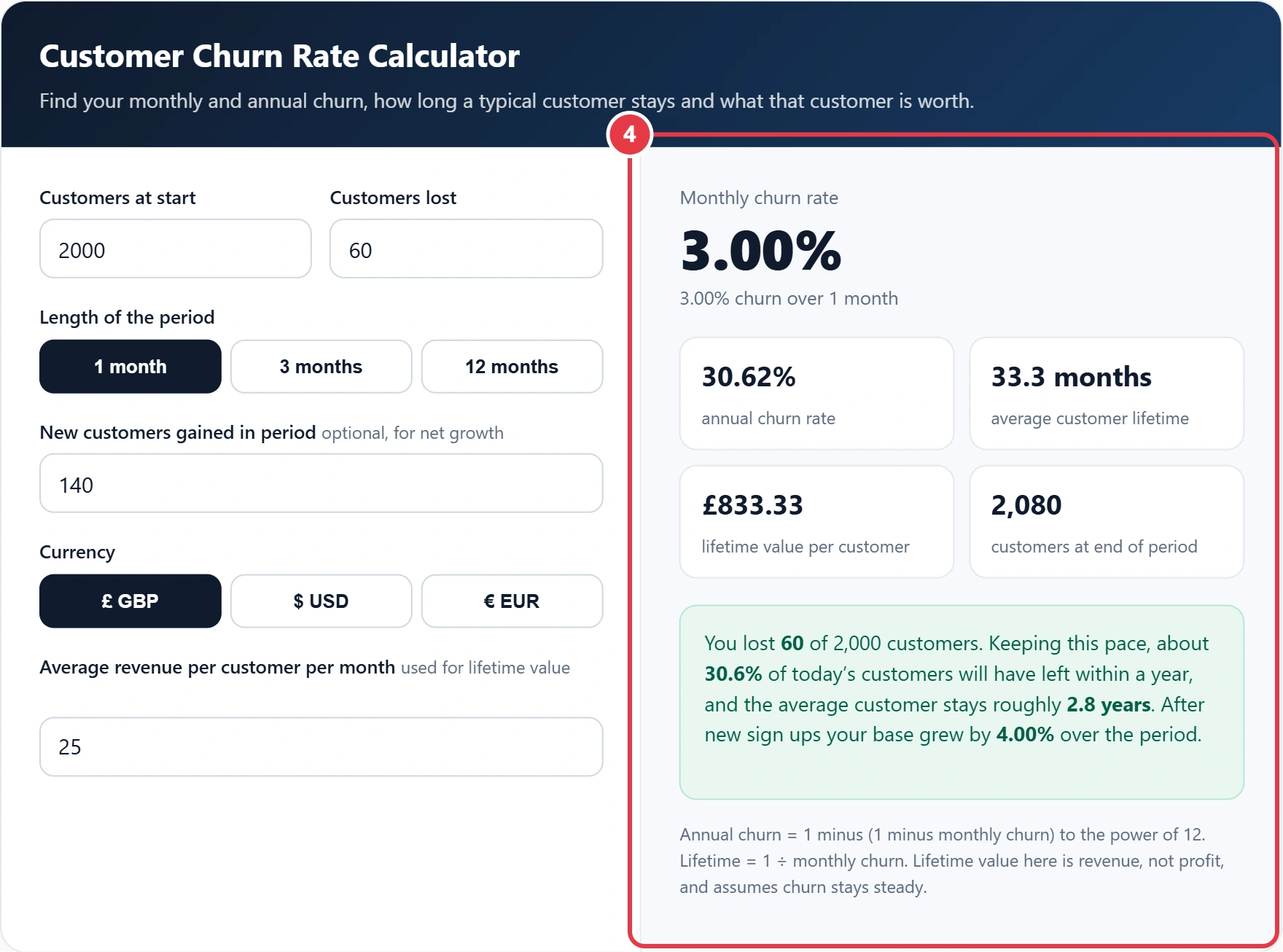
The headline shows monthly churn, with annual churn, average lifetime, lifetime value and end of period customers below it. The summary box says whether your base grew or shrank once sign ups are counted.
Worked Example: A Small Meal Kit Subscription
Hannah runs a vegan meal kit service with 2,000 subscribers on 1 March. During March 60 of them cancel and 140 new people join. Her monthly churn is 60 ÷ 2,000 = 3.00%. Compounded over 12 months, 0.97 to the power of 12 is 0.6938, so annual churn is 30.62%, not 36%. Her average subscriber stays 1 ÷ 0.03 = 33.3 months, and at £25 a month that is a lifetime value of £833.33.
| Monthly churn | Annual churn | Average lifetime | Value at £25 a month |
|---|---|---|---|
| 1% | 11.36% | 100 months | £2,500 |
| 2% | 21.53% | 50 months | £1,250 |
| 3% | 30.62% | 33.3 months | £833.33 |
| 5% | 45.96% | 20 months | £500 |
Cutting churn from 3% to 2% lifts each customer's value by half, which is why retention work often beats extra ad spend. Remember that revenue is not profit: to judge what you can afford to spend winning a customer, run that lifetime value through the profit margin calculator first, then compare it with your acquisition cost. The idea of customer lifetime value is explained in more depth elsewhere, including versions that discount future revenue.
Customer Churn Rate Terms You Should Know
These terms explain the retention maths behind the customer churn rate calculator, so you can compare monthly and annual churn and estimate customer value accurately.
- Customer churn
- The loss of paying customers who cancel, lapse or fail to renew within a period. It is measured against the customer base at the start, so a business can grow overall while still losing a worrying share of existing customers.
- Retention rate
- The share of customers at the start of a period who are still paying at the end, equal to one minus the churn rate. Retention and churn describe the same behaviour from opposite sides.
- Compounded annual churn
- The yearly loss rate found by applying a monthly churn rate repeatedly to a shrinking customer base. It is always lower than twelve times the monthly figure, because each month's losses come from fewer remaining customers.
- Average customer lifetime
- The expected time a typical customer stays before leaving, estimated as the reciprocal of the periodic churn rate. It assumes churn is constant, which is a useful simplification but rarely holds exactly in practice.
- Revenue churn
- The share of recurring revenue lost to cancellations and downgrades in a period, as distinct from the share of customers lost. Losing a few large accounts can create high revenue churn even when customer churn looks low.
- Net customer growth
- The change in customer numbers after adding new sign ups and subtracting customers lost. Strong acquisition can mask high churn in this figure, which is why churn is calculated separately from new customer counts.
</>Embed this calculator on your website
Add the free Customer Churn Rate Calculator to your own site or blog. Copy the code below and paste it into an HTML block. It resizes itself and works on phones.
How we checked this tool: the Tools Veria Editorial Team built this tool by hand, checked it against the official rules or published standards where they apply, and tested it against worked examples. Results are estimates for planning, not personal financial or tax advice. Read our editorial policy and disclaimer, or report an error.
Frequently Asked Questions
Why is my annual churn lower than monthly churn times 12?
Each month you lose a percentage of a smaller group than the month before. Compounding 3% monthly churn gives 30.62% a year, not 36%.
Should new customers be included in churn rate?
Not in the main churn figure. Use only the customers you had at the start, otherwise strong sales can hide a serious retention problem. New customers belong in net growth instead.
What is a good monthly churn rate for a subscription business?
It depends on price and contract length. Low priced consumer subscriptions often see 3% to 8% a month, while business software on annual contracts is often well under 2%.
How do I turn quarterly churn into monthly churn?
Use 1 minus (1 minus quarterly churn) to the power of one third. Pick 3 months in the calculator and it does this for you.
How is average customer lifetime worked out?
Divide 1 by your monthly churn rate. At 4% monthly churn the average customer stays 25 months, assuming churn holds steady.
Is lifetime value the same as profit per customer?
No. This calculator multiplies revenue by lifetime, so you still need to take off delivery costs, payment fees and support to see profit.