Enter a date of birth to find the school year group in England, Wales, Scotland or Northern Ireland for any school year.
| Year group | School year | Age at start |
|---|
Based on the standard cut-off date for each nation. Your council or the school admissions team confirms the year group, especially after a deferred or delayed start.
This school year group calculator tells parents in England, Wales, Scotland and Northern Ireland which school year their child is in for 2026/27 or any year up to 2033/34. Enter a date of birth and it applies each nation's cut-off date, using the rules on school starting age on GOV.UK for England, then shows when your child starts primary and secondary school and which summer they sit their first big exams.
Quick answer: in England and Wales a child born between 1 September 2019 and 31 August 2020 is in Year 2 in 2026/27. Scotland uses a 1 March cut-off and Northern Ireland a 1 July cut-off, so the same child can be in a different year. The school year group calculator works it out.
In This Guide
What Is a School Year Group Calculator?
A school year group calculator is a tool that converts a date of birth into the class a child belongs in for a given school year. In plain words: find the school year your child was born in using your nation's cut-off date, add five years to get the year they start school, then count the years since. In England that first year is called Reception, followed by Year 1 to Year 13.
Children are grouped by birth date, not by when they start nursery or move house, so a child born on 31 August is the youngest in a class and a child born on 1 September is the oldest, almost a full year apart. The cut-off is 31 August in England and Wales, the end of February in Scotland and 1 July in Northern Ireland.
How to Use the School Year Group Calculator
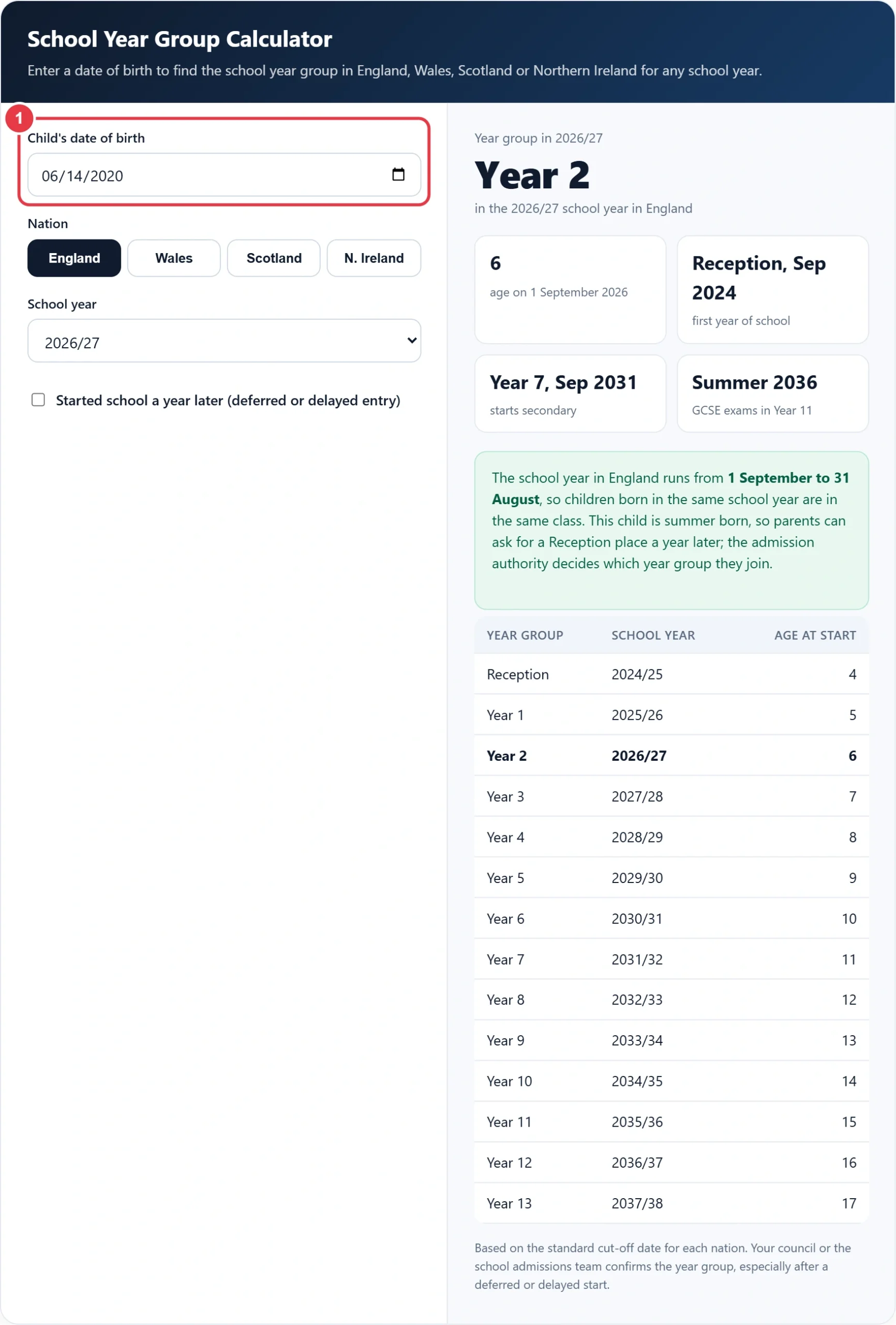
Step 1: Enter the Date of Birth
Type your child's full date of birth. The exact day matters for children born near a cut-off, such as 31 August, 1 March or 1 July.
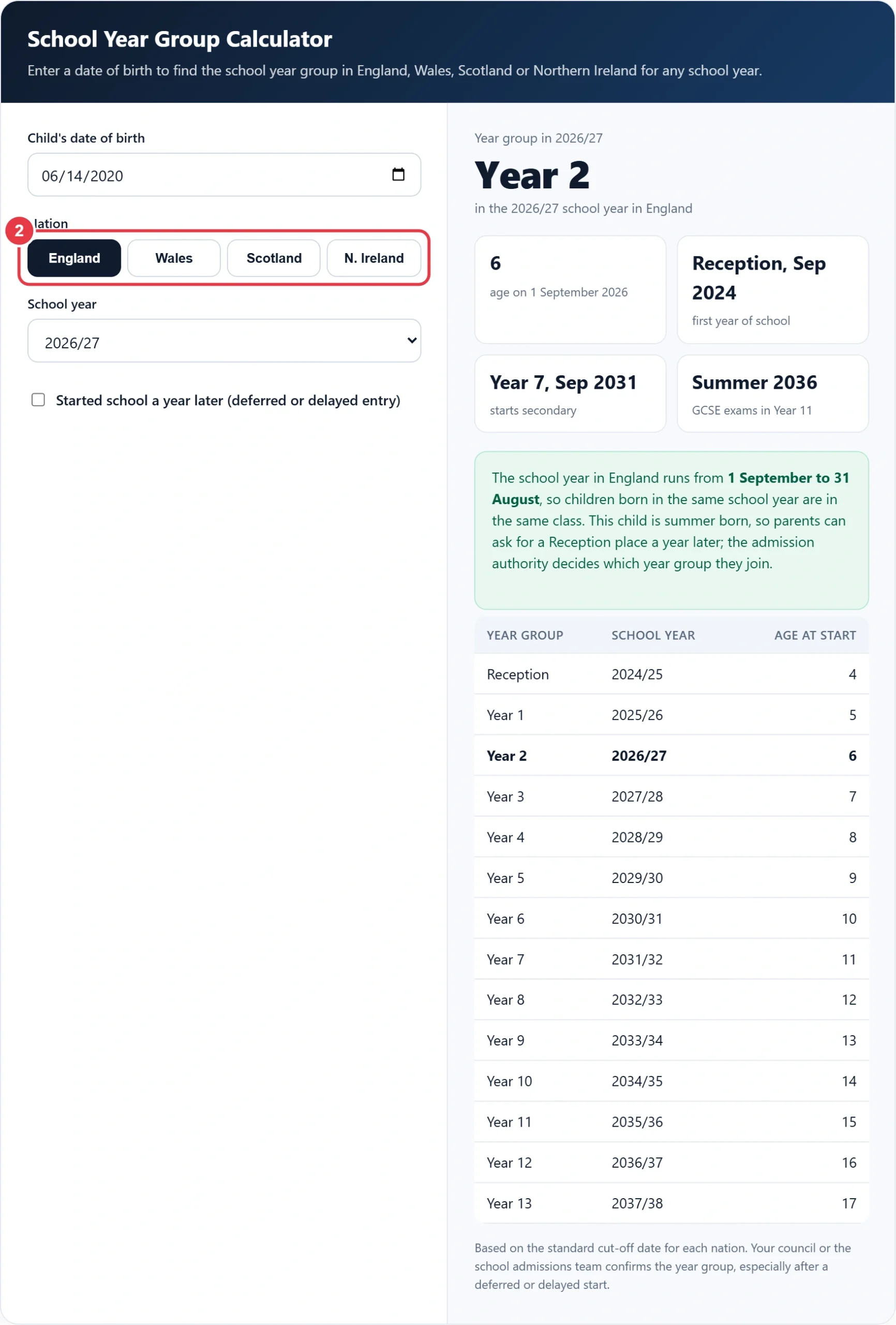
Step 2: Choose the Nation
Pick the nation where your child goes to school. England and Wales share the same year groups, Scotland uses P1 to P7 and S1 to S6, and Northern Ireland uses P1 to P7 followed by Year 8 to Year 14.
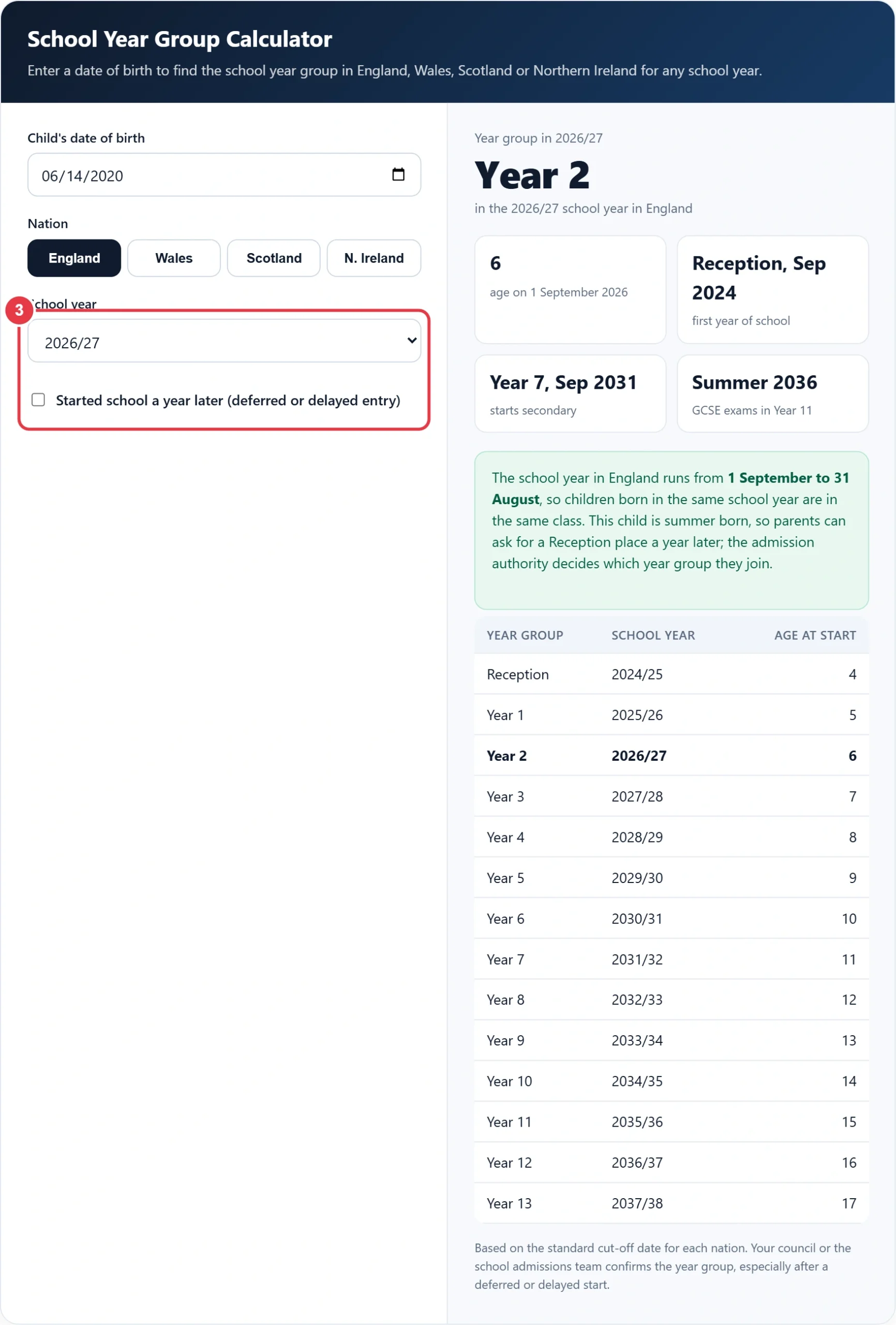
Step 3: Pick the School Year
The school year starts on the current one. Choose a later year to plan ahead, for example when applying for a secondary place. Tick the box if your child started school a year later than usual, through deferred entry in Scotland or Northern Ireland or a delayed Reception start in England.
Step 4: Read the Year Group
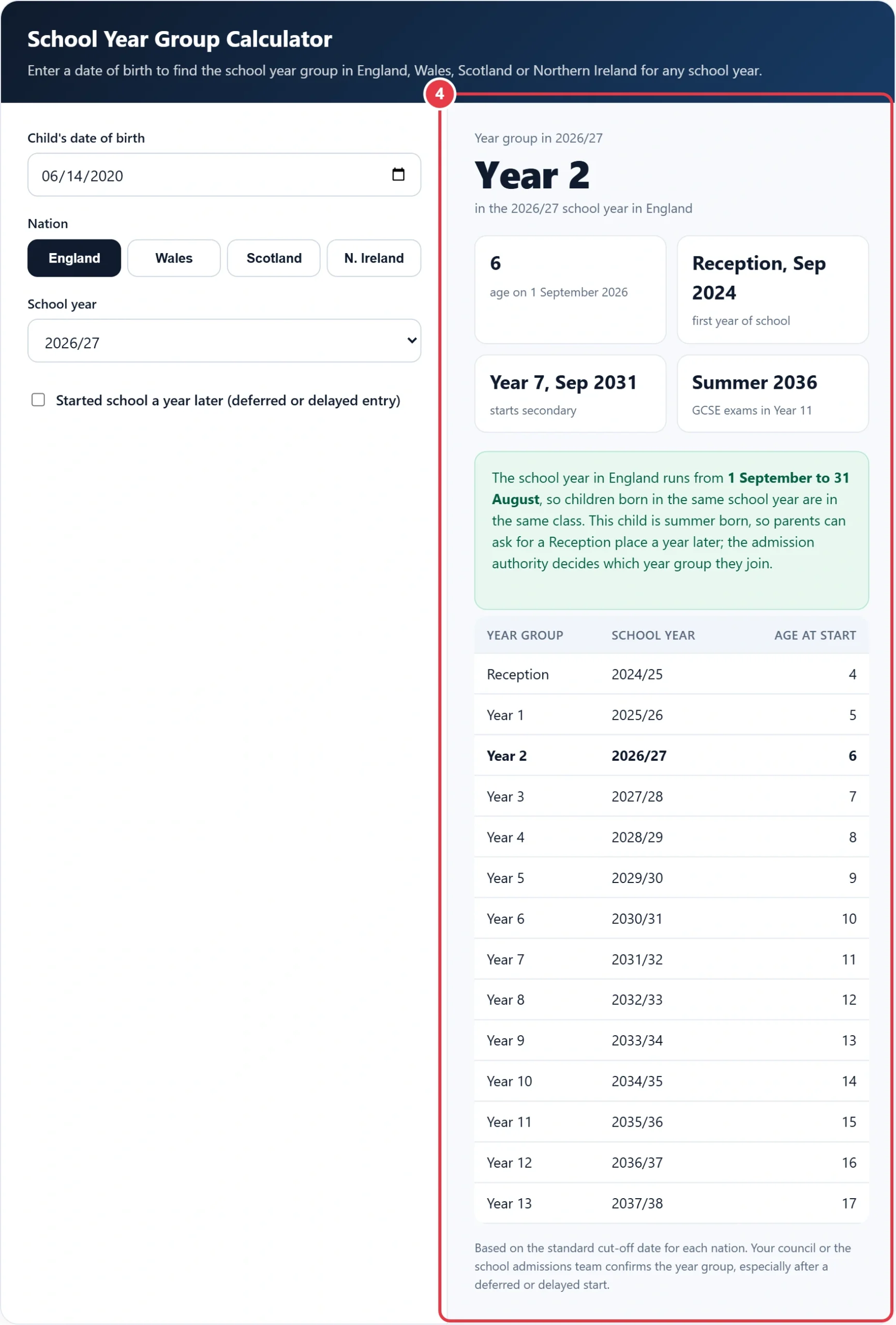
The large result is the year group. The tiles show your child's age at the start of that school year, when they start primary and secondary school, and the summer of their first major exams. The table lists every year from the first class to the last, with the matching school year and age.
What School Year Is My Child In?
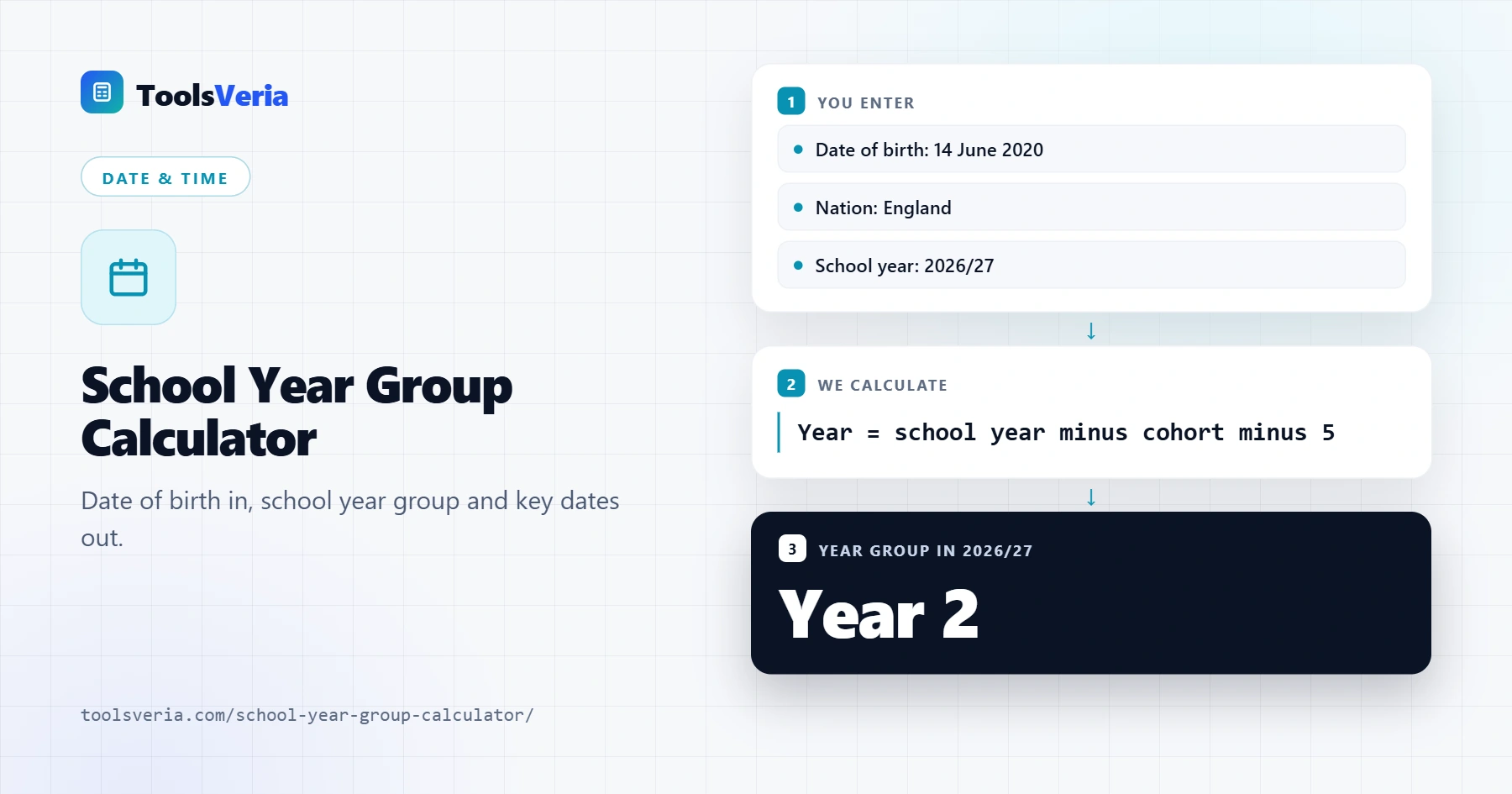
Your child's school year depends on their date of birth and your nation's cut-off date. Worked example: Leah was born on 14 June 2020. In England the school year group calculator puts her in Year 2 in 2026/27, because she started Reception in September 2024. Had her family lived in Scotland she would be in P2, having started P1 in August 2025, and in Northern Ireland she would be in P3, having started P1 in September 2024. In England she starts Year 7 in September 2031 and sits GCSEs in summer 2036.
| Nation | Cut-off (born in one school year) | First class | Year names | Starts secondary |
|---|---|---|---|---|
| England | 1 September to 31 August | Reception, September after 4th birthday | Reception, Year 1 to Year 13 | Year 7 |
| Wales | 1 September to 31 August | Reception | Reception, Year 1 to Year 13 | Year 7 |
| Scotland | 1 March to end of February | P1 in August, aged 4.5 to 5.5 | P1 to P7, S1 to S6 | S1 |
| Northern Ireland | 2 July to 1 July | P1 in September | P1 to P7, Year 8 to Year 14 | Year 8 |
When Does My Child Start School?
In England most children start Reception full time in the September after their fourth birthday. They must be in full time education by compulsory school age, which GOV.UK sets as 31 December, 31 March or 31 August following their fifth birthday, whichever comes first. A child born on 10 October 2021 can start Reception in September 2026 and must be in full time education from the term starting in January 2027 at the latest, after compulsory school age on 31 December 2026.
If you are planning a return to work around a new school timetable, the working days calculator counts weekdays and bank holidays between any two dates, which helps when mapping term dates against annual leave.
How Are Scotland and Northern Ireland Different?
Scotland and Northern Ireland use different cut-off dates and year names. Education Scotland says children start primary school aged between 4.5 and 5.5: those born from 1 March to 31 August start in the August when they are 5, and those born from September to February start the August before. A child who is still 4 on the start date can be deferred by a year with an extra year of funded early learning and childcare. In Northern Ireland, the Department of Education says a child who turns 4 between 1 September and 1 July starts P1 the next September.
Can a Summer Born Child Start School a Year Later?
Yes, in England you can ask for a summer born child to start Reception a year later, in the September after they turn 5, instead of joining Year 1. The admission authority decides, so apply in the normal round and explain your reasons. In Northern Ireland, parents of children born between 1 April and 1 July can ask to defer under the School Age Act 2022. Once a child has started, the national curriculum key stages follow their year group, so a deferred child stays a year behind their birth cohort all the way through.
- Moving between nations: a child moving from Scotland to England may change year group, so ask the new school before you move.
- Nursery funding: pre-school years are linked to the same cut-off, so the calculator shows a pre-school year before Reception or P1.
- Family planning: the maternity pay calculator estimates Statutory Maternity Pay if a new baby is due around a school start.
- Holidays abroad: school holidays fix your travel dates, so check passports early with the passport validity checker for Europe.
Results are an estimate; your council or the school admissions team confirms the year group, especially after a deferred start. Figures checked October 2026 against GOV.UK, Education Scotland and the Northern Ireland Department of Education.
</>Embed this calculator on your website
Add the free School Year Group Calculator to your own site or blog. Copy the code below and paste it into an HTML block. It resizes itself and works on phones.
How we checked this tool: the Tools Veria Editorial Team built this tool by hand, checked it against the official rules or published standards where they apply, and tested it against worked examples. Results are estimates for planning, not personal financial or tax advice. Read our editorial policy and disclaimer, or report an error.
Frequently Asked Questions
What year group is a child born in 2020 in for 2026/27?
In England and Wales, a child born between 1 September 2019 and 31 August 2020 is in Year 2, and one born between 1 September 2020 and 31 August 2021 is in Year 1. The 31 August cut-off decides which of the two classes a 2020 birthday falls into.
What is the cut-off date for school years in England?
The school year in England runs from 1 September to 31 August, so 31 August is the cut-off. A child born on 31 August is the youngest in the class, and a child born on 1 September is the oldest, almost a year older.
What school year is a 10 year old in?
In England most children who are 10 at the start of September are in Year 6, the last year of primary school, and turn 11 during it. A child who turns 10 during the school year is in Year 5. Scotland and Northern Ireland differ, so use the calculator.
When does a child start school in Scotland?
Children in Scotland start P1 in August when they are aged between 4.5 and 5.5. Those born from 1 March to 31 August start when they are 5, and those born from September to February start at 4 and can be deferred for a year.
What year do children sit GCSEs?
In England and Wales pupils sit GCSEs at the end of Year 11, usually aged 16. In Northern Ireland GCSEs are taken in Year 12, which is the same age. In Scotland most pupils sit National 5 exams in S4 instead.
Can my child be put in a different year group?
Sometimes. In England a summer born child can start Reception a year late if the admission authority agrees, and in Scotland and Northern Ireland eligible children can be deferred. Outside these cases, children are placed in the year group that matches their date of birth.