Exact age in years, months and days, totals in weeks and days, the day you were born and a countdown to your next birthday.
| Milestone | Date | Days away |
|---|
Ages use the UK rule that you reach a new age at the start of your birthday. Months are counted to the same day number; for days 29 to 31 in shorter months the last day of the month is used. Hours assume midnight births.
This age calculator works out anyone's exact age in years, months and days from a date of birth, for today or any past or future date, in UK date format. It follows the rule in the Family Law Reform Act 1969, section 9, that you reach a new age at the start of your birthday, and it also shows your age in months, weeks and days, the weekday you were born and a countdown to your next birthday.
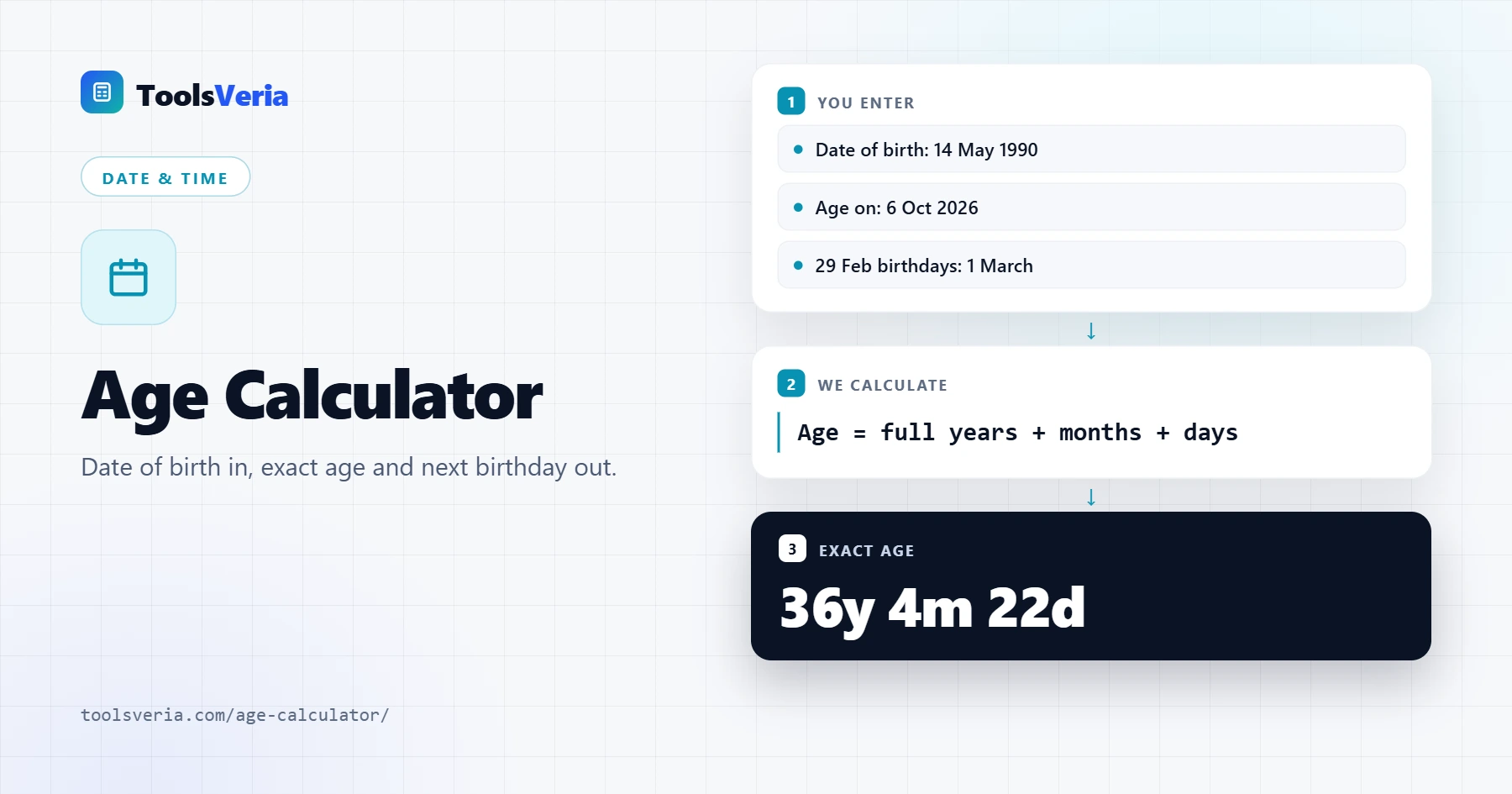
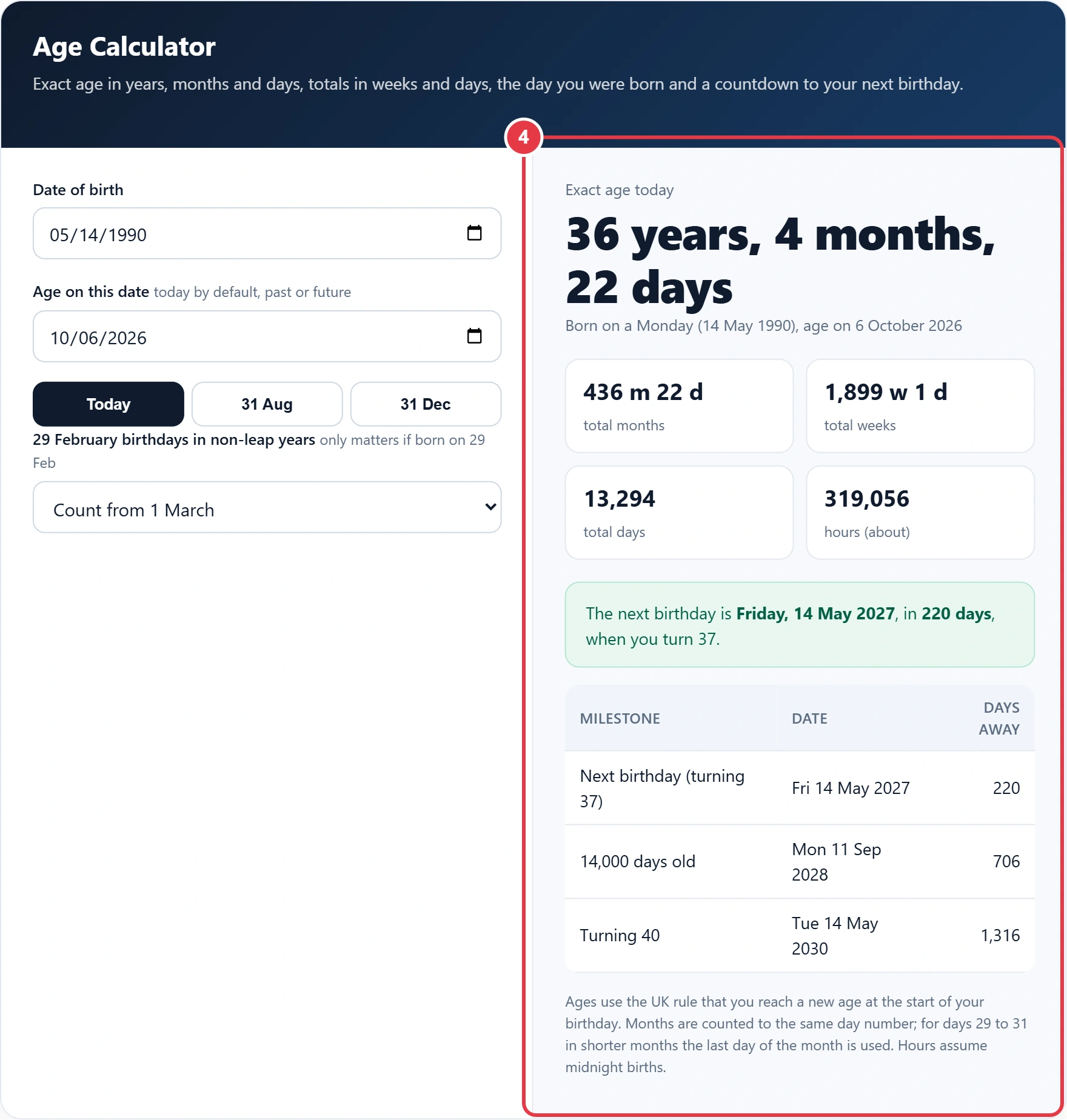
Quick answer: An age calculator counts the full years since your last birthday, then the full months, then the days left over. Someone born on 14 May 1990 is 36 years, 4 months and 22 days old on 6 October 2026, which is 13,294 days. Leap years and different month lengths are handled automatically.
In This Guide
What Is an Age Calculator?
An age calculator is a date tool that measures the exact time between a date of birth and another date, expressed as completed years, months and days. It saves you counting calendar pages and getting leap years or 30 and 31 day months wrong.
The formula in plain words: age = completed years since birth + completed months since the last birthday + days since the last monthly anniversary. Total days are simply the number of days between the two dates, and total weeks are total days divided by 7.
How to Use the Age Calculator
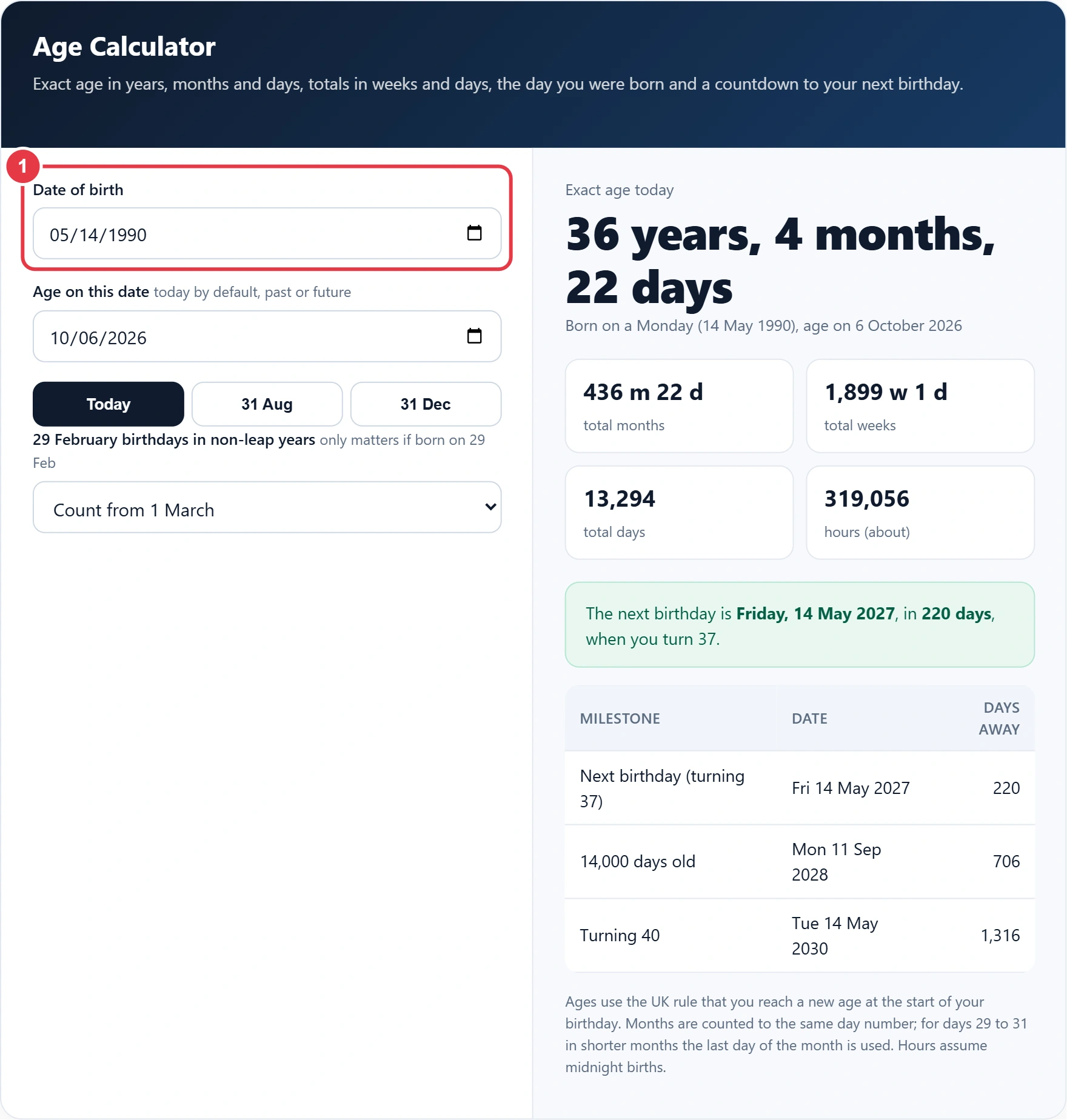
Step 1: Enter the Date of Birth
Pick the date of birth from the date box or type it in. It works for anyone born from 1900 onwards, so you can check a child's, parent's or grandparent's age just as easily as your own.
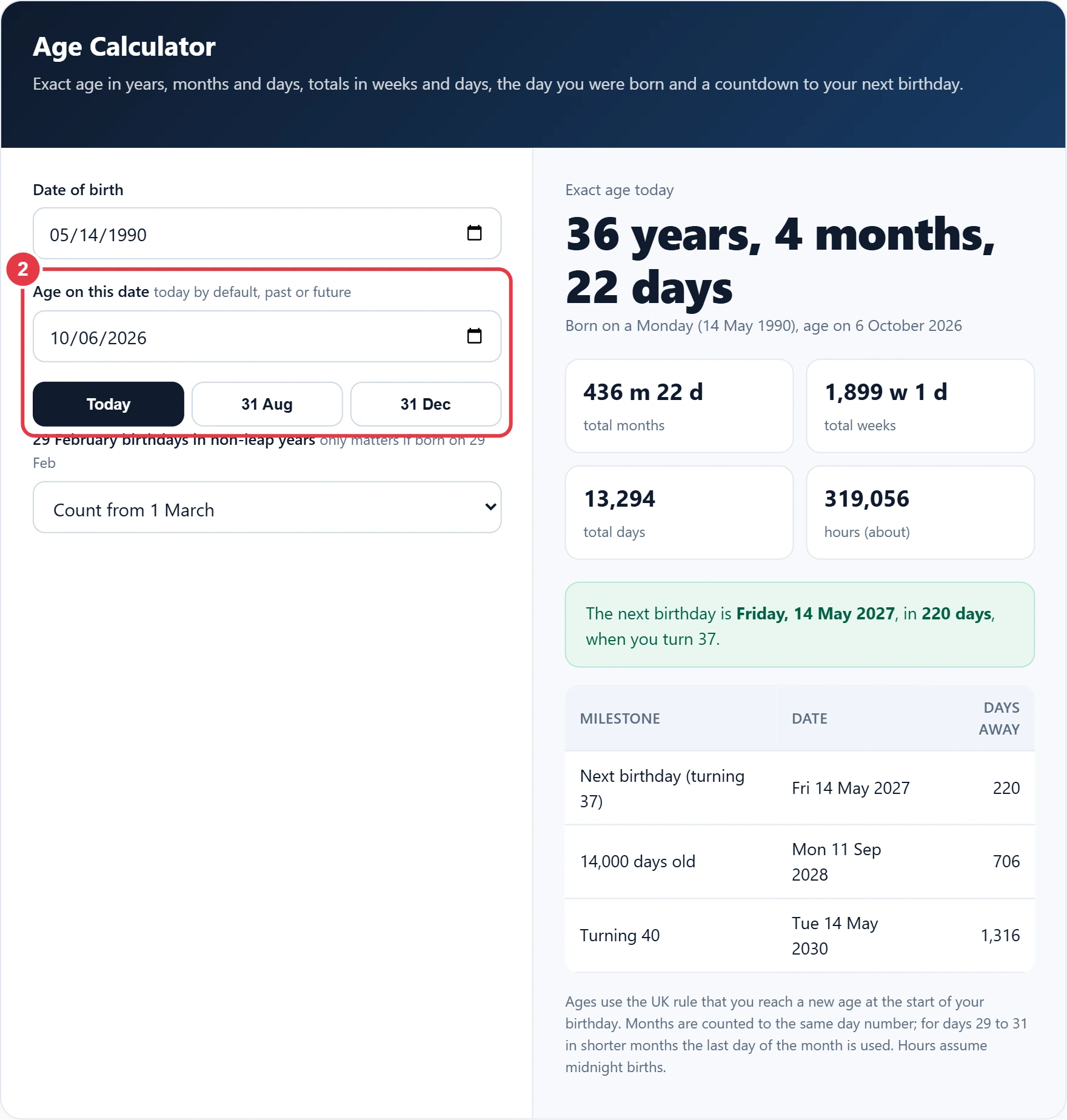
Step 2: Choose the Date to Measure To
The calculator uses today unless you change it. Pick any past or future date to see how old someone was or will be, or tap 31 Aug or 31 Dec for common cut-off dates. For a gap between two dates that are not birthdays, our days between dates calculator splits the total into weekdays and weekend days as well.
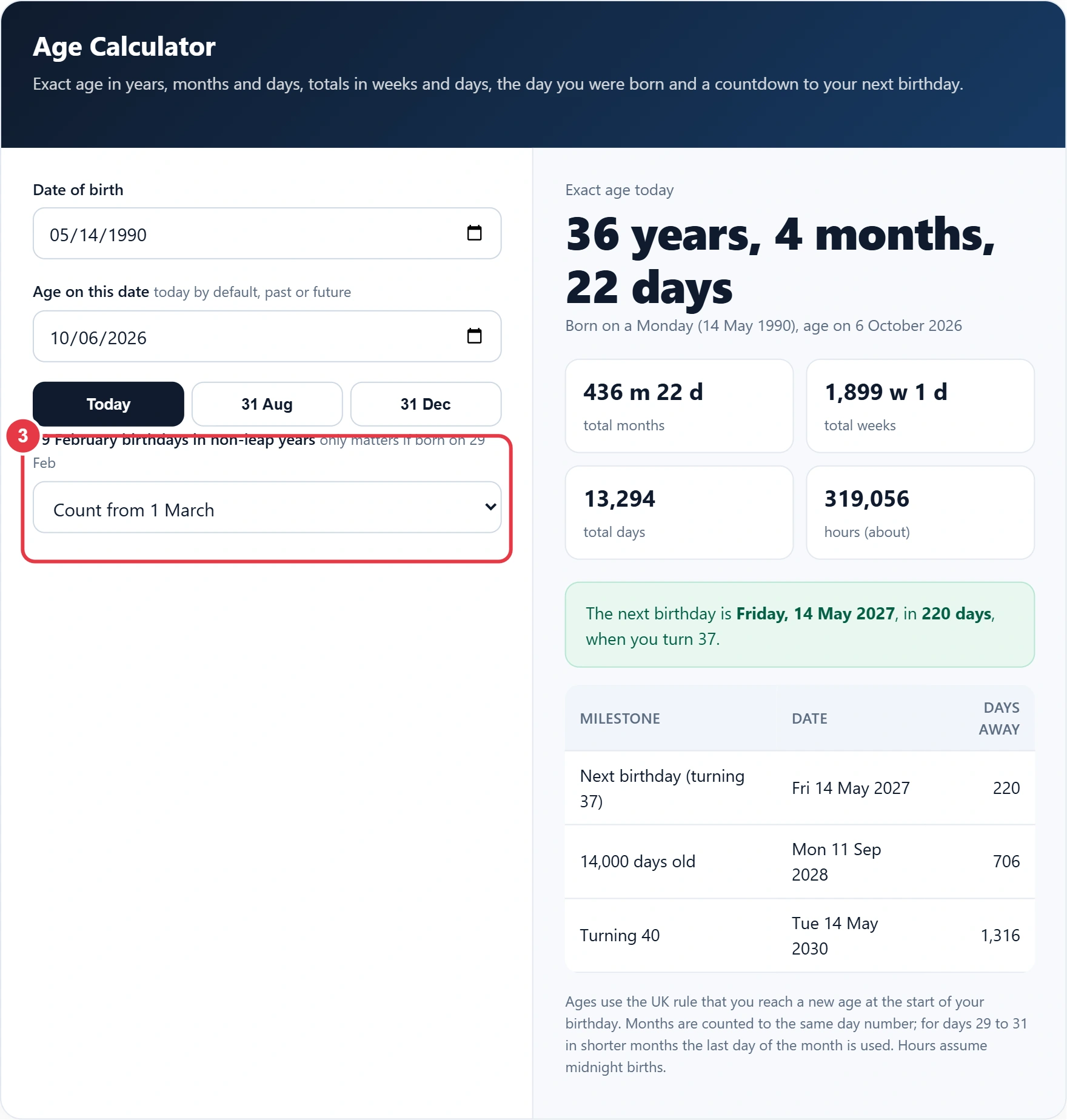
Step 3: Set the 29 February Rule
This setting only matters for people born on 29 February. Choose whether their birthday counts from 1 March or 28 February in years without a leap day. Everyone else can leave it as it is.
Step 4: Read the Results
You will see the exact age, the weekday you were born, total months, weeks, days and hours, and a countdown to the next birthday. The milestone table adds dates such as your next round birthday and your next 1,000 day milestone, each with its weekday.
How Do You Calculate Your Exact Age?
You calculate exact age by counting completed years first, then completed months since your last birthday, then the remaining days. Doing it in that order avoids the common mistake of subtracting the birth year from the current year, which overstates your age until your birthday has passed.
Worked example: Amelia was born on Monday 14 May 1990. On 6 October 2026 she has had 36 birthdays, the last on 14 May 2026. From 14 May to 14 September is 4 full months, and 14 September to 6 October is 22 days, so she is 36 years, 4 months and 22 days old. In total that is 13,294 days, or 1,899 weeks and 1 day, and her next birthday is Friday 14 May 2027, 220 days away.
Months that are shorter than the birth day need a rule. If you were born on 31 January, the calculator treats the last day of February as your monthly anniversary, so on 28 February you are exactly 1 month older, not 28 days.
To find how old you will be in a future year, subtract your birth year from that year, then take off one if the date falls before your birthday. Amelia will turn 40 on Tuesday 14 May 2030, which is 1,316 days after 6 October 2026.
How Many Days Old Am I?
You are roughly 365.25 days old for every year of your age, so a 30 year old has lived 10,957 or 10,958 days. The exact figure depends on how many 29 Februarys fall between your birth and today, which is why the table gives a range for most ages.
| Age | Days lived on that birthday | Weeks (approx) |
|---|---|---|
| 18 | 6,574 or 6,575 | 939 |
| 21 | 7,670 or 7,671 | 1,096 |
| 30 | 10,957 or 10,958 | 1,565 |
| 40 | 14,610 | 2,087 |
| 50 | 18,262 or 18,263 | 2,609 |
| 60 | 21,915 | 3,131 |
| 66 | 24,106 or 24,107 | 3,444 |
Day counts apply to birthdays between 1901 and 2099, when every fourth year is a leap year. Checked October 2026.
When Does a 29 February Birthday Count in Other Years?
There is no single answer: depending on the country, a person born on 29 February reaches a new age on either 28 February or 1 March in a non-leap year. The law in England and Wales says only that you reach an age at the start of the anniversary of your birth date, and it does not name a date for leap day birthdays.
Other countries spell the rule out in their own laws, so a leap day baby can have a different legal birthday abroad. The summary of legal age rules on Wikipedia notes that Hong Kong and Australia use 1 March while Taiwan uses 28 February. If a date matters for a contract, licence or benefit, ask the organisation which rule it applies and set the calculator to match.
When Do UK Rules Depend on Your Exact Age?
Many UK entitlements start on a birthday or a fixed date after it. Most children start reception in the September after their fourth birthday, and the school year group calculator shows which year group a child belongs in from their date of birth. Later in life, the free bus pass age calculator finds the exact date you qualify for free travel in England, Scotland, Wales or Northern Ireland.
Exact dates matter for school too. Children in England reach compulsory school age on 31 December, 31 March or 31 August after their fifth birthday, whichever comes first, as the GOV.UK guidance on school starting age explains, so the 31 Aug button shows a child's age at the end of a school year in one tap.
</>Embed this calculator on your website
Add the free Age Calculator to your own site or blog. Copy the code below and paste it into an HTML block. It resizes itself and works on phones.
How we checked this tool: the Tools Veria Editorial Team built this tool by hand, checked it against the official rules or published standards where they apply, and tested it against worked examples. Results are estimates for planning, not personal financial or tax advice. Read our editorial policy and disclaimer, or report an error.
Frequently Asked Questions
How old am I if I was born in 2000?
If you were born in 2000, you are 26 years old in 2026 once your birthday has passed, and 25 before it. Enter your full date of birth in the age calculator to get the exact figure in years, months and days.
How do I work out someone's age on a specific date?
Enter their date of birth, then change the age on date to the day you need, such as an application deadline. The calculator shows their exact age on that day, which is useful for forms, school places and insurance.
How many weeks old am I?
Divide the number of days you have lived by 7. A person born on 14 May 1990 is 1,899 weeks and 1 day old on 6 October 2026, because they have lived 13,294 days. The calculator shows this total for any date of birth.
Does the age calculator count leap years?
Yes. It uses the real calendar, so every 29 February between the two dates is counted as a day lived. That is why someone turning 18 has lived either 6,574 or 6,575 days, depending on the leap years in between.
What day of the week was I born?
Enter your date of birth and the calculator shows the weekday straight away under your age. For example, 14 May 1990 was a Monday and 1 January 2000 was a Saturday. It works for any date from 1900 onwards.
When do you legally turn a new age in the UK?
In England and Wales you reach a new age at the very start of your birthday, at midnight, under section 9 of the Family Law Reform Act 1969. You do not have to wait until the time of day you were born.