Enter the date code from the tyre sidewall (US: tire) to see how old it is and when it should be inspected or replaced.
5 and 10 years are example defaults that match common tyre maker guidance. Your vehicle or tyre manufacturer's advice takes priority.
Week 01 is the first full week of the year, so the made date is accurate to within about a week. Age is only one factor: replace any tyre with cracks, bulges or tread below the legal limit whatever its age.
This tyre age calculator tells drivers in the UK and US exactly how old a tyre (or tire) is from the DOT date code on its sidewall, and shows when it should be inspected each year and when to replace it, including the 10 year legal limit on UK lorries, buses, coaches and minibuses set out on GOV.UK. Type the four digits, and the answer appears in years and months.
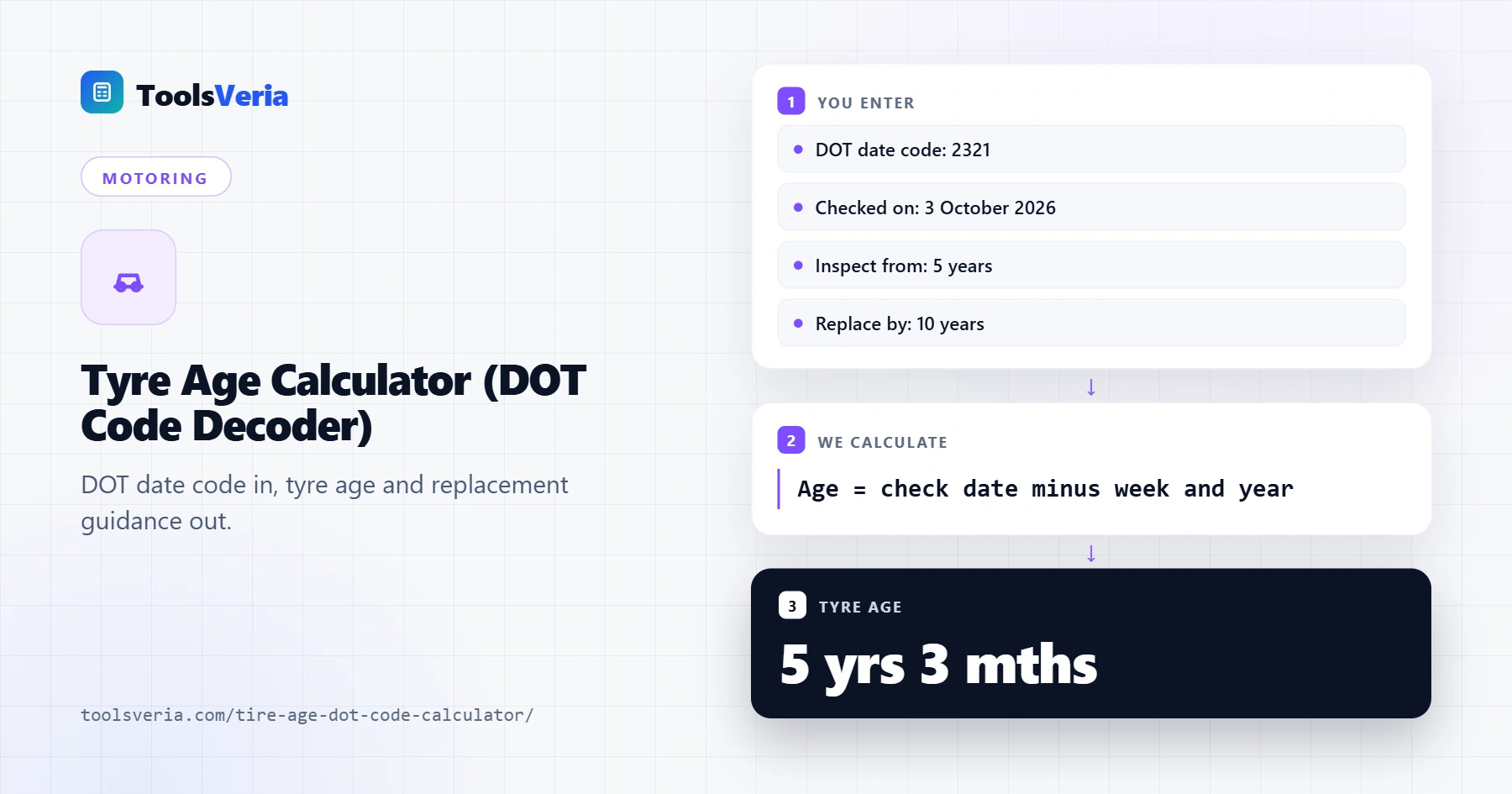
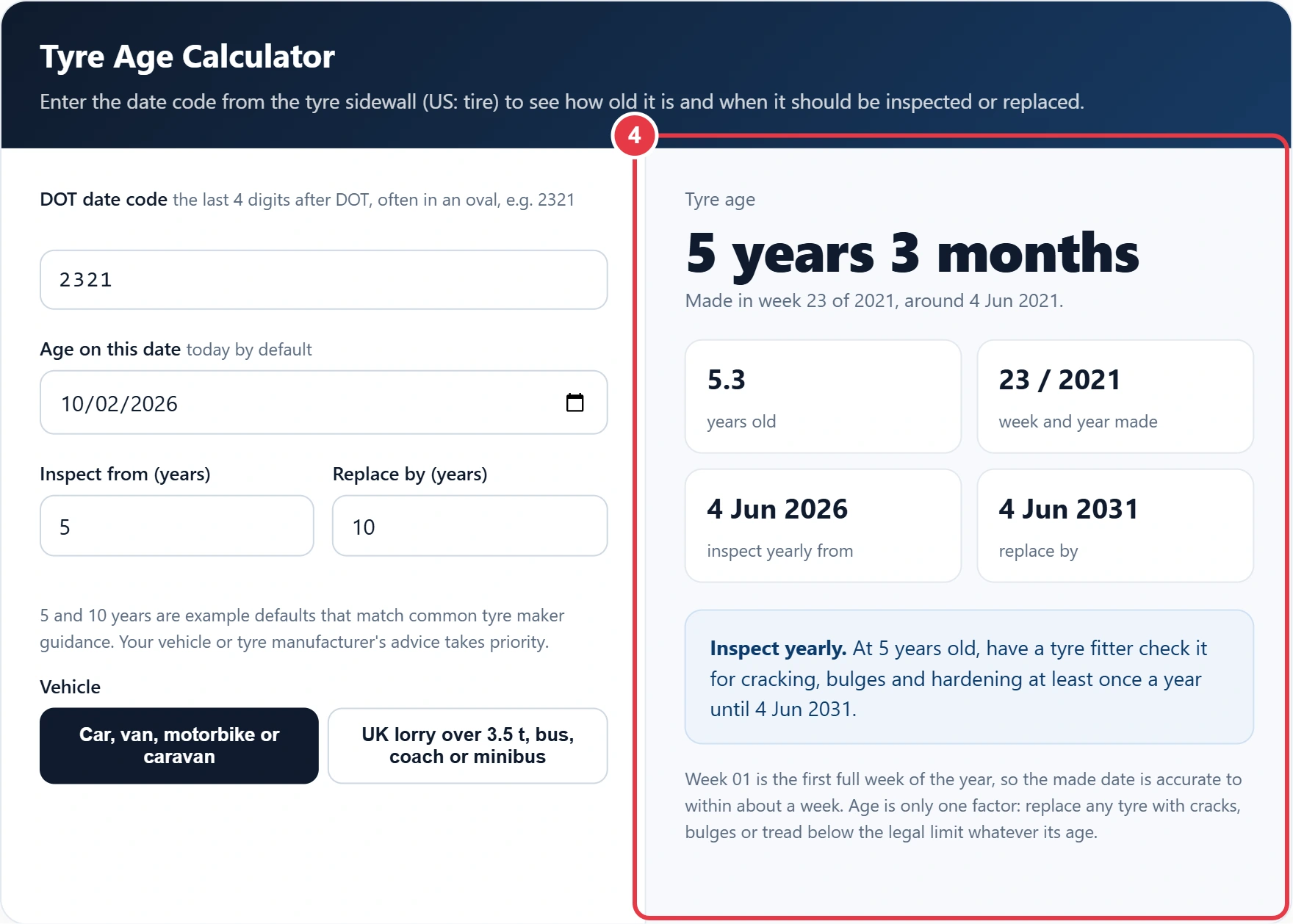
Quick answer: find the four digits after DOT on the sidewall: the first two are the week and the last two are the year, so 2321 means week 23 of 2021. On 3 October 2026 that tyre is 5 years 3 months old. The tyre age calculator above does this for any code.
In This Guide
What Is a Tyre Age Calculator?
A tyre age calculator is a tool that converts the week and year code moulded into a tyre into its manufacture date and its age today. The formula in plain words: take the year from the last two digits, count forward to the week given by the first two digits, then measure the time from that week to the date you are checking.
The code comes from the tyre identification number required in the US under federal rule 49 CFR 574.5, which says the date code is the final group of four numbers and that week 01 is the first full calendar week of the year. Tyres sold in the UK and Europe carry the same code, so this one tool answers both "how old are my tyres" and "how old are my tires".
How to Use the Tyre Age Calculator
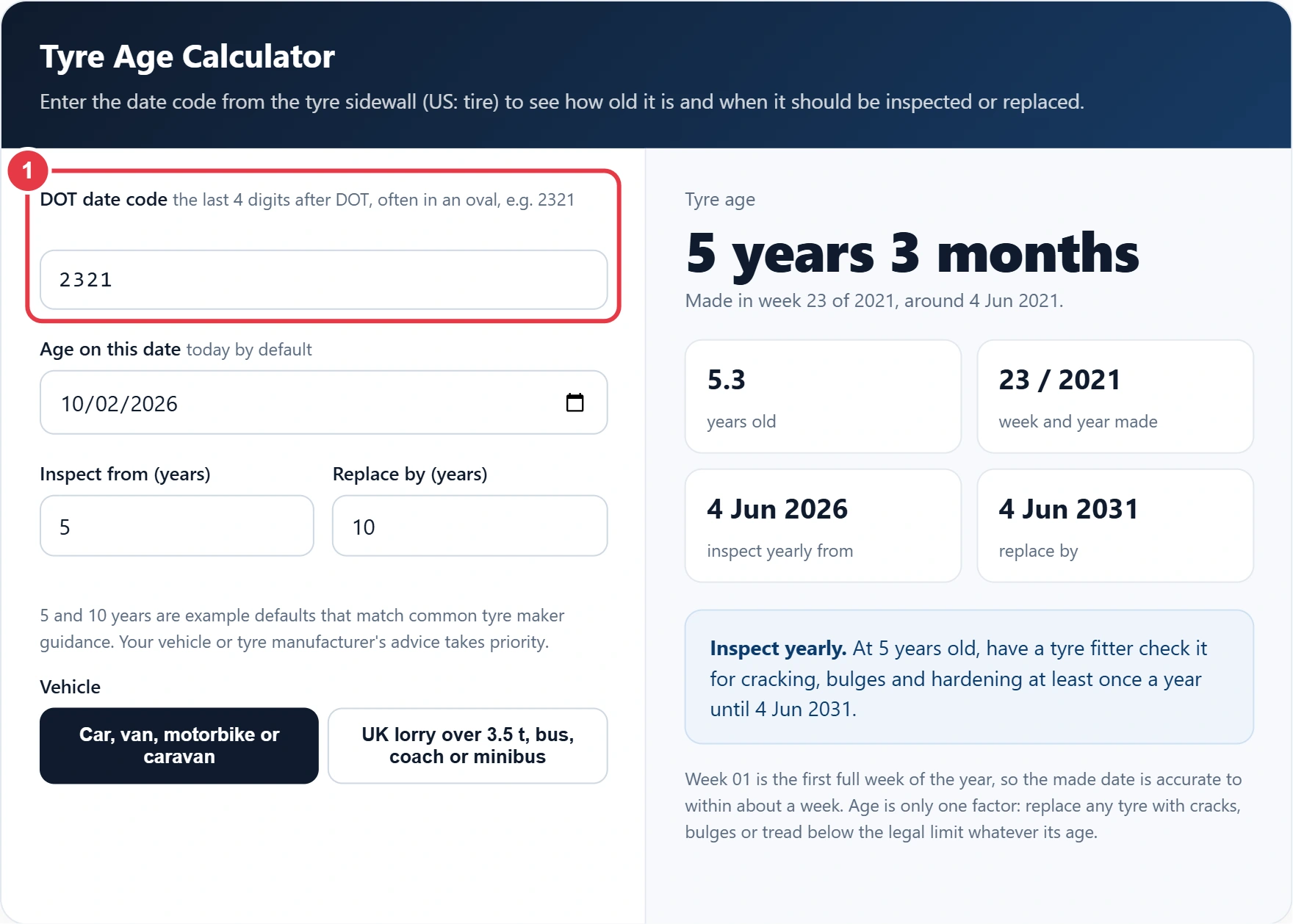
Step 1: Find and Enter the Date Code
Look on the sidewall for the letters DOT followed by about 12 characters. The last four digits, often in a raised oval, are the date code. You can type just those four digits or paste the whole DOT number. The full code is sometimes on the inner sidewall only, so check both sides.
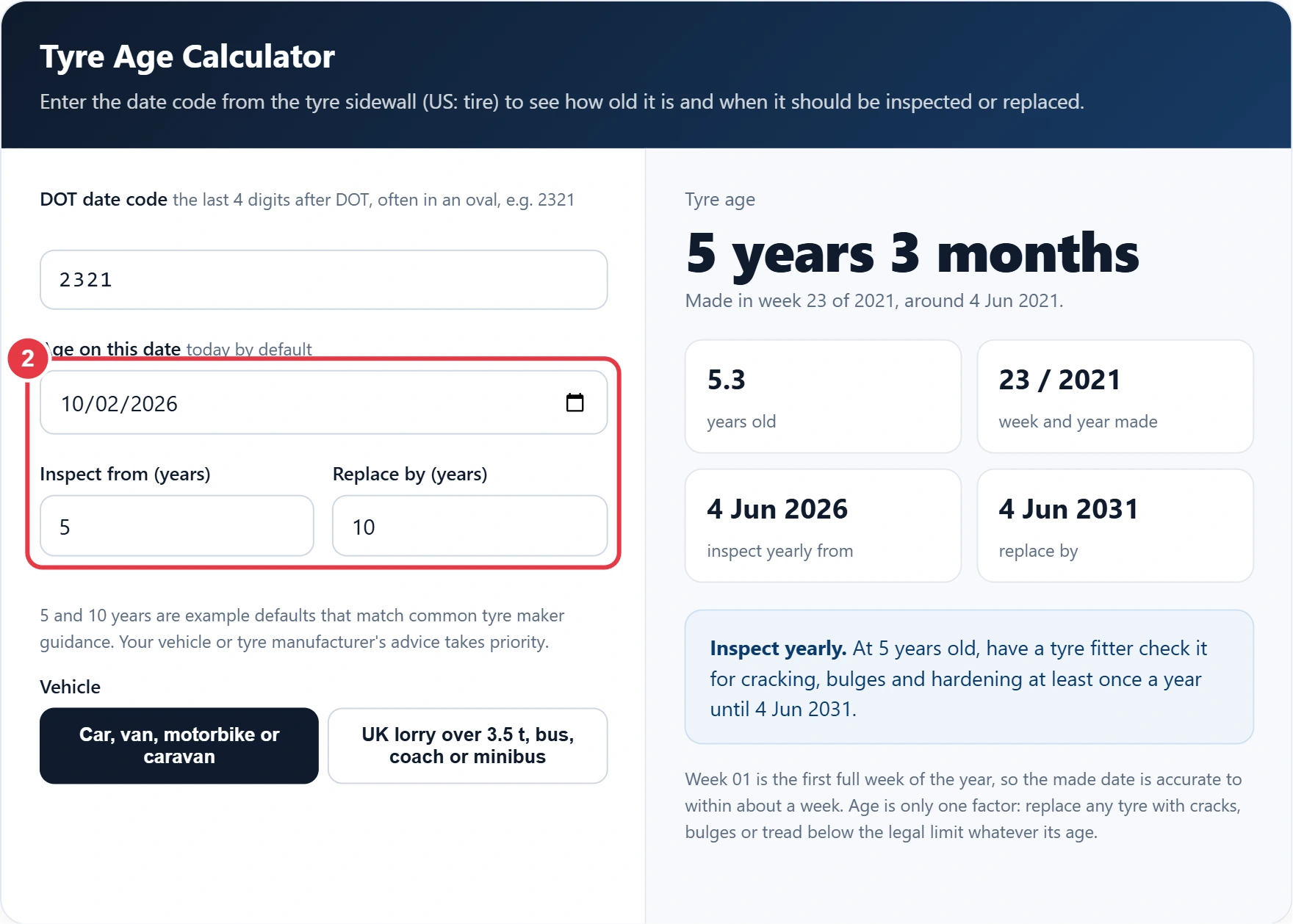
Step 2: Set the Date and Age Limits
The check date is today unless you change it, which helps when you are judging a used car before a test drive. The default limits, yearly inspection from 5 years and replacement by 10 years, are editable because tyre and vehicle makers set their own figures.
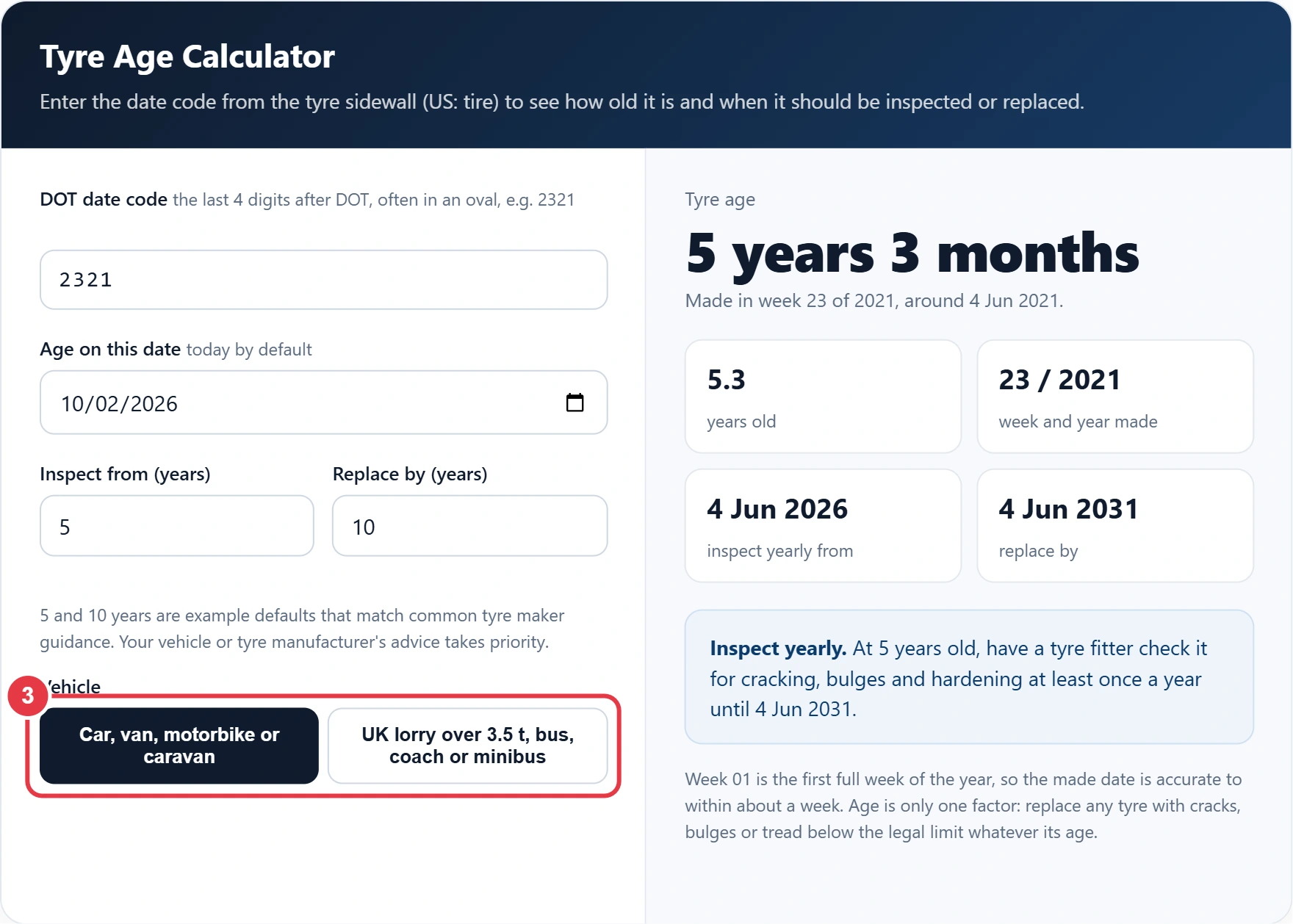
Step 3: Choose the Vehicle
Pick the second option for a UK lorry over 3.5 tonnes, bus, coach or minibus, and the result adds the legal 10 year limit for steering axles and single wheel axles. Cars, vans, motorbikes and caravans have no legal age limit in the UK.
Step 4: Read the Result
You get the age in years and months, the approximate manufacture date, and the dates when yearly inspections and replacement fall due. A green box means the tyre is fine on age, blue means inspect it yearly, and red means replace it.
How Old Are My Tyres?
Your tyres are as old as the time since the week and year in their four digit DOT code, regardless of when they were fitted. Worked example: Priya in Leeds is buying a 2020 hatchback in October 2026. The tyres read 2321, 2321, 4419 and, on the spare, 3816. The tyre age calculator shows 5 years 3 months for the first two, 6 years 11 months for 4419 (week 44 of 2019), and exactly 10 years for the spare (week 38 of 2016), so she asks the seller for a new spare and budgets for two front tyres soon.
| Date code | Made | Age on 3 October 2026 | Suggested action |
|---|---|---|---|
| 3125 | Week 31, 2025 | 1 year 2 months | Normal checks |
| 2321 | Week 23, 2021 | 5 years 3 months | Inspect yearly |
| 4419 | Week 44, 2019 | 6 years 11 months | Inspect yearly |
| 3816 | Week 38, 2016 | 10 years 0 months | Replace |
| 129 (3 digits) | Week 12, before 2000 | Over 26 years | Replace now |
When Should Tyres Be Replaced Because of Age?
Many tyre makers advise a yearly professional inspection from 5 years old and replacement by 10 years old, even if the tread looks good. Rubber hardens as it ages, which lengthens wet braking distances, and fine cracks between the tread blocks or on the sidewall are an early warning. Before a long trip, check the codes and pressures together, and use the fuel cost calculator to budget the journey, because a summer holiday is when old caravan tyres are most likely to fail. Spares, caravan and motorhome tyres often reach 10 years with plenty of tread left, which is exactly why their age needs checking.
Is It Legal to Drive on Old Tyres in the UK?
Yes for cars: UK law sets no maximum tyre age for private cars, vans, motorbikes or caravans. The legal tests are condition and tread, and the Highway Code annex on vehicle maintenance and tyre tread says cars and light vans must have at least 1.6 mm across the central three quarters of the tread. In Great Britain since 1 February 2021, tyres over 10 years old have been banned on the front steering axles of lorries over 3.5 tonnes, buses, coaches and minibuses, and on their axles without twin wheels, and the date code must be legible.
An older car can sit on young tyres and a nearly new car can carry old stock, so check each code rather than assuming. If you are checking a used car's paperwork at the same time, the VIN model year decoder confirms its model year from the chassis number. Figures checked October 2026 against GOV.UK and 49 CFR 574.5.
</>Embed this calculator on your website
Add the free Tyre Age Calculator (DOT Code Decoder) to your own site or blog. Copy the code below and paste it into an HTML block. It resizes itself and works on phones.
How we checked this tool: the Tools Veria Editorial Team built this tool by hand, checked it against the official rules or published standards where they apply, and tested it against worked examples. Results are estimates for planning, not personal financial or tax advice. Read our editorial policy and disclaimer, or report an error.
Frequently Asked Questions
How do I read the date code on a tyre?
Find the last four digits after the letters DOT on the sidewall. The first two digits are the week of manufacture and the last two are the year, so 0824 means week 8 of 2024, which is late February 2024.
How old is too old for a tyre?
Many tyre makers advise yearly inspection from 5 years and replacement at 10 years from the manufacture date, whatever the tread depth. Replace sooner if you see cracks, bulges or tread below 1.6 mm on a car.
Is there a legal age limit for car tyres in the UK?
No. There is no legal age limit for car, van or motorbike tyres in the UK. In Great Britain since 1 February 2021, tyres over 10 years old are banned on front steering axles of lorries over 3.5 tonnes, buses, coaches and minibuses.
What does a 3 digit tyre date code mean?
A 3 digit code means the tyre was made before 2000. The first two digits are the week and the third is the last digit of the year, so the tyre is at least 26 years old in 2026 and should be replaced.
Can a new tyre be several years old?
Yes. A tyre can sit in a warehouse before sale, so a newly fitted tyre may already be a year or two old. Ask the fitter for stock under about 2 years old and check the four digit date code before fitting.
Do I need to check the spare tyre's age?
Yes. Spare tyres are rarely used, so they often look new but can be over 10 years old. Enter the spare's DOT date code in the tyre age calculator and replace it if it is past the replacement age.