
Daniel was about to pay £7,800 for a 2018 estate car in Swindon when he crouched down, rubbed the dirt off a sidewall and asked himself how old are my tyres going to be if I buy this. The tread looked deep and the rubber was shiny. The four small digits beside the letters DOT told a different story on one of the five wheels.
Tread depth tells you how worn a tyre is. Only the date code tells you its age, and rubber keeps ageing whether the car is driven or parked on a drive. Below, Daniel’s five codes are decoded one by one, alongside what the law in Great Britain actually requires and what tyre makers recommend.
Quick answer: Find the four digits after DOT on the sidewall. The first two are the week and the last two are the year of manufacture, so 2321 means week 23 of 2021, which makes the tyre 5 years 4 months old on 21 October 2026. GOV.UK sets no age limit for car tyres; many makers advise replacement by 10 years.
In This Guide
How do I read the date code on my tyres?
You read a tyre’s date code from the last four digits of the DOT number on its sidewall: the first pair is the week of manufacture and the second pair is the year. The digits often sit in a small raised oval at the end of a string of about 12 letters and numbers that begins with DOT.
The rule in plain words: take the last two digits as the year, count forward to the week shown by the first two, then measure from that week to today. The code comes from the US federal rule 49 CFR 574.5, which defines week 01 as the first full calendar week of the year, and tyres sold in the UK carry the same marking.
One practical snag catches most people. The full code is often moulded on one side only, and on many cars that side faces inwards. If the outer wall shows a shorter DOT string with no oval, turn the steering to full lock and look at the inner wall of the front tyres with a phone torch, or check the rear tyres from underneath the arch.
- Four digits, such as 0620: week 6 of 2020.
- Three digits, such as 129: made before 2000, so at least 26 years old today.
- No oval visible: the full date code is probably on the other sidewall.

How old are my tyres? Five real codes decoded
Your tyres are as old as the time since the week and year in their date code, regardless of when they were fitted or how far they have been driven. Daniel found five different codes on the estate, and the ages below are worked out for 21 October 2026.
| Position | Date code | Made | Age on 21 October 2026 | Suggested action |
|---|---|---|---|---|
| Front left | 4325 | Week 43, 2025 | 11 months | Normal checks |
| Front right | 4325 | Week 43, 2025 | 11 months | Normal checks |
| Rear left | 0620 | Week 6, 2020 | 6 years 8 months | Inspect yearly |
| Rear right | 4419 | Week 44, 2019 | 6 years 11 months | Inspect yearly |
| Spare | 3816 | Week 38, 2016 | 10 years 1 month | Replace |
The pattern is typical of a car that has had two owners. Someone fitted a new pair on the front last autumn, the rears were left alone because their tread still passed, and nobody ever looked at the spare under the boot floor. Daniel used the age of that spare to knock £60 off the price, which covered a new matching tyre with change to spare.
Each of these results takes seconds when the code is typed into the tyre age calculator, which also shows the date a yearly inspection becomes due. The tool flags an impossible code, such as a week number above 53, which usually means a digit has been misread under a layer of road grime.

How old is too old for a tyre?
Many tyre and vehicle makers advise a yearly professional inspection once a tyre is 5 years old and replacement by 10 years old, even when the tread still looks healthy. These are manufacturer recommendations rather than UK law, and some car handbooks set a shorter limit of 6 years, so check yours first.
The reason is chemistry, not wear. Oils and antioxidants in the rubber slowly leave the compound, so an old tyre becomes harder and grips less well on a cold wet road. Fine cracks between the tread blocks or around the sidewall, a dull grey look and small bulges are the visible warnings, and any one of them means the tyre needs a professional opinion whatever its date code says.
Daniel’s rear tyres show how the guidance works in practice. At almost 7 years old with 4 mm of tread and no cracking, they are fine for now, but they move into the yearly check category. He has noted October 2027 as the point to inspect again, and he expects to replace them well before the rear right reaches 10 years in November 2029.
Is there a legal age limit for tyres in the UK?
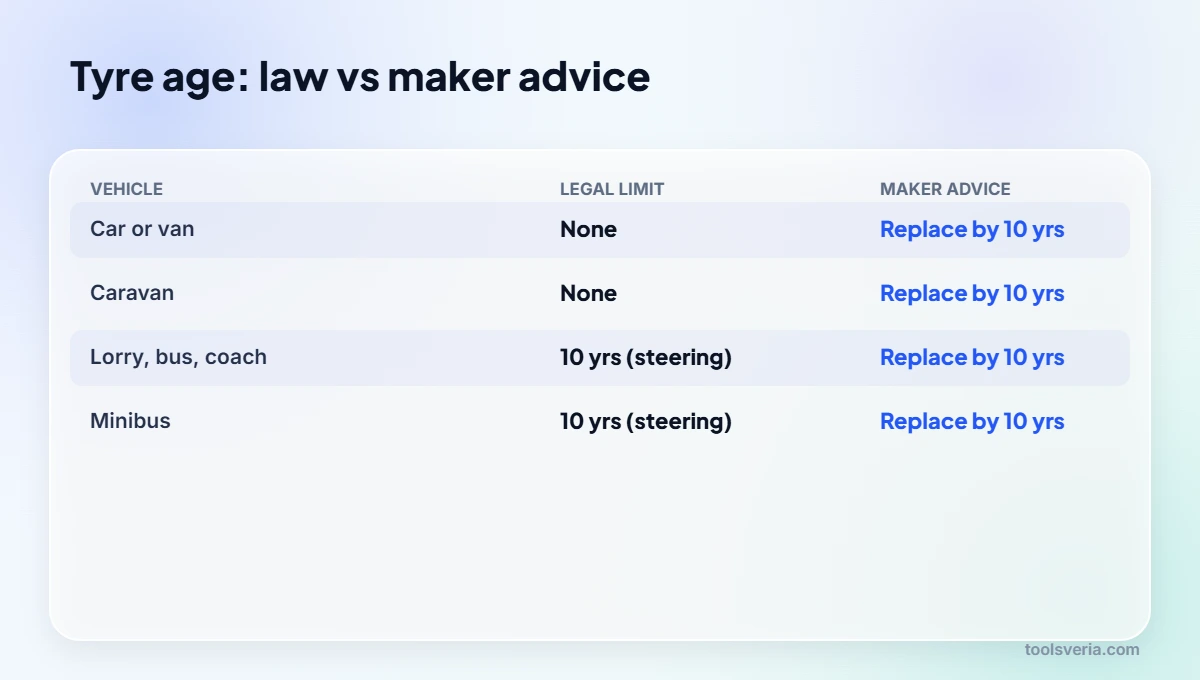
There is no legal age limit for tyres on private cars, vans, motorcycles or caravans in the UK; the legal tests are condition and tread depth. Cars and light vans need at least 1.6 mm of tread across the central three quarters of the tyre, as the Highway Code annex on vehicle maintenance sets out, all the way around the circumference.
Heavier vehicles are different. In England, Scotland and Wales since February 2021, tyres more than 10 years old have been banned from the front steering axles of lorries over 3.5 tonnes, buses, coaches and minibuses, and from their rear axles unless they run twin wheels. The GOV.UK guidance on tyre age restrictions also makes it an offence to run those tyres with an illegible date code, and a retread counts its age from the date it was retreaded.
| Vehicle | Legal age limit in Great Britain | What still applies |
|---|---|---|
| Car, van or motorcycle | None | Condition and tread depth (1.6 mm for cars) |
| Caravan or motorhome | None in law | Condition; makers often advise replacement by 10 years |
| Lorry over 3.5 tonnes, bus or coach | 10 years on steering axles and single wheel axles | Date code must be legible |
| Minibus | 10 years on steering axles and single wheel axles | Date code must be legible |
An MOT tester checks tread, cuts, bulges and cracking, not the birthday on the sidewall. If a car is coming up to its third birthday, the first MOT due date calculator tells you when that test falls, which is a good moment to read the codes on all the original tyres as well.
Which tyres are most likely to be too old?
Spare wheels, caravan tyres and the tyres on low mileage cars are the ones most likely to pass 10 years with plenty of tread left. They rarely wear out, so nothing prompts the owner to replace them, and age becomes the only warning sign.
Ruth tows a single axle caravan to Cornwall each summer and covers about 600 miles a year with it. She budgets each holiday with the fuel cost calculator, yet she had never checked the tyres: they still have 6 mm of tread, but the date code reads 2216, week 22 of 2016, so they turned 10 in late May 2026. Two new tyres are now on her list before the next trip.
New tyres can be old stock too. A tyre may sit in a warehouse for a year or more before it is sold, so ask the fitter to check the date code before fitting and say if you would rather have stock made within the last two years. When buying a used car, confirm the model year from the chassis number with the VIN model year decoder, then read every tyre code, including the spare. Original tyres that are as old as the car itself are a sign that nothing has been replaced since the factory, which is worth knowing before you agree a price.
Key points
- The last four digits of a tyre’s DOT code show the week and then the year it was made.
- A tyre coded 2321 is 5 years 4 months old on 21 October 2026.
- A three digit date code means the tyre was made before 2000 and should be replaced.
- UK law sets no age limit for car tyres, but cars need at least 1.6 mm of tread.
- Since February 2021, tyres over 10 years old are banned on steering axles of lorries, buses, coaches and minibuses in Great Britain.
Key Tyre Age Terms Explained
These terms help you answer how old are my tyres from the sidewall markings, and tell the difference between tyre age, tread wear and legal limits.
- DOT code
- The string of letters and numbers moulded into a tyre sidewall after the letters DOT, identifying the factory, size and production batch. Its final four digits record the manufacture week and year, which is the only reliable guide to the tyre’s age.
- Date of manufacture
- The week and year a tyre left the factory, read as a two digit week followed by a two digit year. Age is counted from this date, not from the date of fitting, because rubber begins ageing as soon as it is cured.
- 49 CFR 574.5
- The US federal regulation that sets the format of tyre identification numbers, including the date code. It defines week 01 as the first full calendar week of the year, and tyres sold in the UK carry the same marking.
- Tread depth
- The depth of the grooves in a tyre’s contact surface, measured in millimetres. It shows how worn a tyre is but says nothing about its age, so a tyre with deep tread can still be old enough to need replacing.
- Tyre ageing
- The slow hardening and cracking of rubber as oils and antioxidants leave the compound over time. It happens whether or not the car is driven, which is why makers set inspection and replacement ages independent of mileage.
Frequently Asked Questions
My tyre says 0117. Is that January 2017?
Yes, 0117 means week 1 of 2017, the first full week of January that year. On 21 October 2026 the tyre is 9 years 9 months old, so it should be inspected now and planned for replacement before it reaches 10 years in January 2027.
The garage fitted my tyres last month but the code says 2024. Should I complain?
Not necessarily, because tyres often spend a year or more in storage before sale. A code from late 2024 makes the tyre under 2 years old, which most fitters treat as acceptable. If you want newer stock, ask for it before fitting rather than afterwards.
Will my car fail its MOT because the tyres are 8 years old?
No, the MOT does not test tyre age on cars. It checks tread depth, which must be at least 1.6 mm, and damage such as cuts, bulges and cracking. An 8 year old tyre in good condition passes, while a 3 year old tyre with a bulge fails.
I can only find three digits after DOT. What does that mean?
A three digit date code means the tyre was made before 2000, because the year was shown by a single digit. It is at least 26 years old in 2026 and should be replaced straight away, even if it has never been used.
Daniel bought the estate with a new spare in the boot and a note to inspect the rear tyres next October. Check your own five codes, spare included, and you will know in a few minutes which tyres are fine and which need a closer look. Figures checked October 2026.