Financial year 1 April 2026 to 31 March 2027. Your home is charged at the band below.
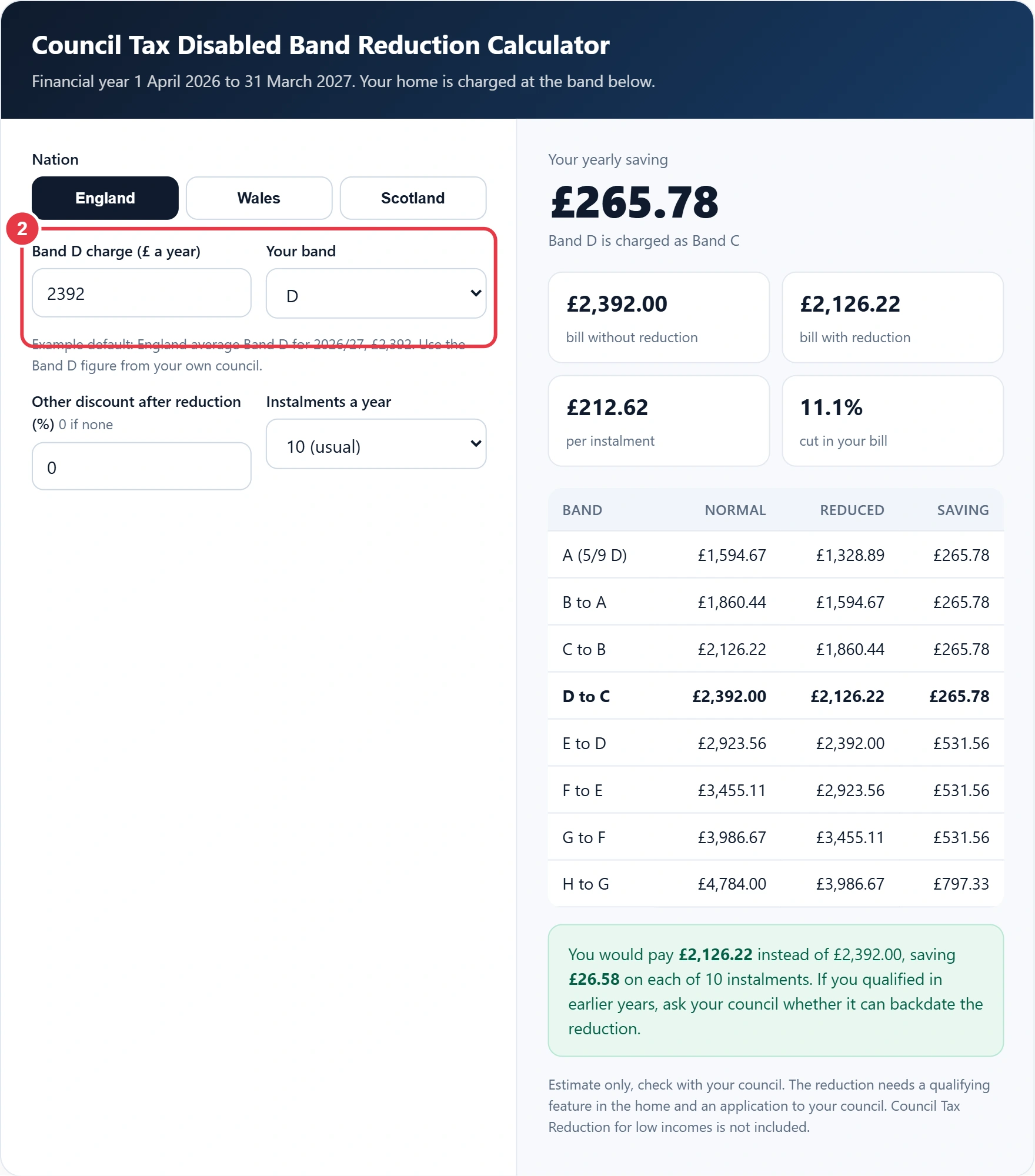
Example default: England average Band D for 2026/27, £2,392. Use the Band D figure from your own council.
| Band | Normal | Reduced | Saving |
|---|
Estimate only, check with your council. The reduction needs a qualifying feature in the home and an application to your council. Council Tax Reduction for low incomes is not included.
This council tax disabled band reduction calculator shows households in England, Wales and Scotland how much the disabled band reduction takes off a 2026/27 council tax bill. The rules on GOV.UK's page on discounts for disabled people say the home is charged at the next band down, and the tool turns that into pounds for your band and your council. Figures checked October 2026.
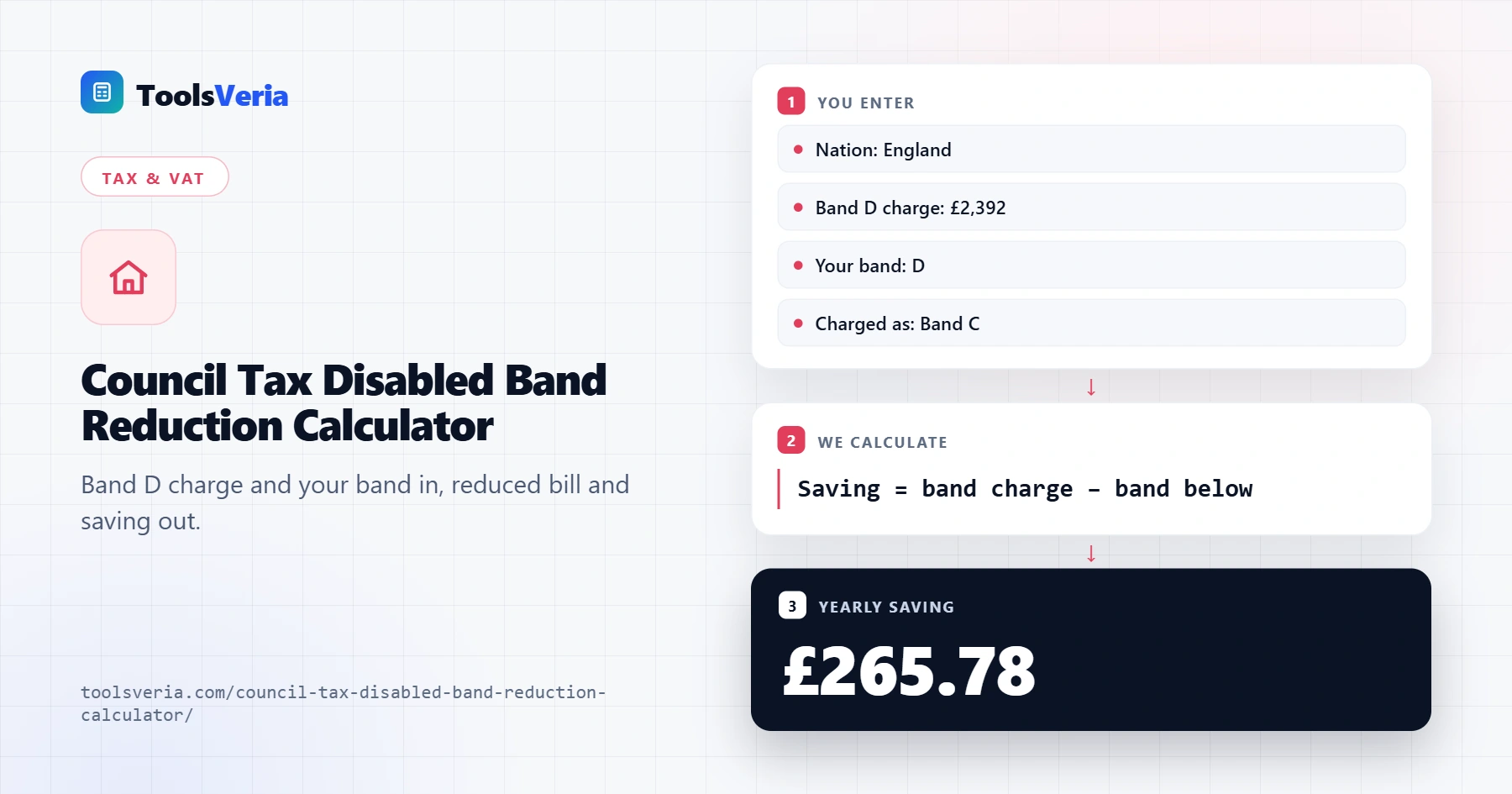
Quick answer: The disabled band reduction charges your home at the band below its real band, so Band D pays the Band C rate. In England the council tax disabled band reduction calculator shows a saving of one ninth of Band D for Bands A to D, two ninths for Bands E to G and three ninths for Band H.
In This Guide
What Is the Council Tax Disabled Band Reduction?
The disabled band reduction is a council tax reduction that bills a home one valuation band lower because it is bigger than it would need to be if a disabled resident did not live there. It is not means tested, it does not depend on any benefit, and the disabled person can be an adult or a child.
In plain words: saving = your band's charge minus the charge for the band below. Every band is a fixed fraction of Band D. In England and Wales Band A is 6/9, B is 7/9, C is 8/9, E is 11/9, F is 13/9, G is 15/9, H is 18/9 and Welsh Band I is 21/9. Band A has no band below it, so it is charged at 5/9 of Band D instead, a cut of one sixth (16.67%), which GOV.UK rounds to 17%. Scotland uses its own proportions out of 360: 240, 280, 320, 360, 473, 585, 705 and 882 for Bands A to H.
How Much Is the Disabled Band Reduction Worth in 2026/27?
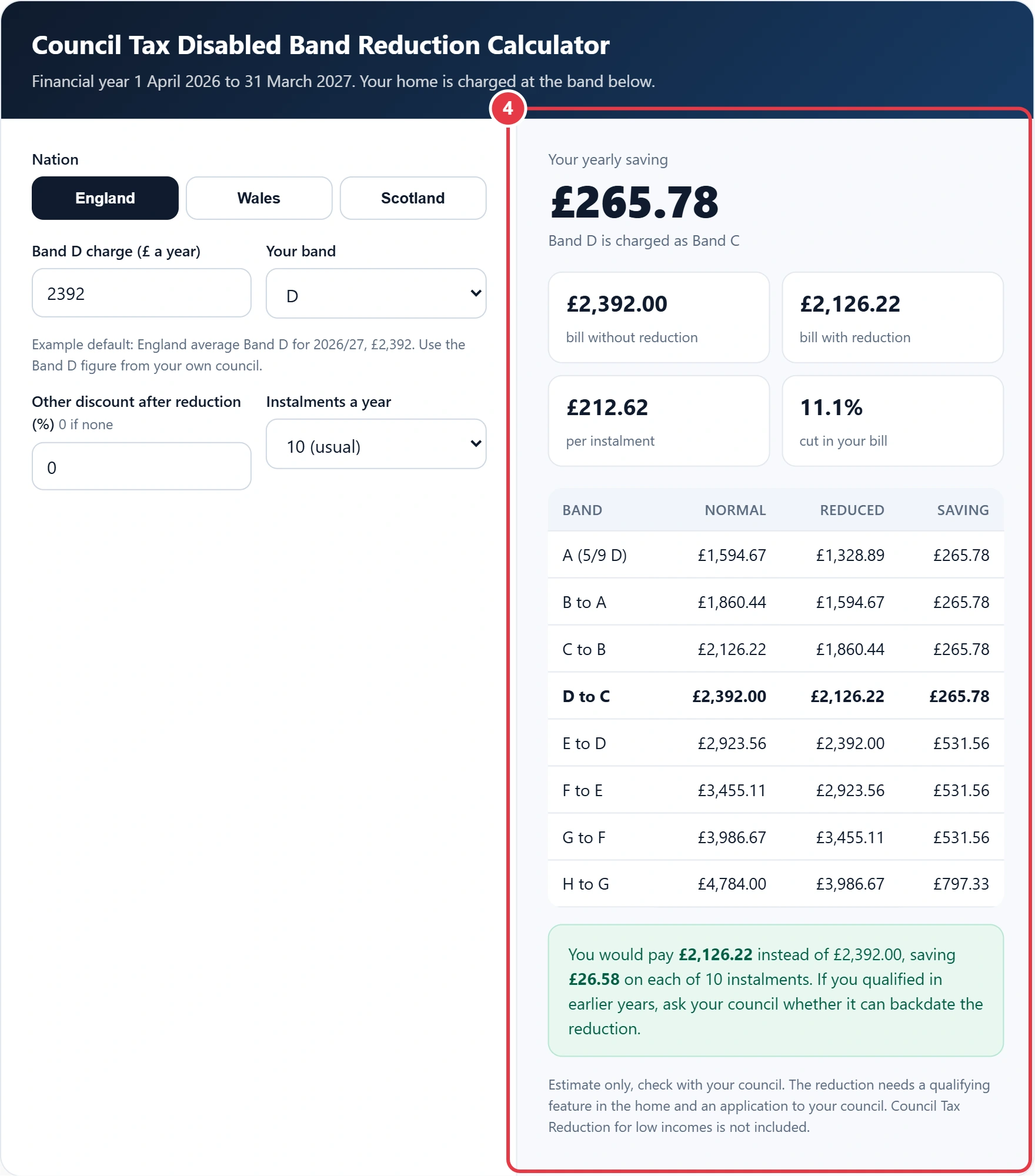
On the 2026/27 average English Band D charge of £2,392, the disabled band reduction is worth £265.78 a year for Bands A to D, £531.56 for Bands E to G and £797.33 for Band H. Your own figure depends on your council's Band D charge, which includes the county, police, fire and parish parts.
| Your band (England) | Charged as | Normal bill | Reduced bill | Yearly saving |
|---|---|---|---|---|
| A | 5/9 of Band D | £1,594.67 | £1,328.89 | £265.78 |
| B | A | £1,860.44 | £1,594.67 | £265.78 |
| C | B | £2,126.22 | £1,860.44 | £265.78 |
| D | C | £2,392.00 | £2,126.22 | £265.78 |
| E | D | £2,923.56 | £2,392.00 | £531.56 |
| F | E | £3,455.11 | £2,923.56 | £531.56 |
| G | F | £3,986.67 | £3,455.11 | £531.56 |
| H | G | £4,784.00 | £3,986.67 | £797.33 |
Take Amira, whose son uses a wheelchair indoors. Their Band D house in an English council charging the average of £2,392 is billed as Band C once the reduction is granted, so the bill falls to £2,126.22. That is £265.78 off the year, or £26.58 less on each of the usual 10 monthly instalments. If the house were Band E the saving would double to £531.56, because the gap between Bands E and D is two ninths of Band D.
How to Use the Council Tax Disabled Band Reduction Calculator
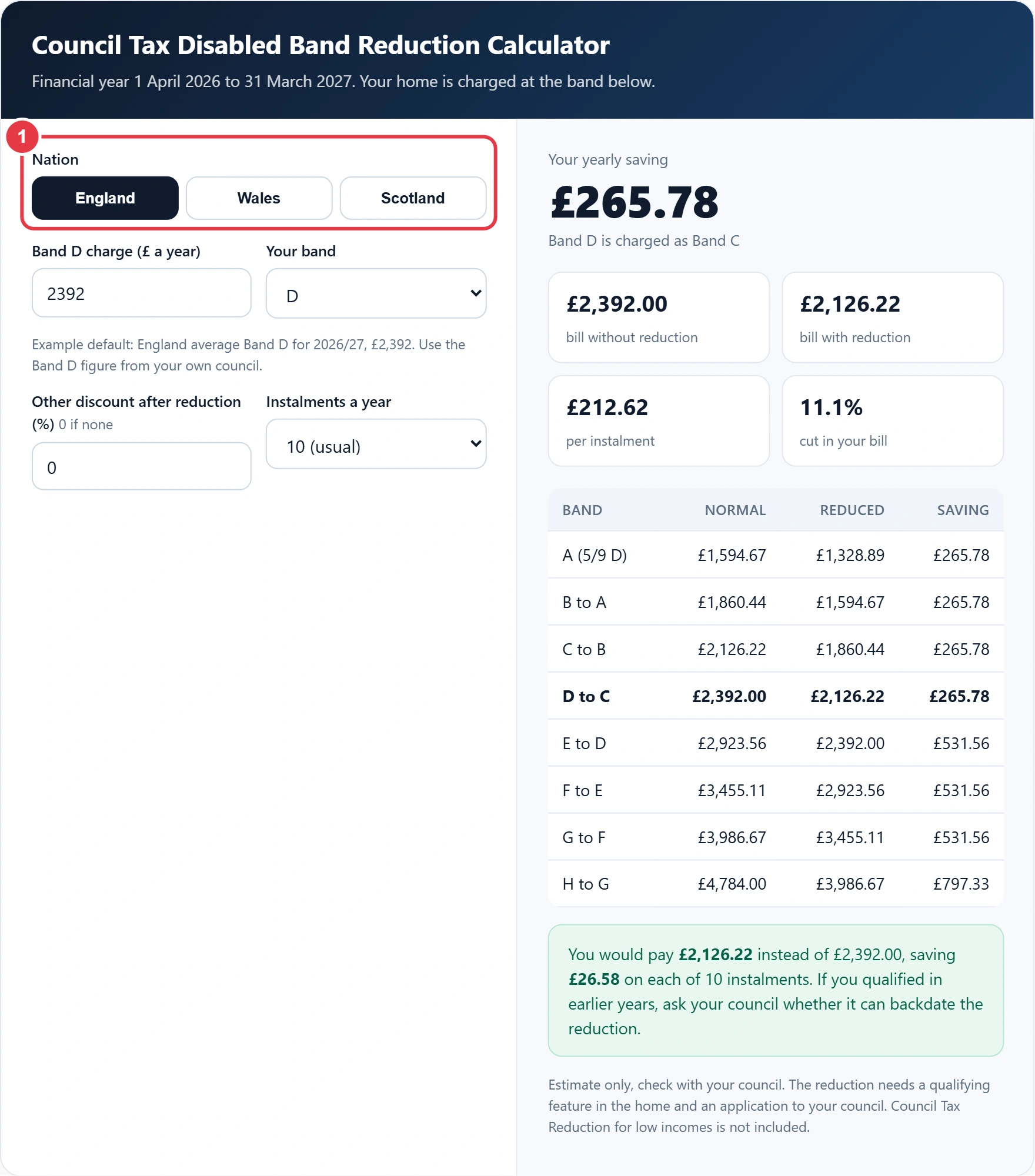
Step 1: Choose Your Nation
Pick England, Wales or Scotland. Wales adds Band I and Scotland uses different band proportions, so the choice changes the maths. Northern Ireland uses domestic rates rather than council tax and is not covered.
Step 2: Enter the Band D Charge and Your Band
Find the 2026/27 Band D figure for your parish or area on your council's website or on the back of your bill, then pick your band. The default of £2,392 is the English average, so replace it with your own council's figure for a precise answer.
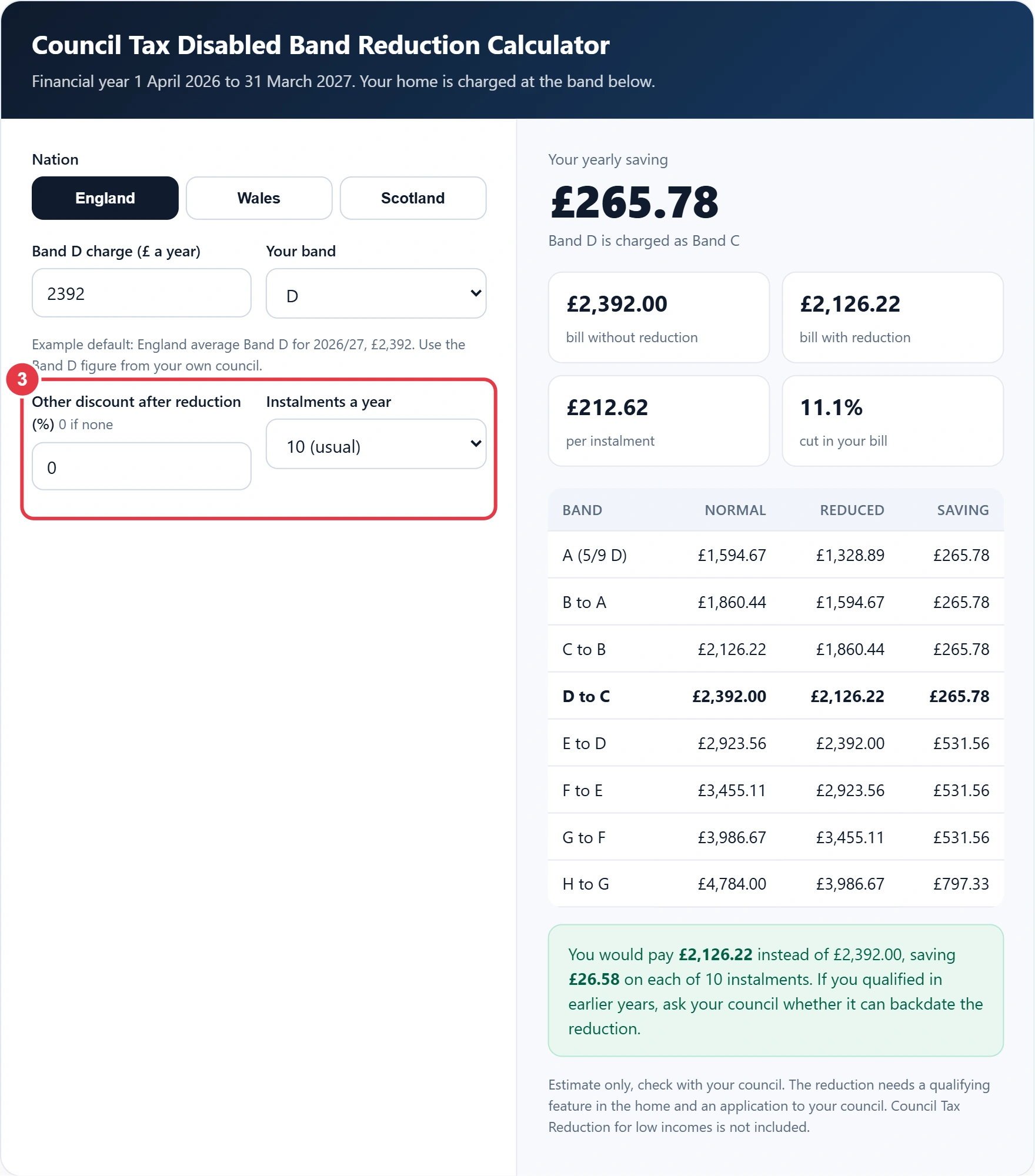
Step 3: Add Any Other Discount and Instalments
If another percentage discount also applies to your home, enter it so it is taken off after the band reduction, which is the order councils use. Then choose 10 or 12 instalments. If you also own a second property that stands empty, the council tax empty homes premium calculator works out that bill separately, because premiums follow different rules.
Step 4: Read Your Saving and Band Table
The council tax disabled band reduction calculator shows the yearly saving, both bills, the cut per instalment and the percentage cut. The table lists every band for your nation, with your own band in bold, so you can check the figure on your new bill.
Who Qualifies for the Disabled Band Reduction?
You qualify if the home is the main residence of at least one substantially and permanently disabled person and it has at least one of these features that the disabled person needs:
- An extra bathroom or kitchen kept for the disabled person's needs.
- Another room, other than a bathroom, kitchen or toilet, needed for and mainly used by the disabled person, such as a ground floor bedroom or a room for treatment equipment.
- Enough extra space inside to use a wheelchair, where a wheelchair is needed indoors.
A room that is only more convenient, or a wheelchair used only outdoors, usually does not count, and councils often visit before deciding. The rule sits in regulation 4 of the Council Tax (Reductions for Disabilities) Regulations 1992, which also sets the 5/9 rule for Band A homes in England and Wales. Apply to your council with a letter from a GP or occupational therapist describing the need.
Can I Get the Reduction Together With Other Discounts?
Yes, the band reduction is worked out first and any other discount, such as a single person discount, then comes off the reduced figure. Council Tax Reduction for people on low incomes is assessed separately by your council after that. To see how a lower council tax bill changes your overall household budget, the energy bill calculator covers the other big fixed cost most homes face each year.
</>Embed this calculator on your website
Add the free Council Tax Disabled Band Reduction Calculator to your own site or blog. Copy the code below and paste it into an HTML block. It resizes itself and works on phones.
How we checked this tool: the Tools Veria Editorial Team built this tool by hand, checked it against the official rules or published standards where they apply, and tested it against worked examples. Results are estimates for planning, not personal financial or tax advice. Read our editorial policy and disclaimer, or report an error.
Frequently Asked Questions
How much does the disabled band reduction save on Band D?
It saves one ninth of the Band D charge, because Band D is billed as Band C. On the 2026/27 English average of £2,392 that is £265.78 a year, or £26.58 a month over 10 instalments.
Do Band A homes get the disabled band reduction?
Yes. A Band A home cannot drop a band, so it is charged at 5/9 of Band D instead of 6/9. That is a one sixth cut, which GOV.UK describes as a 17% discount.
Is the disabled band reduction means tested?
No. Income, savings and benefits do not matter. You only need a substantially and permanently disabled resident and a qualifying room, bathroom, kitchen or wheelchair space that they need in the home.
Can the disabled band reduction be backdated?
Many councils will consider backdating it to the date you first qualified if the qualifying feature existed then. Ask when you apply and give evidence, such as a letter or invoice, showing when the need and adaptation began.
Does a disabled child count for the band reduction?
Yes. The disabled person can be an adult or a child, as long as the home is their main residence and the extra room, bathroom, kitchen or wheelchair space is needed because of the disability.
How much is the disabled band reduction on Band H?
In England a Band H home is billed as Band G, which saves three ninths of Band D. On a £2,392 Band D charge that is £797.33 a year, the largest saving of any band.