Tom rents a two bed flat in Leeds and could not understand why his October bill jumped. A spare fan heater in the box room turned out to be the culprit, and pricing it took him about a minute. Working out appliance running costs in the UK needs only three numbers: the wattage on the label, the hours the thing is switched on, and the pence you pay per unit.
Quick answer: To work out appliance running costs UK households pay, use cost = watts ÷ 1,000 × hours × unit rate. At 26.32p per kWh, a 2,000 W fan heater on for 4 hours uses 8 units and costs £2.11, while a 3 minute boil on a 3,000 W kettle costs about 3.95p.
Below you will find Tom’s method, a price list for everyday kit at the autumn 2026 cap rate, and the handful of habits that genuinely move a household bill.
In This Guide
How Do You Work Out Appliance Running Costs in the UK?
Suppliers charge by the unit, and a unit is simply 1,000 watts kept running for sixty minutes, which is the basis of the sum from watts to pounds. Suppliers charge by the unit, and a unit is simply 1,000 watts kept running for sixty minutes; the Wikipedia entry on the kilowatt hour as a unit of energy has the background if you want it. Tom’s heater label said 2,000 W, so his sum went like this:
- Knock three zeros off the wattage: 2,000 W becomes 2 kW.
- Times that by the evening’s 4 hours: 8 units.
- Times the units by 26.32p: £2.11.
Two pounds a night sounds harmless. Repeated through a thirty day month, though, it comes to roughly £63, which was most of Tom’s mystery increase.
Wattage is printed on a small rating plate, usually underneath or on the back. Be careful with fridges, ovens and washing machines: their element or compressor switches itself on and off, so the peak figure overstates real use. For those, trust the yearly kWh number on the energy label instead.

What Do Common Appliances Cost to Run?
These running costs assume 26.32p a unit, the average direct debit rate for October to December 2026, and the energy figures are typical rather than exact. These appliance running costs UK households pay all assume 26.32p a unit, the average direct debit rate for October to December 2026. Energy figures are typical rather than exact, so your own model may sit a little above or below.
| Appliance and use | Energy used | Cost each time |
|---|---|---|
| Kettle, 3,000 W, 3 minute boil | 0.15 kWh | 3.95p |
| Microwave, 1,200 W, 10 minutes | 0.2 kWh | 5.26p |
| LED bulb, 8 W, 5 hours | 0.04 kWh | 1.05p |
| TV, 100 W, 5 hours | 0.5 kWh | 13.16p |
| Washing machine, 40°C cycle | 1 kWh | 26.32p |
| Dishwasher, standard cycle | 1.2 kWh | 31.58p |
| Electric shower, 9 kW, 10 minutes | 1.5 kWh | 39.48p |
| Electric oven, 1 hour at about 2 kW average | 2 kWh | 52.64p |
| Tumble dryer, full load | 2.5 kWh | 65.80p |
| Fan heater, 2,000 W, 4 hours | 8 kWh | £2.11 |
Scan down the right hand column and a rule jumps out: anything that warms air, water or food sits near the bottom with the big numbers. Duration matters as much as power. Tom’s 3,000 W kettle is the hungriest item in his kitchen for those three minutes, yet a 100 W television left on through an evening quietly costs over three times as much as one boil.

From one use to a full year
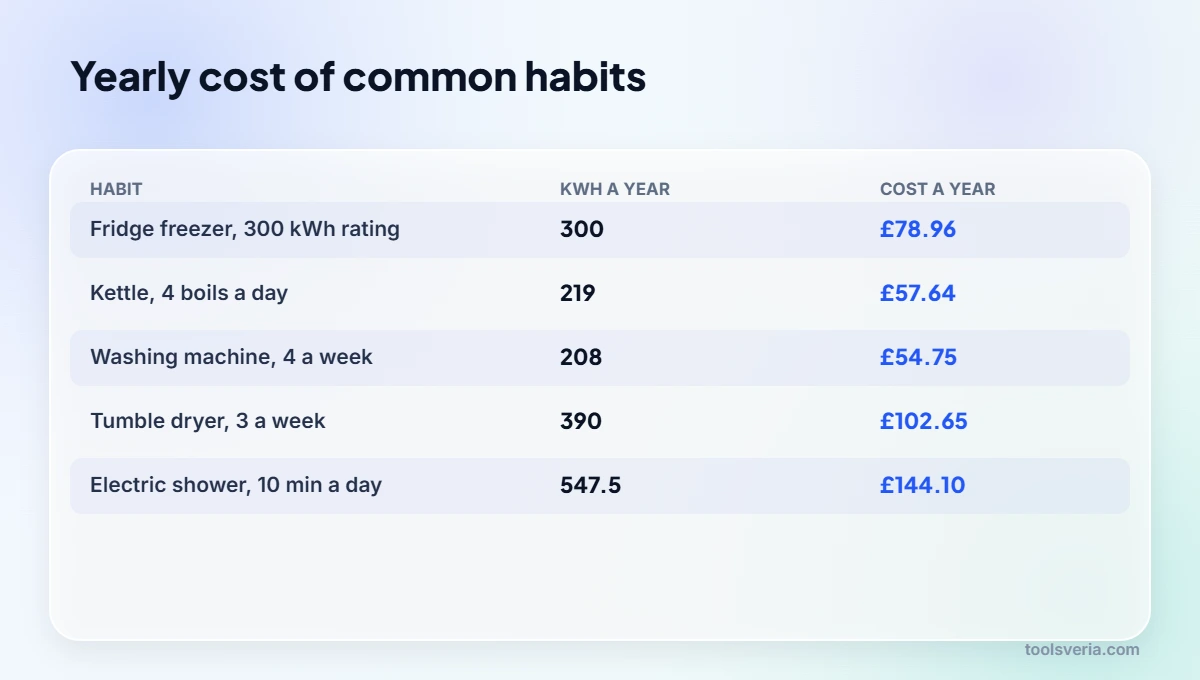
Pennies per use hide the real picture. Multiply by how often a typical family reaches for each item and the ranking changes:
| Habit | Energy a year | Cost a year |
|---|---|---|
| Fridge freezer rated at 300 kWh a year | 300 kWh | £78.96 |
| Kettle, 4 boils a day | 219 kWh | £57.64 |
| Washing machine, 4 loads a week | 208 kWh | £54.75 |
| Tumble dryer, 3 loads a week | 390 kWh | £102.65 |
| Electric shower, 10 minutes a day | 547.5 kWh | £144.10 |
| TV, 5 hours a day | 182.5 kWh | £48.03 |
Shower and dryer top the list because they pair high wattage with daily or near daily use. Two small tweaks show the scale. Hanging out one load a week instead of drying it saves 130 units over twelve months, about £34. Trimming a daily shower from ten minutes to eight keeps around £29 in your pocket. To test a habit of your own, type the yearly units into our kWh cost calculator with your tariff rate and it hands back a figure in pounds.
How Much Does Standby Power Cost?
A games console idling at 5 W uses 0.12 units a day, which is 3.16p a day and about £11.53 across twelve months. Small loads that never sleep deserve a second look, because a year has 8,760 hours and standby uses every one of them. Picture a games console idling at 5 W. Over a day that is 0.12 units, or 3.16p, and across twelve months about £11.53. Three or four such boxes under the television and you are paying for a meal out.
A cheap plug in energy monitor settles the question by showing live watts for whatever sits behind it. Tom tried his router, soundbar, old phone charger and the monitor on his desk. Only the soundbar was worth switching off at the wall, since the router has to stay on anyway.
Got a reading? Pop the watts and daily hours into the electricity cost calculator and you see hourly, daily, monthly and yearly totals together. That makes the replace or keep decision simple: a shiny efficient model only earns back its price when the yearly saving is a decent slice of what you paid.
Your unit rate and standing charge
Change the rate and all of these appliance running costs UK estimates change with it. We used 26.32p because it is the averaged direct debit figure published for the autumn quarter on the Ofgem energy price cap page, yet your own rate moves with region, payment method and tariff type. Fixed deals and time of use plans have their own prices printed on the bill, so swap those in.
Then there is the 54.83p daily standing charge under the same cap, which arrives whether the house is busy or empty. Over 365 days it adds up to about £200 before a single light goes on. Pairing that fixed amount with your usage is exactly what our energy bill calculator does, giving a full year view of where the appliances sit within the total.
Key points
- Cost = watts ÷ 1,000 × hours × unit rate.
- Heaters, showers, dryers and ovens dominate because they make heat.
- For fridges and washers, use the energy label’s yearly kWh, not peak watts.
- Five watts of standby runs to about £11.53 a year at 26.32p.
- Swap in the rate printed on your own bill for accurate answers.
Key Terms Behind Appliance Running Costs in the UK
These terms explain how appliance running costs UK households pay are measured and priced, so you can check any device against your own tariff.
- Kilowatt hour (kWh)
- The energy used by a load of 1,000 watts running for one hour, the unit that appears on every electricity bill. Because it combines power and time, a low wattage device left on for hours can cost more than a powerful one used briefly.
- Watt
- The SI unit of power, measuring the rate at which an appliance draws energy at a given moment. The figure on the rating plate is a maximum, so it must be multiplied by actual running time before it says anything about cost.
- Unit rate
- The price charged for each kilowatt hour of electricity, quoted in pence. The examples use 26.32p, the average direct debit rate for October to December 2026, so households on fixed or time of use tariffs should substitute their own figure.
- Energy price cap
- The ceiling Ofgem sets each quarter on what suppliers may charge per unit and per day on standard variable tariffs. It limits the rate, not the total bill, so heavy use still means a larger charge.
- Energy label
- The rating sticker on appliances such as fridges and washing machines, which shows an efficiency class and estimated yearly kWh. For cycling appliances that figure is a better guide than wattage, because the motor or element switches on and off.
- Thermostatic cycling
- The pattern in which a compressor or heating element switches on and off to hold a set temperature. It means fridges, ovens and washing machines rarely draw their full rated power for long, so peak wattage overstates their real consumption.
Frequently Asked Questions
My gas boiler heats the house, so which electrical item is likely costing me most?
Usually an electric shower or a tumble dryer. In our yearly table a daily ten minute shower comes to £144.10 and three dryer loads a week to £102.65, well ahead of the fridge freezer.
We boil the kettle about four times a day. Is that worth worrying about?
Not much. Each three minute boil on a 3,000 W kettle costs around 3.95p, so four a day comes to £57.64 over a year. Filling it only as far as you need shaves a little off that.
For a jacket potato for one, should I use the oven or the microwave?
The microwave wins easily. Ten minutes at 1,200 W costs roughly 5p, whereas an hour in an electric oven averaging 2 kW comes to about 53p.
The label on my old dehumidifier has worn off. How can I get its wattage?
Search the model number for the manual, or plug it into an energy monitor and read the live watts. Multiply by your hours and 26.32p, as in Tom’s heater example, to price it.
Tom moved the fan heater to the loft and bought a thicker duvet for the box room. Pricing your own appliances the same way shows which ones deserve attention and which you can stop feeling guilty about.