Ruth and Dev live in a three bed semi in Swindon on their supplier’s default tariff, and the letter about the energy price cap October 2026 rates left them asking one thing: how much more, or less, will we actually pay? The honest answer is that the cap fixes the price of each unit and each day’s standing charge from 1 October to 31 December, but says nothing about how many units a home burns through.
Quick answer: The energy price cap October 2026 level runs from 1 October to 31 December. For direct debit customers it averages 26.32p a unit plus 54.83p a day for electricity, and 7.97p a unit plus 29.68p a day for gas. A medium home lands at about £1,935.65 a year on these prices.
So the useful move is to put real usage next to the new prices. That is what the sections below do, for four kinds of home, with notes on who sits outside the cap altogether.
In This Guide
Energy price cap October 2026: the October to December rates
Ruth pays by monthly direct debit, so these averaged figures are the ones that apply to her household this quarter:
| Fuel | Unit rate | Standing charge | Standing charge over a year |
|---|---|---|---|
| Electricity | 26.32p per kWh | 54.83p per day | £200.13 |
| Gas | 7.97p per kWh | 29.68p per day | £108.33 |
Treat them as a national middle point. A household in Merseyside will see slightly different pence from one in Kent, and anyone topping up a prepayment meter or paying on receipt of a bill has separate capped levels. Region by region tables sit on the Ofgem energy price cap page, which is also where the January figures will appear once announced.
Homes in Northern Ireland are outside all of this. Their electricity and gas run through a different market, so the cap only reaches households in England, Scotland and Wales.

How Many Units Does Ofgem Assume a Typical Home Uses?
Ofgem benchmarks a medium home at 2,700 units of electricity and 11,500 units of gas over twelve months. Ofgem benchmarks a medium home at 2,700 units of electricity and 11,500 units of gas over twelve months, which is close to what Ruth and Dev’s meter readings show. If today’s prices stayed put for a whole year, their sum would run like this:
- Electricity: 2,700 kWh at 26.32p comes to £710.64; add £200.13 of daily charges for £910.77.
- Gas: 11,500 kWh at 7.97p comes to £916.55; add £108.33 of daily charges for £1,024.88.
- Combined: £1,935.65 over the year, roughly £161.30 a month.
Bear in mind this is our own arithmetic, not a figure Ofgem announces. Spending is also lumpy: the boiler works hardest from November to February, so a flat monthly direct debit tends to build up credit through the summer and use it up over winter. A credit balance in September is normal, not a sign of overpaying.
Worked bills for different homes
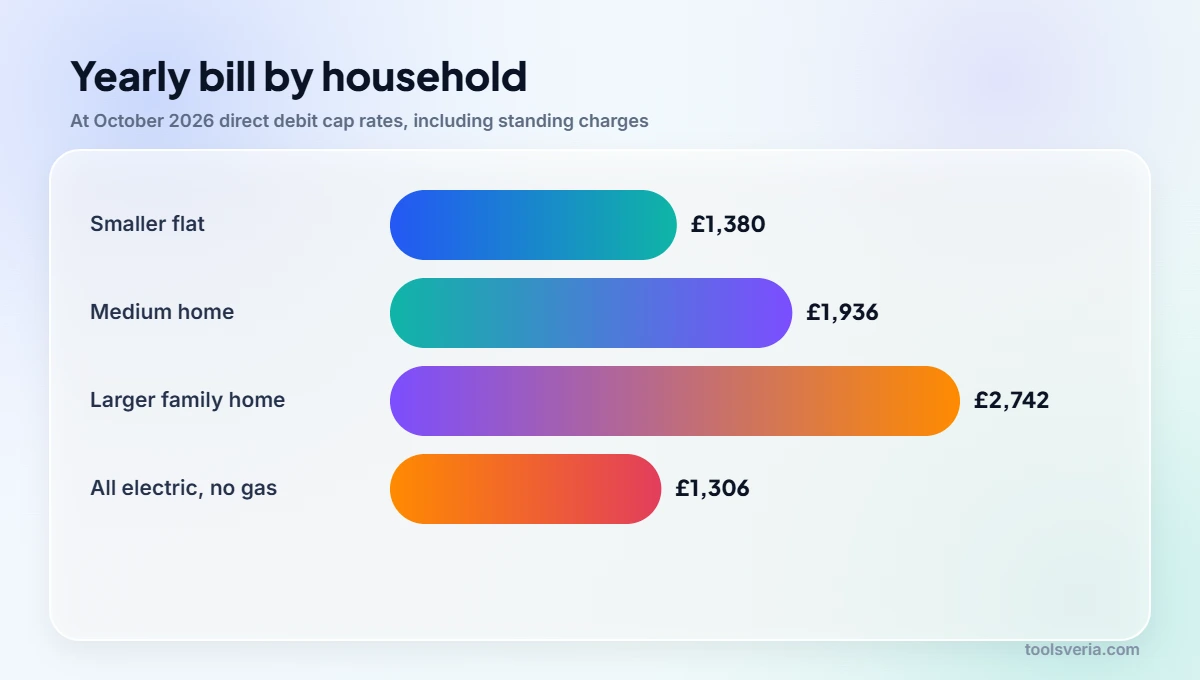
Averages flatter some homes and punish others. Here are four households priced at the same energy price cap October 2026 direct debit rates: a one bed flat, Ruth and Dev’s semi, a busy five person house, and a new build with no gas connection.
| Household | Electricity a year | Gas a year | Yearly bill | Monthly average |
|---|---|---|---|---|
| Smaller flat | 1,800 kWh | 7,500 kWh | £1,379.97 | £115.00 |
| Medium home | 2,700 kWh | 11,500 kWh | £1,935.65 | £161.30 |
| Larger family home | 4,100 kWh | 17,000 kWh | £2,742.48 | £228.54 |
| All electric, no gas | 4,200 kWh | None | £1,305.57 | £108.80 |
All four totals carry a full 365 days of standing charges. Notice the new build: it uses more electricity than the semi yet pays less overall, partly because it escapes the gas daily charge entirely. Be wary of reading too much into that row, though. Plenty of homes that rely on electric heating get through far more than 4,200 units, and their bills climb steeply. Typing your actual readings into our energy bill calculator gives you the same kind of yearly and monthly split for your own address.

How Much Is the Standing Charge Under the Energy Price Cap?
A dual fuel home pays 84.51p every day in standing charges, which is £308.46 a year, with every appliance switched off. Add the two daily charges together and a dual fuel home is paying 84.51p every day, £308.46 a year, with every appliance switched off. In the semi that slice is around 16% of the annual total. For a single pensioner using very little, the share is much bigger, which is why low users often feel the standing charge most.
Unit prices are the lever you control. Skip one unit of electricity and you keep 26.32p; skip one of gas and you keep 7.97p. A ratio of more than three to one explains why a plug in oil radiator is a pricey way to warm a room next to a gas boiler, and why a heat pump has to deliver several units of heat per unit of power to win. Before booking an installer survey, run your house through the heat pump running cost calculator, which sets both options side by side at today’s cap prices.
Sensitivity is another way to read your bill. Nudge the electricity price up 1p and Ruth’s yearly cost rises by £27. Do the same to gas and it rises by £115, since the semi uses over four times as many gas units. For dual fuel homes, then, thermostat and boiler settings beat almost any gadget tweak.
Curious which plug in items eat the electricity side? Feed each one’s wattage and daily hours into the electricity cost calculator and rank them, then tackle the top two or three first.
Do You Need to Do Anything When the Price Cap Changes?
If you are on a standard variable tariff
Prices on a default tariff follow the energy price cap October 2026 level without any action from you. Prices on a default tariff follow the energy price cap October 2026 level without any action from you. Ruth’s one job was to photograph both meters on 1 October and submit the numbers, so the old prices cover September usage and the new ones cover everything after.
If you are on a fixed tariff
A fix ignores the cap until the end date. Lay your contract’s pence per unit and daily charges beside the table above; if your deal is now dearer, look up the exit fee before deciding whether leaving early is worth it.
If you are struggling with bills
Ring your supplier before arrears pile up, since they are expected to help customers in difficulty set a repayment level they can manage. It is also worth reading the eligibility rules for the Warm Home Discount scheme again this winter, as people who missed out previously sometimes now qualify.
Key points
- Autumn 2026 direct debit cap: electricity 26.32p a unit plus 54.83p a day; gas 7.97p a unit plus 29.68p a day.
- Prices are capped, spending is not.
- A medium home lands at about £1,935.65 a year on these prices.
- Dual fuel standing charges total £308.46 before any usage.
- New figures arrive each quarter, so redo the sums every three months.
Energy Price Cap October 2026 Terms Explained
These terms explain how the energy price cap October 2026 rates turn into a real household bill, and why your own total may differ from the headline.
- Standard variable tariff
- The default energy deal a household is placed on when no fixed term contract is in force. Its prices can move each quarter, and it is the type of tariff whose unit rates and daily charges the price cap limits.
- Cap period
- The three month window for which a set of capped rates applies. The October 2026 level runs from 1 October to 31 December, after which Ofgem publishes new rates for the following quarter.
- Payment method differential
- The variation in capped prices according to how a customer pays, for example by direct debit, prepayment meter or on receipt of a bill. Each method has its own capped level, so averages quoted for direct debit may not match other customers.
- Regional pricing
- The difference in capped rates between electricity distribution regions of Great Britain, reflecting local network costs. A national average sits in the middle, and households in individual regions pay slightly more or less per unit and per day.
- Prepayment meter
- A meter that requires credit to be added before energy can be used, through a key, card or app top up. Prepayment customers are covered by the cap but at their own capped rates, separate from direct debit figures.
- Credit balance
- Money held by a supplier when payments made so far exceed the value of energy used. With a flat monthly direct debit, credit typically builds in warmer months and is drawn down in winter, when heating demand peaks.
Frequently Asked Questions
I pay by direct debit. Which pence per unit should I expect from October?
On average 26.32p for each unit of electricity and 7.97p for gas, with daily charges of 54.83p and 29.68p. Your regional figure may differ by a little.
My bill went up even though prices barely moved. How?
Usage is uncapped. A 1p rise in the gas price across 11,500 units adds £115 on its own, and a colder month simply puts more units on the meter.
Will these prices still apply when I pay my January bill?
Only for energy used up to 31 December 2026. A fresh level starts on 1 January, and Ofgem announces it ahead of that date.
My statement shows 27p, not 26.32p. Has my supplier got it wrong?
Probably not. The 26.32p headline is a Great Britain average; region, payment type and meter all shift it, and a fixed deal is not tied to the cap at all.
Ruth and Dev now know their autumn quarter in pounds rather than pence. Read your meters, price your own usage, and hold any fixed offer up against that number before you sign.