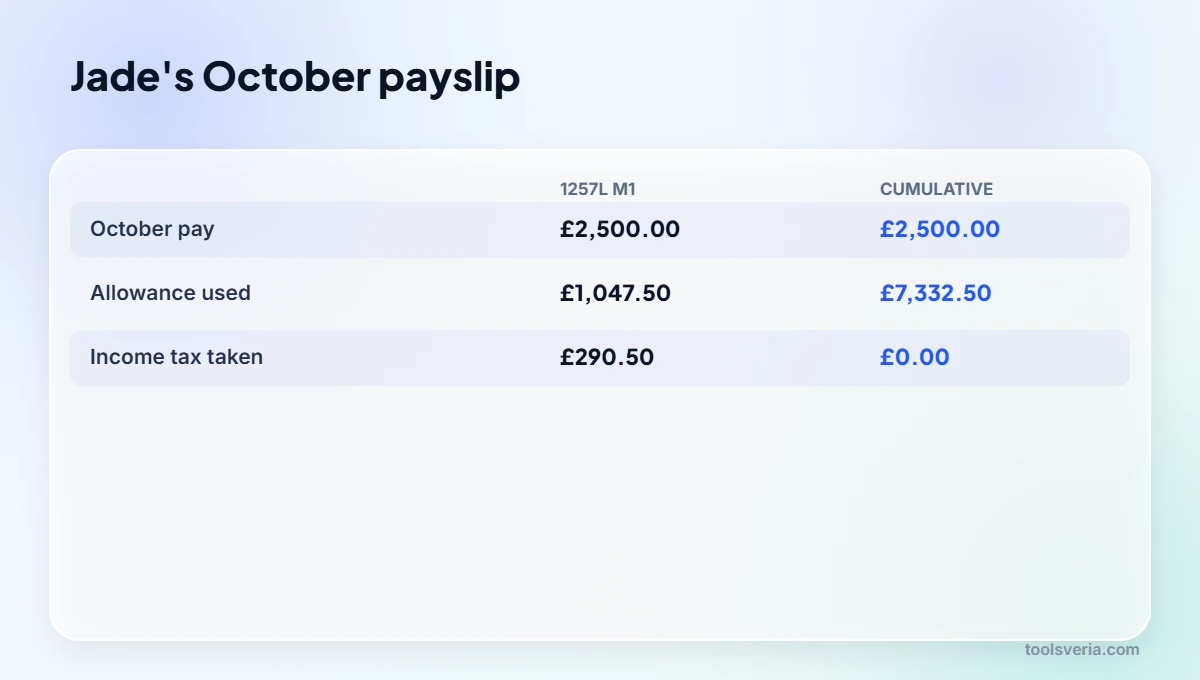
Jade started a new job in October and her first payslip showed £290.50 of income tax on £2,500 of pay, even though she had earned nothing since April. The culprit was four characters printed beside her name: 1257L M1. Having the UK tax code explained in plain numbers is the fastest way to spot when HMRC or an employer has the wrong picture of your income.
Below, Jade and four other employees each carry a different code. Their payslips show what the number does, what each letter means and how a single wrong code can cost hundreds of pounds before anyone notices.
Quick answer: With your UK tax code explained, 1257L means the standard £12,570 Personal Allowance is tax free in 2026/27, the number being the allowance without its last digit. HMRC lowers the number for benefits or untaxed income, and W1, M1 or X marks an emergency code that taxes each payment in isolation.
In This Guide
UK Tax Code Explained: What Does the Tax Code 1257L Mean?
The tax code 1257L means your employer should let you earn about £12,570 tax free across the 2026/27 tax year, which is the standard Personal Allowance for England, Wales and Northern Ireland. The number is the allowance with the last digit removed, and the L shows you are entitled to the standard allowance with nothing added or taken away.
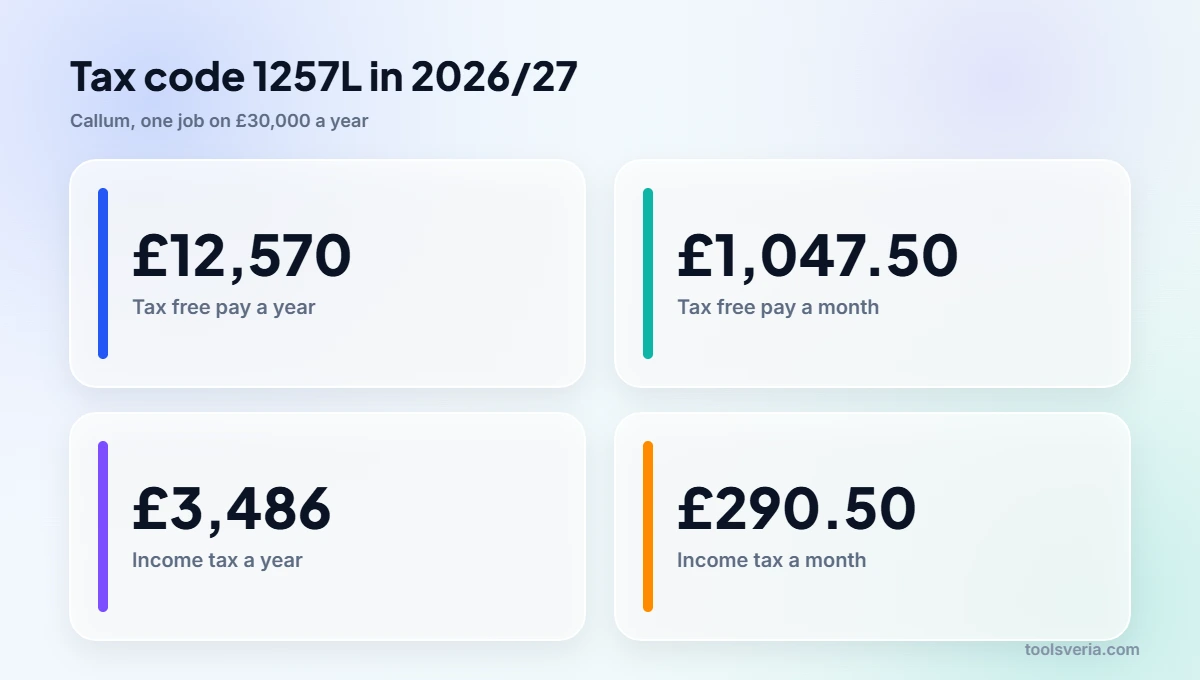
Callum is a warehouse supervisor on £30,000 with one job. His code spreads the £12,570 across the year, roughly £1,047.50 a month, and he pays 20% on the rest. That is £17,430 taxed at 20%, or £3,486 for the year and about £290.50 a month. If he is paid by the hour rather than a salary, our hourly to annual salary converter gives the yearly figure to use in the same sum.
Codes beginning with S or C follow the same pattern but use Scottish or Welsh income tax rates. A Glasgow worker on S1257L gets the same allowance as Callum, while the bands applied to the rest of their pay differ.
Why is my tax code lower than 1257L?
HMRC cuts a code below 1257L whenever it has extra tax to gather through PAYE, for example on a company car, private medical cover, untaxed income or an underpayment carried from an earlier year. HMRC subtracts that amount from your £12,570 allowance and issues a smaller number, so more of each payslip is taxed.
Ewa, a sales manager, has a company car with a taxable benefit of £3,200. Her allowance becomes £12,570 minus £3,200, which is £9,370, so her code is 937L. As a basic rate taxpayer she pays an extra £640 a year, about £53 a month, through PAYE instead of a separate bill. The GOV.UK guide to what your tax code means walks through a similar subtraction step by step.
Marriage Allowance works the other way. In 2026/27 a lower earning spouse or civil partner can pass £1,260 of allowance to their partner. The receiver’s code rises to 1383M, the giver’s falls to 1131N, and the couple can save up to £252 in the year.
| Tax code | What it tells the employer | Tax free pay in 2026/27 |
|---|---|---|
| 1257L | Standard Personal Allowance | About £12,570 |
| 937L | Allowance reduced by £3,200 of benefits | About £9,370 |
| 1383M | Marriage Allowance received | About £13,830 |
| 1131N | Marriage Allowance given away | About £11,310 |
| K343 | Benefits exceed allowance by £3,430 | None, and £3,430 added to taxable pay |
| BR | All pay taxed at 20% | £0 |
| D0 | All pay taxed at 40% | £0 |
| 0T | No allowance, normal bands apply | £0 |
| NT | No tax taken from this income | All of it |
What is an emergency tax code?
An emergency tax code is a normal code with W1, M1 or X added, such as 1257L M1, and it tells payroll to tax each payment on its own as though you earn that amount every week or month of the year. It usually appears when you start a job without a P45, begin receiving a company benefit or start drawing the State Pension.
Jade’s case shows why that matters. Under 1257L M1, October is taxed in isolation: £2,500 minus about £1,047.50 of allowance leaves £1,452.50 taxed at 20%, or £290.50. On an ordinary cumulative 1257L, payroll would count the unused allowance from April to October, roughly £7,332.50 by month seven, and her October tax would be nil. The GOV.UK page on emergency tax codes says HMRC normally sorts out the code within 35 days once your details arrive.
Jade had spent the spring and summer travelling, so she had no P45 for this tax year. She filled in her new employer’s starter checklist to confirm this was her first job since April and then checked her code in the HMRC app. Once a cumulative code arrived, the overpaid £290.50 came back through her next payslip.
What does a K tax code mean?
A K tax code means the benefits, untaxed income or tax owed that HMRC is collecting through your pay are larger than your whole Personal Allowance, so instead of tax free pay you have an amount added to your taxable pay. The number after the K, multiplied by ten, is roughly that extra amount.
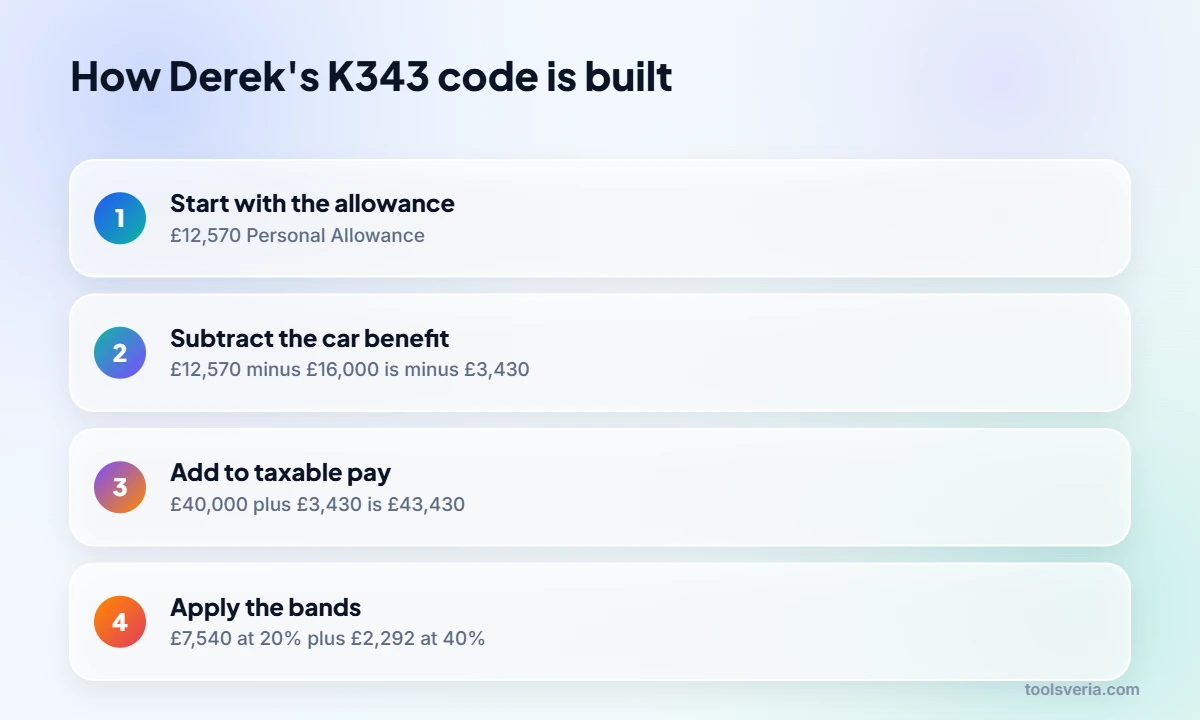
Derek earns £40,000 and has a company car benefit of £16,000. His allowance of £12,570 minus £16,000 leaves minus £3,430, so his code is K343. Payroll treats his pay as £43,430 of taxable income. The first £37,700 is taxed at 20%, which is £7,540, and the remaining £5,730 at 40%, which is £2,292, giving £9,832 for the year. The car alone pushes part of his income into the higher rate band.
There is a safety valve. Under HMRC rules, an employer or pension provider using a K code cannot take more than half of your pre tax pay or pension, which protects people with low wages and large benefits from an empty payslip.
When are BR, D0 and 0T used?
BR and D0 are usually used on a second job or pension where your allowance is already used elsewhere, while 0T is used when there is no allowance to give or your employer lacks the details needed. Each one removes tax free pay from that source.
Sam works full time on 1257L and earns £8,000 a year from weekend bar shifts coded BR. All £8,000 is taxed at 20%, so £1,600 comes off the bar job, which is correct because his main salary already uses the allowance.
If Sam cut his main job to three days, its pay could fall below £12,570 and part of his allowance would go unused there. Running the new hours through our pro rata salary calculator shows the reduced salary, and he could then ask HMRC to split the allowance so the bar job stops being taxed from the first pound.
High earners can see their code shrink for another reason. The Personal Allowance falls by £1 for every £2 of income above £100,000, so on £110,000 it drops to £7,570 and HMRC may issue a code of around 757L. Side income outside PAYE, such as freelance profit that you estimate with our self employed tax calculator, can also lower your code if HMRC collects that tax through your salary.
Key points
- Tax code 1257L gives about £12,570 of tax free pay in the 2026/27 tax year.
- HMRC lowers the number to collect tax on benefits, so £3,200 of benefits turns 1257L into 937L.
- Emergency codes end in W1, M1 or X and tax each payment in isolation.
- A K code adds income to your taxable pay, but no more than half of pre tax pay can be taken.
- You can check your code in your HMRC personal tax account, the HMRC app or on your payslip.
What the Key UK Tax Code Terms Mean
These definitions explain the numbers, letters and suffixes in a UK tax code, helping you check 1257L and spot emergency or K codes on your payslip.
- Tax code
- A short combination of numbers and letters that HMRC issues to an employer or pension provider. It tells payroll how much tax free pay to give each period, and which rates to apply to the rest.
- L suffix
- The letter showing that someone receives the standard tax free Personal Allowance with no adjustments. In 1257L, the numbers are the allowance of £12,570 with its final digit removed, spread across the tax year.
- K code
- A code used when taxable benefits or untaxed income are larger than the allowance. Instead of giving tax free pay, the number is added to taxable pay, so K343 adds £3,430 of income to be taxed.
- Emergency tax code
- A temporary code marked W1, M1 or X, used when HMRC lacks full details of earlier pay in the year. Each payment is taxed on its own, without credit for allowance unused in earlier months.
- Marriage Allowance
- A transfer of part of one spouse’s or civil partner’s Personal Allowance to the other. In 2026/27 the amount is £1,260, shown by an M code for the receiver and an N code for the giver.
- BR code
- A code that taxes every pound of pay at the 20% basic rate with no tax free amount. It is commonly used for a second job or pension, because the allowance is already given against the main income.
Frequently Asked Questions
My payslip says 1257L X. Am I paying too much tax?
Possibly, since X marks an emergency code that ignores the allowance you have not used earlier in the year. If you started mid year with no earlier earnings, you may be overpaying, and the excess usually comes back once HMRC issues a cumulative code.
I gave up my company car in June. Why is my code still 937L?
HMRC only changes your code once it hears about the change, usually from your employer. Update the benefit in your personal tax account, and any tax overpaid since June should be corrected through later payslips or after the year ends.
My pension provider uses BR but my salary uses 1257L. Is that right?
Usually yes, because your £12,570 allowance can only be used once and HMRC has placed all of it on your salary. Your pension is then taxed at 20% from the first pound, which is correct as long as your total income stays inside the basic rate band.
Does my tax code affect National Insurance?
No, your tax code only controls income tax. Employee National Insurance in 2026/27 is worked out separately at 8% on earnings between £12,570 and £50,270 a year and 2% above that, whatever code you have.
Jade now opens the HMRC app every time she changes jobs, and checks the four characters before the first payday rather than after. Type your own code and salary into the calculator and you will know within seconds whether your payslip adds up. Figures checked October 2026.