
Hannah is 34, weighs 82 kg and wants to lose about 7 kg before next summer. Her friend swears by 1,200 calories a day, a magazine says 1,500, and her app suggests something else again. The honest answer to how many calories should I eat to lose weight depends on her body, her week and how fast she wants to go, and it takes about five minutes to work out properly.
Below, Hannah and two other people with very different starting points run the numbers, so you can see where the familiar NHS figures come from, when they fit and when they would leave you hungry or stuck.
Quick answer: The NHS suggests most adults cut about 600 calories a day, which works out at roughly 1,400 calories for women and 1,900 for men. A personal figure is better: work out your maintenance calories from your BMR and activity level, subtract 500 to 600, and aim to lose 0.5 to 1 kg a week.
In This Guide
How many calories should I eat to lose weight?
Most UK adults lose weight by eating about 600 calories a day less than their body uses, which the NHS rounds to about 1,400 calories a day for women and 1,900 for men. Those two numbers start from the average needs the NHS quotes, 2,000 calories for a woman and 2,500 for a man, and the NHS Better Health calorie counting guide describes the 600 calorie cut as a safe, sustainable pace for most people.
The catch is the word average. A 1.60 m retired woman and a 1.85 m scaffolder do not burn the same amount, so the same target would be far too generous for one and far too harsh for the other. Treat 1,400 and 1,900 as a sensible first guess, then personalise it.
How do I work out my own calorie target?
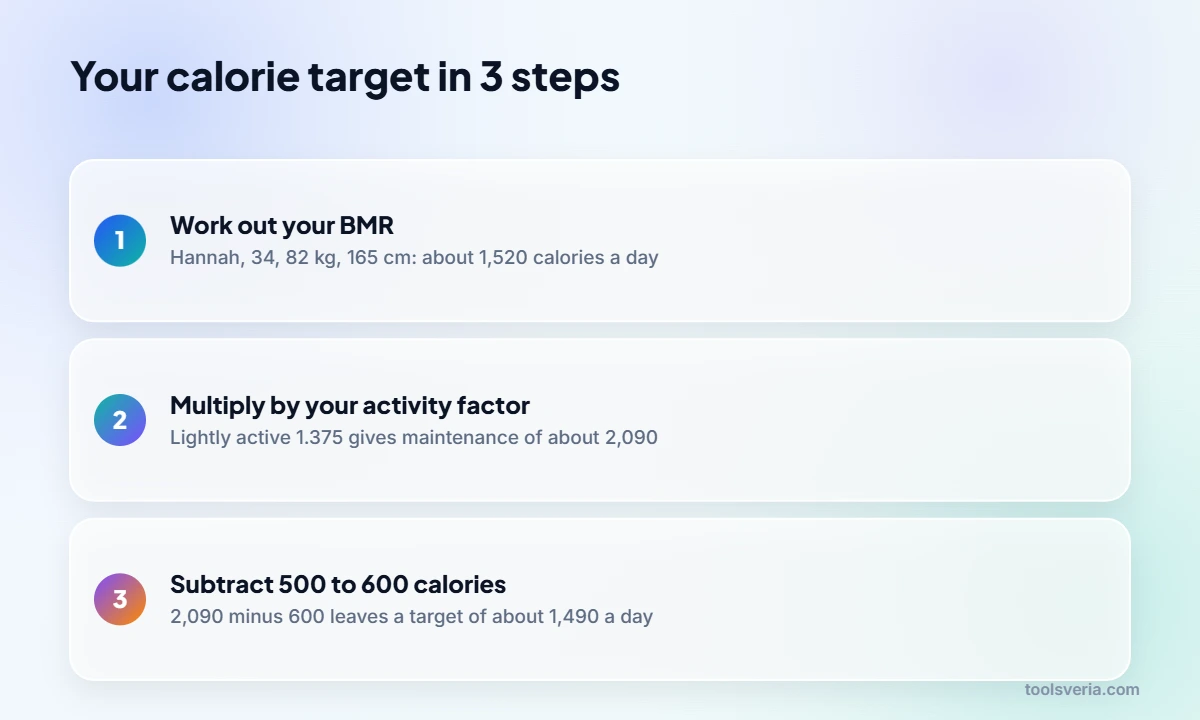
Your own calorie target for weight loss is your maintenance calories minus 500 to 600 a day, where maintenance is your basal metabolic rate (BMR) multiplied by an activity factor. In plain words: estimate what your body burns at rest, scale it up for how much you move, then take a fixed amount off.
- BMR (Mifflin St Jeor) = 10 × weight in kg, plus 6.25 × height in cm, minus 5 × age, then add 5 for men or subtract 161 for women.
- Maintenance calories = BMR × activity factor, from 1.2 for a desk job with little exercise to 1.9 for hard physical work plus training.
- Weight loss target = maintenance minus 500 to 600 calories.
Hannah is 165 cm tall. Her BMR is 820 plus 1,031.25, minus 170, minus 161, which comes to about 1,520 calories. She walks to the station and does a couple of classes a week, so she counts as lightly active at 1.375, giving maintenance of about 2,090. Taking 600 off leaves her a target of about 1,490 calories a day. Our BMR calculator runs the first step for you if you would rather not do the sums by hand.
Choosing the right activity level matters more than people expect. The table shows Hannah’s maintenance and 600 calorie target at each level, and the gap between the bottom and top rows is over 1,000 calories.
| Activity level | Factor | Hannah’s maintenance | Target after a 600 cut |
|---|---|---|---|
| Sedentary (desk job, little exercise) | 1.2 | 1,824 | 1,224 |
| Lightly active (1 to 3 sessions a week) | 1.375 | 2,090 | 1,490 |
| Moderately active (3 to 5 sessions) | 1.55 | 2,356 | 1,756 |
| Very active (6 to 7 sessions) | 1.725 | 2,622 | 2,022 |
| Extra active (physical job plus training) | 1.9 | 2,888 | 2,288 |
A useful habit is to pick the level below the one you think fits. Most people overestimate how active they are, and starting slightly low means any extra walking becomes a bonus rather than the reason your plan quietly stalls.
Why does the NHS figure not fit everyone?
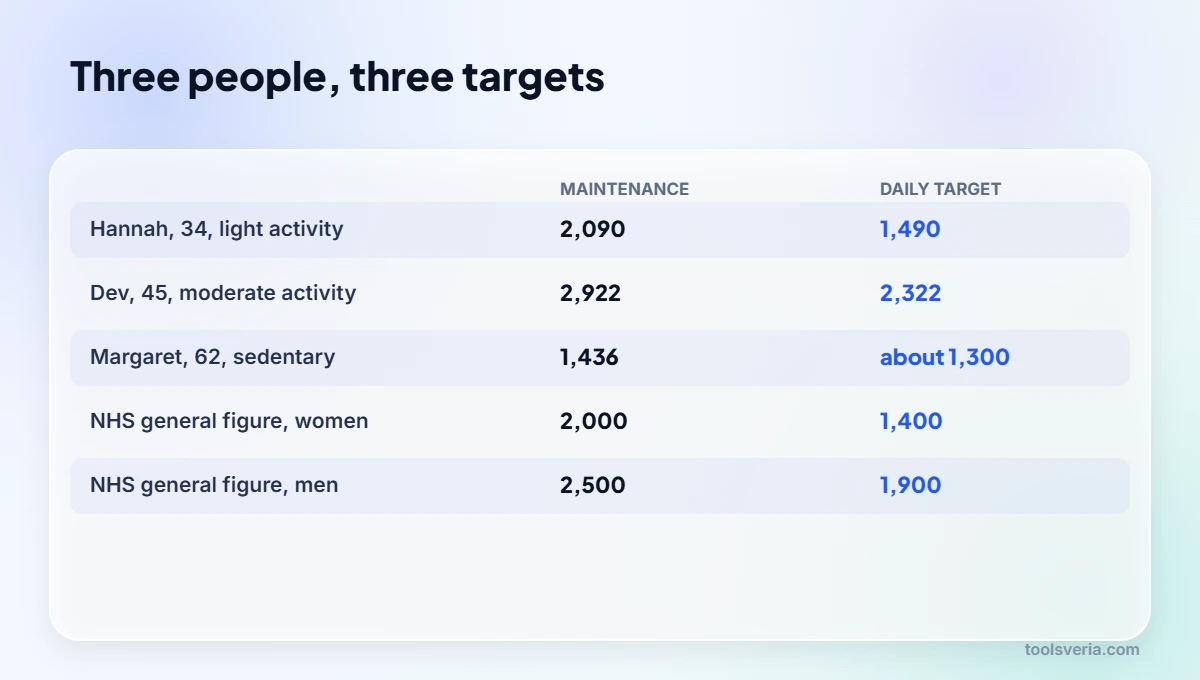
The NHS 1,400 and 1,900 figures are built on average needs, so anyone much larger, smaller, older or more active than average will get a better result from a personal calculation. Two more people show how far apart the right answers can be.
Dev: 45, 98 kg, 180 cm, moderately active
Dev coaches youth football three evenings a week. His BMR is 980 plus 1,125, minus 225, plus 5, which is 1,885 calories. At 1.55 his maintenance is about 2,922, so a 600 calorie cut gives him roughly 2,322 a day. If he followed the generic 1,900, he would be running a deficit of over 1,000 calories, and he would probably be too hungry to keep it up past the first fortnight.
Margaret: 62, 68 kg, 158 cm, mostly sitting
Margaret’s BMR is 680 plus 987.5, minus 310, minus 161, which is about 1,197 calories. At the sedentary factor her maintenance is only about 1,436. Cutting 600 would leave her on 836 calories, far too low to manage on her own. A gentler plan works better: daily walks lift her towards the lightly active level of about 1,645, and eating around 1,300 then gives her a deficit of roughly 345 calories without going near very low calorie territory.
Where that floor sits matters for safety, because national guidance on weight management is clear about very low intakes. The NICE guideline on overweight and obesity management (NG246) says diets of 800 to 1,200 calories a day should only be used within a specialist weight management service with long term support, and diets under 800 calories only with specialist clinical supervision. NICE also advises against using either as a long term way of managing weight.
| Person | BMR | Maintenance | Personal target | NHS general figure |
|---|---|---|---|---|
| Hannah, 34, lightly active | 1,520 | 2,090 | 1,490 | 1,400 |
| Dev, 45, moderately active | 1,885 | 2,922 | 2,322 | 1,900 |
| Margaret, 62, sedentary | 1,197 | 1,436 | about 1,300 with more walking | 1,400 |
How fast will I lose weight on a calorie deficit?
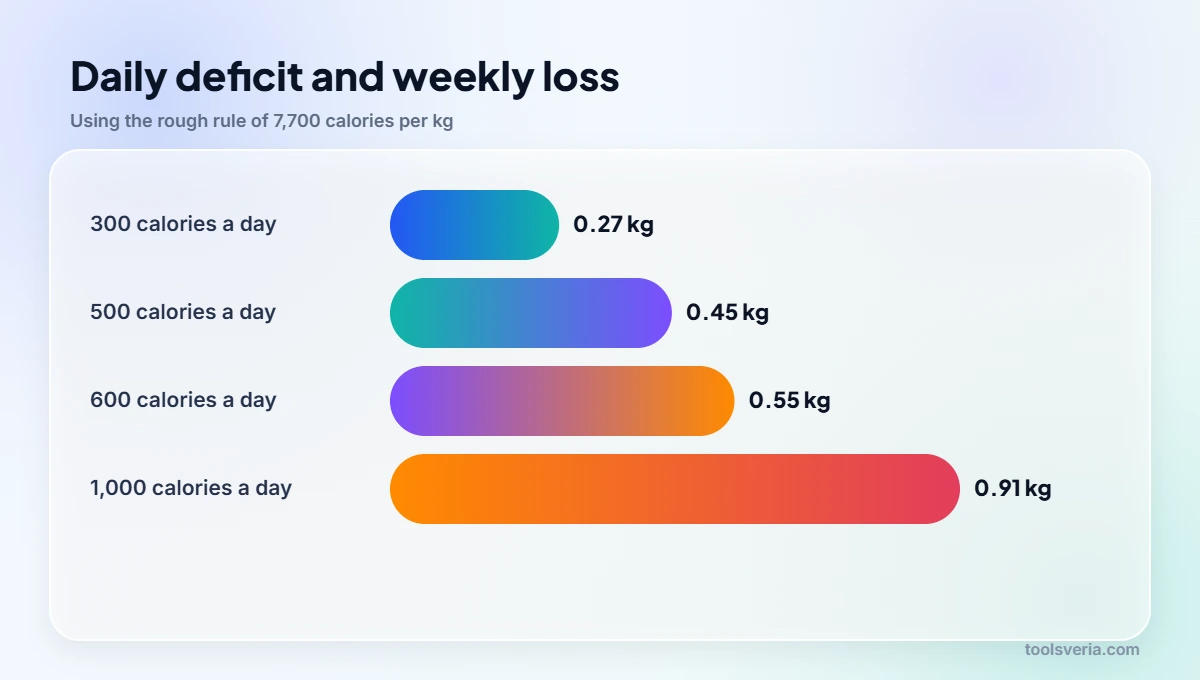
A daily deficit of 500 to 600 calories usually leads to a loss of about 0.5 kg a week at first, and the NHS treats 0.5 to 1 kg (1 to 2 lb) a week as a safe and sustainable rate. Faster than that tends to cost muscle as well as fat and is much harder to stick with.
The rough sum many dietitians use is that about 7,700 calories equals 1 kg of body fat. It is a rule of thumb rather than a law, because early weeks include water and later weeks run slower, but it gives a fair first estimate.
| Daily deficit | Weekly deficit | Estimated loss per week |
|---|---|---|
| 300 calories | 2,100 | about 0.27 kg (0.6 lb) |
| 500 calories | 3,500 | about 0.45 kg (1 lb) |
| 600 calories | 4,200 | about 0.55 kg (1.2 lb) |
| 1,000 calories | 7,000 | about 0.91 kg (2 lb) |
For Hannah, 7 kg at about 0.55 kg a week works out at just under 13 weeks on paper, and the weight loss timeline calculator turns that into a calendar date, including how it shifts at a gentler pace. If you think in stones, the kg to stone converter shows that 7 kg is about 1 stone 1 lb, so her goal is a little over a stone.
Why does weight loss slow down after a few weeks?
Weight loss slows because a lighter body burns fewer calories, so the same daily intake produces a smaller deficit as the weeks go by. Re-running the sums every 3 to 4 kg keeps the target honest.
When Hannah reaches 75 kg, her BMR falls to about 1,450 and her lightly active maintenance to about 1,994 calories, roughly 96 less than when she started. Still eating 1,490, her deficit has shrunk from 600 to about 504 a day. Nothing has gone wrong; the maths has simply moved. Smaller slips add up too: an unlogged latte and a handful of biscuits can easily be 300 calories.
Protein helps on both counts, because it keeps you fuller and protects muscle while you eat less. The protein intake calculator suggests a daily amount for your weight, and a simple split for Hannah’s 1,490 might be 300 calories at breakfast, 450 at lunch, 500 at dinner and 240 for snacks.
When should you speak to a GP before cutting calories?
Speak to a GP before you start a calorie deficit if you are pregnant or breastfeeding, take insulin or other diabetes medicines, have a history of an eating disorder, are under 18, or have a long term condition such as heart or kidney disease. These calculations are estimates for healthy adults and are not medical advice.
It is also worth booking an appointment if you are losing weight without trying, if your BMI is 40 or more, or if you have tried for months without progress. You can check your BMI with the NHS BMI calculator before you go, which gives your GP a useful starting point and may open the door to local weight management support.
Key points
- The NHS suggests cutting about 600 calories a day, roughly 1,400 for women and 1,900 for men.
- A personal target is maintenance calories (BMR × activity factor) minus 500 to 600.
- The NHS treats losing 0.5 to 1 kg a week as a safe and sustainable rate.
- NICE NG246 limits diets of 800 to 1,200 calories a day to specialist weight management services.
- Maintenance calories fall as you lose weight, so recalculate every 3 to 4 kg.
Calorie and Weight Loss Terms You Should Know
These terms help you answer how many calories should I eat to lose weight, explaining each step from resting energy use to a realistic daily target.
- Maintenance calories
- The daily energy intake that keeps body weight stable, equal to total energy burned through resting metabolism, digestion and movement. Weight loss targets are set by subtracting a deficit from this figure rather than from a generic average.
- Activity factor
- A multiplier applied to basal metabolic rate to account for daily movement and exercise, ranging from sedentary to very active levels. Choosing it accurately matters, since overstating activity is a common cause of targets set too high.
- Mifflin St Jeor equation
- A predictive formula estimating resting energy needs from weight, height, age and sex, with a separate constant for men and women. It is widely used in dietetics as a reliable starting point for healthy adults.
- Kilocalorie
- The unit commonly called a calorie on food labels, equal to the energy needed to raise one kilogram of water by one degree Celsius. Daily energy intake and expenditure are both measured in it.
- Adaptive thermogenesis
- A drop in energy expenditure beyond what weight loss alone would predict, as the body conserves energy during a sustained deficit. It is one reason progress slows and targets may need recalculating after losing weight.
- NHS Better Health
- A public health campaign run in England offering free tools and guidance for weight loss, healthier eating and activity. Its calorie advice gives the benchmark daily figures many people use as a first estimate.
Frequently Asked Questions
My app says 1,200 calories. Is that too low for me?
For many adults it is lower than needed, and NICE reserves plans of 800 to 1,200 calories a day for specialist services with support. Work out your maintenance first; if 1,200 is more than 600 below it, a higher target will usually be easier to sustain.
I eat 1,500 calories and the scales have not moved for two weeks. Why?
Two weeks is often too short to judge, because water shifts can hide fat loss. If nothing changes after four weeks, recalculate maintenance at your current weight and check portion sizes and drinks, which commonly add 200 to 300 unlogged calories a day.
Should I eat back the calories my watch says I burned at the gym?
Only partly, because wearables often overestimate exercise burn. If you already chose an activity factor that includes your training, your target already covers it, so eating back the full number would cancel much of your 500 to 600 calorie deficit.
I want to lose 2 stone. How long should that take?
Two stone is about 12.7 kg, which takes roughly 13 to 25 weeks at the NHS safe rate of 0.5 to 1 kg a week. Plan for the slower end, because the deficit shrinks as you get lighter unless you recalculate.
Hannah settled on about 1,490 calories a day, Dev on about 2,322 and Margaret on around 1,300 with more walking, three very different answers to the same question. Run your own numbers, recheck them as your weight changes and speak to a GP if any of the warning signs above apply. Figures checked October 2026.