
Hannah is 34, works in a dental practice and walks the dog every evening. Her phone says she burns 2,400 calories a day, her smartwatch says 2,050, and a website she tried offered 1,800. Knowing how to calculate TDEE by hand lets her see where each number comes from and decide which one deserves her trust.
TDEE stands for total daily energy expenditure: every calorie your body uses across 24 hours, from keeping your heart beating to climbing the stairs at work. The arithmetic takes two steps and about five minutes. Below, Hannah does it in metric, her brother Gareth does it from stone and feet, and then both learn how to test the result against the bathroom scales.
Quick answer: To calculate TDEE, find your BMR with the Mifflin St Jeor equation (10 × kg + 6.25 × cm minus 5 × age, then +5 for men or minus 161 for women) and multiply it by an activity factor from 1.2 to 1.9. A lightly active woman of 34, 70 kg and 165 cm burns about 1,925 kcal daily.
In This Guide
What is TDEE made of?
TDEE is made of four parts: your basal metabolic rate (BMR), the energy used to digest food, planned exercise, and all the everyday movement that is not exercise. BMR is the largest slice for most people, commonly somewhere between 60% and 80% of the total depending on how active they are.
Digesting and storing food, known as the thermic effect of food, costs roughly 10% of what you eat. Exercise is the gym class or the Saturday parkrun. The fourth slice, non exercise activity thermogenesis or NEAT, is the one people forget: walking to the bus, standing at a counter, carrying shopping, fidgeting. Two people with identical BMRs can differ by several hundred calories a day on NEAT alone, which is why a shop floor job and a desk job feel so different by evening.
Nobody measures all four slices at home. Instead, the hand method estimates BMR from body size and then scales it up with a single activity factor that bundles digestion, exercise and NEAT together. That is the whole trick, and it is why choosing the factor honestly matters so much.
How do you calculate TDEE step by step?
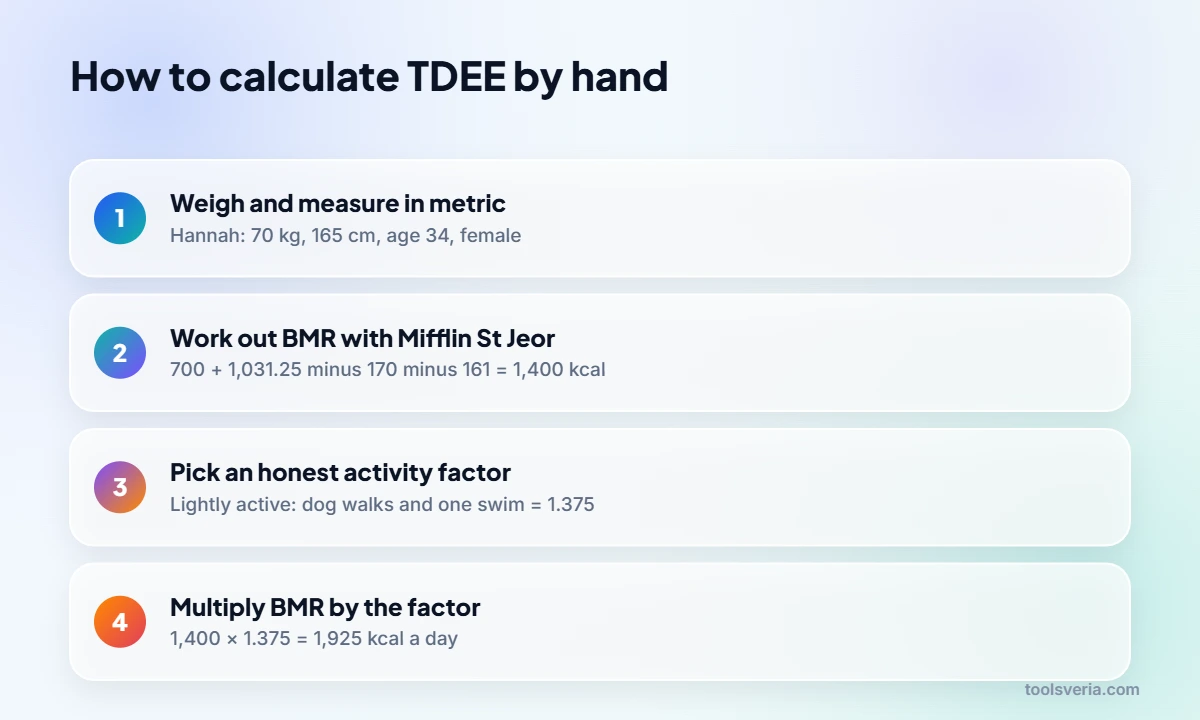
You calculate TDEE in two steps: estimate BMR from your weight, height, age and sex, then multiply that BMR by the activity factor that matches a normal week. The Mifflin St Jeor equation is the usual choice for step one, because the 1990 Mifflin St Jeor study of 498 healthy adults found it predicted measured resting energy use more closely than the older Harris Benedict sums.
- Men: BMR = (10 × weight in kg) + (6.25 × height in cm) minus (5 × age) + 5
- Women: BMR = (10 × weight in kg) + (6.25 × height in cm) minus (5 × age) minus 161
- Then: TDEE = BMR × activity factor
Hannah: 34, 70 kg, 165 cm, lightly active
Ten times 70 kg gives 700. Height adds 6.25 × 165, which is 1,031.25. Age takes away 5 × 34, or 170. As a woman she subtracts a further 161. So 700 + 1,031.25 minus 170 minus 161 leaves a BMR of 1,400 kcal. Her dog walks and a weekly swim make her lightly active, so she multiplies by 1.375 and gets a TDEE of 1,925 kcal a day.
That lands between her watch and the lowest website figure, and well under the 2,400 her phone suggested. If you would like the BMR step on its own with three formulas side by side, our BMR calculator shows Mifflin St Jeor, Harris Benedict and Katch McArdle for the same inputs.
Which activity factor should you use?
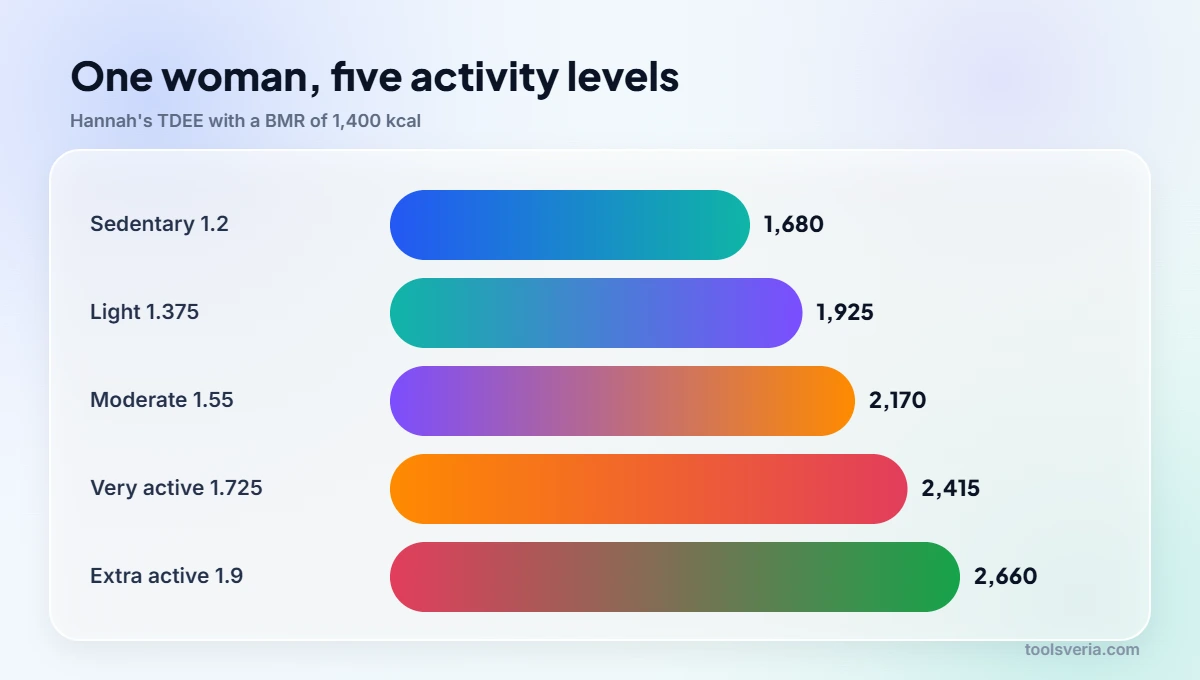
Use the activity factor that describes an ordinary week rather than your best week: 1.2 for mostly sitting, 1.375 for light activity, 1.55 for moderate exercise most days, 1.725 for hard training six or seven days a week and 1.9 for heavy manual work plus training. Most people who get a disappointing result picked one level too high.
| Activity level | Typical week | Factor | Hannah’s TDEE |
|---|---|---|---|
| Sedentary | Desk job, driving, little planned exercise | 1.2 | 1,680 kcal |
| Lightly active | Daily walks or one to three easy sessions | 1.375 | 1,925 kcal |
| Moderately active | Three to five proper workouts | 1.55 | 2,170 kcal |
| Very active | Hard training six or seven days | 1.725 | 2,415 kcal |
| Extra active | Physical job plus regular training | 1.9 | 2,660 kcal |
The spread is nearly 1,000 kcal for the same woman, which is bigger than any difference between BMR formulas. A practical test: count only sessions that leave you properly out of breath, then add a level if your job keeps you on your feet for most of the day. A postal worker who also lifts weights three times a week can justify 1.725. If your watch logs workouts, our calories burned calculator gives a second opinion on what a typical session really costs, and a teacher who runs twice a week usually lands at 1.375 or 1.55, not higher.

How do you calculate TDEE in stone and feet?
To calculate TDEE in stone and feet, convert weight to kilograms (multiply total pounds by 0.45359237) and height to centimetres (multiply total inches by 2.54) first, because the equation only works in metric. Then run the same two steps.
Gareth: 46, 15 st 2 lb, 5 ft 10 in, moderately active
Fifteen stone two is 212 lb, which converts to 96.2 kg. Five feet ten is 70 inches, or 177.8 cm. His BMR is 961.6 + 1,111.25 minus 230 + 5, giving 1,848 kcal. For the weight conversion on its own, our kg to stone converter shows the working both ways. Gareth plays five a side twice a week and cycles to work, so 1.55 fits, and his TDEE comes out at 2,864 kcal a day.
It helps to set the two siblings side by side and then hold both results against a national benchmark. The NHS guide to calories uses 2,000 kcal for an average woman and 2,500 kcal for an average man. Hannah’s 1,925 kcal sits just under the average figure, while Gareth’s 2,864 kcal is well above it, mainly because he is heavier and more active. A personal TDEE is simply a more tailored version of those population averages.
When is Katch McArdle better than Mifflin St Jeor?
Katch McArdle is better when you know your body fat percentage with reasonable accuracy, because it estimates BMR from lean body mass instead of total weight. The formula is 370 + (21.6 × lean mass in kg), and it needs no age or sex.
Hannah’s gym scales put her at 30% body fat, so her lean mass is 70 × 0.7, or 49 kg. Her Katch McArdle BMR is 370 + 1,058.4, which is 1,428 kcal, only 28 kcal more than Mifflin St Jeor gave. For an average build the two agree closely. The gap widens for very muscular people, whom Mifflin tends to underestimate, and for people carrying a lot of fat, whom it can overestimate. Home body fat scales are often several points out, though, so a rough body fat figure can make Katch McArdle less accurate rather than more.
How can you check whether your TDEE is right?
Once you know how to calculate TDEE, you check the answer by eating a steady, logged amount for two to three weeks, weighing yourself under the same conditions each morning, and comparing the trend with what the sum predicted. Real data always beats an equation, which can be out by 10% or more for an individual.
Hannah logs an average of 1,760 kcal a day for 14 days. Her weekly averages fall by 0.3 kg in total over the fortnight. Using the common estimate that 1 kg of body fat holds about 7,700 kcal, 0.3 kg is roughly 2,310 kcal, or 165 kcal a day. Her real TDEE is therefore about 1,760 + 165, which is 1,925 kcal, matching her calculation. Had she lost nothing, her true figure would sit nearer 1,760, and she would drop to the next activity level.
Compare weekly averages rather than single days, since water, salt and hormones can swing the scales by a kilogram overnight. Recalculate after every 4 to 5 kg of change, because a lighter body burns less.
How do you use TDEE to lose weight safely?
To lose weight, eat below your TDEE: a daily gap of about 500 kcal leads to roughly 0.45 kg of loss a week, inside the 0.5 to 1 kg a week pace that the NHS advice on losing weight describes as realistic. To maintain, eat close to your TDEE, and to gain slowly, add 200 to 300 kcal.
For Hannah, a 500 kcal gap means about 1,425 kcal a day, which is close to her BMR, so she chooses a gentler 350 kcal cut and eats around 1,575 kcal. Gareth can take 500 to 600 kcal off 2,864 and still eat well over 2,200. The calorie deficit calculator turns any gap into a daily target, and the weight loss timeline tool shows when a goal weight is likely to arrive.
These sums are estimates for healthy adults and are not medical advice. Speak to your GP before changing how you eat if you are pregnant or breastfeeding, have a thyroid condition, diabetes or another long term illness, take medicine that affects weight or appetite, have a history of eating disorders, or are losing weight without trying.
Key points
- TDEE equals BMR multiplied by an activity factor between 1.2 and 1.9.
- The Mifflin St Jeor equation estimates BMR from weight in kg, height in cm, age and sex.
- Choosing the activity factor moves the result by up to about 1,000 kcal, far more than switching formulas.
- Two to three weeks of logged food and weekly average weights reveal your real TDEE.
- A daily gap of about 500 kcal below TDEE gives roughly 0.45 kg of loss a week.
Key TDEE Terms Explained
These terms break down every part of the estimate when you learn how to calculate TDEE, from resting energy use to the activity factor you choose.
- Total daily energy expenditure (TDEE)
- The full number of calories the body uses over 24 hours, combining resting metabolism, digestion, exercise and everyday movement. Eating at this level keeps weight steady, so it is the anchor for setting any loss or gain target.
- Activity factor
- A multiplier applied to BMR to account for digestion, exercise and daily movement in one step. It ranges from 1.2 for mostly sitting to 1.9 for heavy manual work plus training, and choosing it honestly has the largest effect on the result.
- Thermic effect of food
- The energy spent breaking down, absorbing and storing what you eat, at roughly 10% of intake. Protein costs more to process than fat or carbohydrate, so the share shifts slightly with the make-up of the diet.
- Non exercise activity thermogenesis (NEAT)
- Energy burned through movement that is not deliberate exercise, such as walking to the bus, standing at work or fidgeting. It varies widely between people with similar bodies, which explains much of the gap between desk and shop floor jobs.
- Exercise activity thermogenesis
- The calories used during planned training sessions, such as a gym class, swim or run. For most people it is a smaller share of daily burn than expected, which is why exercise alone rarely transforms the total.
- Energy balance
- The relationship between calories eaten and calories used. When intake matches TDEE weight stays level, a lasting shortfall leads to loss and a lasting surplus to gain, which is how scale readings can test an estimate.
Frequently Asked Questions
My watch says I burn 600 kcal more than the formula. Which should I believe?
Trust neither blindly and test both. Wrist devices often overestimate exercise calories, while the formula can miss an unusually active job. Eat at the formula figure for two weeks, track your weekly average weight, and adjust towards whichever number your scales support.
I go to the gym three times a week but sit at a desk all day. Am I moderately active?
Usually yes, if those three sessions are genuinely hard, so 1.55 is a fair starting factor. If the sessions are light or short and your step count is low, start at 1.375 instead, then confirm with two to three weeks of weigh ins.
I have lost a stone. Do I need to work out my TDEE again?
Yes, a stone is a good moment to recalculate. Under Mifflin St Jeor each kilogram lost lowers BMR by 10 kcal, so 6.35 kg cuts about 64 kcal before activity, or around 87 kcal a day at a 1.375 factor.
Can I eat below my BMR to lose weight faster?
Eating below your BMR for long periods is not recommended without medical supervision. Faster loss tends to cost muscle and is harder to keep up. Most adults do better with a gap of 300 to 600 kcal below TDEE, staying within the NHS pace of 0.5 to 1 kg a week.
Hannah now knows how to calculate TDEE herself, that her 1,925 kcal is a starting estimate rather than a promise, and that two weeks of honest logging will confirm it. Put your own numbers into the TDEE calculator, choose the activity level that matches an ordinary week, and let the scales have the final word. Figures checked October 2026.