For British passport holders. Enter the dates printed on your passport and your trip dates to test both EU entry rules.
| Rule | Needs | Result |
|---|
An estimate based on GOV.UK foreign travel advice for British citizens. Airlines and border officers make the final decision, so check the GOV.UK page for your destination before you book.
This passport validity checker for Europe helps British passport holders in the UK find out, for their exact trip dates in 2026 and 2027, whether their passport meets the two EU entry rules. It applies the wording in the GOV.UK entry requirements for Schengen countries, then gives you the latest day you can arrive and the latest day you can leave on your current passport.
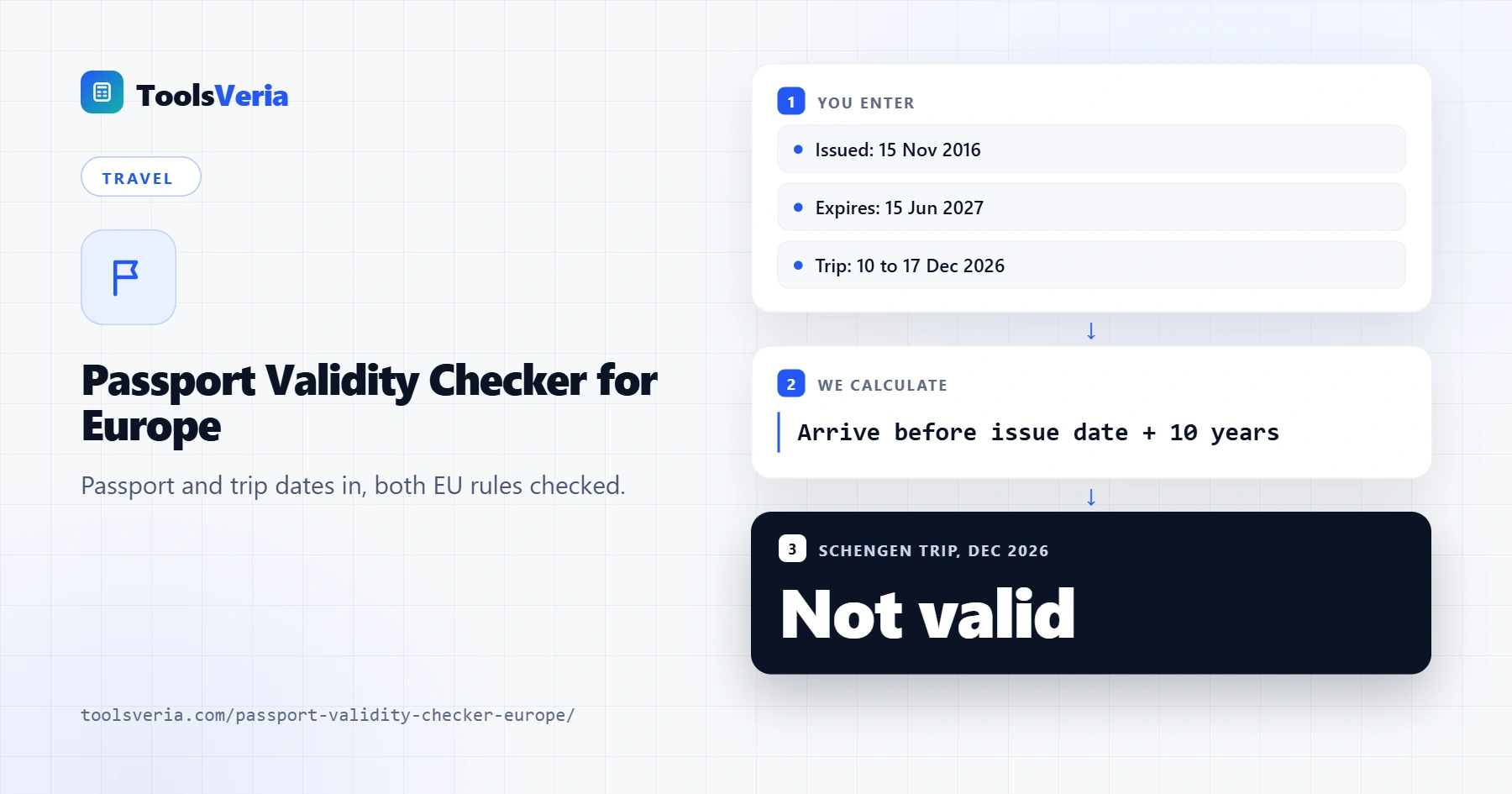
Quick answer: for EU travel your British passport must be issued less than 10 years before the day you arrive and must expire at least 3 months after the day you leave. Both rules apply. A passport issued 15 November 2016 fails for any arrival after 14 November 2026. The passport validity checker for Europe tests both.
In This Guide
What Is a Passport Validity Checker for Europe?
A passport validity checker for Europe is a date tool that compares the issue and expiry dates on your passport with your travel dates. In plain words: the arrival date must be before the issue date plus 10 years, and the leaving date plus 3 months must be on or before the expiry date. If either test fails, you can be refused boarding or entry even with a passport that is still in date.
The rules exist because the UK left the EU, so British citizens are now treated as third country nationals at Schengen borders. Some older British passports run for more than 10 years, because unused months from the previous passport were added when it was renewed early. Those extra months help with the 3 month rule but never with the 10 year rule, which is counted from the date of issue.
How to Use the Passport Validity Checker for Europe
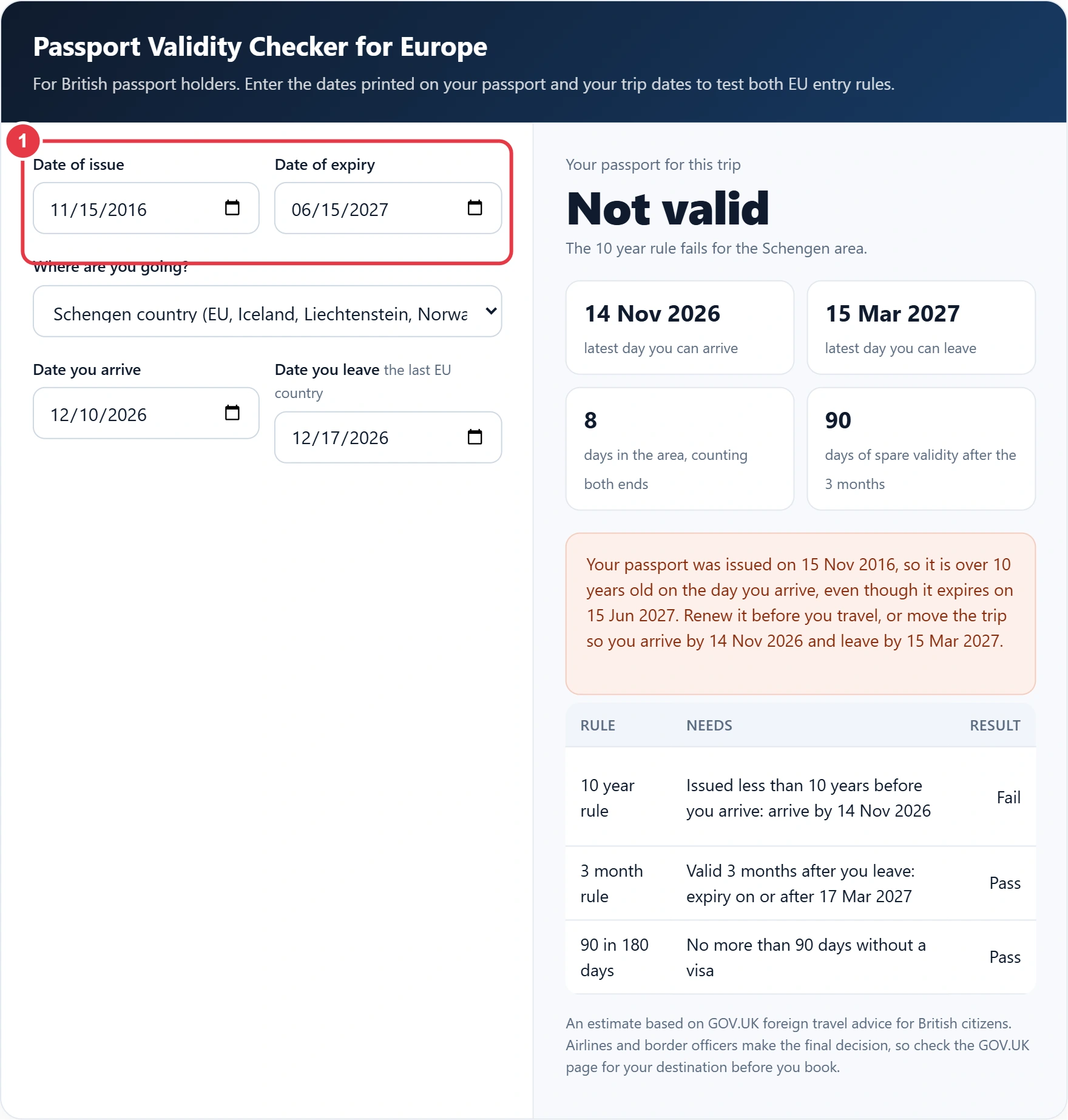
Step 1: Enter the Passport Dates
Copy the date of issue and the date of expiry from the photo page. Check each person in your group separately, because passports issued in different years can fail even when the expiry dates look similar.
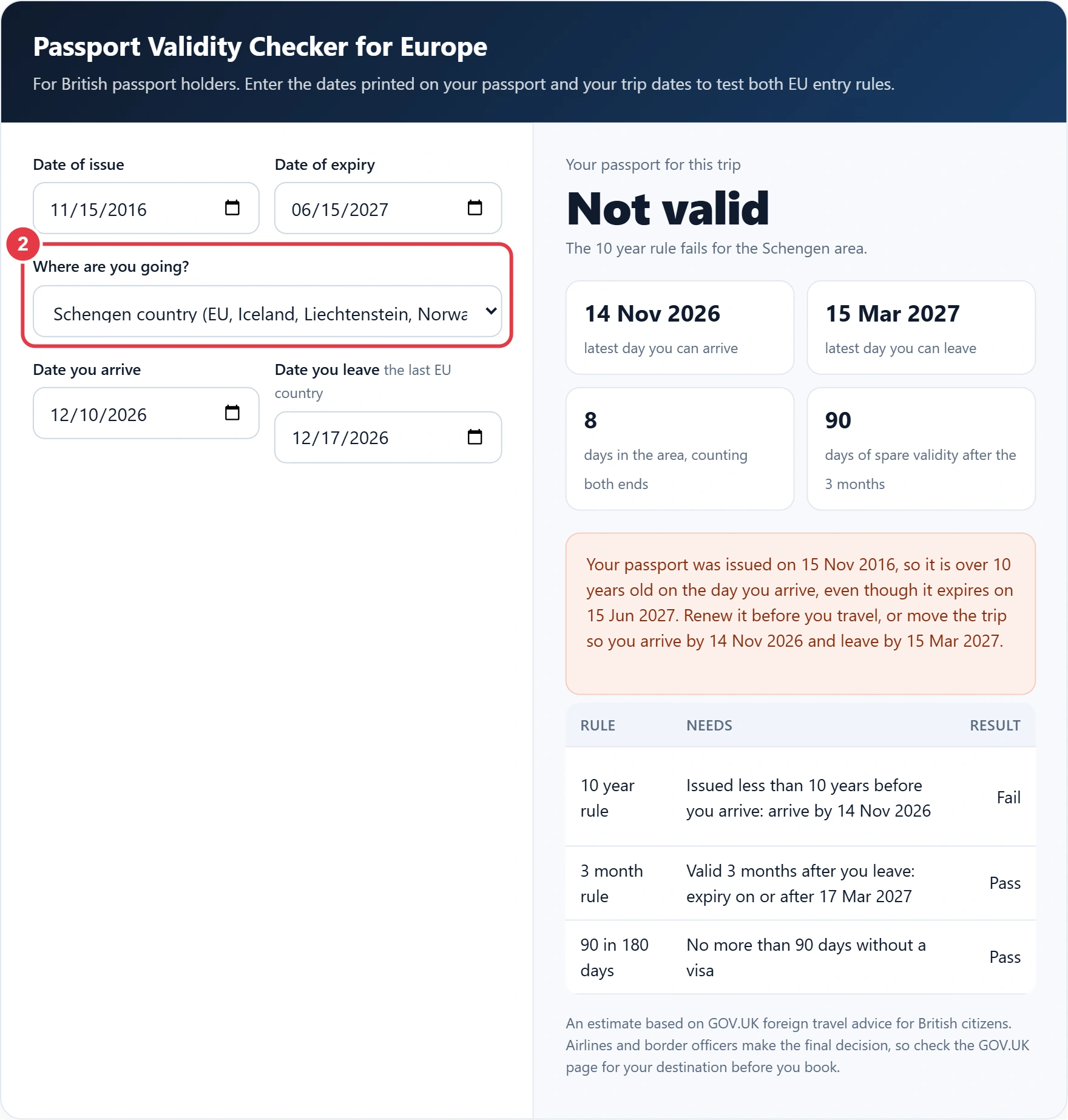
Step 2: Choose Your Destination
Pick a Schengen country for most of Europe, including Spain, France, Greece, Italy and Portugal, as well as Norway and Switzerland. Cyprus has its own option because it is outside Schengen but uses the same two rules. Ireland has different rules altogether.
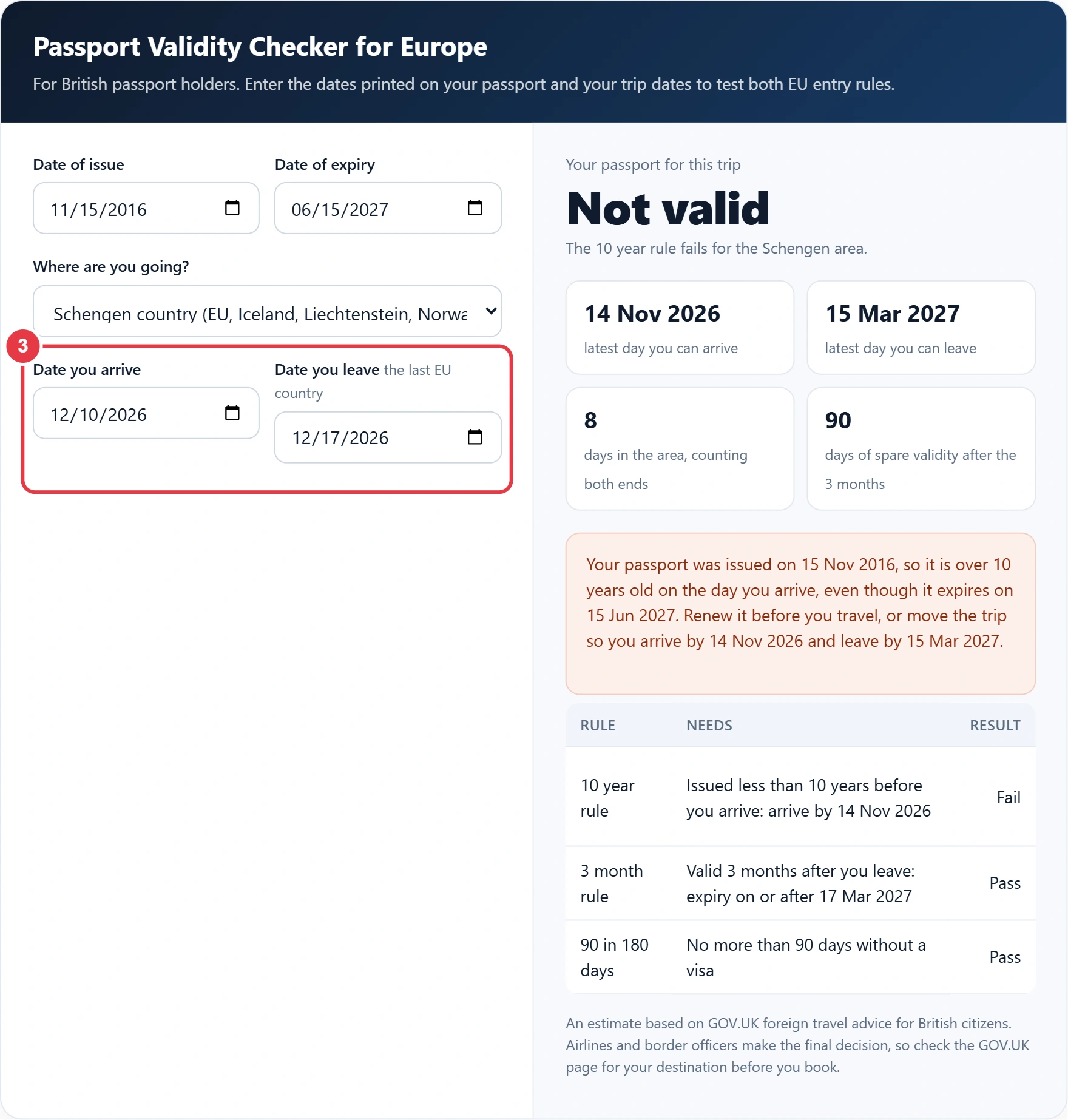
Step 3: Enter Your Trip Dates
Enter the day you arrive in the first Schengen country and the day you leave the last one. On a touring holiday, use the day you cross back out, not the day you leave the first country.
Step 4: Read the Verdict
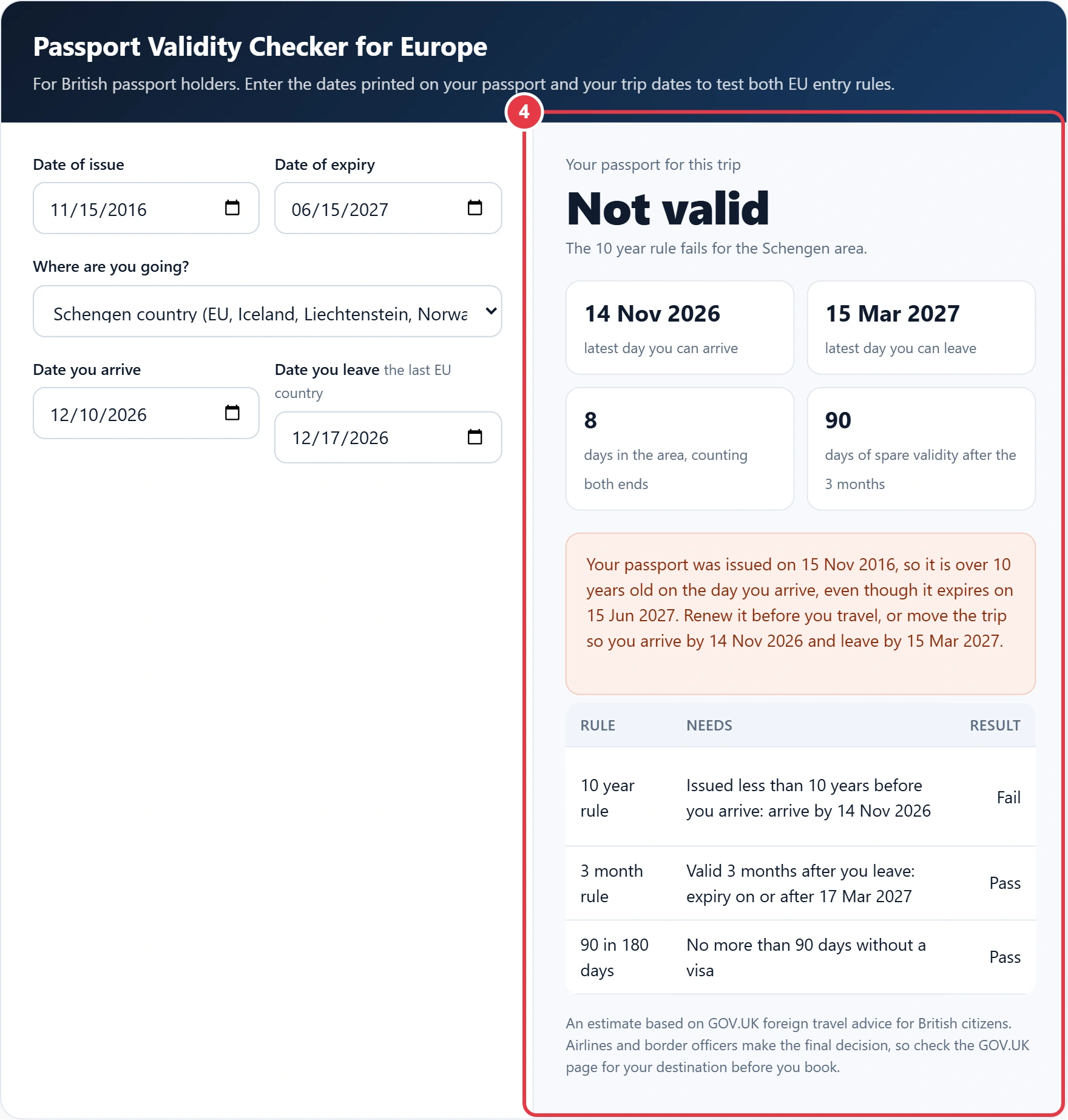
The headline shows whether the passport is valid for this trip. The tiles show the latest day you can arrive under the 10 year rule, the latest day you can leave under the 3 month rule, the length of the trip and any spare validity. The table shows each rule as a pass or a fail, including the 90 day limit.
Is My Passport Valid for Europe?
Your passport is valid for Europe if it was issued less than 10 years before the day you arrive and expires at least 3 months after the day you leave. Worked example: Joanne from Bristol has a passport issued on 15 November 2016 that expires on 15 June 2027. She books a Christmas market break in Cologne from 10 to 17 December 2026. Her expiry date is fine, because she needs validity only until 17 March 2027. But the passport turns 10 years old on 15 November 2026, so the passport validity checker for Europe marks it not valid. She must renew, or arrive by 14 November 2026.
| Issued | Expires | Trip | 10 year rule | 3 month rule | Verdict |
|---|---|---|---|---|---|
| 15 Nov 2016 | 15 Jun 2027 | 10 to 17 Dec 2026 | Fail | Pass | Not valid |
| 2 Mar 2019 | 2 Mar 2029 | 1 to 8 Aug 2027 | Pass | Pass | Valid |
| 20 Jul 2017 | 20 Jul 2027 | 10 to 24 May 2027 | Pass | Fail (needs 24 Aug 2027) | Not valid |
| 5 Jan 2021 | 5 Jan 2031 | 20 Mar to 30 Jun 2027 | Pass | Pass | Over 90 days |
Can I Travel if My Passport Expires in 3 Months?
No, not to the Schengen area or Cyprus if it expires within 3 months of the day you leave. A passport expiring on 1 March 2027 can only be used for an EU trip that ends by 1 December 2026, and only if it was also issued less than 10 years before you arrive. The 3 months are counted from the day you leave the last Schengen country, so a two week road trip needs more validity than a weekend away.
If you are driving to France, plan the paperwork together: the Crit'Air sticker checker shows whether your car needs a clean air sticker for French low emission zones, and it takes a few weeks to arrive by post, much like a passport renewal.
Do the Rules Apply to Ireland and Cyprus?
The rules apply to Cyprus but not to Ireland. GOV.UK travel advice for Cyprus uses the same wording: issued less than 10 years before you arrive and valid for 3 months after you leave, with stays of up to 90 days without a visa. For the Republic of Ireland, British nationals are not legally required to show a passport because both countries are in the Common Travel Area, although airlines and ferry companies still ask for photo ID.
How Do EES and ETIAS Affect My Trip?
EES and ETIAS are border checks, not passport validity rules, so you need a valid passport and must also meet them. The EU Entry/Exit System started on 12 October 2025 and records your fingerprints and photo at the first Schengen border; the GOV.UK EES guidance says the record lasts 3 years and that Ireland and Cyprus are not covered. The same page says ETIAS, an online travel authorisation with a 20 euro fee, will launch in autumn 2026.
- Check before you book: run every passport in the group through the checker before paying for flights, because airlines can refuse boarding.
- Count your 90 days: the limit is 90 days in any 180 day period across all Schengen countries, so long winter stays in Spain need careful planning.
- Driving abroad: the fuel cost calculator estimates the cost of driving to the Channel ports and on through France.
- Renew in good time: allow several weeks for a standard renewal before the latest arrival date shown by the tool.
Results are an estimate based on GOV.UK foreign travel advice; check the advice page for your destination before you travel. Figures checked October 2026 against GOV.UK travel advice for France, Cyprus and Ireland and the GOV.UK EES guidance.
</>Embed this calculator on your website
Add the free Passport Validity Checker for Europe to your own site or blog. Copy the code below and paste it into an HTML block. It resizes itself and works on phones.
How we checked this tool: the Tools Veria Editorial Team built this tool by hand, checked it against the official rules or published standards where they apply, and tested it against worked examples. Results are estimates for planning, not personal financial or tax advice. Read our editorial policy and disclaimer, or report an error.
Frequently Asked Questions
Is my passport valid for Europe if it has 6 months left?
Usually yes for the expiry rule, because the EU needs only 3 months after you leave. It must also have been issued less than 10 years before the day you arrive, so check the issue date too. A passport with 6 months left but issued 11 years ago fails.
What is the 10 year passport rule?
For Schengen countries and Cyprus, a British passport must have been issued less than 10 years before the date you arrive. Extra months added from an older passport do not count, so a passport issued on 15 November 2016 fails for arrivals from 15 November 2026.
Does the 3 month rule count from arrival or departure?
It counts from departure. Your passport must have an expiry date at least 3 months after the day you plan to leave the Schengen area or Cyprus. For a trip ending on 17 December 2026, the passport must expire on or after 17 March 2027.
Do I need a passport to travel to Ireland from the UK?
British nationals are not legally required to show a passport to enter Ireland, according to GOV.UK, because of the Common Travel Area. Airlines and ferry operators still require photo ID, and many accept only a passport, so check their rules before you travel.
How many days can I stay in Europe without a visa?
British citizens can stay up to 90 days in any 180 day period in the Schengen area without a visa. The days are counted across all Schengen countries together, and both the arrival and departure days count. Cyprus allows up to 90 days separately.
Does ETIAS change the passport validity rules?
No. ETIAS is a separate online travel authorisation with a 20 euro fee that GOV.UK says launches in autumn 2026. Your passport must still meet the 10 year and 3 month rules on every trip, whether or not you also need an ETIAS.