Callum moved into a rented flat in Leicester and found two rows of numbers on the electricity meter. The letting agent called it “the cheap night tariff”, which sounded like a bonus. Yet his gas boiler heats the flat, he cooks at seven in the evening and nothing runs overnight except the fridge. So is Economy 7 worth it for someone like Callum? For him, no, and the reason is one sum that most guides skip.
Economy 7 gives seven hours of cheaper electricity at night in exchange for a dearer rate during the other seventeen. Whether that trade pays off depends on three unit prices and one percentage from your own bill. Below, three households run the numbers against Ofgem’s price cap for October to December 2026.
Quick answer: Economy 7 is worth it only when your night share of electricity beats the break even point: day rate minus single rate, divided by day rate minus night rate. Using Ofgem’s October 2026 cap of 26.32p per kWh and example Economy 7 rates of 32.50p by day and 14.00p by night, you need 33.4% of your use at night.
In This Guide
Is Economy 7 worth it for most UK homes?
Economy 7 is worth it for UK homes that can move a large slice of their electricity into the night hours, typically a third or more, and it costs extra for homes that cannot. The cheap night rate only helps if the electricity is actually used at night; the higher day rate applies to everything else.
The tariff was built for night storage heaters and hot water cylinders, which charge up on cheap power and release heat the next day. The history of the Economy 7 tariff goes back to 1978, long before electric cars, smart meters or gas central heating in most flats. A typical home with a gas boiler uses most of its electricity in the evening peak, which is exactly when Economy 7 charges the most.
Ofgem also changed its benchmark this year. From 1 July 2026, it uses 3,400 kWh a year as the typical consumption for homes with multi register meters such as Economy 7, against 2,500 kWh for a single rate home. That gap is a clue: Economy 7 homes are usually the ones with electric heating or hot water.

How do you work out the Economy 7 break even point?
You work out the Economy 7 break even point by dividing the gap between the day rate and the single rate by the gap between the day rate and the night rate. The answer is the share of your electricity that must be used at night for both tariffs to cost the same.
With the example rates in this article, that is (32.50 minus 26.32) divided by (32.50 minus 14.00), or 6.18 divided by 18.50, which gives 33.4%. Every kWh you use in the day costs 6.18p more than on the single rate, and every kWh at night saves 12.32p. You need roughly one night kWh for every two day kWh just to stand still.
Standing charges can move the line. If an Economy 7 quote carries a standing charge 5p a day higher than the single rate tariff, that adds £18.25 a year. Spread over 3,400 kWh it is about 0.54p per kWh, which lifts the break even share from 33.4% to about 36.3%. This is why the old “40% at night” rule is a rough guide rather than an answer: your figure depends on your own three rates.
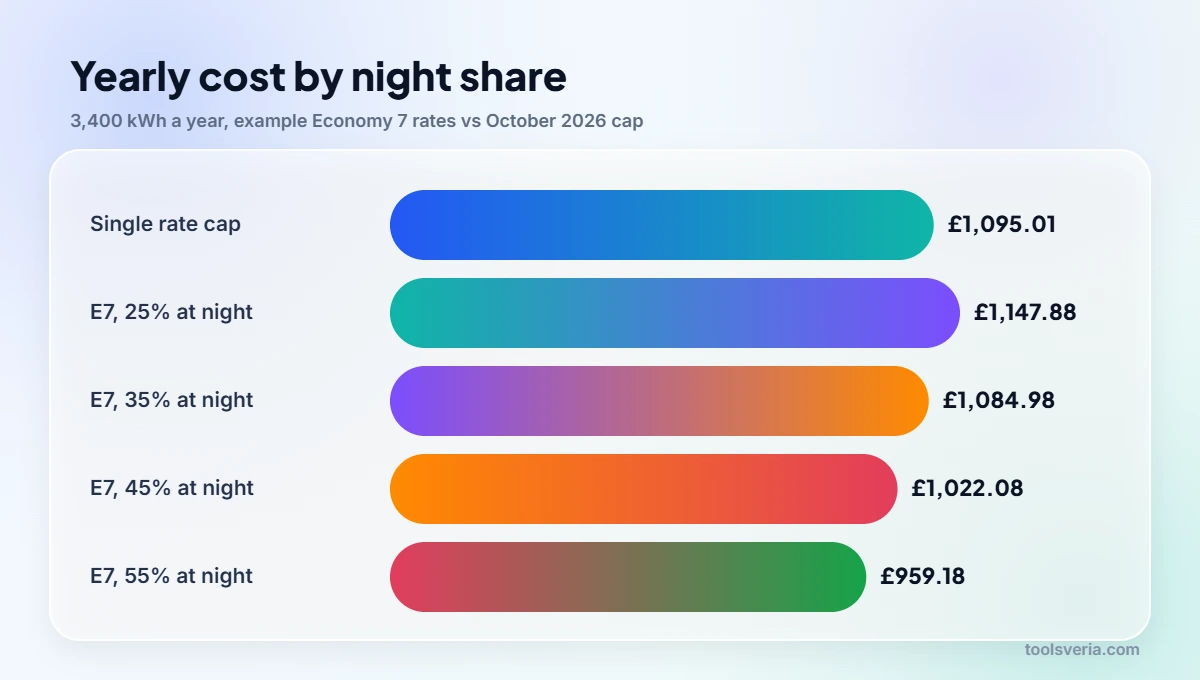
| Share used at night | Economy 7 cost a year | Single rate cost a year | Result |
|---|---|---|---|
| 25% | £1,147.88 | £1,095.01 | £52.87 more |
| 35% | £1,084.98 | £1,095.01 | £10.03 saved |
| 45% | £1,022.08 | £1,095.01 | £72.93 saved |
| 55% | £959.18 | £1,095.01 | £135.83 saved |
The table assumes 3,400 kWh a year, 32.50p day and 14.00p night rates, and the same 54.83p daily standing charge on both tariffs. Each extra 10% of use shifted to the night is worth about £63 a year at these prices, so small changes in habits add up.
Three households put Economy 7 to the test
All three use the Ofgem price cap for direct debit customers from 1 October to 31 December 2026, which is 26.32p per kWh and 54.83p a day for single rate electricity, against the same example Economy 7 rates.
Joanne: storage heaters and an immersion cylinder
Joanne’s 1970s semi in Cumbria has no gas supply. She uses 6,000 kWh a year, 55% of it overnight as the heaters and the hot water cylinder charge. Economy 7 costs her £1,539.63 a year; the same use on the single rate cap would cost £1,779.33. She saves £239.70, roughly £20 a month, and switching away would be an expensive mistake.
Callum: gas heating and an inherited meter
Callum uses 2,400 kWh a year and only 18% falls in the night hours. On Economy 7 he pays £900.21; on the single rate he would pay £831.81. The cheap nights save him very little, and the dearer days cost him £68.40 a year in total. Asking his supplier to move him to a single rate is the obvious fix.
Priti: the electric car changes everything
Before her electric car arrived, Priti used 3,400 kWh with 25% at night, and Economy 7 cost her £52.87 more than the single rate. She then added about 2,500 kWh a year of overnight charging. Her total rose to 5,900 kWh with 56.8% at night, and Economy 7 now saves her £255.13 a year. The charging alone costs £350 at 14.00p, against £658 at the cap rate.
If you want to see what a single appliance costs at the day rate and at the night rate, our kWh cost calculator handles one item at a time, and the result shows which loads are worth putting on a timer.

How do you find out how much electricity you use at night?
You find your night share by dividing a year of night register kWh by the total of both registers and multiplying by 100. Most annual statements list the two totals separately; if yours does not, take two readings of both registers twelve months apart.
Joanne’s statement showed 3,300 night kWh and 2,700 day kWh, so 3,300 divided by 6,000 gives 55%. A smart meter app often shows the same split by half hour. If the night figure is below about a third, and you have no plans for storage heating or an electric car, the single rate tariff is likely cheaper.
Check the times as well. The seven cheap hours vary by region and by meter, and many older meters stay on GMT all year, so in summer the window runs an hour later by the clock. Homes that relied on the long wave signal for switching needed new meters, because the Radio Teleswitch Service closed on 30 June 2026 and those meters no longer receive switching instructions.
Who should switch away from Economy 7?
You should consider switching away from Economy 7 if your night share sits below your break even point and you cannot realistically move more use overnight. Gas heated flats, homes where everyone is out at work by day and back for evening cooking, and households with no hot water cylinder usually fall into this group.
- Stay on Economy 7: storage heaters, an immersion heater on a night timer, electric car charging, night shift workers.
- Test both: heat pump homes, where our heat pump running cost calculator shows how much of the heating load could run in cheaper hours.
- Probably switch: gas heated homes with under a third of use at night and no timers.
Before switching, try a month of cheap habits. Setting the dishwasher, washing machine and immersion heater to run after midnight can lift a night share by several points. Tumble dryers are best run when someone is awake, so keep those to daytime even on Economy 7. Economy 10 and newer smart time of use tariffs offer different windows, sometimes including afternoon hours, and are worth comparing with the same formula.
To compare total bills rather than unit rates, our energy bill calculator adds standing charges and gas to the picture, which matters when you are weighing a whole tariff change.
Key points
- Economy 7 is worth it only when your night share of electricity is above your break even point.
- The break even share is the day rate minus the single rate, divided by the day rate minus the night rate.
- Against Ofgem’s October 2026 cap of 26.32p per kWh, example rates of 32.50p and 14.00p give a break even of 33.4%.
- A higher Economy 7 standing charge raises the break even share, by about 3 points for 5p a day at 3,400 kWh.
- Ofgem uses 3,400 kWh a year as typical consumption for Economy 7 homes from 1 July 2026.
Key Economy 7 Tariff Terms Explained
These terms explain the rates and percentages you need to decide whether Economy 7 is worth it for your home, compared with a single rate tariff.
- Economy 7
- A UK electricity tariff that charges a cheaper unit rate for seven night hours and a higher rate for the rest of the day. It was designed around equipment that stores energy overnight, such as storage heaters and hot water cylinders.
- Break even night share
- The percentage of electricity that must be used in the cheap hours for a two rate tariff to cost the same as a single rate. Above it the tariff saves money, and below it the dearer day rate wipes out the savings.
- Unit rate
- The price charged for each kilowatt hour of electricity used, quoted in pence. An Economy 7 tariff has two unit rates, one for day and one for night, while a standard tariff has a single rate.
- Standing charge
- A fixed daily fee for being connected to the supply, paid regardless of usage. If a two rate tariff has a higher standing charge than a single rate one, the break even night share rises.
- Energy price cap
- The limit set by Ofgem on the unit rates and standing charges suppliers can charge default tariff customers in Great Britain. It is reviewed every quarter and is used as the single rate benchmark for comparison.
- Storage heater
- An electric heater that fills internal bricks with heat during the cheap night period and releases it through the following day. Homes with them usually use a large share of electricity at night, which suits Economy 7.
Frequently Asked Questions
My flat has gas heating but an Economy 7 meter. Am I losing money?
Probably, because gas heated homes rarely use a third of their electricity at night. With 2,400 kWh a year and 18% at night, the example rates cost £68.40 more than Ofgem’s October 2026 single rate cap. Check your two register totals before asking to switch.
Is the 40% at night rule still right?
The 40% rule is a rough guide, not a fixed answer. Your real break even depends on your day, night and single rates plus any standing charge difference. With 32.50p, 14.00p and 26.32p it is 33.4%, rising to about 36.3% if the Economy 7 standing charge is 5p a day higher.
I am getting an electric car next month. Should I move to Economy 7?
Very likely, since overnight charging pushes your night share up sharply. Adding 2,500 kWh of night charging to a 3,400 kWh home took one example from 25% to 56.8% at night, turning a £52.87 loss into a £255.13 yearly saving. Compare dedicated EV tariffs too.
Does the energy price cap cover Economy 7 tariffs?
Yes, Ofgem’s price cap covers standard variable Economy 7 tariffs as well as single rate ones, but suppliers set their own day and night split within it. That is why Economy 7 rates differ between suppliers and regions, so always use the rates printed on your own bill.
Joanne keeps Economy 7 and saves £239.70 a year, Callum switches and saves £68.40, and Priti’s car turned her verdict around. Enter the rates from your own bill into the calculator to find which camp you belong in. Figures checked October 2026.