2026 tax on savings and investments, with the actual return (tegenbewijs) check.
Partners: enter your combined assets and debts. The allowance and debt threshold double.
| Step | Amount |
|---|
Estimate only, check with the Belastingdienst. 2026 figures from the Belastingdienst: savings 1.28% and debts 2.70% are provisional, other assets 6.00%, allowance €59,357, debt threshold €3,800 per person, rate 36%. Green investment exemptions are not modelled. Figures checked October 2026.
This box 3 calculator works out the 2026 Dutch tax on savings and investments for residents and expats in the Netherlands, using the Belastingdienst figures for the 2026 tax year: deemed returns of 1.28% on bank savings, 6.00% on other assets and 2.70% on debts, a €59,357 tax free allowance and a 36% rate. It also checks whether paying tax on your actual return would cost less. Figures checked October 2026.
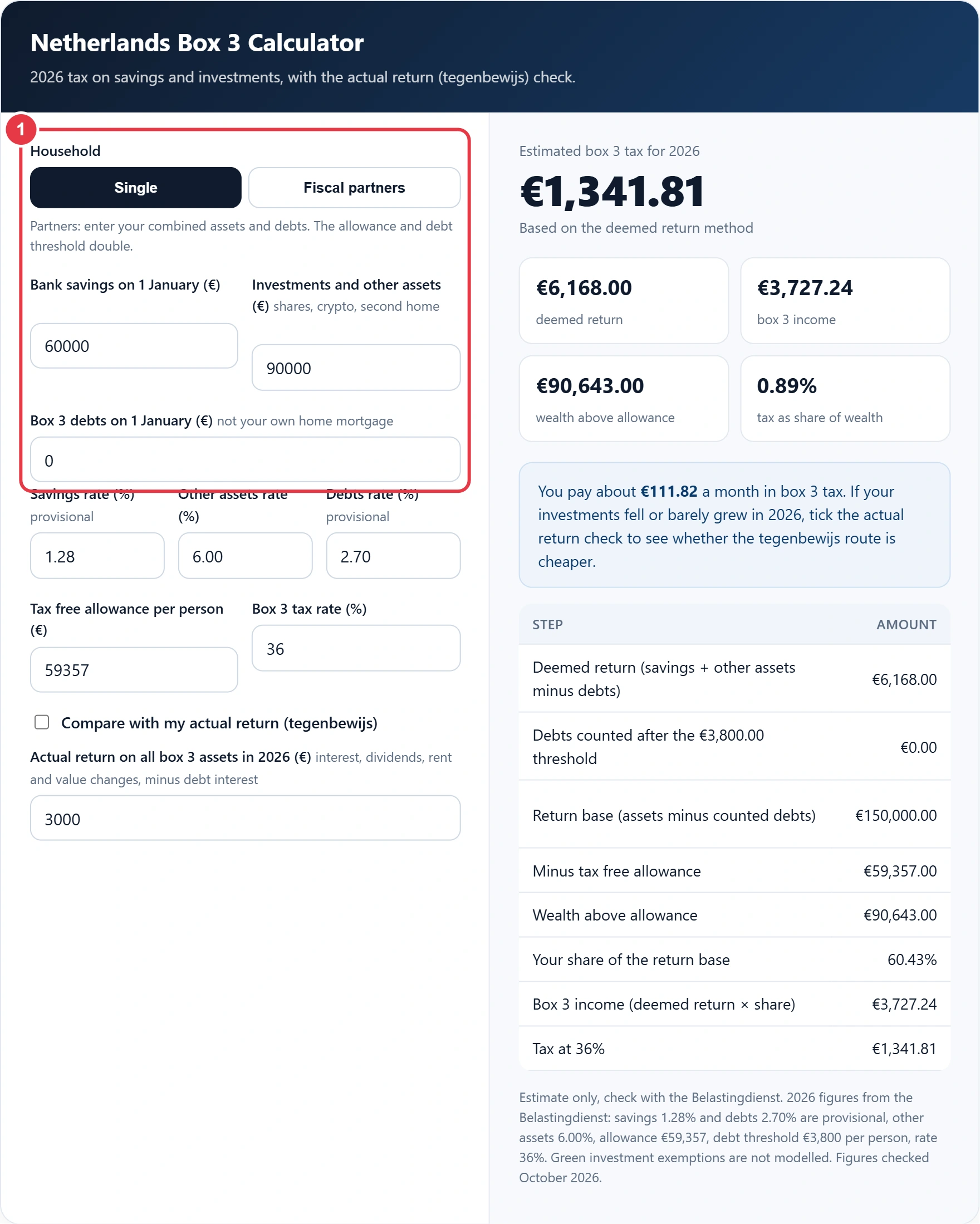
Quick answer: Box 3 tax for 2026 is 36% of a deemed return on the part of your wealth above €59,357 per person. With €60,000 in savings and €90,000 in investments, the box 3 calculator finds a deemed return of €6,168, box 3 income of €3,727.24 and tax of €1,341.81.

In This Guide
What Is Box 3 Tax in the Netherlands?
Box 3 is the part of Dutch income tax that taxes savings and investments, based on an assumed return on what you own on 1 January rather than the interest or gains you actually received. Your salary falls in box 1 and a substantial shareholding in your own company falls in box 2, as explained in this overview of taxation in the Netherlands, which also covers how the three boxes fit together.
In plain words, the Belastingdienst method has five steps: multiply bank savings by 1.28% and other assets by 6.00%, subtract 2.70% of debts above €3,800, then work out what share of your net wealth sits above the tax free allowance, apply that share to the deemed return, and tax the result at 36%. Fiscal partners add their wealth together and get a €118,714 allowance and a €7,600 debt threshold, and can split the box 3 income between them as they choose.
How Much Box 3 Tax Will I Pay in 2026?
Most people with wealth between €100,000 and €350,000 pay between 0.2% and 1.6% of that wealth each year, and nothing is due if your net wealth is at or below €59,357. Take Priya, an engineer from Bangalore living in Amsterdam, who had €60,000 in a savings account and €90,000 in an index fund on 1 January 2026. Her deemed return is €768 plus €5,400, so €6,168. Her wealth of €150,000 is €90,643 above the allowance, which is 60.43% of the total. Her box 3 income is €6,168 × 60.43% = €3,727.24, and at 36% she owes €1,341.81, about €112 a month.
| Wealth on 1 January 2026 | Household | Box 3 income | Box 3 tax |
|---|---|---|---|
| €50,000 savings | Single | €0 | €0 |
| €100,000 savings | Single | €520.23 | €187.28 |
| €60,000 savings + €90,000 investments | Single | €3,727.24 | €1,341.81 |
| €60,000 savings + €90,000 investments, €20,000 debt | Single | €3,188.36 | €1,147.81 |
| €25,000 savings + €250,000 investments | Single | €12,013.28 | €4,324.78 |
| €40,000 savings + €300,000 investments | Partners | €12,048.37 | €4,337.41 |
The table shows why the mix matters: investments are taxed on a 6.00% deemed return, more than four times the savings rate, so the same wealth costs far more tax when it is invested.
How to Use the Box 3 Calculator
Step 1: Enter Your Assets and Debts
Choose single or fiscal partners, then enter the values on 1 January 2026. Bank savings include current and savings accounts and cash. Investments and other assets include shares, funds, crypto, a second home or a rented out property, and money lent to others. Debts are box 3 loans such as a personal loan or a mortgage on a second home, not the mortgage on the home you live in.
Step 2: Check the Rates and Allowance
The 2026 figures are filled in. The savings and debt rates are provisional and are fixed after the year ends, so update them when the Belastingdienst publishes the final percentages. Your preliminary assessment (voorlopige aanslag) uses the provisional rates.

Step 3: Compare With Your Actual Return
Tick the actual return box and enter everything your box 3 wealth earned in 2026: interest, dividends, rent and the rise or fall in value, even if you did not sell, minus interest paid on box 3 debts. Costs such as fund fees cannot be deducted, and no allowance applies to the actual return.

Step 4: Read Your Result
The box 3 calculator shows the tax, the deemed return, your box 3 income, the wealth above the allowance and the tax as a share of your assets. The step table lists every figure so you can match it against your return. To see how a lower tax bill adds up over the years, the compound interest calculator projects the growth on the money you keep invested.

Can I Pay Box 3 Tax on My Actual Return?
Yes. If your actual return was lower than the deemed box 3 income, you can file an actual return statement (opgaaf werkelijk rendement) and pay 36% on the real figure instead. This follows Supreme Court (Hoge Raad) rulings that the deemed system can breach property rights when it taxes returns people never made. Using Priya's numbers, an actual return of €3,000 gives tax of €1,080, which is €261.81 less than the deemed €1,341.81.
The catch is that the actual return is measured on your whole box 3 wealth with no allowance, and unrealised gains count. In a year when markets rise strongly, the deemed method is usually cheaper. A year with falling share prices is where the check pays off, and the Belastingdienst applies whichever figure is more favourable to you.
What Counts in Box 3?
- Savings and current accounts, including foreign accounts held by Dutch residents.
- Shares, bonds, funds and crypto, at their value on 1 January.
- A second home or holiday home, and property you rent out, usually at its WOZ value or a percentage of it.
- Money you have lent to others, and the value of some insurance policies.
- Debts that do not fall in box 1, above the €3,800 threshold per person.
Your own main home falls in box 1, and qualifying green investments have a separate exemption that this tool does not model. Deemed return taxes like this are a form of wealth tax in practice, because the bill depends on what you own rather than what you earn. If you are buying a Dutch home, the Netherlands transfer tax calculator shows the separate tax due on the purchase.
Key Netherlands Box 3 Terms Explained
These Dutch tax terms explain the method behind the Netherlands box 3 calculator, helping residents and expats estimate their bill and judge whether an actual return claim helps.
- Box 3
- The part of the Dutch income tax system covering income from savings and investments. Rather than taxing what you actually earned, it applies set notional returns to the assets and debts you hold at the start of the year.
- Deemed return
- The fictional yield the tax office assumes each category of wealth produced, set separately for bank savings, other assets and debts. It is the starting figure from which taxable box 3 income is derived, whatever your investments really did.
- Tegenbewijs
- The Dutch name for the actual return rebuttal, a procedure allowing taxpayers to show that their real return was lower than the deemed return. If accepted, tax is charged on the real figure, which can reduce or remove the bill.
- Reference date
- The first day of January, on which box 3 assets and debts are valued for the whole tax year. Money moved, spent or invested later in the year does not change that year's calculation.
- Fiscal partner
- A spouse, registered partner or qualifying cohabitant recognised by Dutch tax law. Fiscal partners combine their box 3 wealth, receive a doubled allowance and debt threshold, and may divide the resulting income between them as they prefer.
- Debt threshold
- An amount of box 3 debt per person that is ignored before debts reduce taxable wealth. Only debt above it counts, and a home mortgage for your main residence falls in box 1, so it is excluded here altogether.
</>Embed this calculator on your website
Add the free Netherlands Box 3 Calculator to your own site or blog. Copy the code below and paste it into an HTML block. It resizes itself and works on phones.
How we checked this tool: the Tools Veria Editorial Team built this tool by hand, checked it against the official rules or published standards where they apply, and tested it against worked examples. Results are estimates for planning, not personal financial or tax advice. Read our editorial policy and disclaimer, or report an error.
Frequently Asked Questions
How is box 3 tax calculated in 2026?
Box 3 tax is 36% of a deemed return: 1.28% on savings, 6.00% on other assets, minus 2.70% on debts above €3,800. Only the share of your wealth above the €59,357 allowance per person is taxed.
What is the box 3 tax free allowance for 2026?
The tax free allowance (heffingsvrij vermogen) for 2026 is €59,357 per person, or €118,714 for fiscal partners. If your net box 3 wealth on 1 January 2026 is at or below this, you pay no box 3 tax.
Are the 2026 box 3 percentages final?
No. The 6.00% rate for other assets is fixed, but the 1.28% savings rate and 2.70% debts rate are provisional and are set after the end of 2026. Your final assessment uses the final rates.
Can I use my actual return instead of the deemed return?
Yes. If your actual return on all box 3 wealth was lower than your deemed box 3 income, you can submit an actual return statement and pay 36% on that figure. No allowance applies to the actual return.
Does my own home count in box 3?
No. Your main home and its mortgage fall in box 1. A second home, holiday home or rented out property does count in box 3, along with any mortgage on it above the debt threshold.
Do expats pay box 3 tax in the Netherlands?
Yes, Dutch tax residents pay box 3 tax on their worldwide savings and investments. Non residents only pay box 3 tax on certain Dutch assets, such as Dutch property, so check your status with the Belastingdienst.