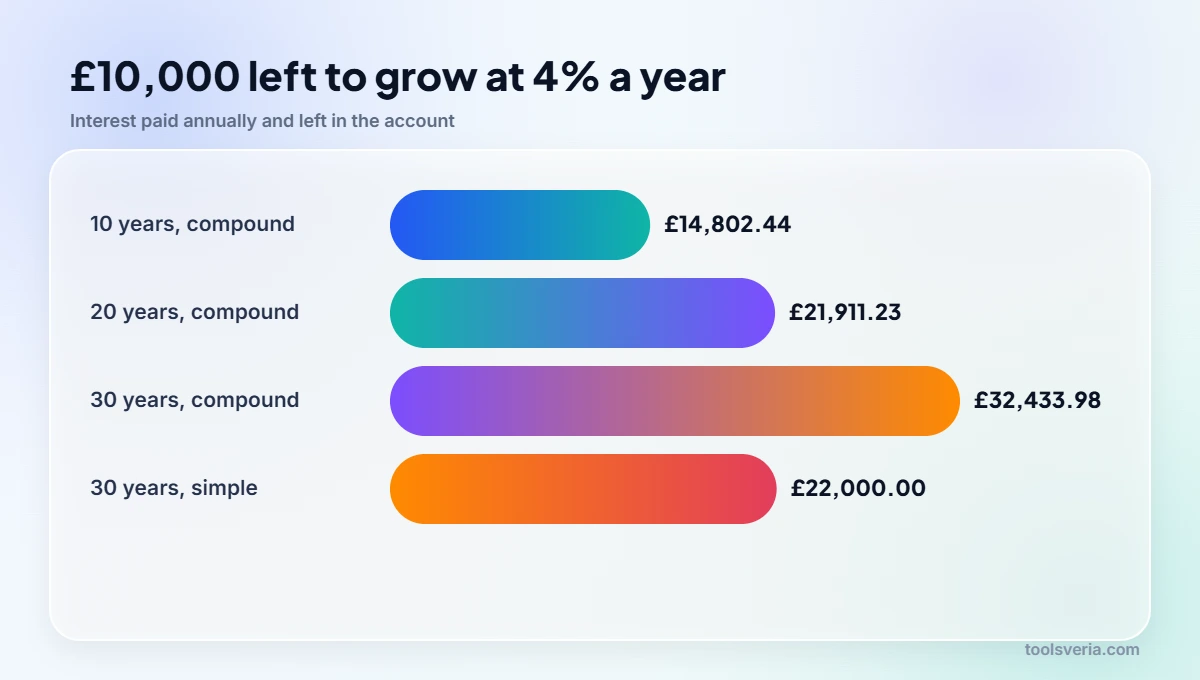
Picture Hannah, who puts £10,000 into an easy access account at 4% and then forgets about it for three decades. Her compound interest savings end up more than £10,000 ahead of a version of the same account that paid her interest out each year, and she never adds another penny. Every number in that story comes from leaving each year’s interest where it landed.
Quick answer: Compound interest savings grow because each year’s interest stays in the account and earns more, following A = P × (1 + r/n)^(n × t). £10,000 at 4% reaches £14,802.44 after ten years and £32,433.98 after thirty, against £22,000 if the interest is paid out. At 4%, money doubles in about 17.7 years.
Below we follow Hannah and a few other savers through real sums: how far the gap widens, why monthly payouts edge ahead of annual ones, what starting ten years earlier is worth, and how much HMRC may take. Treat the rates as examples rather than offers from any bank, and check the live rate on any account before you open it.
In This Guide
What Is the Difference Between Simple and Compound Interest?
Simple interest is paid out, leaving the pot at £10,000 and a flat £400 a year, while compound interest stays in the account so each year earns 4% on a larger balance. Suppose Hannah had a twin, Rob, whose bank sent his £400 of yearly interest straight to his current account. Rob’s pot sits at £10,000 forever and he collects a flat £400 each year. Hannah’s interest stays in the account, so her second year pays 4% on £10,400, her third on a little more again, and so on.
For years the twins look almost identical. The table adds Rob’s payouts to his £10,000 so the two totals can be compared side by side, with interest credited once a year.
| Years | Simple interest balance | Compound interest balance | Extra from compounding |
|---|---|---|---|
| 10 | £14,000.00 | £14,802.44 | £802.44 |
| 20 | £18,000.00 | £21,911.23 | £3,911.23 |
| 30 | £22,000.00 | £32,433.98 | £10,433.98 |
At year ten Hannah leads by about £800, which hardly feels worth bragging about. By year thirty her lead is £10,433.98, a sum bigger than her original deposit. Same bank, same 4%, same starting money; the only change was where the interest went each year.
How Do You Calculate Compound Interest on £10,000?
To find the balance after ten years, multiply £10,000 by 1.04 ten times over, which is 1.04 to the power of 10, and you land on £14,802.44. Hannah’s year ten figure can be checked on a phone calculator. Multiply £10,000 by 1.04 ten times over (1.04 to the power of 10) and you land on £14,802.44. For accounts that credit interest more than once a year, split the rate into smaller slices and multiply more often: written out, A = P × (1 + r/n)^(n × t), where P is the opening deposit, r the yearly rate as a decimal, n the number of credits per year and t the number of years. Anyone curious about where that expression comes from can follow the derivation in the compound interest article on Wikipedia, which also covers continuous compounding.
For a quick mental estimate, savers lean on the rule of 72. Divide 72 by the rate and you get a rough doubling time. At 4% the shortcut says 18 years, while the precise answer is 17.7 years, so the rough version is close enough for planning over a cup of tea.
Does It Matter How Often Interest Is Paid?
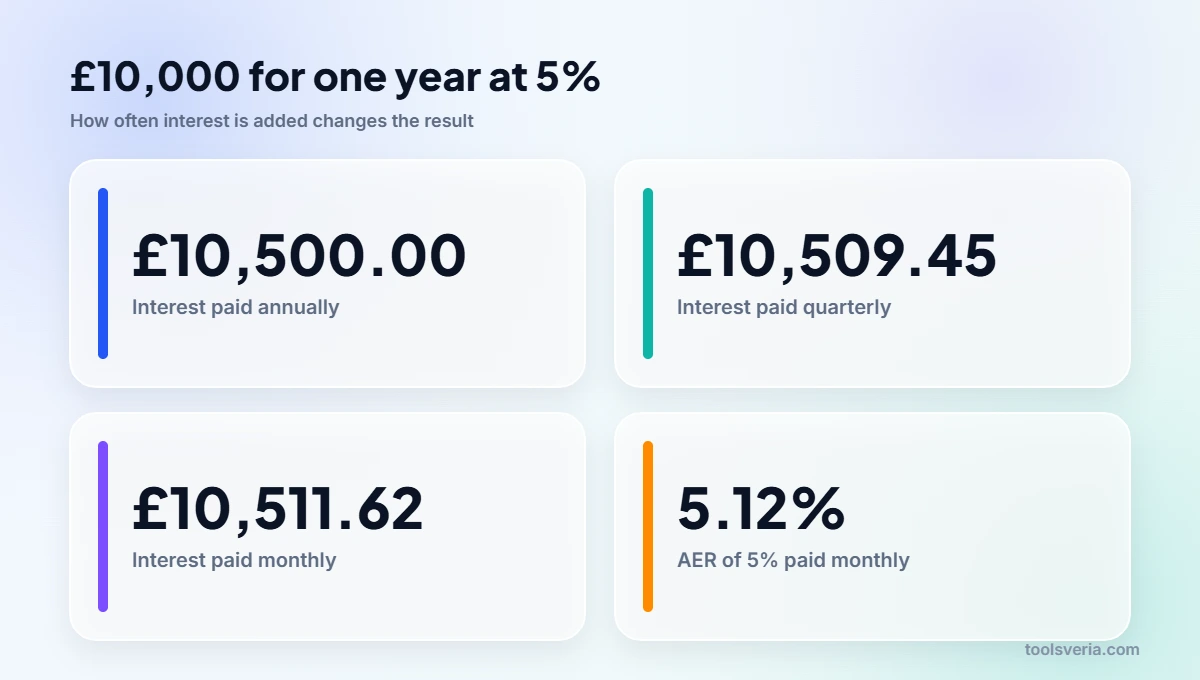
Two accounts can both advertise 5% and still finish the year with different balances, depending on how often the interest is paid. Two accounts can both advertise 5% and still finish the year with different balances. Put £10,000 into each version below and leave it for twelve months:
- Interest paid annually: £10,500.00
- Interest paid quarterly: £10,509.45
- Interest paid monthly: £10,511.62
Monthly crediting wins by £11.62 because January’s interest has eleven months to earn a bit more before December. Banks in the UK publish an AER (annual equivalent rate) precisely so you do not have to work this out yourself: it converts any payment pattern into a like for like yearly figure. That 5% paid monthly carries an AER of roughly 5.12%. So if one account says 5.10% AER paid yearly and another says 5% paid monthly, the monthly one still edges it, and the AER column on a comparison table is the one to read.
Regular Saving and the Power of Starting Early
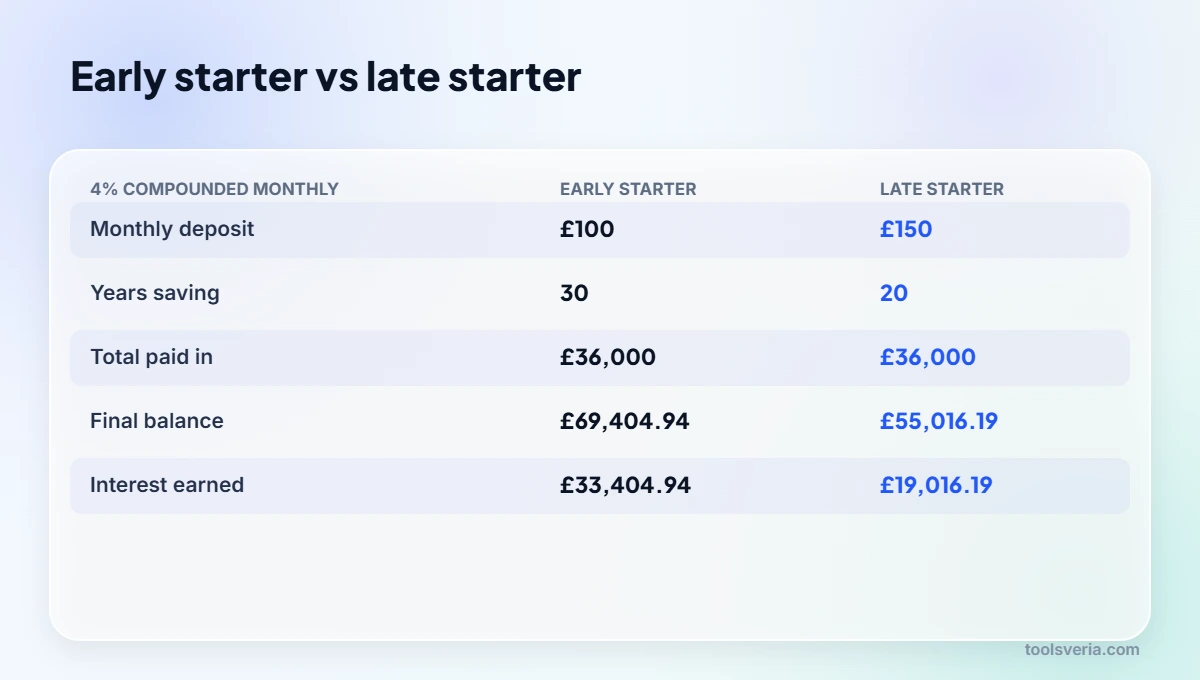
Few people have £10,000 sitting idle. Far more set up a standing order on payday. Meet Jas, who starts paying £100 a month at 25, and her colleague Leon, who waits until 35 and then pays £150 a month to catch up. We ran both through the compound interest calculator at 4% credited monthly, with each deposit landing at the end of the month.
| Saver | Monthly deposit | Years | Total paid in | Final balance | Interest earned |
|---|---|---|---|---|---|
| Early starter | £100 | 30 | £36,000 | £69,404.94 | £33,404.94 |
| Late starter | £150 | 20 | £36,000 | £55,016.19 | £19,016.19 |
Each of them hands over £36,000 in total. Jas finishes more than £14,000 richer even though her monthly payment was the smaller one, because her earliest pounds spent ten more years earning. The practical lesson: a modest standing order set up this month usually does more than a bigger one you keep promising to start next year.
Mixing the two approaches works well for compound interest savings too. Say you open an account with £5,000 from a work bonus, then add £200 every month at 4.5% credited monthly. A decade later you will have deposited £29,000 and the balance should read about £38,074.58, which means roughly £9,074 arrived as interest rather than from your own pocket.
Tax on Savings Interest
Compound interest savings growth outside an ISA is not automatically yours to keep. HMRC treats that interest as income, though most people get a slice of it free through the personal savings allowance. In 2026/27 a basic rate taxpayer can earn £1,000 of interest without tax, a higher rate taxpayer £500, and an additional rate taxpayer gets no allowance. Low earners may also qualify for the starting rate for savings, a 0% band worth up to £5,000 that is cut by £1 for each £1 of non savings income above the personal allowance. Anything left over is charged at 20%, 40% or 45%, matching your band.
Here is how that plays out for a £30,000 pot at 4.5%, which produces £1,350 of interest over the year. Kate, a basic rate payer, has £1,000 covered and owes 20% on £350, so £70. Her manager Dev pays higher rate tax, so only £500 is covered and he owes 40% on £850, a bill of £340. Plug your own salary into the savings interest calculator to see which side of the line you fall, and read the GOV.UK guidance on savings interest for how HMRC usually recovers the money by adjusting your tax code.
Getting the Most From Compound Interest
- Keep the interest in the pot. Having it paid out to a current account quietly turns Hannah’s result into Rob’s.
- Read the AER column. It has already done the frequency maths for you.
- Diary the bonus end date. Plenty of accounts sweeten year one with a bonus, then drop the rate; a calendar reminder tells you when to switch.
- Check the rate against inflation. A balance that grows more slowly than prices is shrinking in what it can buy.
- Clear pricey borrowing first. A credit card at a high rate compounds against you far faster than a savings account compounds for you.
Debt deserves a second look because the arithmetic does not care which side of the ledger you are on. Interest on a home loan builds up in exactly the same way, so running your figures through a mortgage overpayment calculator shows the interest an extra monthly payment would remove, and you can set that against what your savings earn once tax is taken off.
Key Points
- Leaving interest in the account lets each payment earn more in later years.
- Years matter more than amounts: Jas beat Leon by over £14,000 on the same £36,000.
- Monthly crediting helps slightly, and the AER makes accounts comparable.
- For 2026/27 the personal savings allowance is £1,000 (basic rate) or £500 (higher rate).
- Expensive debt compounds too, so pay it down before chasing savings rates.
Frequently Asked Questions
My bank pays my interest into my current account. Am I losing out?
Over long periods, yes. On £10,000 at 4%, having interest paid away leaves you with £22,000 after 30 years once you add up the payouts, against £32,433.98 if it had stayed in the savings account.
One account shows 5% gross and another 5.12% AER. Which pays more?
They could be the same deal. A 5% gross rate credited monthly works out at about 5.12% AER, so always line up the AER figures before deciding.
If I leave £10,000 at 4%, roughly when will it reach £20,000?
Dividing 72 by 4 suggests about 18 years, and the exact figure is 17.7 years provided the rate holds. At 3% the same rule gives around 24 years; at 6%, about 12.
I’m a higher rate taxpayer earning over £500 in interest. Would a cash ISA help?
Very likely. HMRC ignores whatever a cash ISA pays you, and that interest leaves your £500 allowance untouched for other accounts, so Dev’s £340 bill in our example would vanish if the £30,000 were held in an ISA wrapper.
Hannah’s result came from three dull habits: a fair AER, money left alone, and plenty of years. Before choosing an account, try your own deposit, monthly amount and rate in the calculator, then nudge each one up or down to see which change shifts your final balance the most.