Sarah runs a one person design consultancy through her own limited company. She pays herself £12,570 in salary and took £40,000 in dividends last year. Under dividend tax 2026/27 rules, repeating exactly the same pay plan this year costs her £790 more, because the basic and higher dividend rates both climbed two points on 6 April 2026.
Quick answer: For dividend tax 2026/27, the first £500 of dividends is taxed at 0%, then dividends are charged at 10.75% in the basic rate band, 35.75% in the higher rate band and 39.35% above £125,140. A director on a £12,570 salary taking £40,000 in dividends pays £4,821.25, which is £790 more than in 2025/26.
We use Sarah and a handful of other directors to walk through the new rates, the £500 allowance, the way dividends sit above salary, the corporation tax that comes first and the January payment deadline. The figures apply to directors in England, Wales and Northern Ireland, and because dividend rates are set UK wide, Scottish directors face the same percentages on this part of their income.
In This Guide
Dividend Tax 2026/27: Rates and Allowances
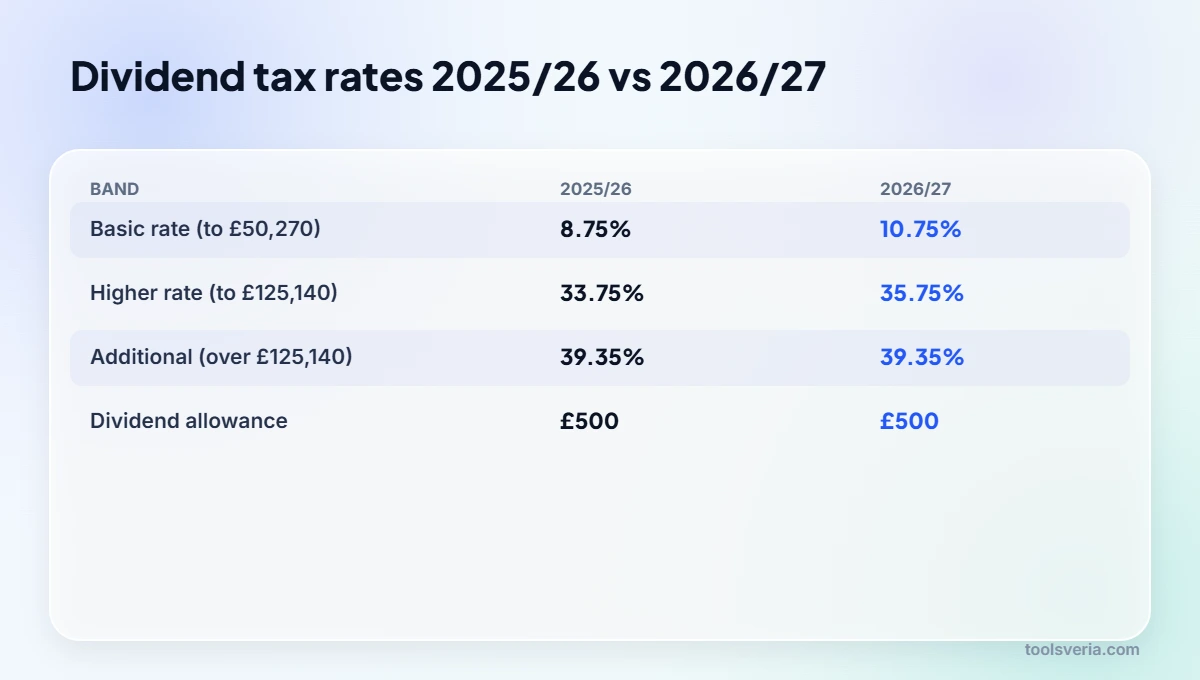
Dividend rates sit below salary rates for a reason: Sarah’s company has already handed corporation tax to HMRC on the profit before any of it reaches her. Here is how the bands compare across the last two tax years (2026/27 runs from 6 April 2026 to 5 April 2027):
| Band | Taxable income | Dividend rate 2025/26 | Dividend rate 2026/27 |
|---|---|---|---|
| Personal allowance | Up to £12,570 | 0% | 0% |
| Basic rate | £12,571 to £50,270 | 8.75% | 10.75% |
| Higher rate | £50,271 to £125,140 | 33.75% | 35.75% |
| Additional rate | Over £125,140 | 39.35% | 39.35% |
Only the top rate stayed put. Separately, every shareholder gets a £500 dividend allowance, which charges the first £500 at 0% yet still occupies £500 of whichever band it lands in, a detail that catches people out near the £50,270 line. Very high earners lose the personal allowance gradually: £1 goes for each £2 of income over £100,000, so by £125,140 none is left. Shares held inside an ISA sit outside all of this, and the GOV.UK page on dividend tax lists the current percentages if you want to double check them.
How Do Dividends Stack on Top of Your Salary?
Salary, pension income and any other non savings income use up the personal allowance and the lower bands first, so dividends always start at whatever level the salary reached. Think of your income as a glass being filled from the bottom. Salary, pension income and any other non savings income go in first and use up the personal allowance and the lower bands. Dividends are poured in last, so they always start at whatever level the salary reached.
That picture explains why so many owner managers settle on a £12,570 salary. It soaks up the personal allowance exactly, so no income tax is due on the wages, and the very first dividend pound begins life in the 10.75% band. Is that precise figure right for your company? It depends on employer National Insurance and whether you can claim the Employment Allowance, which is a question for your accountant rather than a rule of thumb.
Worked Examples for 2026/27
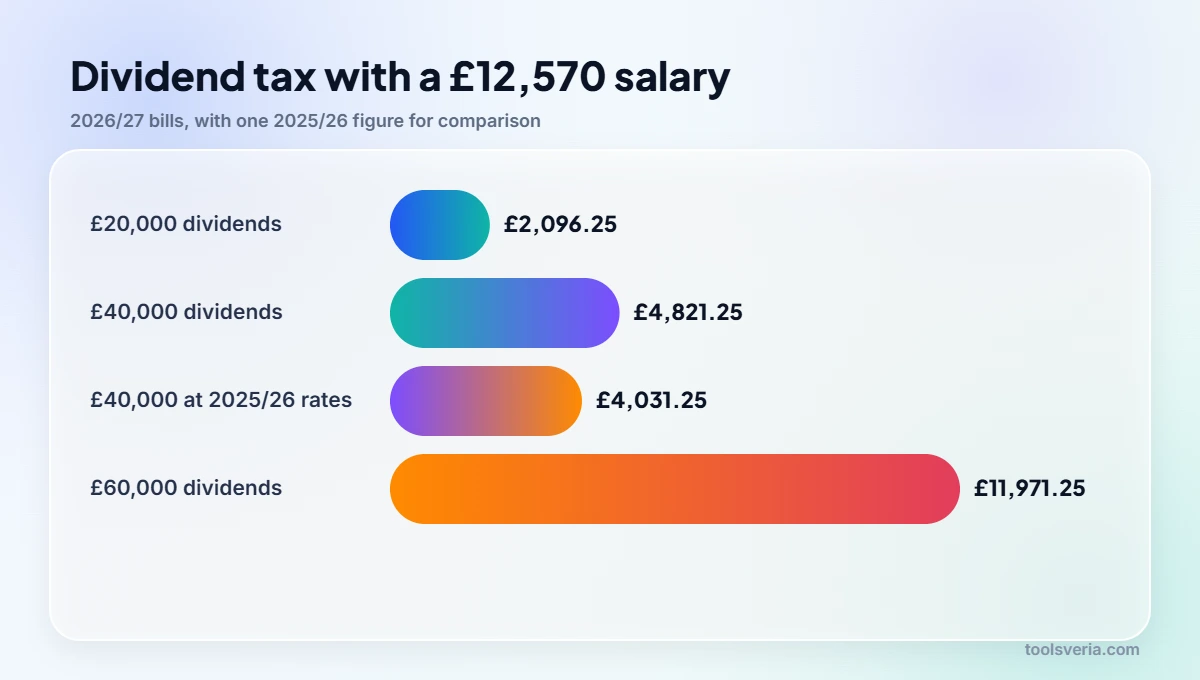
All three directors below take the same £12,570 salary, have no other income and draw their dividends inside the 2026/27 year. Only the dividend total changes from row to row.
| Dividends | Taxed at 10.75% | Taxed at 35.75% | Dividend tax | Effective rate on dividends |
|---|---|---|---|---|
| £20,000 | £19,500 | £0 | £2,096.25 | 10.5% |
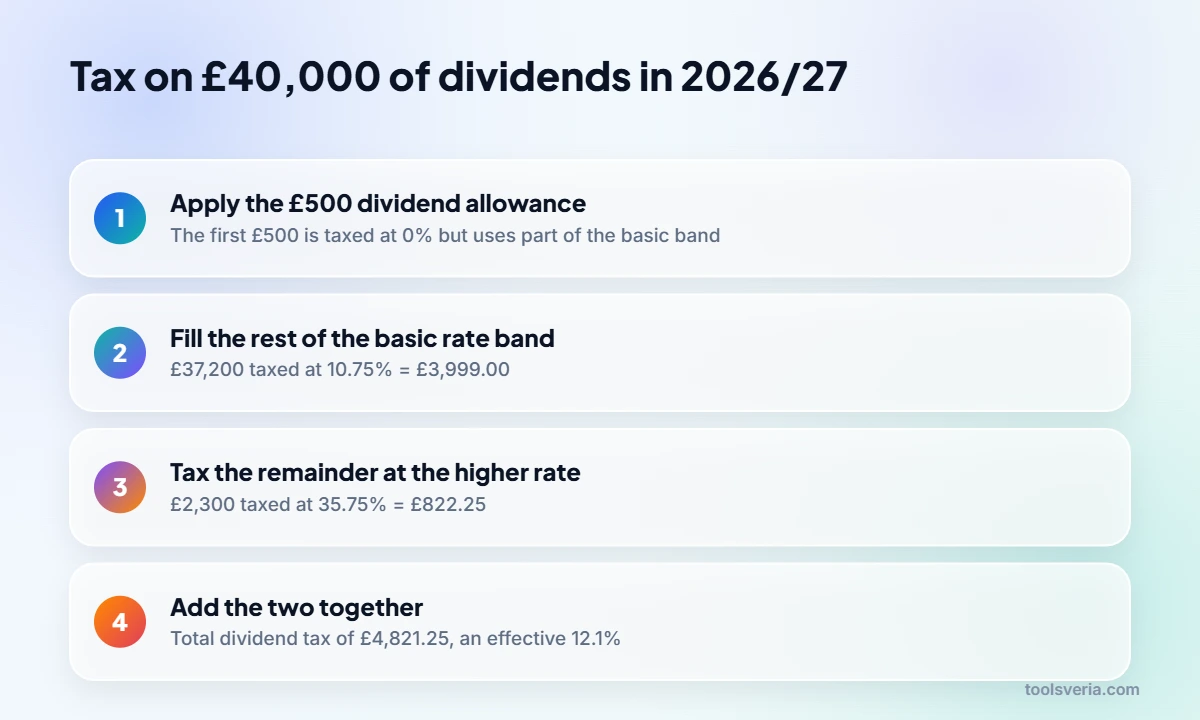
| £40,000 | £37,200 | £2,300 | £4,821.25 | 12.1% |
| £60,000 | £37,200 | £22,300 | £11,971.25 | 20.0% |
Sarah sits on the middle row, so let us unpack her £40,000. Her allowance swallows £500 at 0%. The basic band is £37,700 wide, and since the allowance has taken £500 of that room, £37,200 is charged at 10.75%, which comes to £3,999.00. The last £2,300 overflows into the higher band at 35.75%, adding £822.25. Her total is £4,821.25.
Run the same £40,000 through last year’s rates and the answer is £4,031.25, so Sarah’s bill is £790 heavier. If you have been parking a fixed percentage of each dividend in a tax pot, that pot now needs topping up. Rather than working out your dividend tax 2026/27 bill by hand, drop your figures into the dividend tax calculator and it splits the bill band by band for you.
Now meet Tom, who pays himself a £50,270 salary. His wages have already filled the basic band to the brim, so when he declares £10,000 of dividends, only the £500 allowance escapes tax and the other £9,500 is charged at 35.75%. Tom owes £3,396.25 on a sum that would have cost a £12,570 salary director far less.
Do Companies Pay Corporation Tax Before Dividends?
Yes, a company settles its own corporation tax before paying dividends, with profits up to £50,000 charged at the 19% small profits rate and profits above £250,000 at the 25% main rate. Before Sarah can pay herself a penny in dividends, her company settles its own tax. Profits up to £50,000 are charged at the 19% small profits rate, profits above £250,000 at the 25% main rate, and companies in between pay a blended figure through marginal relief, which the GOV.UK corporation tax rates page sets out. A company with £50,000 of taxable profit therefore sends £9,500 to HMRC and keeps up to £40,500 that could be distributed.
Check the balance sheet before you vote yourself a dividend. If retained profits cannot cover it, the payment may be unlawful and you could have to hand it back to the company. A quick run through the profit margin calculator shows how much of your turnover genuinely ends up as profit, which is a sensible starting point when you plan the year’s pay.
When Is Dividend Tax Paid?
You report each dividend payment on your Self Assessment return, and the balance for 2026/27 falls due on 31 January 2028. No PAYE deduction happens when a dividend lands in your account; the full amount arrives gross. You report each payment on your Self Assessment return, and the balance for 2026/27 falls due on 31 January 2028. A large bill can also trigger payments on account for the next year, so that January payment can be close to one and a half times what you were expecting.
For every dividend, file a voucher and a short board minute recording the date, the amount and who received it. Those two pieces of paper are what HMRC will want to see if it questions how you were paid. Directors who also run a side business as a sole trader can model that income on its own with the self employed tax calculator before combining both on the return.
Key Points
- For 2026/27 the rates are 10.75% (basic), 35.75% (higher) and 39.35% (additional).
- The £500 allowance is taxed at 0% but still uses up band space.
- Salary fills the bands first, so it decides where your dividends begin.
- Sarah’s £40,000 of dividends costs £4,821.25, which is £790 more than in 2025/26.
- The company pays corporation tax first, and the dividend needs retained profit behind it.
- Dividend tax 2026/27 bills are usually due by 31 January 2028.
Frequently Asked Questions
I took £20,000 in dividends on a £12,570 salary. What will I owe for 2026/27?
About £2,096.25. The first £500 goes through at 0% and the other £19,500 is charged at 10.75%, which works out at roughly 10.5% of the whole payout.
Will my accountant add National Insurance to my dividend bill?
No. Sarah’s £40,000 of dividends attracts no National Insurance at all, whereas wages above the thresholds do, and that gap is a big part of why the low salary and dividends mix remains popular with directors even after the 2026/27 increase.
I live in Edinburgh. Do Scottish rates change my dividend tax?
Not on the dividends themselves, which use the same 10.75%, 35.75% and 39.35% rates as the rest of the UK. Your salary, however, is still taxed under the Scottish bands.
With no salary at all, how much could I take in dividends before any tax is due?
Up to £13,070. Your unused £12,570 personal allowance covers the first slice, and the £500 dividend allowance covers the next £500.
Paying yourself mainly in dividends still beats an all salary approach for most small company directors, just by a slimmer margin than before April 2026. Model your bill early in the year, move a fixed share of each dividend into a separate tax account the day you take it, and talk to an accountant before you rearrange how you draw money from the business.