Hannah and Tom have £200 left over most months and keep asking the same thing: should I overpay my mortgage or leave the cash in the bank? Their answer turned out to be worth roughly £36,000 and six years of payments, but only after they ticked off a few safety checks that many couples skip.
Quick answer: Should I overpay my mortgage? On £200,000 at 4.5% over 25 years, an extra £200 a month saves about £36,280 of interest and 6 years 1 month. Each overpaid pound effectively earns 4.5% tax free, but build a cash buffer, clear costlier debts and check your penalty free allowance, commonly 10% a year, first.
To answer should I overpay my mortgage, below we follow their numbers line by line, look at where a lump sum beats a monthly top up, and show the point at which a savings account or an ISA starts to win instead.
In This Guide
Why an extra £1 today shrinks every later bill
Picture the balance as a meter that the lender reads once a month. Whatever figure it shows on that day decides the interest added. Hannah’s contractual payment first pays off that interest and then chips away at the debt; any extra she sends skips the interest queue entirely and lowers the meter reading straight away.
Because next month’s interest is worked out on a smaller number, a bigger share of her usual payment now attacks the capital. That knock on effect repeats for every remaining month. So £100 sent in year two does far more damage to the total bill than £100 sent in year twenty, simply because it has more months left to keep working.
How Much Interest Would £200,000 at 4.5% Cost?
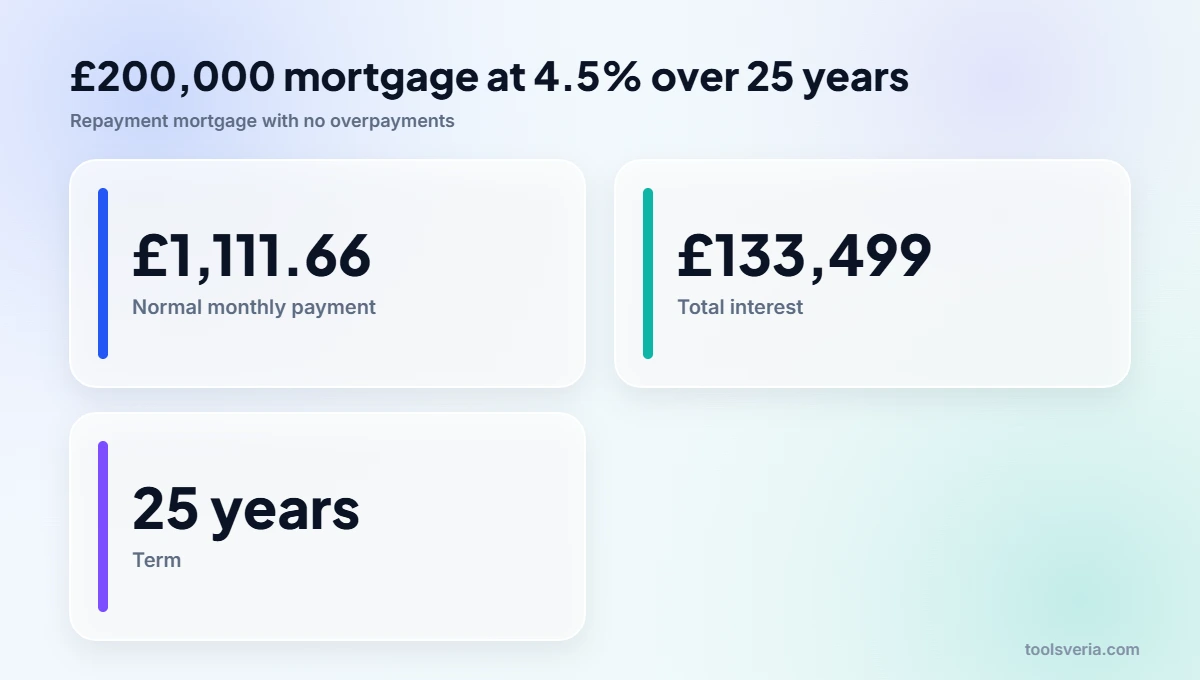
A £200,000 repayment mortgage over 25 years at 4.5% has a standard payment of £1,111.66 and would cost £133,499 in interest if nothing changes. The couple borrowed £200,000 on a repayment basis over 25 years at 4.5%. Their standard payment is £1,111.66, and if nothing changes they will hand the lender £133,499 in interest by the final month. We ran five scenarios, holding the rate at 4.5% for the whole term:
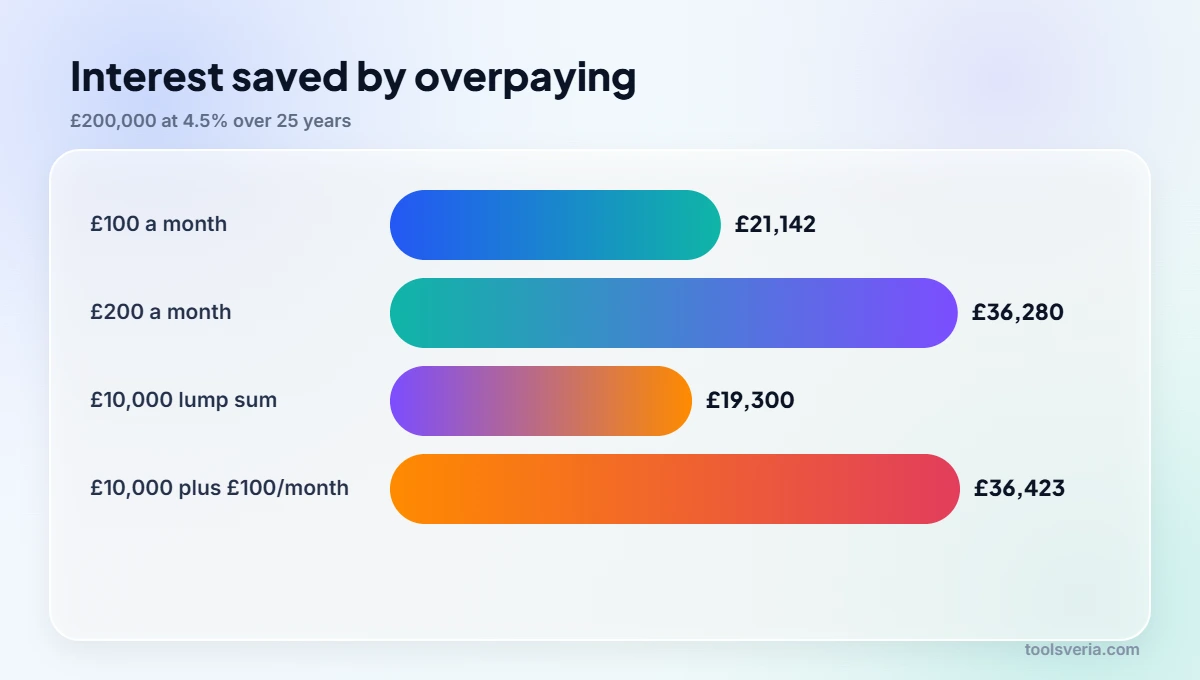
| Overpayment | Total interest | Interest saved | Time saved |
|---|---|---|---|
| None | £133,499 | £0 | None |
| £100 a month | £112,358 | £21,142 | 3 years 6 months |
| £200 a month | £97,219 | £36,280 | 6 years 1 month |
| £10,000 lump sum today | £114,199 | £19,300 | 2 years 2 months |
| £10,000 lump sum plus £100 a month | £97,076 | £36,423 | 5 years 3 months |
Look at the £200 row. Over the 18 years and 11 months the loan now lasts, the couple send in £45,400 of extra money and avoid £36,280 of interest. Each overpaid pound is effectively earning 4.5% with no tax due, because interest you never get charged is not income.
Rate sensitivity matters too. Keep the same loan and the same £200 top up, and the saving drops to about £26,187 at 3.5% but climbs to about £47,770 at 5.5%. Tom’s fix ends next spring, so before committing he typed both rates into our mortgage overpayment calculator to see the range of outcomes side by side.
How Much Can You Overpay Without a Penalty?
A typical allowance lets you clear up to 10% of the outstanding balance a year without a fee, though lenders differ on details. The couple’s current fixed deal carries an early repayment charge, and paying in too much during the deal would trigger it. A typical allowance lets you clear up to 10% of the outstanding balance a year without a fee. For Hannah and Tom that means roughly £20,000 in the first year, comfortably above their £2,400 annual plan. Lenders differ on details, though: some measure the 10% from the start of the deal, others from each anniversary.
A five minute phone call to the lender settled three questions for them:
- What yearly sum can go in before any charge applies?
- Will extra money cut the term, or lower the monthly bill, unless they say otherwise?
- Can past overpayments be clawed back later through a payment break or underpayment?
Keeping the payment fixed and letting the term shrink produces the biggest interest saving. Asking for a lower monthly figure instead frees up cash flow, which suits a household expecting a tight year, but the total saving is smaller. Several lenders ask you to pick an option every time you pay extra.
Should I Overpay My Mortgage or Save?
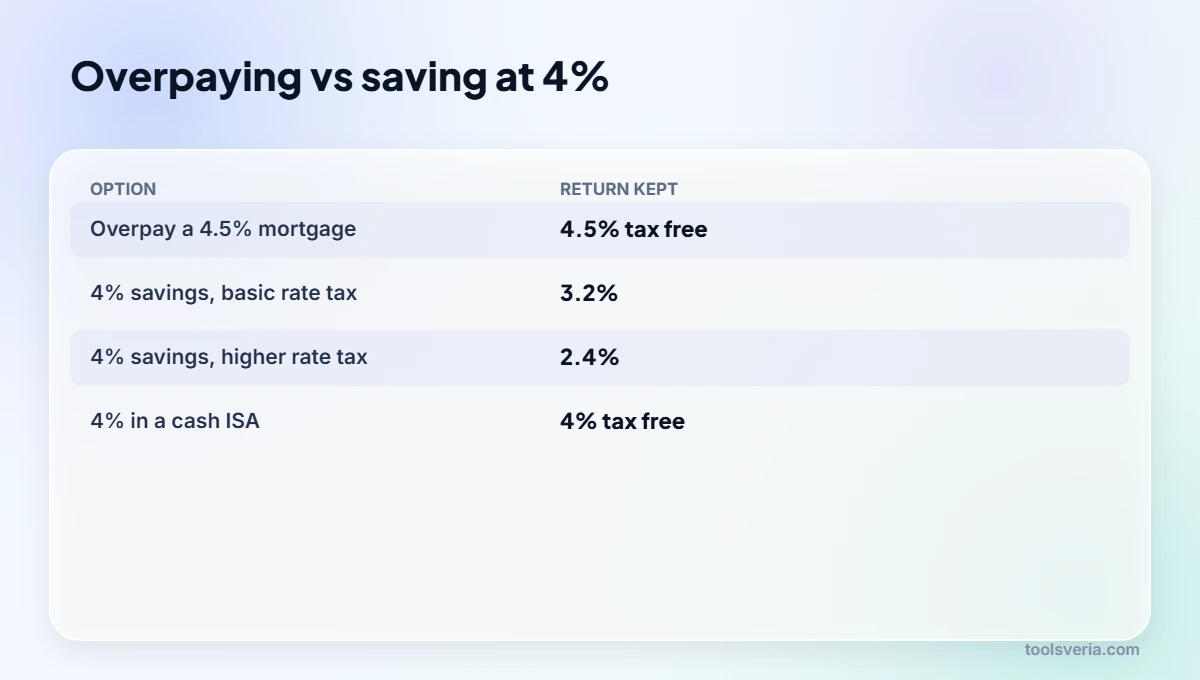
Compare the 4.5% you stop paying on the mortgage with what savings leave you after tax, which is 3.2% for a basic rate taxpayer on a 4% account. Here is the honest test for anyone asking should I overpay my mortgage. Compare the 4.5% you stop paying on the mortgage with what a savings account would leave in your pocket once tax is taken. Suppose an easy access account pays 4%. For a basic rate taxpayer who has already used up their allowance, 20% tax turns that into 3.2%. A higher rate payer keeps just 2.4%. Against either figure, the mortgage wins by a clear margin.
Tax free interest changes the sums. Under the personal savings allowance, a basic rate payer can earn £1,000 of interest each year before any tax is due, falling to £500 for higher rate payers, and cash ISA interest is never taxed at all. Hannah checked her own figures in our savings interest calculator, then glanced at the Bank of England Bank Rate page for a sense of where rates might drift next.
Stocks and shares can outperform overpaying across ten or twenty years, though nothing is promised and values can fall. Tom wanted to see what £10,000 might grow to at an assumed rate, so he used our compound interest calculator and set the answer next to the £19,300 a lump sum would save on the mortgage.
Four boxes to tick before sending extra money
Overpayments are hard to reverse, so the couple put them last in the queue behind these priorities:
- A cash buffer: several months of essential bills sitting somewhere you can reach quickly, since a boiler repair cannot be paid from your mortgage balance.
- Pricier borrowing: a credit card at 20% or an overdraft costs far more than a 4.5% mortgage, so those go first.
- Employer pension match: if your employer adds money when you raise your contribution, that top up usually beats any mortgage saving.
- Your allowance: know your penalty free limit before the first transfer leaves your account.
Anyone thinking about a five figure lump sum should read some impartial guidance before acting. The free, government backed MoneyHelper guidance on homes and mortgages walks through the same trade offs, including what to do if you might need the cash within a few years.
A halfway house exists as well. With an offset mortgage, savings held in a linked account are deducted from the balance before interest is worked out, yet the money stays withdrawable. If Hannah kept £10,000 in an offset pot, she would be charged interest on £190,000 rather than £200,000. These products sometimes carry a higher rate, so compare the full cost rather than the headline feature.
Key points
- On £200,000 at 4.5% over 25 years, £200 extra a month saves about £36,280 and 6 years 1 month.
- Every extra pound sent to the lender quietly returns 4.5% here, with no tax and no market risk.
- A 10% yearly penalty free allowance is common, but confirm your own.
- Build a cash buffer and clear costlier debts first.
- Set your mortgage rate against what savings keep after tax.
Frequently Asked Questions
I have a £10,000 bonus. Is that better than £100 a month?
On our example loan, a £10,000 lump sum today saves £19,300, slightly less than the £21,142 from £100 a month over the full term, because the monthly route ends up sending more money in total. Doing both saves £36,423.
My balance is £200,000. How much could I add this year without a fee?
With the common 10% allowance, about £20,000. Your own lender might count it differently, so check the offer document before you transfer anything large.
I overpaid but my direct debit went down. Did I do it wrong?
Not wrong, just a different setting. Your lender recalculated the payment rather than shortening the term. Ask them to keep the payment at its old level if you would prefer to clear the loan sooner and save more interest.
My savings pay 4% and my mortgage costs 4.5%. Which wins?
If the interest is taxable, you keep 3.2% as a basic rate payer, so overpaying wins. Inside a cash ISA the gap narrows to half a percentage point, and keeping a cash buffer comes first either way.
Few things a household can do with spare cash come with a guaranteed return, and overpaying is one of them. Once Hannah and Tom had their buffer in place and knew their limit, a steady £200 a month was enough to move their final payment date forward by more than six years.