Grace found a pair of trainers on a Berlin shop’s website, picked “38” because it sounded about right, and then spent ten minutes wondering whether that really matched her usual 5. Working out a UK to EU shoe size is quick once you know two numbers, but the systems use different units and step sizes, and dress labels follow a separate logic again. A wrong guess usually means a return label and a fortnight’s wait.
Quick answer: To find a UK to EU shoe size, add 33 to a women’s UK size or 34 to a men’s, so a women’s UK 5 becomes EU 38 and a men’s UK 9 becomes EU 43. For American sizes, add 2 to a women’s UK size or 1 to a men’s.
Below, Grace’s basket becomes the worked example: her trainers, her partner Tom’s Italian shoes and a dress marked 40, plus the charts and measuring habits that settle each one.
In This Guide
Why Do UK and EU Shoe Sizes Use Different Measures?
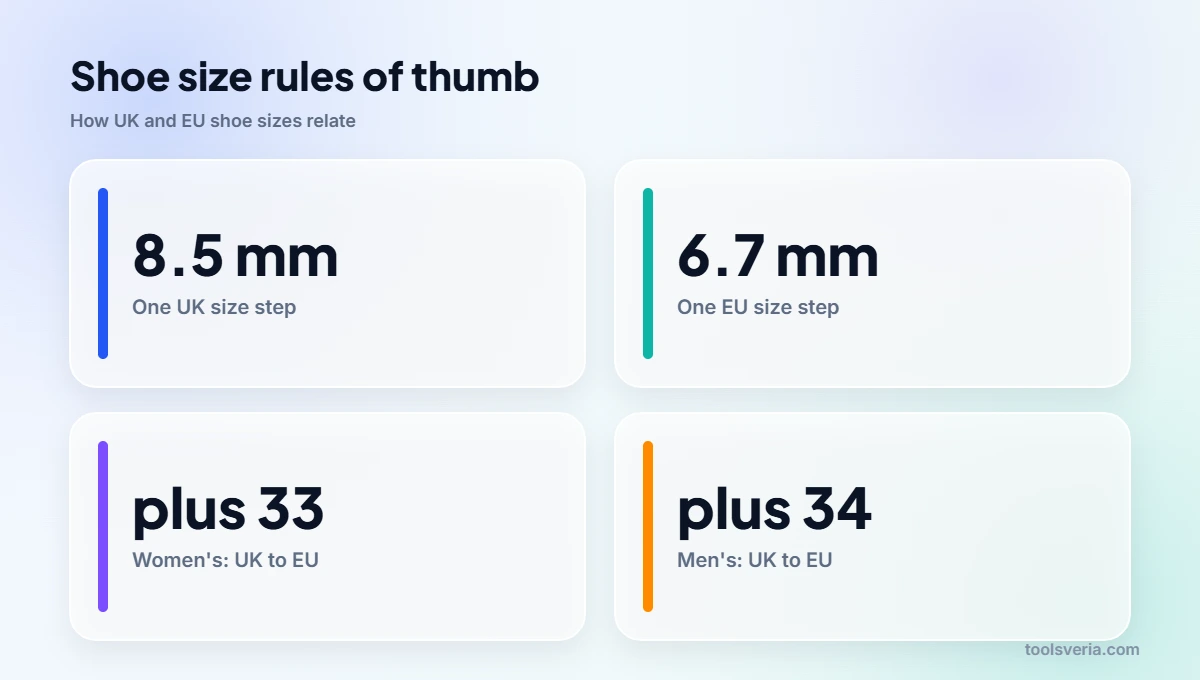
British sizing counts in barleycorns of about 8.5 mm each, while continental sizing counts in Paris points of about 6.7 mm each. British sizing counts in barleycorns. Each step is a third of an inch, roughly 8.5 mm, measured along the last (the foot shaped block a shoemaker builds the shoe on) rather than along your actual foot. Continental sizing counts in Paris points instead, each worth two thirds of a centimetre, or about 6.7 mm.
Since a British step is longer than a continental one, the two scales slowly slip out of line, and no single formula fits every size. You will therefore see some EU numbers repeated on charts and others missing. Wikipedia’s article on shoe size systems covers how this came about, though for a shopping basket these shortcuts are enough:
- Women’s: take the UK number and add 33. Grace’s UK 5 becomes EU 38.
- Men’s: take the UK number and add 34. Tom’s UK 9 becomes EU 43.
- American sizes: add 2 to a women’s UK size, or 1 to a men’s.
UK to EU Shoe Size Chart for Women’s and Men’s Sizes
Every value here matches what our converter returns. Expect a little brand to brand variation, most of all at the very small and very large ends, so use the chart as your first guess and the brand’s own guide as the tie breaker.
| Women’s UK | Women’s EU | Women’s US | Men’s UK | Men’s EU | Men’s US |
|---|---|---|---|---|---|
| 3 | 36 | 5 | 6 | 40 | 7 |
| 4 | 37 | 6 | 7 | 41 | 8 |
| 5 | 38 | 7 | 8 | 42 | 9 |
| 6 | 39 | 8 | 9 | 43 | 10 |
| 7 | 40 | 9 | 10 | 44 | 11 |
| 8 | 41/42 | 10 | 11 | 45 | 12 |
| 9 | 43 | 11 | 12 | 46/47 | 13 |
Half sizes fall neatly in the gaps, so a women’s UK 5.5 normally lines up with EU 38.5. Children are on a different scale: UK kids’ sizes run up to 13 and then start again at junior 1 and 2. For those, and for every half size, the UK to EU shoe size converter gives the EU and US match together with a rough foot length in centimetres.
How Do UK and EU Dress Sizes Compare?
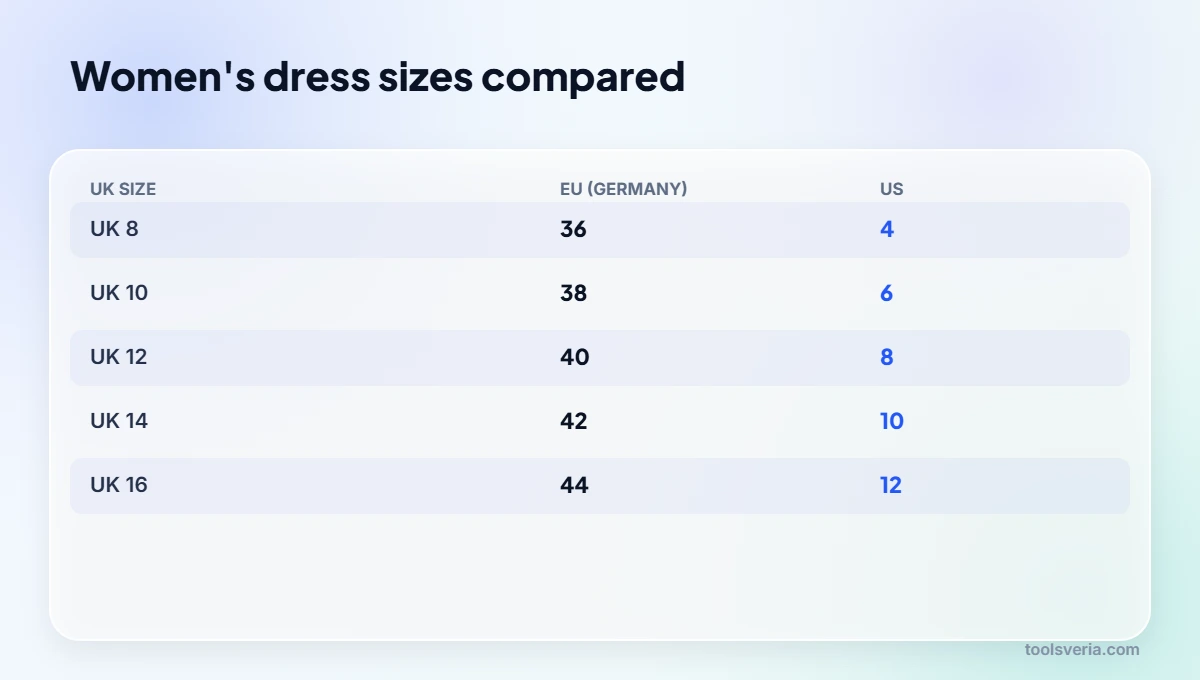
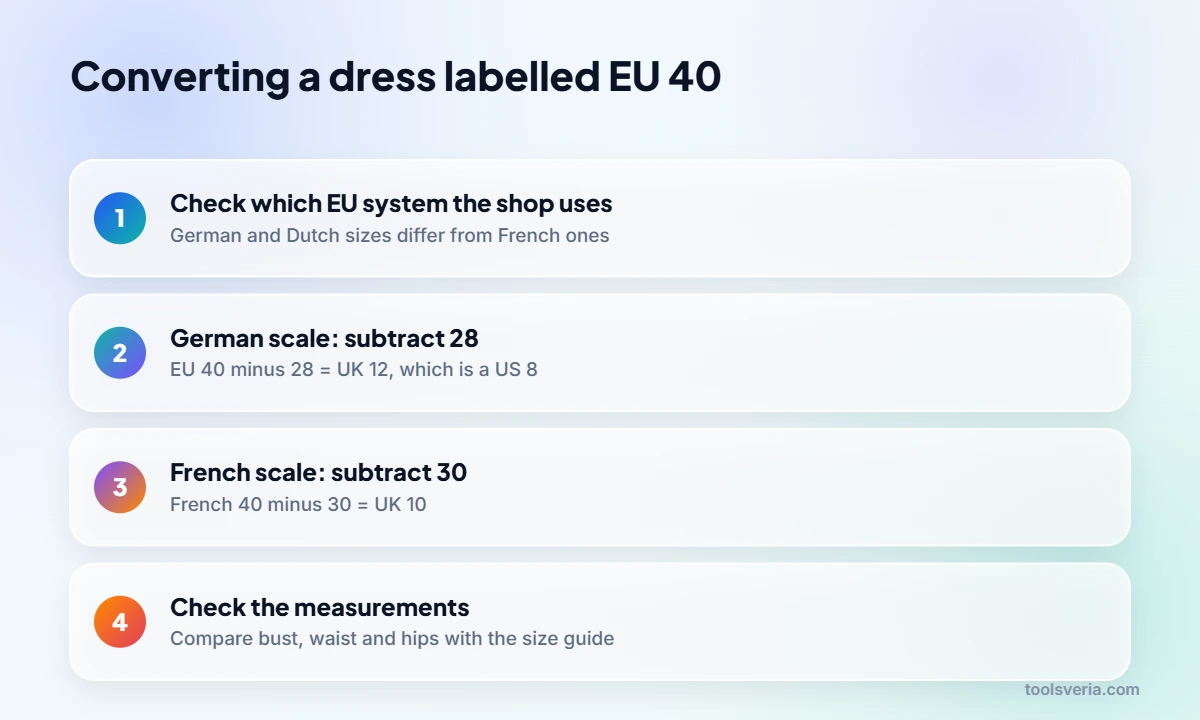
British and continental dress sizes both rise in twos, so the gap never changes, and a UK 12 is labelled 40 in German, Dutch and Scandinavian shops. Dresses are kinder than shoes, because British and continental sizes both rise in twos, so the gap between them never changes. German, Dutch and Scandinavian shops label a UK 12 as 40: their number is always the UK figure plus 28. American sizes sit 4 under the UK. French and Spanish labels read 2 higher than the German one, Italian labels 4 higher, and Australia generally uses the same numbers as the UK.
| UK | EU (Germany) | US | France and Spain | Italy |
|---|---|---|---|---|
| 6 | 34 | 2 | 36 | 38 |
| 8 | 36 | 4 | 38 | 40 |
| 10 | 38 | 6 | 40 | 42 |
| 12 | 40 | 8 | 42 | 44 |
| 14 | 42 | 10 | 44 | 46 |
| 16 | 44 | 12 | 46 | 48 |
| 18 | 46 | 14 | 48 | 50 |
| 20 | 48 | 16 | 50 | 52 |
That is exactly where Grace’s dress gets awkward. A tag reading “40” is a UK 12 from a German label but a UK 10 from a French one. Look at where the shop is based and which scale its size guide quotes. Plenty of European clothes also print body measurements in centimetres, a format set out in the EN 13402 labelling standard, and those figures beat the size number every time.
What Is a UK 5 in EU and US Shoe Sizes?
Trainers from the Berlin shop
A women’s UK 5 is an EU 38 and a US 7, with a matching foot length of about 24.2 cm. Grace is a women’s UK 5. Adding 33 confirms EU 38, and in American sizing she would pick a 7. Our chart puts the matching foot length at about 24.2 cm. The shop lists foot lengths too, so she measured her own foot and compared the two before checking out.
Tom’s shoes from an Italian maker
Tom takes a men’s UK 9. Plus 34 gives EU 43, and plus 1 gives US 10, with an approximate foot length of 27.6 cm. His feet are broad, and width is not standardised between brands, so he read a handful of reviews mentioning fit before adding them to the basket.
The dress marked 40
Had it come from a German or Dutch retailer, 40 minus 28 would make it a UK 12, or a US 8. Grace’s dress is from a Paris boutique, though, where a 40 equals a German 38, which is a UK 10. She double checked in the EU to UK dress size converter, which shows the UK, EU, US, French, Italian and Australian figures side by side.
Measuring habits that prevent returns
- Grace waits until after dinner to measure, since feet swell a little over a day of walking about.
- Put a sheet of paper against a wall, stand on it with your heel touching the wall, mark your longest toe and measure in centimetres.
- Tom’s right foot came out 3 mm longer than his left, so he chose by the right one.
- For dresses, take bust, waist and hip measurements and hold them against the shop’s own table.
- Check the returns page before ordering from abroad, as sending a parcel back can cost more than you expect.
Rings bring a similar puzzle if a present is on the list. British sizes use letters, American ones use numbers and Europe goes by inner circumference, so Grace sorted Tom’s birthday gift with the ring size converter, which works just like the shoe and dress tools.
Key points
- Shoes: add 33 to a women’s UK size or 34 to a men’s to get the EU number.
- American shoe sizes run roughly 2 above UK for women and 1 above for men.
- Dresses: subtract 28 from a German EU size for the UK size; US is 4 lower than UK.
- French labels sit 2 above German ones, Italian labels 4 above.
- Centimetre measurements are more trustworthy than any size label.
Frequently Asked Questions
I take a UK 6 in heels. Should I order a 39 or a 40?
For women’s shoes, 39 is the usual match. A 40 is what a man in a UK 6 would normally pick, so check that the chart in front of you is the women’s one.
These trainers are sold in unisex EU sizes. Which UK size am I?
The EU scale is shared, which is why unisex labelling works. What changes is the UK starting point: on our chart, EU 38 is a women’s UK 5, but a man would need EU 42 for his UK 8.
I’m a UK 12. What should I choose on an Italian site?
Look for a 44. The same body would be a 40 in Germany, a 42 in France or Spain and an 8 in the US.
My foot measures between a 38 and a 39. Which way do I go?
With shoes, most shoppers pick the larger size, especially for trainers and running shoes. For clothing, compare the shop’s measurements and consider the fabric: jersey forgives more than a tailored cut.
Grace now keeps her foot length and her bust, waist and hip figures in a note on her phone. With those numbers and the two shortcuts above, a foreign size label takes seconds to decode, and a converter covers the half sizes and the edge cases.